Boardwalks and viewing platforms
Materials, fixings and finishes
Best practice guidance for the selection of materials, fixings and finishes
Boardwalks and viewing platforms located in aggressive coastal environments or waterlogged areas require materials which provide operational and maintenance benefits.
Timber should be sourced from Australia and from a sustainable source. Timber joists and bearer sizes should be readily available.
Select materials that are:
- Vandal resistant.
- Do not sustain combustion (a combustible material will ignite and burn or will add appreciable heat to an ambient fire).
- Select high quality materials for high use, high profile areas with emphasis on aesthetics and local character.
- Manufactured to engineering specifications (where applicable).
- Do not use 150 x 150 mm timber as posts. This will contain untreated heartwood.
- Stainless steel horizontal wire barrier is not preferred due to increased maintenance requirement (regular tension tightening) and is prone to vandalism (removal).
- Select fixings made of true 304 or 316 marine grade stainless steel.
- Top of joists and all cut ends and timber checks are to have an application of CN oil (or equivalent).
- Select marine grade stainless steel grips, bolts and brackets which allow straightening of timbers.
- Specify CN emulsion (or equivalent).
- Ideally select standardised components such as 38 mm thick FRP grate panels.
See Table 1: Materials for further guidance.
Table 1: Materials
Materials | Key considerations |
Timber |
|
Aluminium |
|
Concrete |
|
Recycled plastic |
|
Fibre reinforced plastic (FPP) |
|
Deck fixings and fasteners
General
Materials must be manufactured and constructed to operate in exposed, high energy environments to achieve the required design life. Select stainless steel considering the following:
- True grade stainless steel has been graded by ASSDA (Australian Stainless Steel Development Association) and manufactured by an ASSDA accredited manufacturer.
- Stainless steel components must be manufactured to engineering specifications (where applicable).
- marine grade 316 stainless steel is required in coastal areas east of Bruce Highway.
- note that stainless steel is low maintenance and has a longer asset life.
- other material such as 304 grade stainless steel and galvanised steel may be selected for use in hinterland areas west of the Bruce Highway.
Fixings and fasteners
- Fixings are to include flat washers, spring washers and nuts, secured with thread lock compound (suitable for removal by hand tools). This will prevent loosening of nuts and loss of structural integrity, while allowing replacement of parts.
- Nyloc nuts (or equivalent) are a type of lock nut which contains a nylon collar insert that resists turning. These are preferred to prevent release or loosening of thread joints due to vibration, corrosion or temperature fluctuations.
- Dyna bolts must be installed and tightened to manufacturers recommendations to ensure they do not work loose.
- Pre-grease all bolts with Lanotec lubricant grease (or equivalent) prior to installation.
- At locations where bolts would be in contact with corrosive materials (treated timber) or in pivot points, pre-grease all bolts with Lanotec lubricant grease (or equivalent) prior to installation. Remove excess grease from end of thread before applying locking compounds.
- Excess bolt protrusion is to be covered with a dome nut, to reduce risk of persons scalping skin when walking past.
- Metal brackets are to be flush and free of sharp protruding edges, to avoid injury.
- All fixings (fasteners) are to be checked for tightness prior to handover, and re-tightened where required.
Deck fixing
- The preference for deck boards is countersunk head stainless steel batten screws (6.3 mm diameter, gauge 14), type 304. Do NOT ‘over’ countersink screws as the extra depth holds water.
- Pre-drill holes for fasteners, to avoid splitting joists or decking.
- Keep screws four times the diameter of the screw head from edge boards.
- When face fixing screws, use a staggered alignment at least four times the diameter of the screw head from the edge.
- No deck fixing in straight lines as this can cause splitting of joists.
- Deck screws should be true 304 grade stainless steel (preferred), reputable brand only (not 316). Tea staining is desirable to dull the shiny surface. Glare can be a problem for people with low vision.
- Hot dip galvanised fixings may be used in non-coastal areas if they are dipped in Dulux “Durebuild” GPE ZP (or equivalent).
- Hot dipped galvanised bolts must be certified Australian made and manufactured.
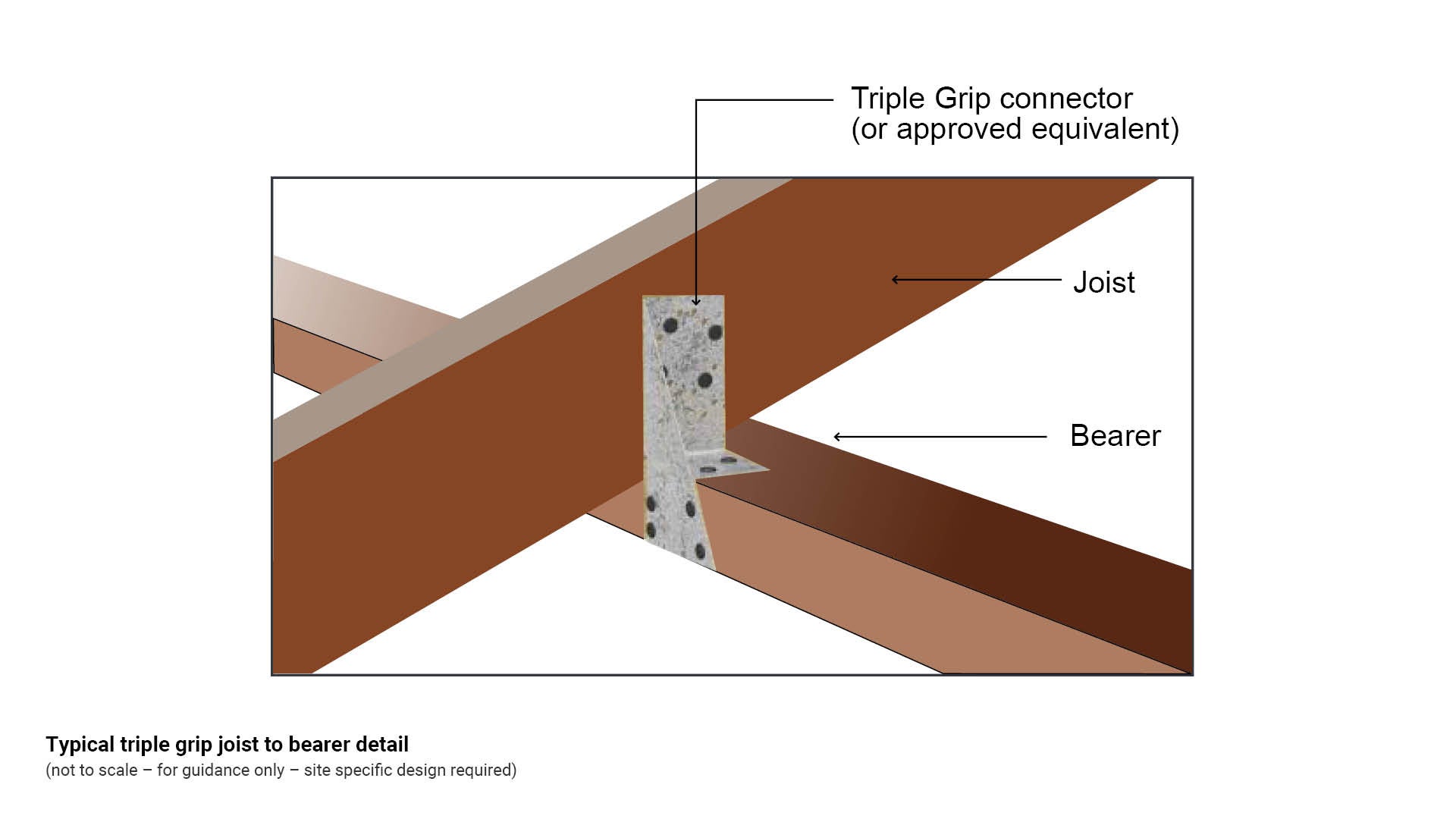
- Vertical bolts should be avoided as they fill with water. Use SS Triple Grip type connections (or approved equivalent).
See Figure 21: Typical triple grip joist to bearer detail.
Figure 21: Typical triple grip joist to bearer detail
Fixings for treated timber
- Minimum HDG bolts for non-coastal areas (these may rust when fixed into CCA treated hardwood).
- Dip HDG bolts in Dulux GPE ZP (or equivalent) and drill oversize holes.
- HDG especially with cut edges will corrode (within 8-10Km of saltwater.
- Select true 304 or 316 stainless steel bolts or stainless steel threaded rod and large stainless steel washers and nuts.
- Trip L Grips, Multigrips, angles must be minimum true 304 stainless steel.
- Stainless steel connectors facilitate horizontal bolting to joist and bearer.
- Joist hangers must be stainless steel.
- Always use 3M (or equivalent) aluminium and bitumen tape on top of joist to prevent water entry.
Timber post installation
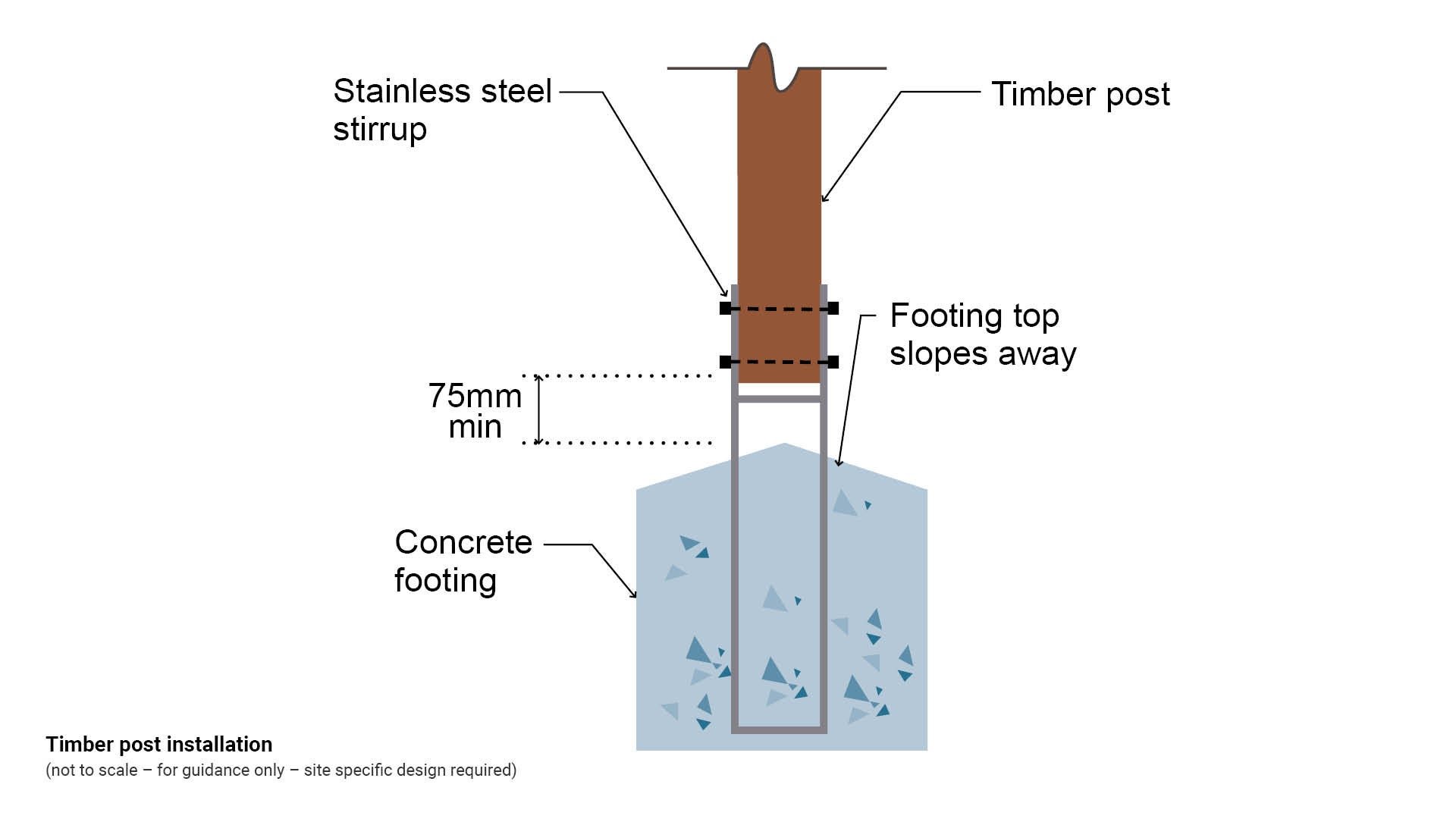
Fix hardwood posts to a 316 stainless steel stirrup/blade:
- Slope footings away from the post for free drainage.
- A further solution for hardwood posts, (not recommended) is to backfill with no-fines concrete, well agitated to ensure adequate compaction.
See Figure 22: Timber post installation.
Figure 22: Timber post installation
Timber preservative treatments
Sapwood is to be treated with Tanalith E (non chrome, non arsenic) in accordance with TUMA (Timber Utilization and Marketing Act Qld 1987).
All preservatives may be significantly enhanced by additional coatings to minimise weathering.
Timber surface coatings
CN oil (or equivalent) – robust oil with additional preservatives, intended for commercial decks. Generally used as the first oil coat on decking.
CN Emulsion (or equivalent) – a grease like timber preservative to be applied liberally to end-grain, cut and checked timber and timber to timber interfaces.
Tanacoat (or equivalent) – a penetrating timber oil which works as a UV blocker and water repellent. Used for re-oiling of existing decks. Suitable for handrails.
- Surface coatings or paints are non-penetrating and can crack at fixings and board ends. They let moisture in but not out and require removal and re-sanding to rectify.
Materials other than timber
Refer to manufacturer/supplier information for installation and maintenance regime.
This component is currently in development