Shade sails

Design
Requirements for the design, manufacture and installation of embellishments
Good design
See the following corporate documents to identify relevant project design requirements:
Sunshine Coast Planning Scheme regulates the way land, buildings and structures are used and developed on the Sunshine Coast.

Sunshine Coast Design contains 10 design principles that guide good project planning and design outcomes, that are appropriate for the Sunshine Coast.
The LIM provides further overarching design advice, refer:
- Introduction and Design Principles - e.g. sustainability, CPTED, accessibility
- Preliminaries - environmental management, tree sensitive design and site set up.
Embellishment requirements
- Universal access.
- Comfortable and suitable for the average person.
- See 'Positioning' and 'Equal access' sections for the corresponding LIM category.
- Made from materials that will be durable and can be suitably protected from exterior elements, such as salt spray and UV exposure.
- Robust and sturdy to withstand constant public use and be resistant to vandalism.
- Fixings are to be 316 marine grade stainless steel (unless otherwise stated).
- Tamper proof fixings should be used
- Graffiti protection coatings applied (where applicable)
- Fire retardant (where applicable).
- Warranties should be as listed below.
- Easily repairable or replaceable.
- Sourced locally and use standard fittings.
- Reputable suppliers should be used who keep a supply of stock parts on hand for the life of the product.
- Use sustainable materials, although sustainability needs to be considered over the lifetime of the embellishment.
- Install on paved, concrete or other hard surfaces (where applicable).
- Manufactured to engineering specifications (where applicable).
- See the 'Standards' section for the corresponding LIM category.
Warranty and asset life
Product/embellishment | Warranty (minimum) | Asset life (typical useful life) |
Steelwork | 10 years | 15 years 2 |
Membrane | 10 years | 15 years 2 |
Membrane stitching | 15 years | 15 years 2 |
Concealed webbing | 5 years | 15 years 2 |
Shade sail workmanship | 5 years | 15 years 2 |
Source 2: Sunshine Coast Council Asset Management Plan 2017/18-2022/23 – Parks and Gardens (figure based on current data, subject to change).
Shade sails
Once the location of the shade sail area has been decided, based on the Environment and Liveability Strategy (ELS) and Recreation Parks Plan (RPP) guidance, consider the appropriate embellishment level to suit the selected site.
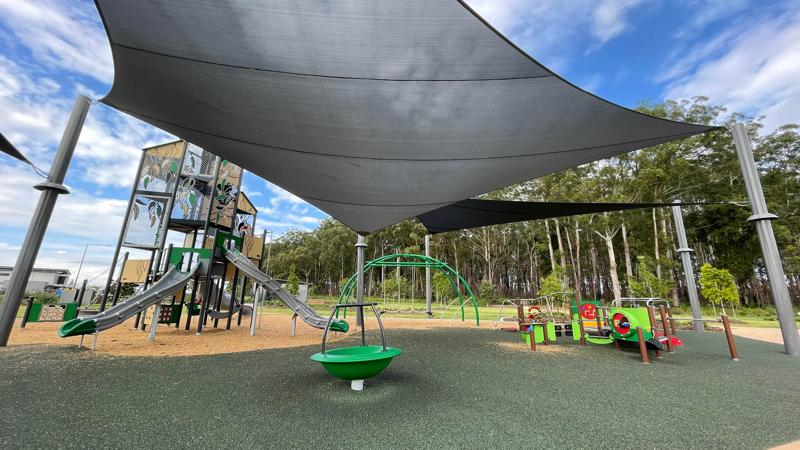
Overall design considerations:
- Smaller, multiple shade sails are preferred over larger single units
- Shade sails are to be non-climbable. Anti-climb barriers are to be installed.
- Clearances are to be maintained to minimise access to shade sail.
- Framework and steel are to be hot dipped galvanised after manufacture. Coating systems must NOT be used.
Certification
For all structures over 3.0 m in height, certification by a professional building certifier is required. The professional certifier will advise which forms are necessary. (e.g. Form 15 - Before construction, Form 12 - During construction, Form 16 - During construction at mandatory inspection stages, Form 21 - End of construction).
Shade requirements
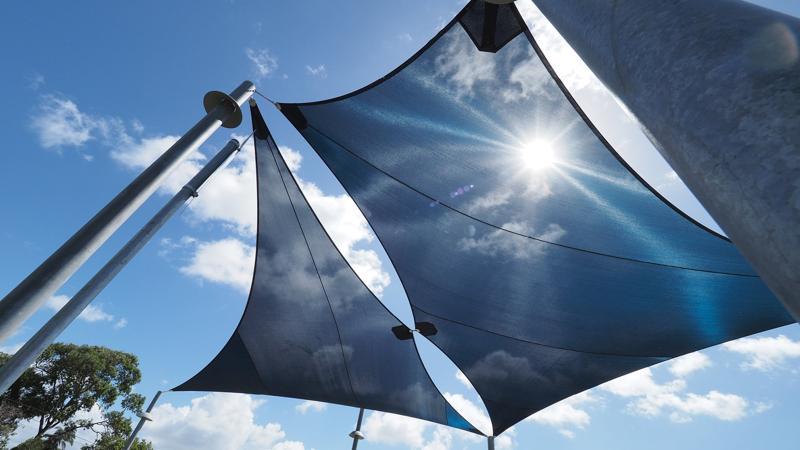
Shade sails MUST comply with the following:
- Provide site specific shade modelling (shade diagram) to illustrate a minimum of 50% shade cover of the activity area (e.g. play space) between 9 am and 3 pm (EST) in summer. (In this instance, 50% shade cover means that between the times nominated, 50% of the play space should be shaded). In addition:
- Dependent on the size, orientation and activity elements, shade modelling shall be extended for:
- a longer duration of the day
- autumn, winter and spring months.
- Dependent on the size, orientation and activity elements, shade modelling shall be extended for:
- To maximise shade coverage, choose materials with maximum Ultraviolet Radiation (UVR) protection factor ratings.
- Consideration should be made to mitigate heat build-up on surfaces.
- Orientation of embellishments must be carefully considered to ensure the shade coverage is appropriately positioned e.g. slide facing south.
- A combination of natural and built shade is the most effective outcome.
- Shade trees:
- Plant new trees to the northern and western sides of the activity area for future shade provision.
- Incorporate existing trees into the design - consider tree roots.
- To prevent opportunities for climbing onto shade sails, consider trees both at time of planting and at expected mature size.
- Ensure that the expected mature size of the tree is considered when positioning shade sails, to prevent creating opportunities for climbing onto sails.
- Shade trees:
Supporting documentation includes the following:
- Creating Shade at Public Facilities: Policy and Guidelines for Local Government Edition 2. For example:
- “consider the movement of sun throughout the day, with particular emphasis between the highest risk hours of 9 am and 3 pm.
- the solar movement impacts the effectiveness of shape and size of a shade structure
- generally east and west positions require wider overhangs to improve shade protection.
- the combination of natural and built shade should be considered as the most effective outcome.
- remember there is concern for UVR both in winter and in summer”.
- Refer also to the appropriate Australian Standards for each activity area eg. playground equipment, exercise equipment.
Shade sail and post design

It is particularly important to ensure retention of line of sight and to minimise unintended access to a shade sail. Incorporate Crime Prevention through Environmental Design (CPTED) principles where possible.
The Sunshine Coast Council area sits wholly within wind speed region B (non cyclonic). Wind region B (South East Queensland) ultimate wind speed is 51.9 m/s or 186.84 km/h.
Shade sails are to comply with the following:
- Minimum wind rating of N3 (non-cyclonic), W50 (gust wind speed in metres per second), or greater.
- Waterproof sails need to be tensioned correctly to make allowance for adequate water runoff, to avoid ponding and the risk of collapse during a rain event.
- Shade sails must be designed to drain into garden beds, not onto equipment.
- Suitable offsets should be incorporated to maintain adequate separation distances to prevent abrasion wear between sails
- Shade structure is to be non-climbable. Clearance heights between the equipment and the shade sail, must be observed. See LIM Shade sails – Positioning for further guidance.
- Any sail connection point is to be a minimum 4.5 m above ground level.
- All shade structures are to be minimum 3.0 m above the highest point of any equipment. This allows for sag and product stretch over time and reduces the opportunity for vandalism.
- Shade sails are to incorporate anti-climb vandal barrier, 1.0 m from the top of each supporting arm.
- Large diameter posts (over 250 mm) are preferable as they are difficult to climb.
- Installation must be by an installer licensed to carry out shade sail installation.
- Technical specifications must be supplied for each item of the shade sail.
See LIM Shade sails - Specifications for:
- frame and rigging
- membranes
- footings, fixings and finishes.
Framework and steel
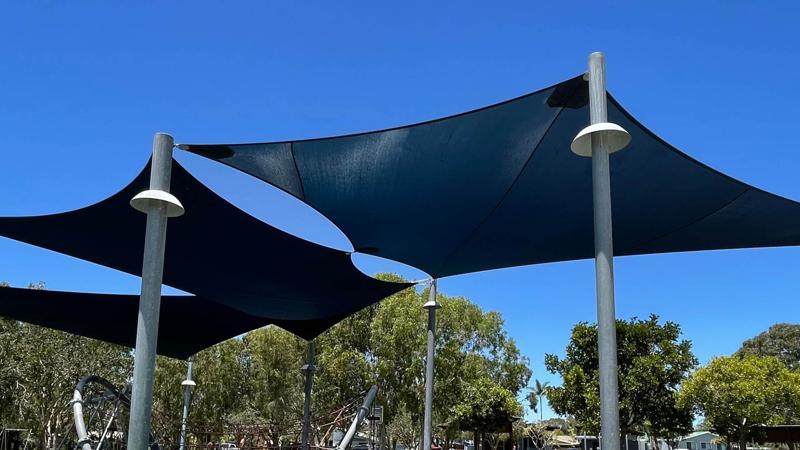
- Framework and steel are to be hot dipped galvanised after manufacture. Coating systems must NOT be used.
- Fasteners and perimeter wires are to be 316 stainless steel.
- Perimeter wire to be a minimum diameter of 5.0 mm.

- Tensioning devices and turnbuckles to incorporate a failsafe system to prevent dislodgement.
- For example; double lock nuts and spring washers, Loctite or similar screw/nut locking compound.
- Install a safety chain. Must be installed to a separate anchor point.
Shade cloth
- Fabric is to be fire retardant.
- Sails are to be cut to form, not stretched to form.
- All shade sail stitching is to be PTFE (polytetrafluoreothylene) UV stabilised sewing thread.

- Smaller multiple sails are preferred over larger single units. This ensures reduced maintenance and replacement costs.
- Where larger single units are necessary, a hole or flap must be engineered to release wind pressure in storm events.
- Dark coloured shade sails are preferred to minimise staining and to meet UV requirements
- The use of subtle colour schemes also needs to be considered for parks in character areas and in direct residential view-lines.
- Light colours (e.g. white, cream, yellow) are NOT accepted.
- Shade cloth acts as a physical barrier to incident solar UVR however it may transmit as much UVR as visible radiation. The more you can see through it, the more UVR can get through.
- Tightly woven shade cloth can absorb up to 90% of harmful UVR penetration.
- Where shade cloth is tightly stretched to form a cover, the holes may expand and therefore allow more UVR to penetrate.
- To maximise shade coverage, select materials with a minimum ultraviolet effectiveness (UVE) rating of “Very Effective”. Shade sail fabric is to be a minimum 91% UV protection.
- AS 4174:2018 Knitted and woven shade fabrics. The performance classification of knitted and woven shade protection fabrics is determined by ultraviolet effectiveness (UVE) classification system:
Material efficiency rating | UVE percentage | Acceptable/not acceptable |
Effective | 88.0 – 90.9 % UVE | NOT acceptable |
Very Effective | 91.0 – 94.9% UVE | Acceptable |
Most effective | 95.0%+ UVE | Acceptable |
Anti-climb vandal barriers
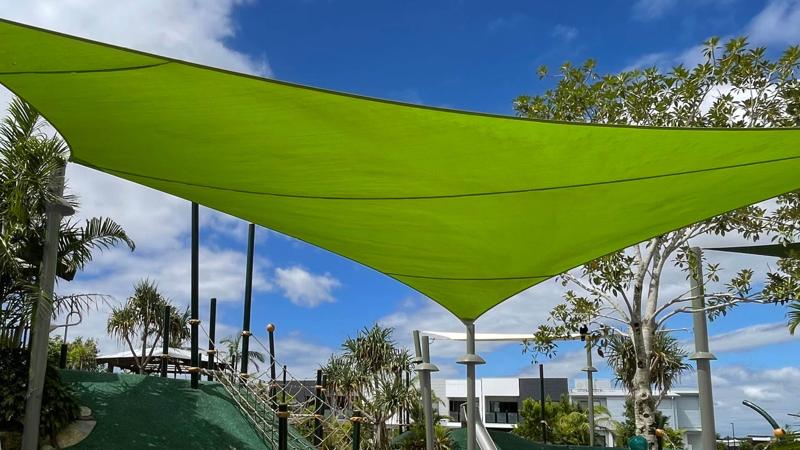
Anti-climb vandal barriers should be fitted to all shade sail posts to discourage climbing of the framework.
- All shade structures are to be 3.0 m above the highest point of any playground equipment.
- Shade sails are to incorporate anti-climb vandal barriers 1.0 m from the top of each supporting arm.
- Any sail connection point is to be a minimum 4.5 m above ground level.
Anti-climb vandal barriers are to be attached in the following manner:
- Posts – 250 mm minimum preferred diameter.
- To protect the integrity of the post, a ring is to be welded to the post 1.0 m from the top of the post, and then hot-dip galvanised after manufacture.
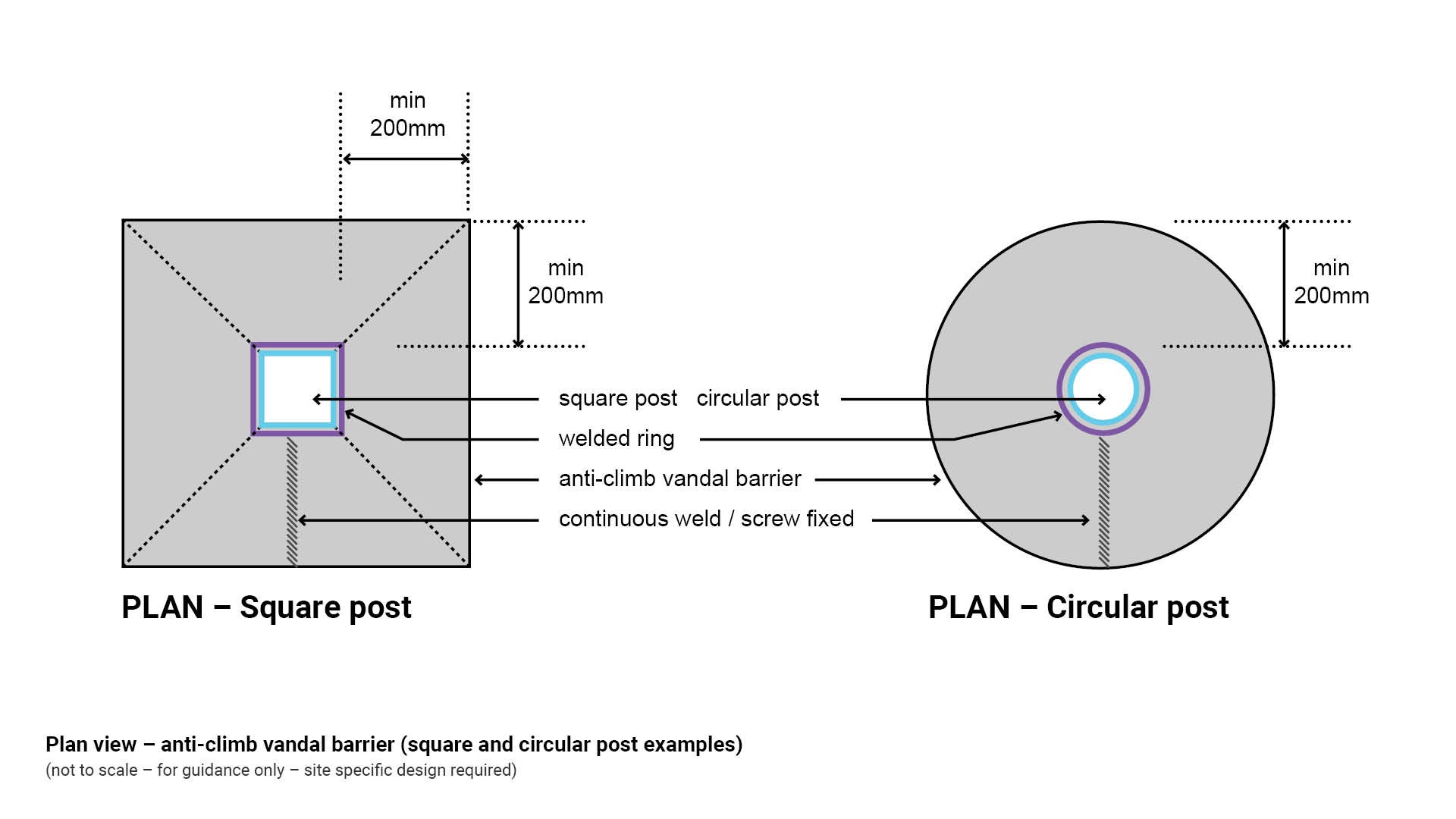
- Anti-climb vandal barriers must provide a minimum 200 mm clear of post
- Assembly – the two halves are positioned above the ring, welded and screw fixed to each other.
See the following for further guidance:
- Figure 2: Elevation – anti-climb vandal barrier installation (circular post example)
- Figure 3: Plan view – anti-climb vandal barrier (square and circular post examples)
- LIM Shade sails – Technical drawings.
Figure 2: Elevation – anti-climb vandal barrier installation (circular post example)
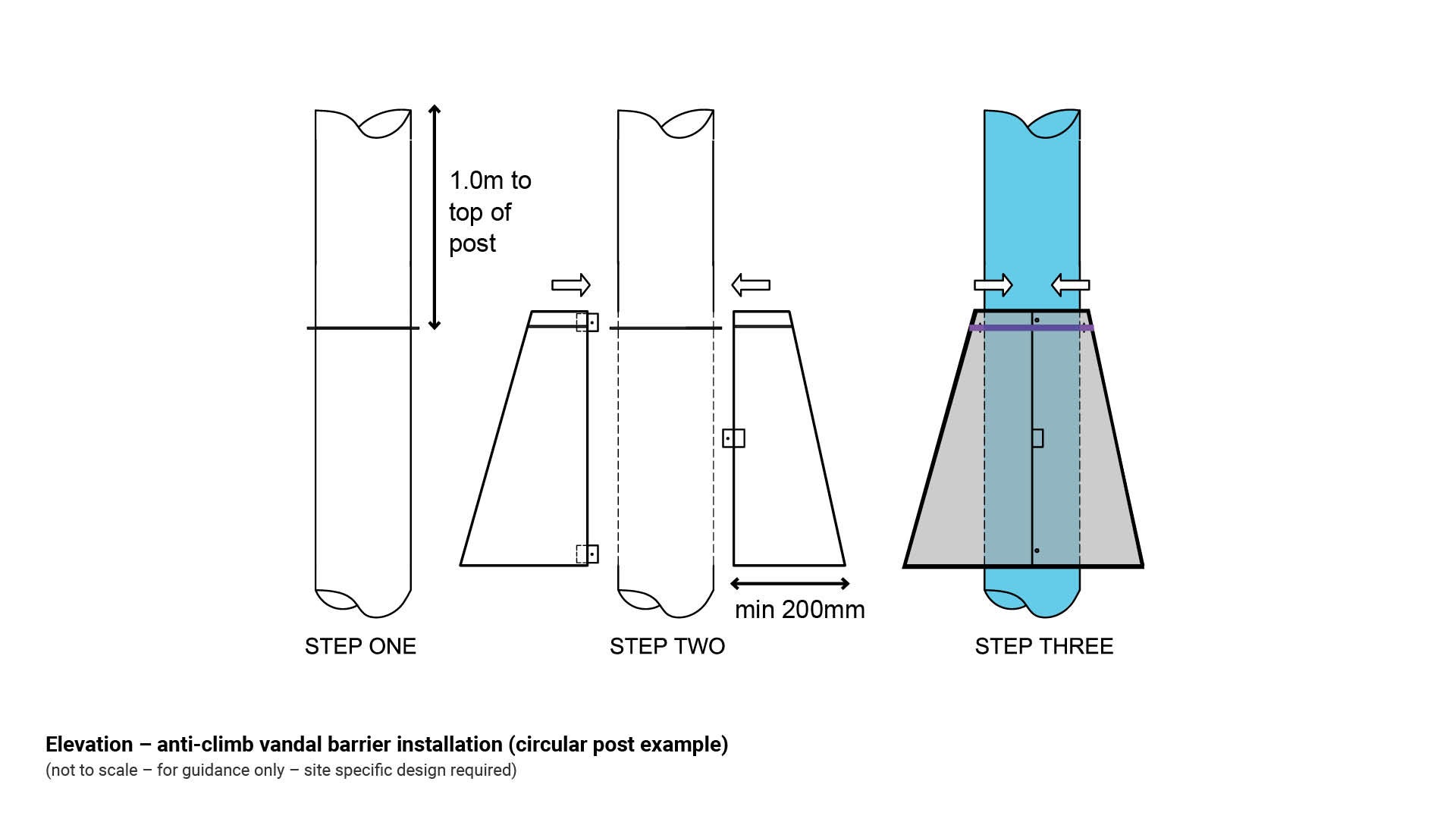
Figure 3: Plan view – anti-climb vandal barrier (square and circular post examples)
This component is currently in development