Shade sails

Positioning
Best practice guidance for the placement and arrangement of embellishments
Site setout
Park users
Provide shade for spectators or parent/caregiver supervision (with clear sight lines) near activity areas and outside the safety clearances.
Orientation
Position shade sails according to a shade sail modelling diagram:
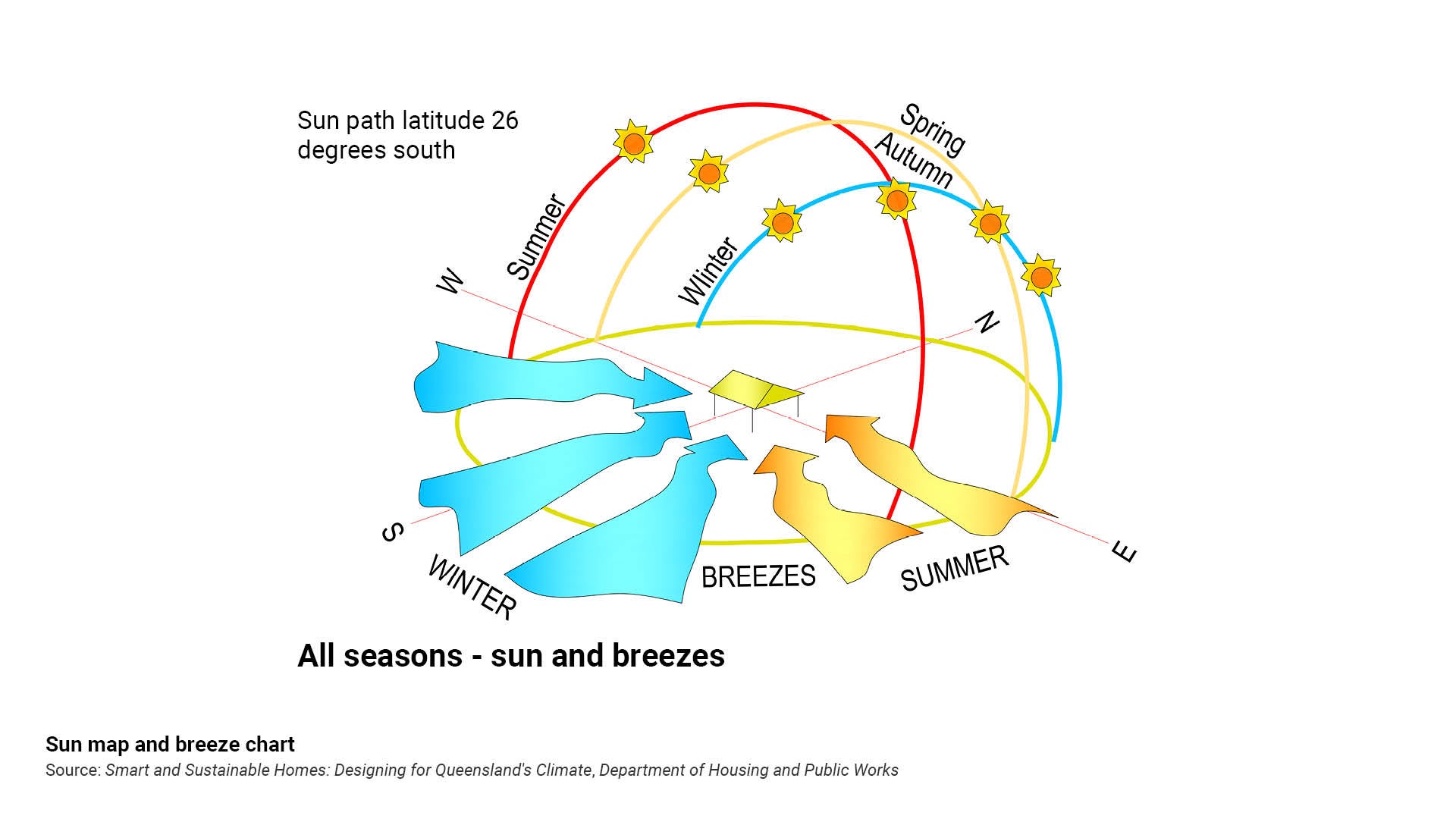
- Shade sails are to be positioned with regard to sun exposure. Shade trees and shade sails are to be sited to ensure equipment is protected from the midday and afternoon sun. For example:
- plant trees to the northern and western sides of the playground for future shade provision.
- shade sails should be installed as temporary measures while trees mature in District and Sunshine Coast Wide parks. Refer RPP for further information for level of park requirements.
- slides are to be positioned facing south to prevent excessive heating by the sun of the slide surface.
See the following:
- Figure 4: Sun map and breeze chart
- LIM Shelters for climate based orientation.
Figure 4: Sun map and breeze chart
Safety
- Crime Prevention through Environmental Design (CPTED) principles apply.
Shade sails with planting
Shade sails in relation to trees and planting:
- Existing mature trees and new tree plantings, can provide additional natural shade.
- Existing mature trees and new tree plantings are intended as the primary shade source for activity areas, with shade sails required until the trees reach maturity. As such, the mature size of newly planted trees should be considered when positioning shade sails.
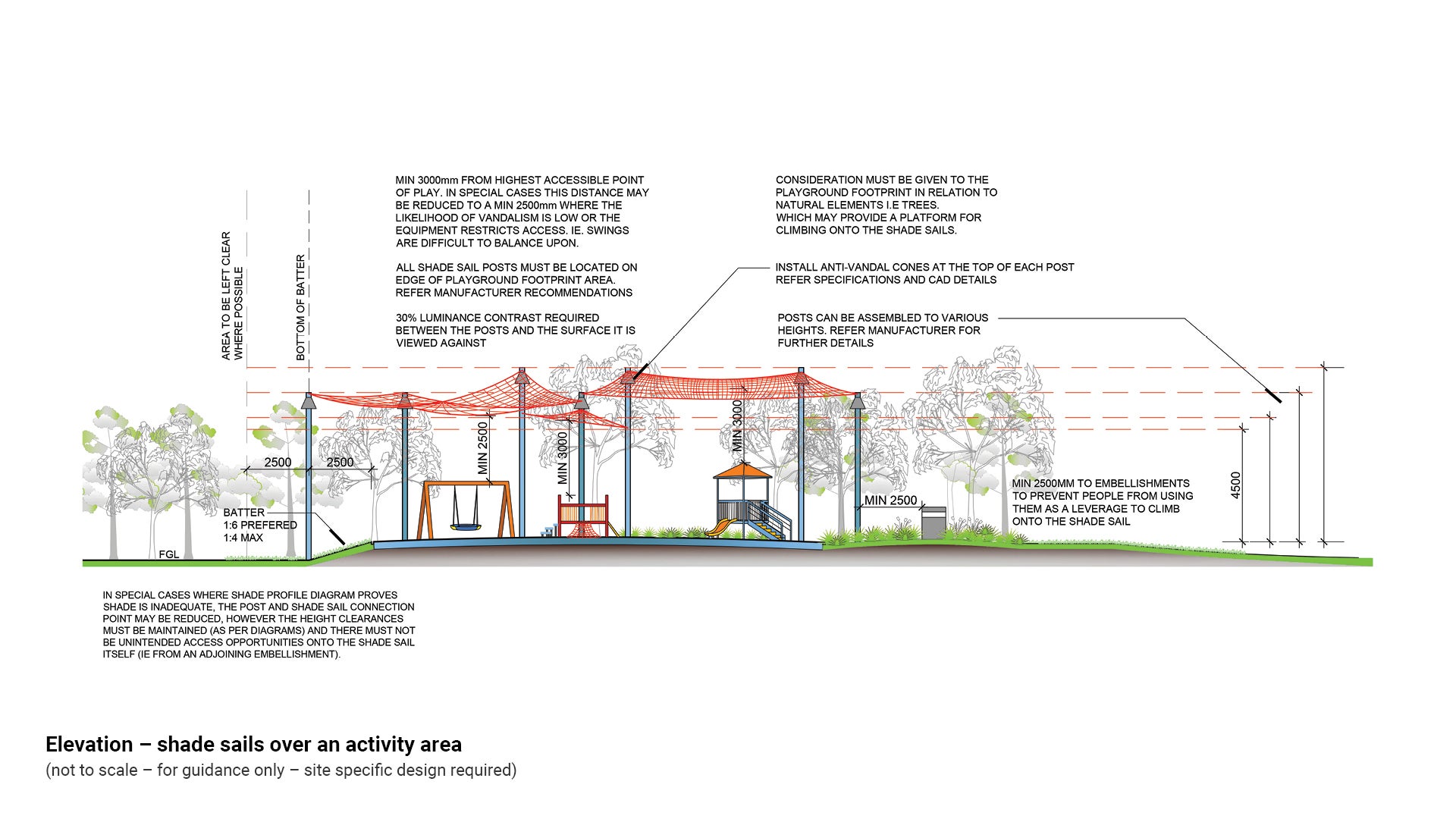
- To prevent unintended access onto shade sails, any part of a tree that can be used as leverage to climb upon must be separated from shade sails by 2.5m. This includes existing mature trees and the mature size of newly planted trees.
- Where the design can be sensitive to tree root requirements, follow the advice of a qualified arborist.
- It is preferable to plant trees at the time of play space, exercise equipment and skate park installation.
- Consult an arborist for species and offset advice.
See LIM Planting (landscape) for further guidance.
Shade sail post location
- Shade sail posts should allow ample space for run up and landings at the beginning and end of elements to reduce conflict and enhance safety (particularly important for skate parks).
- Shade sail post location in play spaces:
- Shade sail posts should be located outside of the playground surfacing footprint as the preferred option.
- position posts in garden beds, or where posts are located in turf, provide a concrete mowing collar.
- Where this isn’t possible, posts may be located within the playground surfacing footprint, provided the following requirements are met:
- a risk assessment must be undertaken and the post location approved by Council (Parks and Gardens).
- the posts must not be located in play space fall zones as per AS requirements.
- the post must not be placed in any transition zones between play equipment elements (i.e. path of travel).
- the post should be placed at the outer edge of the playground footprint where possible.
- adequate luminance contrast between the posts and surfacing must be achieved.
- where possible, posts should not be embedded in rubber surfacing, due to post / footing maintenance.
- Shade sail posts should be located outside of the playground surfacing footprint as the preferred option.
See the following figures:
- Figure 5: Plan – shade sails over an activity area
- Figure 6: Elevation – shade sails over an activity area.
Figure 5: Plan – shade sails over an activity area
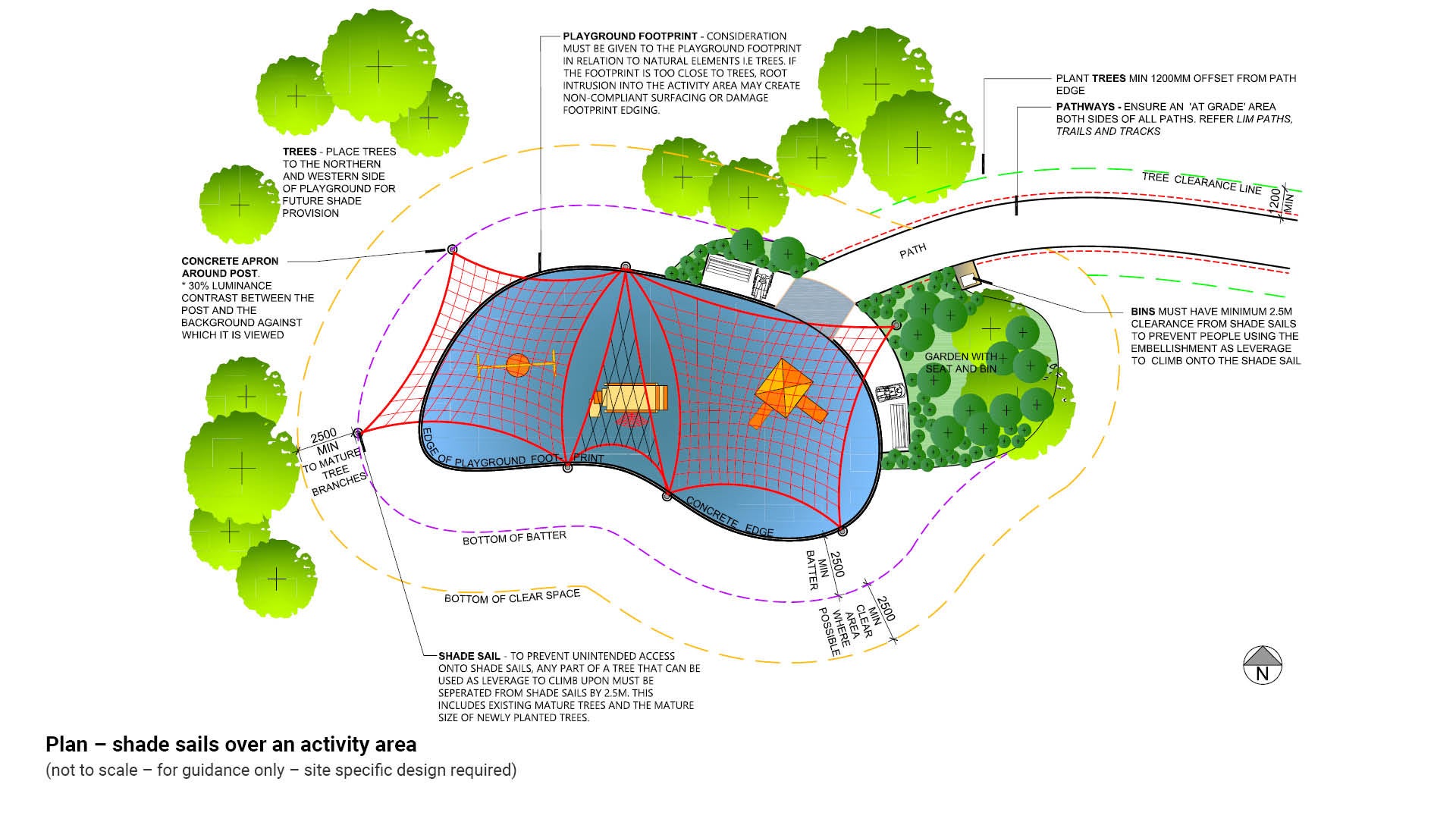
Figure 6: Elevation – shade sails over an activity area
Clearances
Table 1: Positioning guidance offsets
Embellishment | Distance from | Minimum distance | Reason |
Shade sails | Tree – any part of a tree that can be used as leverage to climb upon. | 2.5 m (to be determined by mature size of selected tree species) | To provide shade and to prevent unintended access to shade sail. |
Shade sails | Any embellishment that can be climbed on (e.g. bin) | 2.5 m | To prevent unintended access to shade sails. Note: if 2.5 m offset does not allow for adequate shade, a decreased offset may be considered on a case by case basis to provide appropriate shade. Ensure unintended access is assessed for risk. Any offset reduction must be approved by asset custodian. |
Shade sails | Clear area to any other embellishment | 2.5 m |
|
Shade sails (Vertical clearances) | Ground level | 4.5 m height | Prevent unintended access and vandalism (see also note below) |
Shade sails (Vertical clearances) | Top of any climbable equipment (i.e. can be used to reach the shade sails by balancing on top of the equipment). Note: in special cases this distance may be reduced where the likelihood of vandalism is low or the equipment restricts access and cannot be stood on (i.e cylinder top of a swing frame). | 3.0 m height (preferred height) 2.5 m height (special cases) | Prevent unintended access and vandalism Note:
|
This component is currently in development