Drinking fountains
Equal access
Requirements for the integration of equal access for all users
The Disability Discrimination Act (DDA) defines ‘premises’ as the whole of the built environment and includes existing buildings, new or proposed buildings, transport systems, car parks, pathways, and public parks and gardens.
Note: Consult an access consultant accredited by the Association of Consultants in Access Australia (ACAA).
Elements required for equal access
- Embellishments must be designed in accordance with AS 1428 Design for access and mobility.
- Ensure that drinking fountain slabs are connected to a ‘continuous accessible path of travel’ (CAPT) to enable equal access for people who use wheelchairs. Ensure that the path of travel is connected to an accessible car park space.
- Provide equal access to drinking fountains/bottle filling stations at the recommended mounting and circulation heights to provide wheelchair access and reach heights.
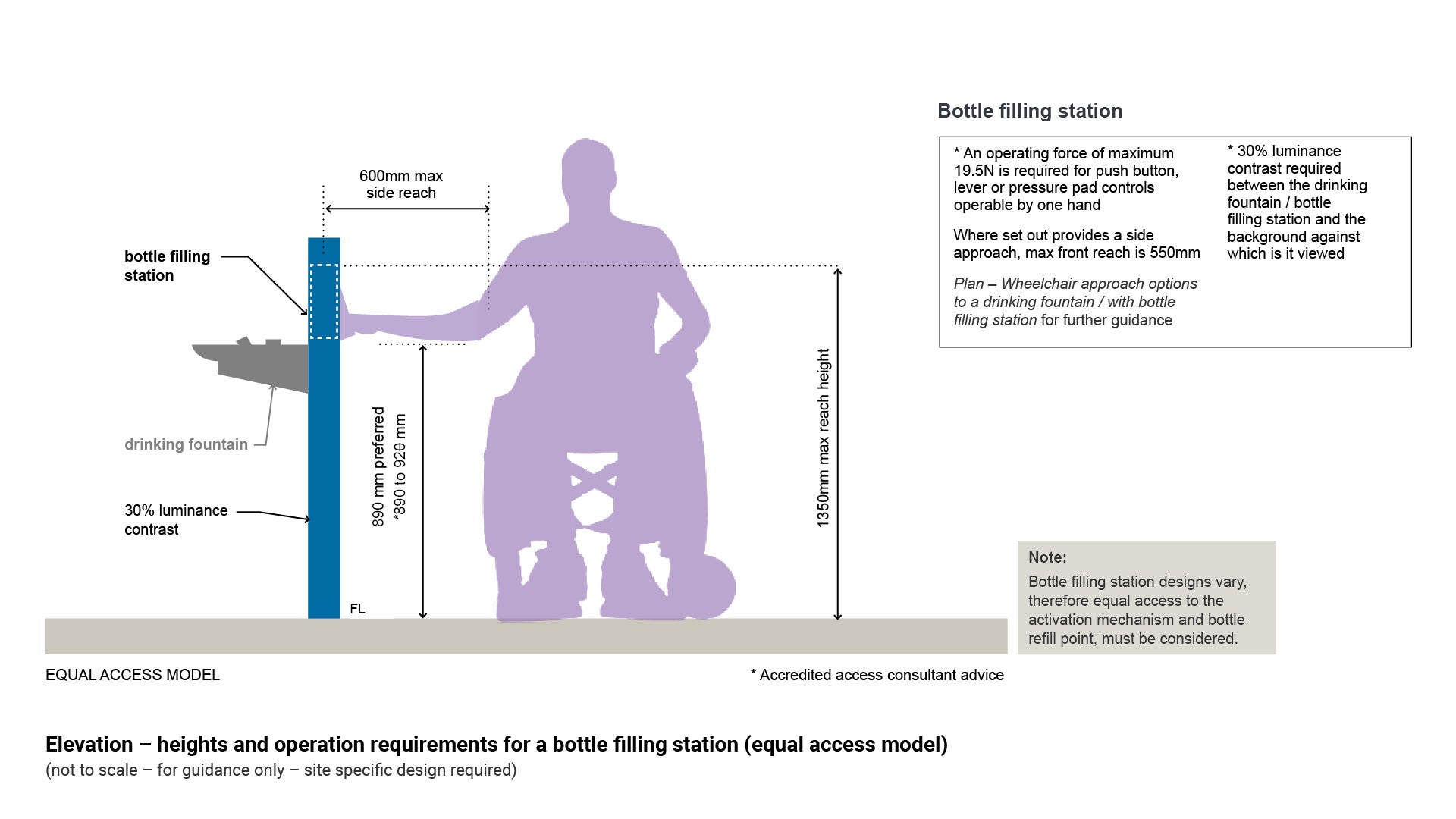
- bottle filling station designs vary, therefore equal access to the activation mechanism and bottle refill point, must be considered.
- If dog drinking bowls are installed, they can make it difficult to access the drinking fountain/bottle filling station by a person using a wheelchair.
- Drinking fountains/bottle filling stations are to be installed at a height of 890 mm - 940 mm (as recommended by the Spinal Injuries Association). 700 mm as per AS 1428 Design for access and mobility is insufficient, as indicated by an accredited access consultant.
- A combination of drinking fountain heights and locations should be used, for example where multiple installations exist:
- the first installation should always be an equal access model
- following the first equal access installation, the low height model can be used
- alternatively the dual model may be used
- note that where a dual height drinking fountain is installed it is preferred that a bottle filling station is not installed, as depending on the design, it may be difficult to access by a person using a wheelchair. See Table 4: Drinking fountain/bottle filling station preferred height and locations for further guidance.
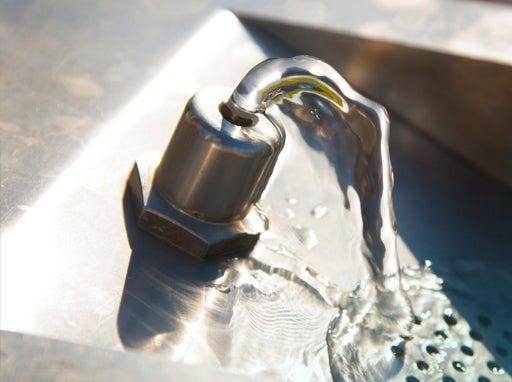
- Drinking fountain water outlet to be as close as possible to the front of the unit, with water flow to a height of 80 mm - 100 mm parallel to the front of the unit.
- Controls operable by one hand require force to be no more than 19.5 N. Push button mechanisms pose difficulty for some types of disability and lever operated units are more user friendly.
- Install equal access drinking fountains/bottle filling stations in consistent locations for ease of recognition by people with a vision impairment.
- When retrofitting an equal access drinking fountain, consider the location of existing embellishments. If there is insufficient circulation space, a new location may be required. Install drinking fountains/bottle filling stations
- Install drinking fountains/bottle filling stations at the recommended offset from the edge of a pathway, to provide clearance for pedestrians and cyclists.
- Avoid finished height difference between a concrete slab and adjoining surfaces to prevent trip hazards and to prevent ‘tramlining’ of pram, bicycle and wheelchair wheels.
- Drinking fountains/bottle filling stations should be accessible from 180 degrees to cater for left and right handed people.
- Consider installing rubber mouth guards to equal access drinking fountains at locations such as ‘all abilities play spaces’ or where there is a demand for this product.
See the following figures and table for further guidance:
- Figure 3: Plan – Wheelchair approach options to a drinking fountain/with bottle filling station
- Figure 4: Plan – single approach – drinking fountain
- Figure 5: Plan – multiple approach – drinking fountain
- Figure 6: Elevation – heights and operation requirements for a drinking fountain – (equal access model)
- Figure 7: Elevation – heights and operation requirements for a drinking fountain – (low height model)
- Figure 8: Elevation – heights and operation requirements for a bottle filling station – (equal access model)
- Table 3: Drinking fountain/bottle filling station (combined unit) preferred height and locations.
Table 3: Drinking fountain/bottle filling station preferred height and locations
Installation | Height of drinking fountain (DF) | Typical user group | Installation location |
1st installation (Note: first installation should always be an equal access model) | Equal access model - Drinking fountain Single DF bowl 890 mm height to top of drinking fountain bowl. | All users including people who use wheelchairs | All |
2nd installation | Low height model - Drinking fountain Single DF bowl 650 mm height to top of drinking fountain bowl. | All users including children and short statured people | All |
All | Dual height model - Drinking fountain Dual DF bowl – combination equal access and low height model on single post
| All | All |
Installation | Height of bottle filling station | Typical user group | Installation location |
1st installation | Equal access model - Bottle filling station 890 mm min reach height to bottle filling station (activation mechanism and filling) Bottle filling stations should be combined with an equal access model drinking fountain. Low height models and dual height models may not be suitable as a combined unit due to equal access requirements. | All users including people who use wheelchairs | All |
Visual/sensory wayfinding
- For people with a vision impairment, provide a minimum 30% luminance contrast between objects and the background they are viewed against, for ease of identification.
- Where luminance contrast may not be achieved (such as grey aluminium furniture on grey concrete), luminance contrast can be addressed by introducing colour into the ground surface providing a minimum 30% luminance contrast with the embellishment base, resulting in the embellishment being more visible for people who have low vision.
- Consider designing nodes with a contrasting coloured concrete, or a variation in surface texture, to enable people with a disability to identify the location of embellishments along a pathway.
Note: Dog bowls are NOT preferred on drinking fountain/bottle filling installations
Figure 6: Elevation – heights and operation requirements for a drinking fountain (equal access model)
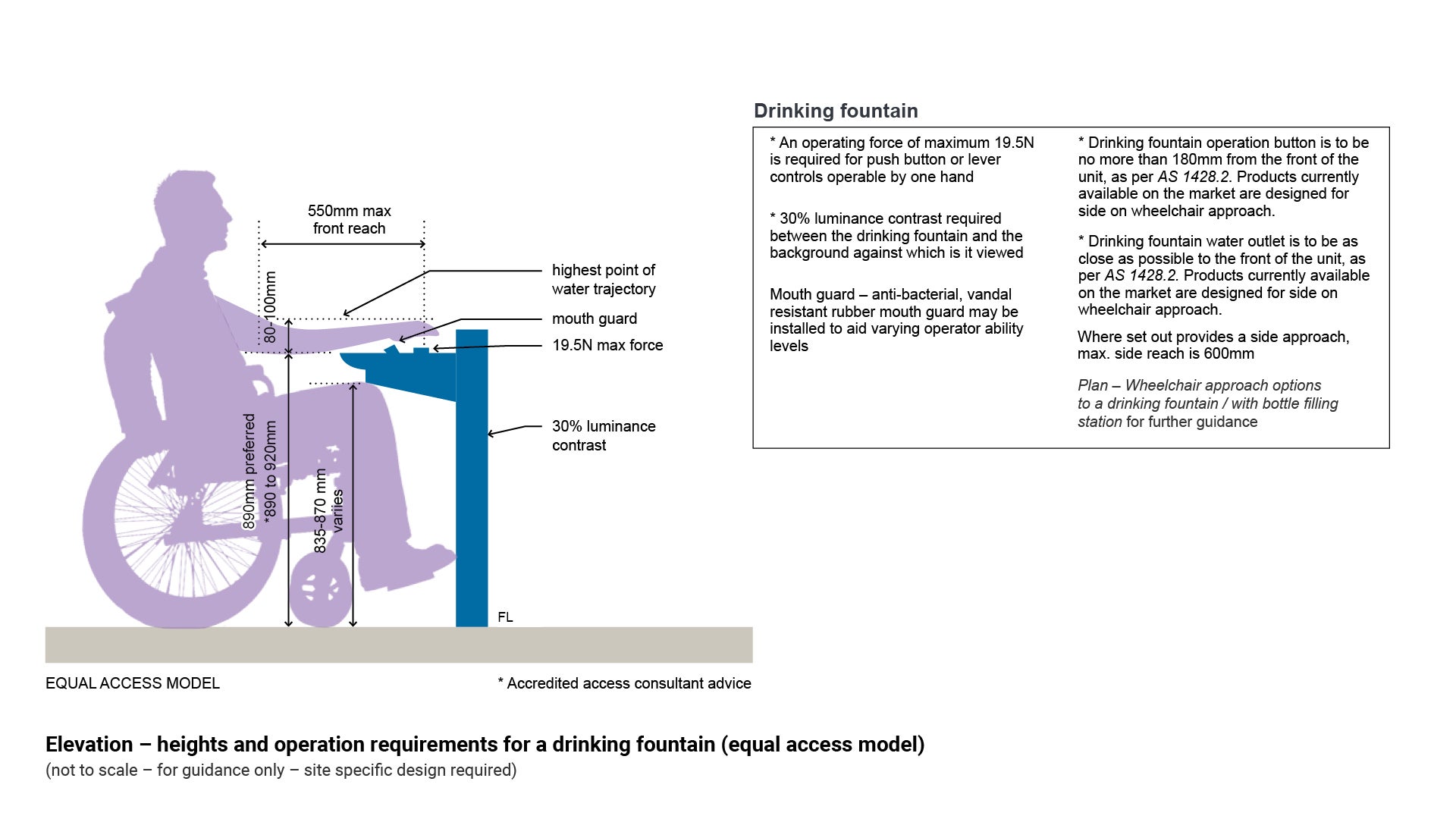
Figure 7: Elevation – heights and operation requirements for a drinking fountain (low height model)
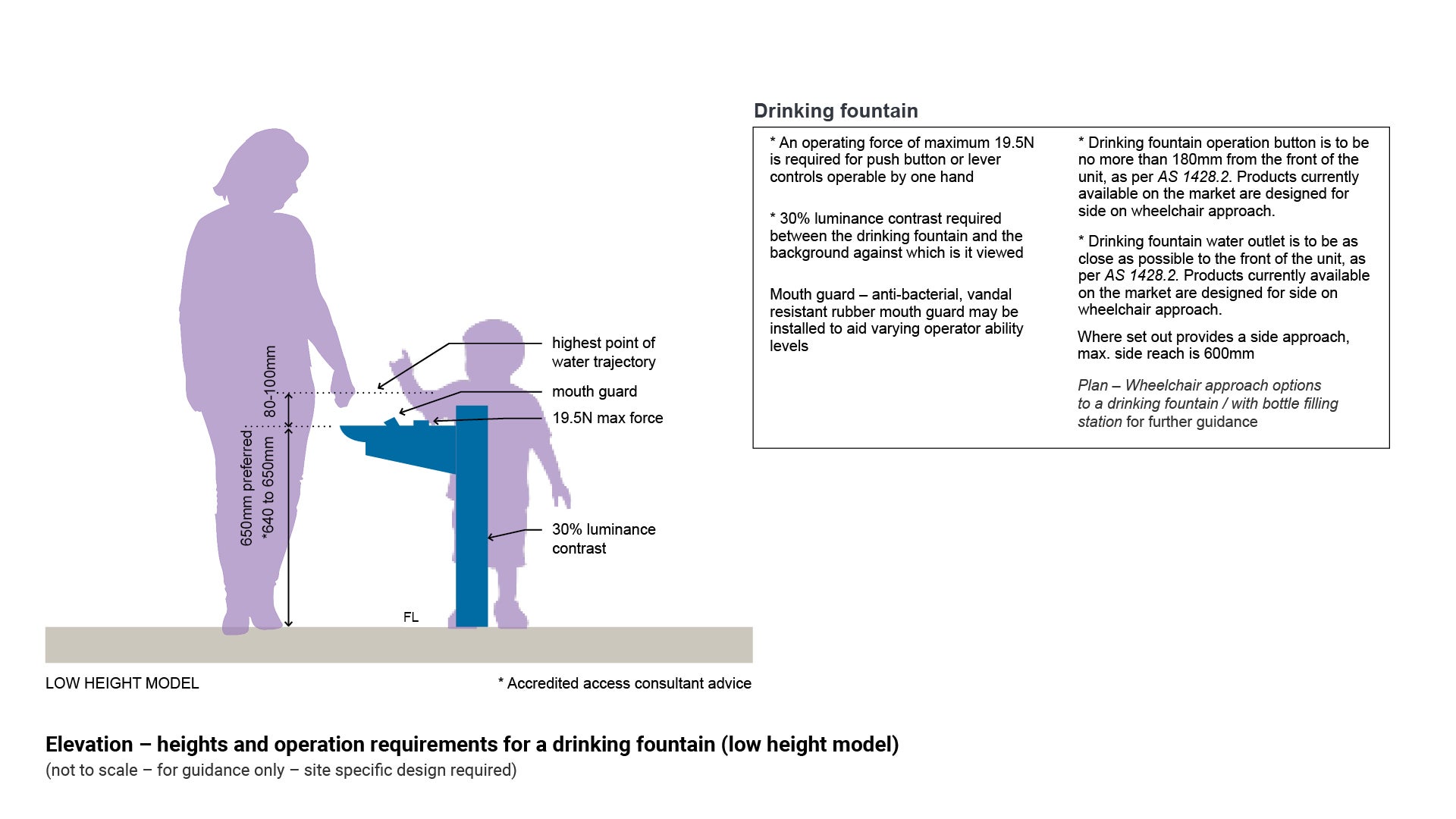
Figure 8: Elevation – heights and operation requirements for a bottle filling station (equal access model)
This component is currently in development