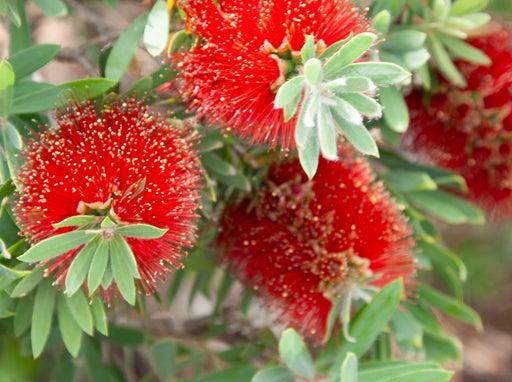
Regional ecological and aesthetic integrity is to be retained.
Existing remnant vegetation is to be retained and enhanced.
Locally native species are generally better suited to local conditions and therefore require less maintenance. (Note that there are exceptions. Some local natives are not suited to formal landscape settings and better utilised in natural areas, and some are high maintenance; while many other Australian natives and introduced exotics require little or no maintenance).
It is preferable to use local species rather than similar non-local Australian species to avoid potential displacement of local species.
Landscape planting design should reference the site’s original regional ecosystem(s) to help retain ecological and aesthetic diversity across the region. See the Queensland Department of Heritage and Wildlife website (wildlife and ecosystems/regional ecosystems) for key species – especially trees.
Plants should be of local/regional provenance and locally procured where possible.
Rare and endangered Sunshine Coast species listed in State and Federal legislation are to be planted to keep them in cultivation and ensure their ongoing existence in case their natural habitat is destroyed. Refer to Sunshine Coast Biodiversity Report – Tables 1 and 2; the Queensland Department of Heritage and Wildlife website (wildlife and ecosystems/threatened species); and to a complete list of rare and endangered plants in the Queensland Nature Conservation (Wildlife) Regulation 2006.
Some Australian native species become weeds when grown outside of their area of natural distribution.
Cultivars/hybrids of native species are acceptable in most landscaping projects, but not in ecological restoration projects which require pure species of regional provenance.
Some exotic species are actual or potential weeds.
Exotic species are acceptable in some situations as long as they have proven over time to be non-invasive. As some exotics may be better suited to some urban environments than native species, they may be trialled for later addition to this palette.
Many introduced species are attractive and non-invasive and may be suitable for feature plantings – such as specimen trees.
Plants other than those listed may be proposed, but will be assessed on their merits.
Proposed non-listed plants will be assessed in context. For example, bamboo may be acceptable in contained planter beds in a city centre, but not in open ground adjacent to a national park.
Proposed non-listed plants must not be ‘prohibited invasive plants’ or ‘restricted invasive plants’ listed on the Queensland Government Department of Agriculture and Fisheries website, or listed in the Sunshine Coast Local Government Area Biosecurity Plan.
Sunshine Coast Biosecurity Plan
The Biosecurity Plan includes information to assist landholders with invasive species management.
The Plan presents the highest priority invasive plants and animals for the Sunshine Coast.
The ratio of Sunshine Coast native, Australian native and introduced exotic species will vary between projects, such as:
revegetation projects should be 100% Sunshine Coast native species, and preferably site specific.
recreation areas which have secondary ecological values (and especially if there are watercourses) may also require 100% locally native species, or a high proportion (say 70%) of locally native species (by species count and total plant numbers) with a balance of non-invasive Australian natives and/or introduced species.
some gardens may require a mix of native and exotic species, as not all native species are suited to formal plantings.
harsh and/or relatively polluted city-centre urban streetscapes may require up to 100% introduced species if native species are unsuited to these conditions.
Page payload data
This component is currently in development
Sunshine Coast Open Space Landscape Infrastructure Manual (LIM) DISCLAIMER
Disclaimer
Information contained in this document may change without notice and you should use the current material available from Council’s website and not rely on material previously printed or stored by you.
All figures and diagrams are intended to be used as an aid to design and include Council’s preferred elements but they are not intended to be prescriptive and may need to be varied as dictated by site specific factors. While Council has exercised reasonable care in preparing this document, it does not warrant or represent that it is accurate or complete. The Council will not accept responsibility for any loss, damage, cost or expense that you may incur as a result of the use of or reliance upon any material contained in this document.
This document is produced to convey general information and is not intended to constitute advice whether professional or legal. Any reference to legislation in this document is not an interpretation of the law. It is to be used as a guide only. Consult relevant authority websites for current documents, revisions and amendments.
Where a particular product or supplier is profiled in this document, Council is NOT nominating this product or supplier as the selected choice. Product/supplier information has been provided to allow users to source products which contain the correct elements required for Council embellishments. Each product profiled states ‘or equivalent’ which means that different products may be supplied provided they satisfy the identified performance criteria, recommended standards, equal access guidance and product specifications.
Product design, manufacture and installation requires appropriately qualified people to provide site specific solutions to ensure the embellishment is appropriately adapted to local conditions and data.
This document does not override requirements stipulated in a development approval. Project specific variations may be appropriate as a result of site, environmental or other constraints. Any variations to these standards must be approved in writing by council prior to commencement of variation works. Components of this document may be used within a contract document but users should undertake their own investigations to confirm the information is suitable for this purpose.
Drawings contained in this document are NOT FOR CONSTRUCTION.
Details in this document are deemed to be the minimum standard and the user may wish to apply a higher standard subject to approval by council.
Acknowledgements
Council wishes to thank all contributors and stakeholders involved in the development of this document.
Copyright
Sunshine Coast Regional Council (Council) supports and encourages the distribution of its material however, copyright protects this document. Council has no objection to this material being reproduced but only if council is recognised as the owner of the copyright and this material remains unaltered.