Bins
Design
Requirements for the design, manufacture and installation of embellishments
Good design
See the following corporate documents to identify relevant project design requirements:

Sunshine Coast Planning Scheme regulates the way land, buildings and structures are used and developed on the Sunshine Coast.

Sunshine Coast Design contains 10 design principles that guide good project planning and design outcomes, that are appropriate for the Sunshine Coast.

The LIM provides further overarching design advice, refer:
- Introduction and Design Principles - e.g. sustainability, CPTED, accessibility
- Preliminaries - environmental management, tree sensitive design and site set up.
Embellishment requirements
- Universal access.
- Comfortable and suitable for the average person.
- See 'Positioning' and 'Equal access' sections for the corresponding LIM category.
- Made from materials that will be durable and can be suitably protected from exterior elements, such as salt spray and UV exposure.
- Robust and sturdy to withstand constant public use and be resistant to vandalism.
- Fixings are to be 316 marine grade stainless steel (unless otherwise stated).
- Tamper proof fixings should be used
- Graffiti protection coatings applied (where applicable)
- Fire retardant (where applicable).
- Warranties should be as listed below.
- Easily repairable or replaceable.
- Sourced locally and use standard fittings.
- Reputable suppliers should be used who keep a supply of stock parts on hand for the life of the product.
- Use sustainable materials, although sustainability needs to be considered over the lifetime of the embellishment.
- Install on paved, concrete or other hard surfaces (where applicable).
- Manufactured to engineering specifications (where applicable).
- See the 'Standards' section for the corresponding LIM category.
Warranty and asset life
Product/embellishment | Warranty (minimum) | Asset life (typical useful life) |
Wheelie bin | 3 years (preferred 5 years) | 5 years 2 |
Wheelie bin security post | 1 year | 10 years 2 |
Bin enclosure | 10 years | 15 years 2 |
Outdoor ashtray | 3 years | 3 years 2 |
Dog bag dispenser | 1 year | 3 years 2 |
Source 2: Sunshine Coast Council Asset Management Plan – Waste and Resource Management, (figure based on current data, subject to change).
Bins (all types)
Once the location of the bins has been decided, based on the Environment and Liveability Strategy (ELS) and Recreation Parks Plan (RPP) guidance, consider the appropriate embellishment level to suit the selected site.
>> See comments in Kontent
Overarching design considerations:
- All open spaces should include universal access (e.g. accessible bins and movement around furniture).
- Bins must have lockable features and meet servicing requirements.
- Designed to rainproof, easy to clean, repairable etc.
Overarching design considerations:
- All open spaces should include universal access (e.g. accessible bins and movement around furniture).
- Bins must have lockable features and meet servicing requirements.
- Designed to rainproof, easy to clean, repairable etc.
Wheelie bin design
Wheelie bins are supplied by Council, but not the stands. They must adhere to AS 4123 (Parts 1,6,7) - Mobile waste containers.
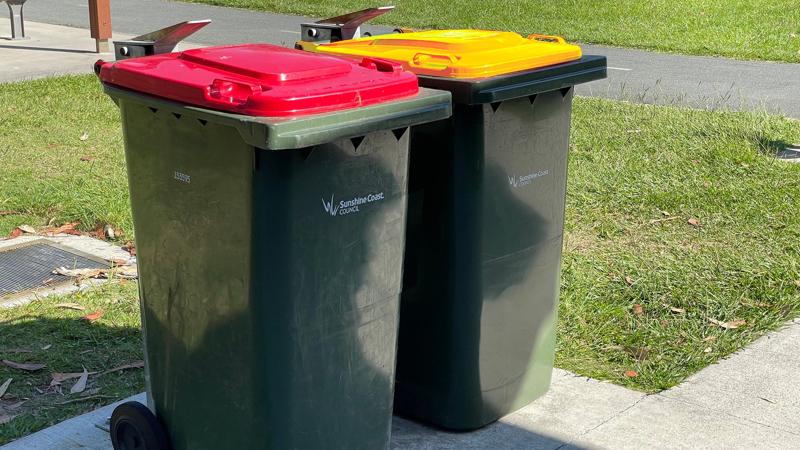
Wheelie bins are supplied by Council, but not the stands. They must adhere to AS 4123 (Parts 1,6,7) - Mobile waste containers.
Design
- All wheelie bins to be 240 L
Security stand design
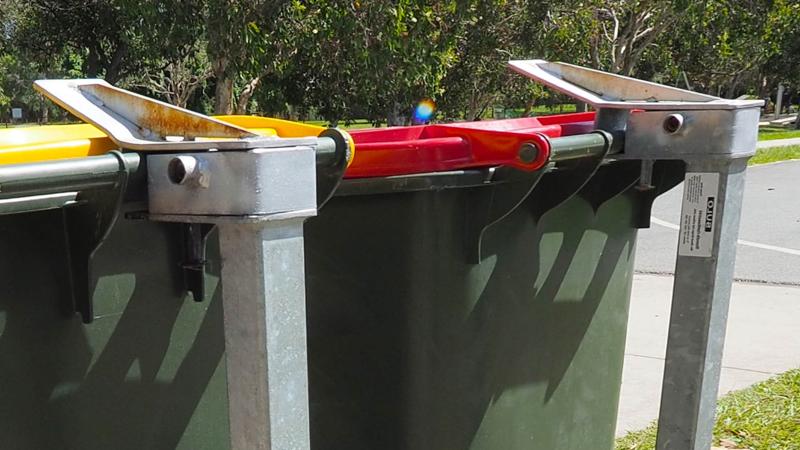
Attaching a wheelie bin to a security stand maintains the planned bin position. The fixture on the top of the stand, limits the size of waste items placed inside the bin and prevents it staying open when not in use.
Position the waste bin on the left and recycle on the right. The exception is where wheelie bins may be installed near a barbecue or picnic area. In this instance, the waste bin must be closest to discourage contamination of recycling.
Design
- Designed to attach a 240 L wheelie bin.
- Bins positioned back to back are not preferred. Only single sided posts are to be used for the following reasons:
- More convenient to access and use. In most cases there are two bins positioned beside one another along a pathway (500 mm offset).
- Ease of maintenance for collection.
- Keeps to footprint to a minimum.
- Multi-head attachments on a single stand (post) are not to be used for the following reasons:
- ease of maintenance (stock replacement).
- single stands allow for better control of the distance between bins. The multi-head attachment can be too far apart creating an undesirable appearance and larger slab size.
- if one bin is removed, the attachment becomes exposed, creating a hazard for passing pedestrians.
- Position security stands (posts) at the rear of bins.
- Designed with a fixture to:
- prevent full lid opening (bird-proof design)
- limit the size of waste items placed inside.
- Provision for dog bag dispenser/ashtray to be bolted on.
- Designed to be bolted down to a level concrete slab.
- Match bin slab surface finish with surrounding pavement or adjacent pathway finish where possible.
- Where a concrete slab is installed, extend the slab a minimum of 200 mm for mowing offset around bins. 500 mm is the minimum offset from a path edge, to the bin, for pedestrian and cyclist safety.
Locks and keys
- To maintain consistency, council requires all wheelie bins to be secured to the stand (post), with a standard lock type – 8.0 mm square hex key.
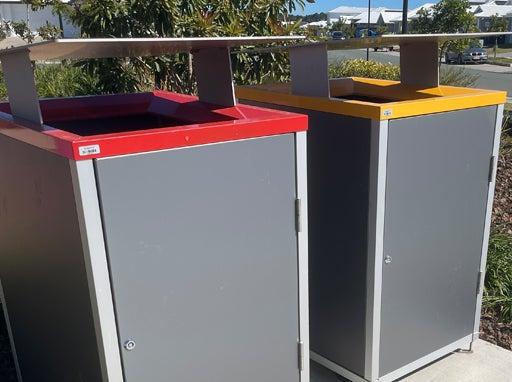
Bin enclosure design
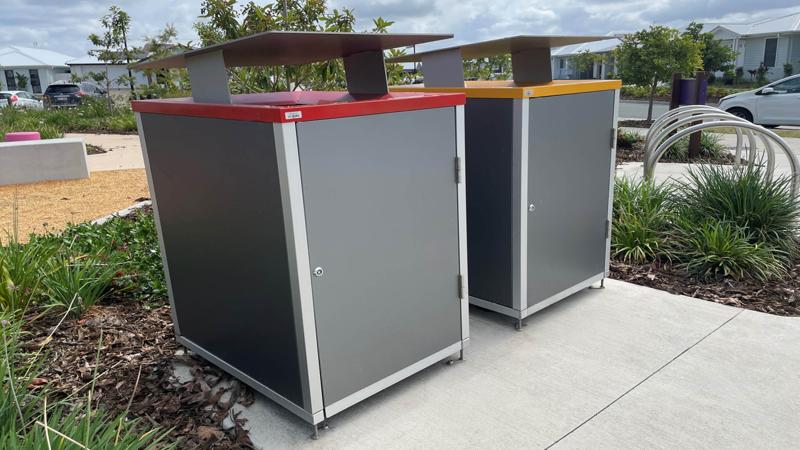
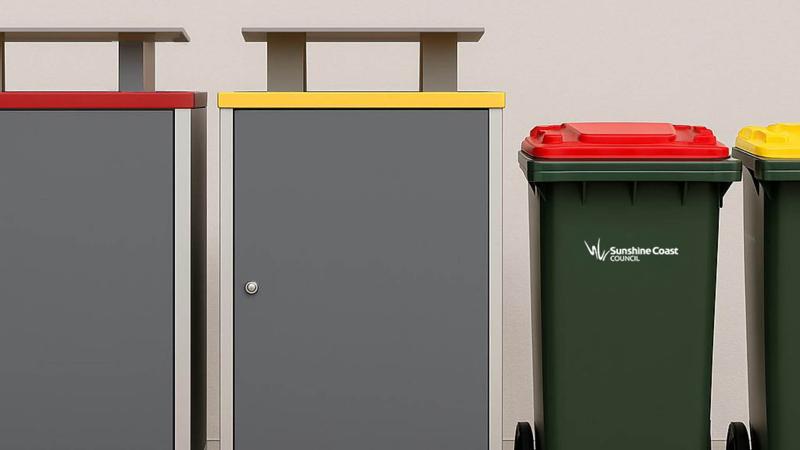
Bin enclosures are not supplied by council. The design of the bin enclosure promotes non-contact use and is more aesthetically pleasing that a wheelie bin on stand.
Position the waste enclosure on the left and recycle on the right. The exception to this is where an enclosure may be installed near to barbecue or picnic area. In this instance, the waste enclosure must be closest to discourage contamination of recycling.
Design
- All bin enclosures are to accommodate 240 L wheelie bins. Wheelie bins located at bus stops must have an enclosure. (Recycle bins are NOT installed at bus stops. Bus stop recycling tends to be low volume and high contamination).
- Design to be rain proof and vermin proof.
- UV/fade resistant replaceable doors and panels.
- Doors and panels must be a flat surface, without grooves - this makes cleaning easier.
- Aluminium panels, with powdercoated finish. Gloss high shine finish, allows for easier cleaning.
- Anti-graffiti coating should NOT be applied to any painted surfaces, this prevents the panel being repainted or repaired. Anti-graffiti paint can oxidise over time and complicates repair and refurbishment of painted enclosures.
- Enclosure to have adjustable feet, to enable easier installation.
- Designed to be bolted down to a concrete slab using 316 stainless steel dynabolts (10 mm x 50 mm).
- Match bin slab surface finish with surrounding pavement or adjacent pathway finish where possible.
- Where a concrete slab is installed, extend the slab a minimum of 200 mm for mowing offset around bins. 500 mm is the minimum offset from a path edge, to the bin, for pedestrian and cyclist safety.
- Minimum 1080 mm high (ground to chute). This height allows sufficient room for a users’ hand to reach between the hood (top cover) and the chute.
- Hood must be connected to enclosure, either built in or attached using anti-tamper proof fixings.
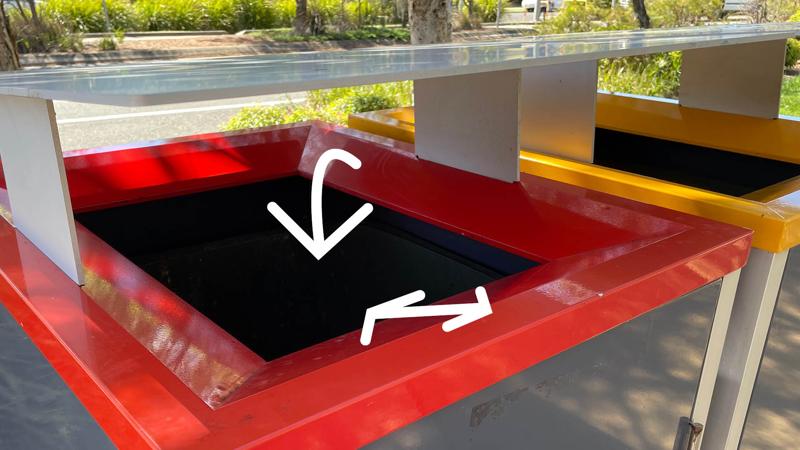
- Waste and recycle bin chute must have sufficient fall. This encourages objects to fall into the chute, rather than sitting atop or falling outside of enclosure.
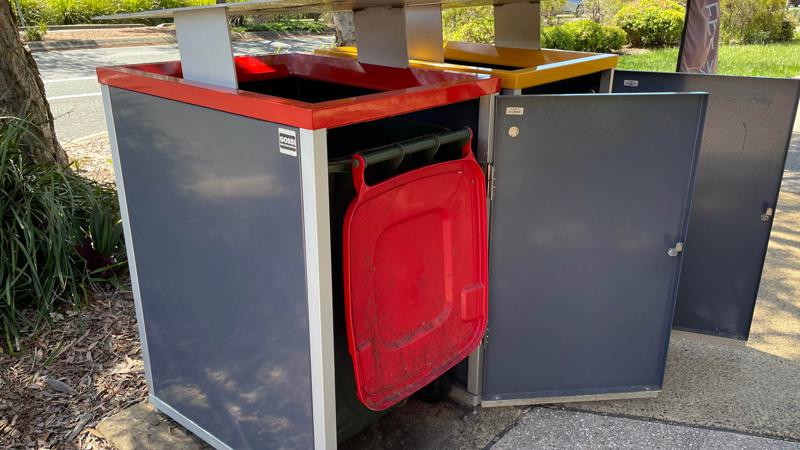
- The size of the enclosure must be the correct size to accommodate the wheelie bin.
- If the enclosure is too large, excess rubbish will overflow onto the ground inside the enclosure. It becomes problematic as the waste contractors then have to shovel the waste out to remove it.
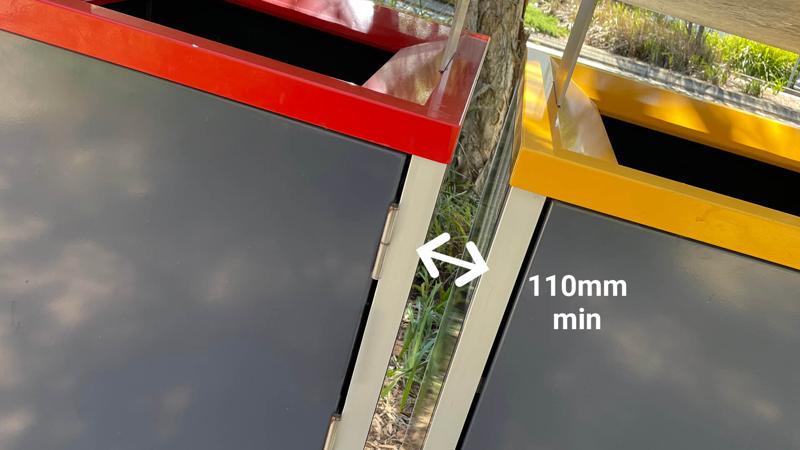
- Provide minimum 110 mm gap between enclosures to enable maintenance cleaning.
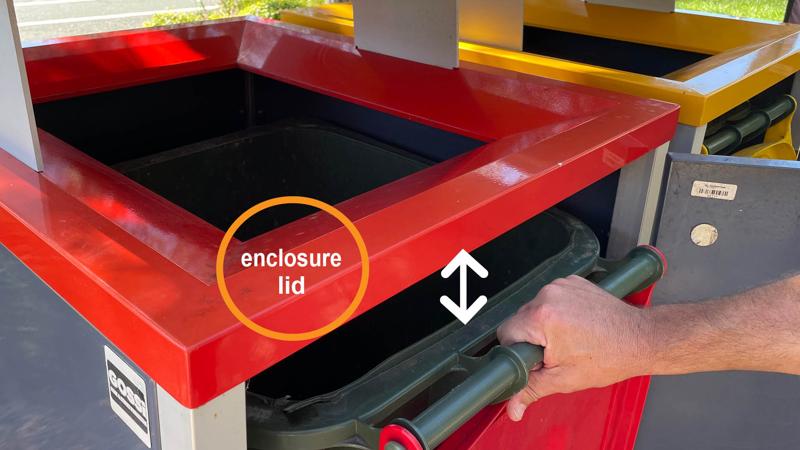
- Ensure there is space between wheelie bin handle and underside of chute for ease of wheelie bin removal
- Door handles are not accepted (use key to open).
- Sharp edges on the outside and inside of the enclosures are NOT acceptable and can be hazardous to the public and waste contractors.
- Door must be hung with three hinges.
Colour
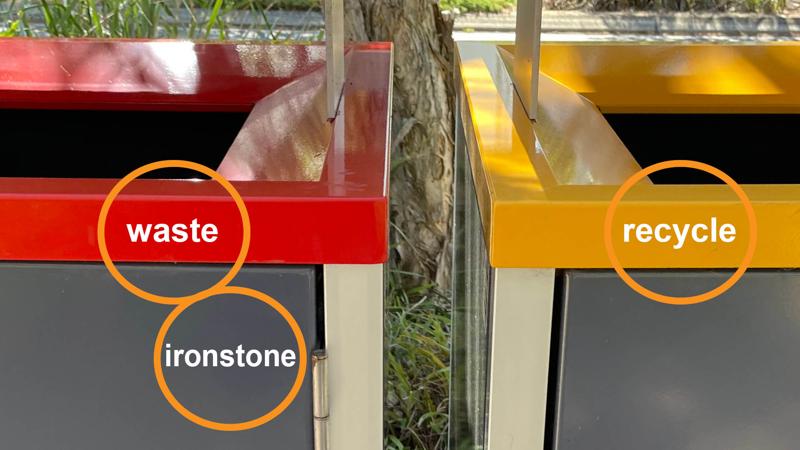
- For ease of maintenance and consistency across the region the following must be considered:
- All bin enclosures (panels) are to be ironstone (or equivalent) in colour as per the LIM Bins – Technical drawings.
- All enclosures lids are to be red (for waste), or yellow (for recycle), as per the LIM Bins – Technical drawings.
- Any variations in colour to be discussed with Council (Waste and Resource Management), (contact Council Customer Service). Typically, variations in colour are only considered where the enclosure may be installed in a ‘precinct’. At these locations the designer may match the enclosure panels to the pre-determined ‘precinct’ colour. Approval will be required.
Signage, imprints and markings
- Council (Waste and Resource Management) will install any signage where required.
Locks and keys
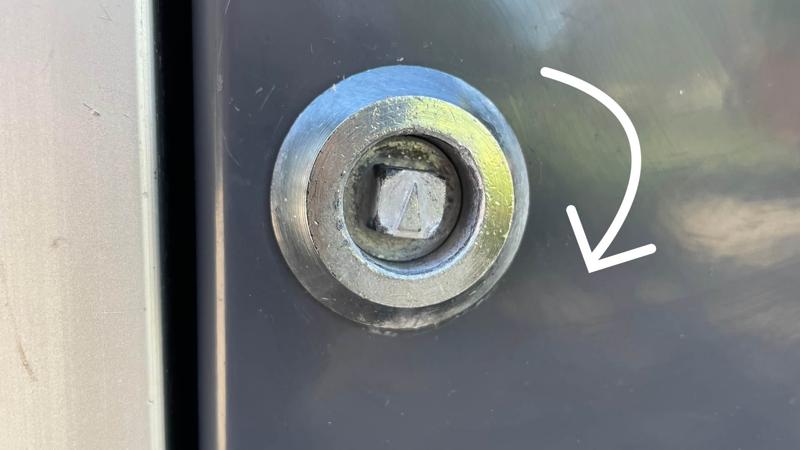
- To maintain consistency, Council requires all bin enclosures to be secured with a standard lock type - 8.0 mm square male (female key).
- Preferred mechanism to be quarter turn, 32 mm escutcheon, cam with stopper (26 mm H x 45 mm L).
- Spray bin enclosure locks internally with a suitable high quality lubricant, to increase longevity and usability of lock and enclosure.
Smart technology
- Waste bin fill level sensor may be installed in a wheelie bin enclosure where appropriate locations (identified as high use/volume sites) and where approved by the asset custodian.
See LIM Smart technologies for further guidance, including key considerations for installation.
Outdoor ashtray design
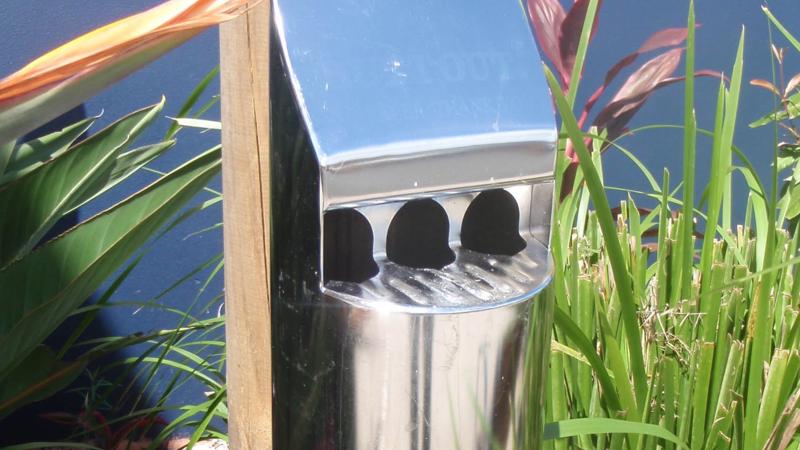
Outdoor ashtrays are not supplied by Council. They are designed to prevent cigarette butts from being thrown directly into a bin, which may result in a fire. The ashtray enables the user to ‘stamp’ out the end of their cigarette and then place it in a designated box designed to prevent or contain any hazard after discarding occurs.
Design
- Design to be rain proof.
- Designed to be fire retardant.
- Provide a spring loaded flap door and stainless steel canister located at the bottom of the bin insert.
- Design to promote non-contact use and emptying system.
- Must always be located on or near the waste bin security stand or enclosure, to avoid contamination of the recycle bin and to allow for easy emptying. Mounting height and location should be accessible for all users. Attachment options:
- To side of the enclosure (towards the front).
- To a security stand (which is attached to a wheelie bin).
- To a free-standing bollard/post, close to a bin, to optimise visibility and convenience, encouraging use of the butt bin.
- Council prefers outdoor ashtrays to be manufactured from 316 marine grade stainless steel to increase longevity and maintenance.
Colour
- 316 Stainless steel.
Locks and keys
- To maintain consistency, council requires all outdoor ashtrays to be secured with a standard lock type – 8.0 mm square male (female key).
See Figure 5: Typical outdoor ashtray mounting options.
xxxx 5: Typical outdoor ashtray mounting options
Outdoor ashtray mounting options | |
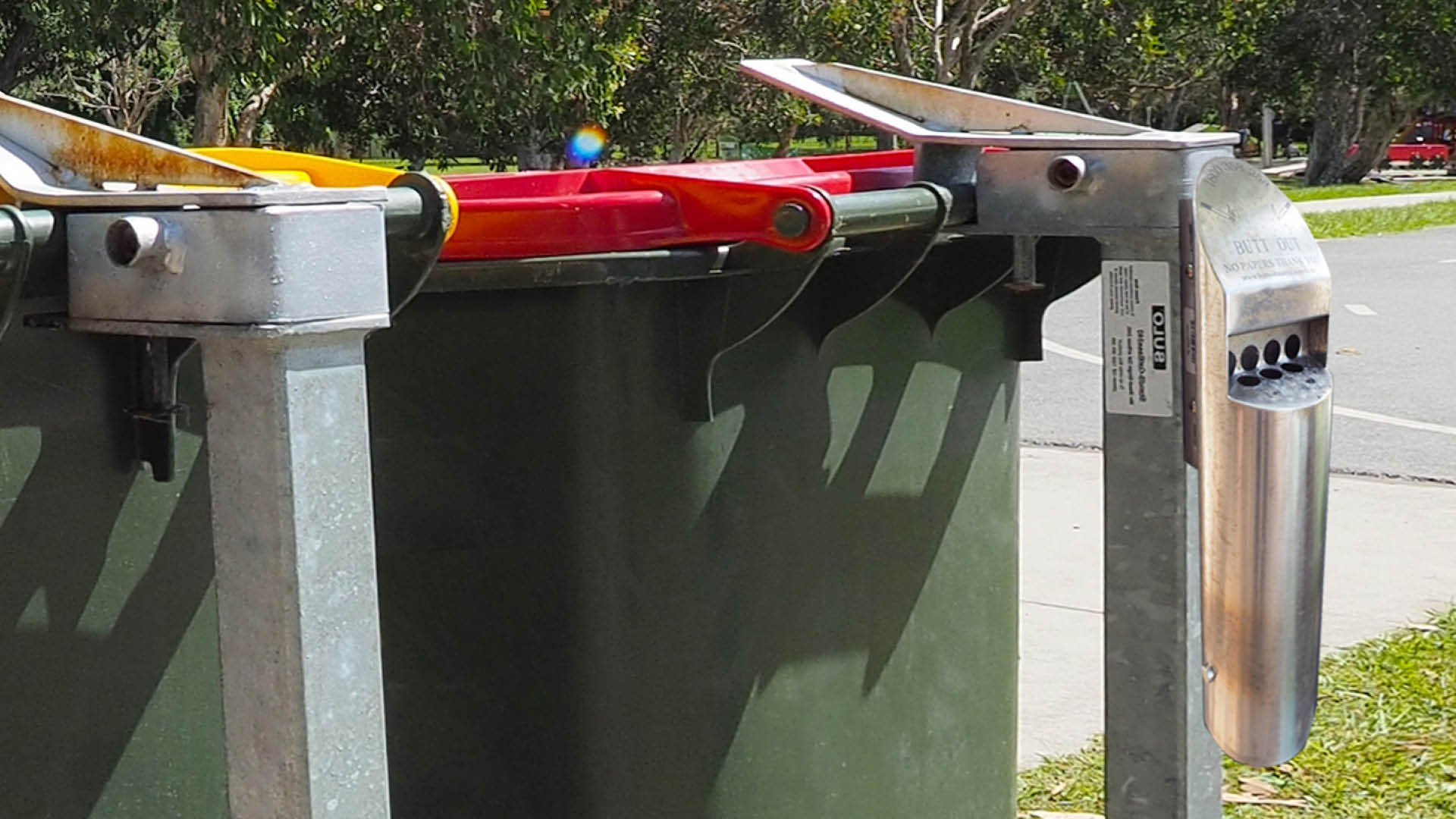 |
Outdoor ashtray attached to security stand (preferred) |
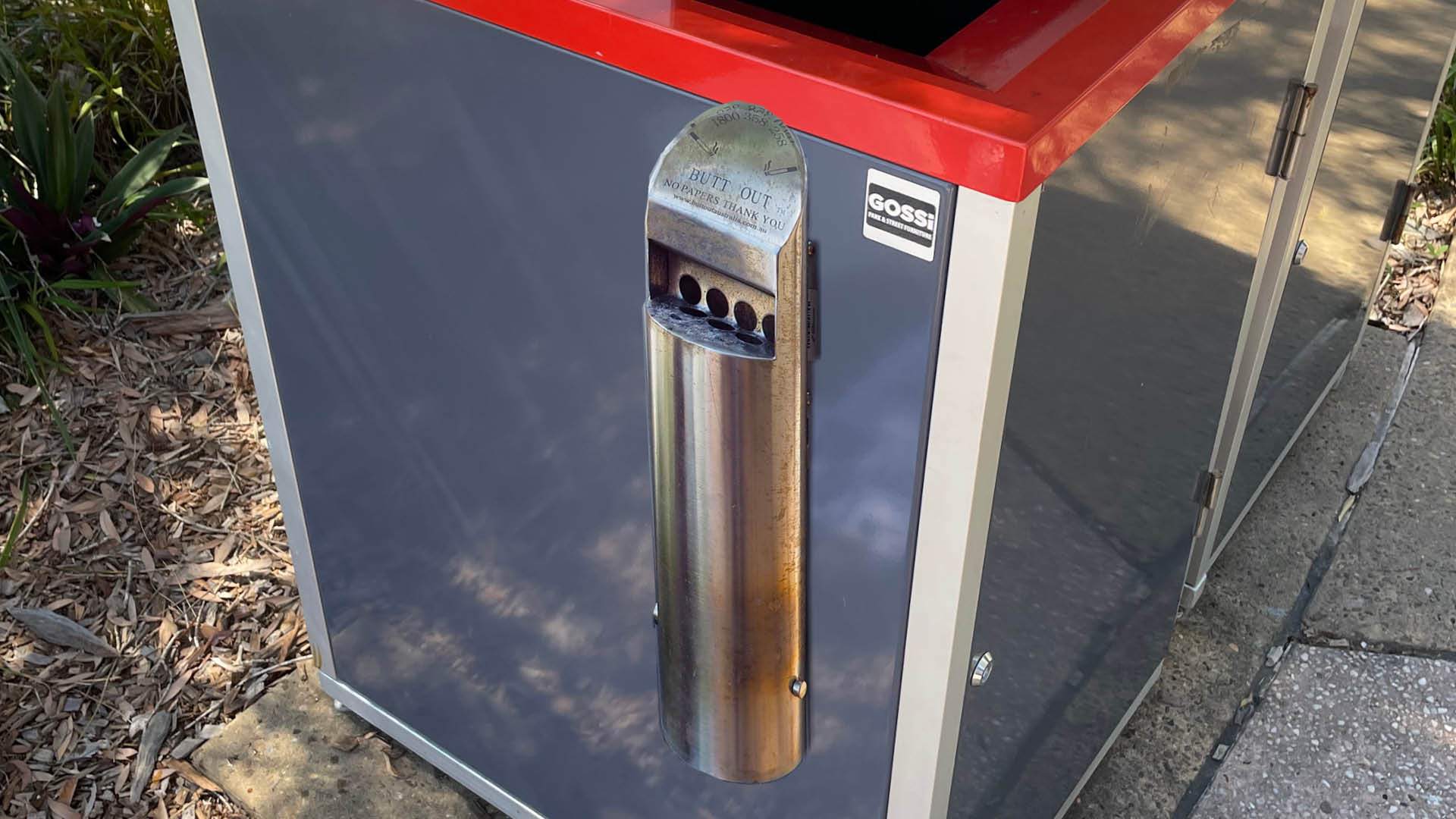 | Outdoor ashtray attached to bin enclosure (preferred) |
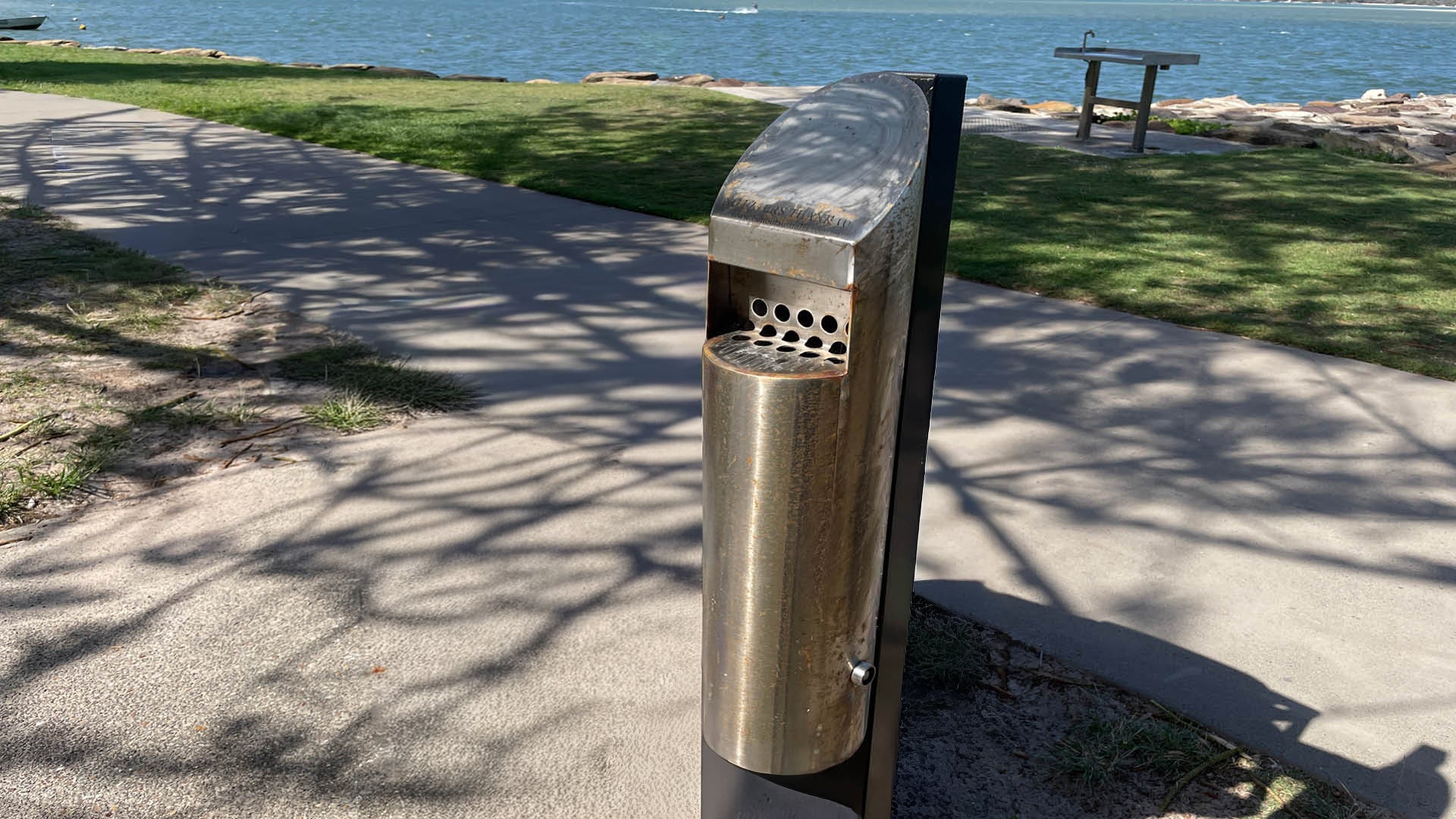 | Outdoor ashtray attached to free-standing post |
Dog bag dispenser design
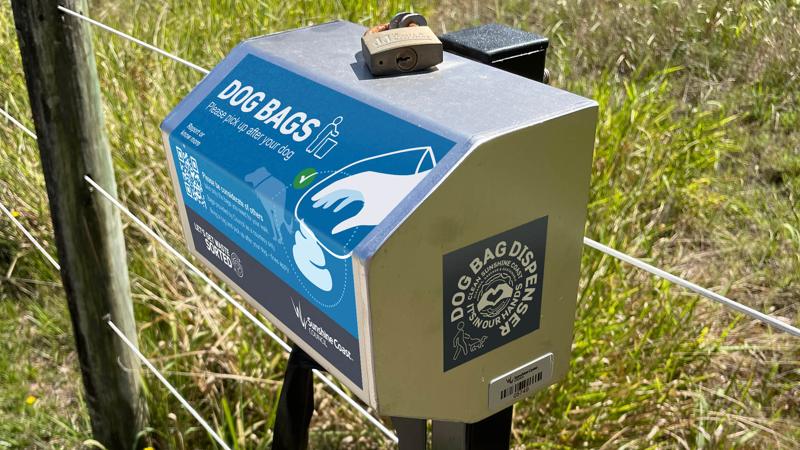
Dog bags supplied in appropriate locations, provide dog owners with a convenient way to manage dog waste. Dog bag dispensers (provided and installed by council) are to be installed as per LIM Dog exercise areas (DEAs).
Design
Dispenser
- Easily release dog bags one at a time, in a roll type dispenser.
- Rain proof.
- Able to be attached to a wheelie bin enclosure/security stand (post). Mounting height and location should be accessible for all users. Attachment options:
- To the waste enclosure or security stand.
- To a purpose installed, free-standing post, close to a bin.
- Dog bag dispensers to be manufactured from 316 marine grade stainless steel, to increase longevity and reduce maintenance.
Dog bags
- Will be supplied in a roll type only.
Locks and keys
- To maintain consistency, council requires all dog bag dispensers to be secured with a standard lock type:
- For dog bag dispensers, the padlock and key are supplied by the waste collections contractor.
- The dog bag dispenser must have a padlock staple/hole to accommodate this.
- The dog bag dispenser must have no other lock (padlock staple hole only).
Signage
- Dispensers are required to have signage and a QR code with information for dog owners (supplied by Council).
Figure 6: Typical dog bag dispenser mounting options.
Figure xxxx: Typical dog bag dispenser mounting options
Dog bag dispenser mounting options | |
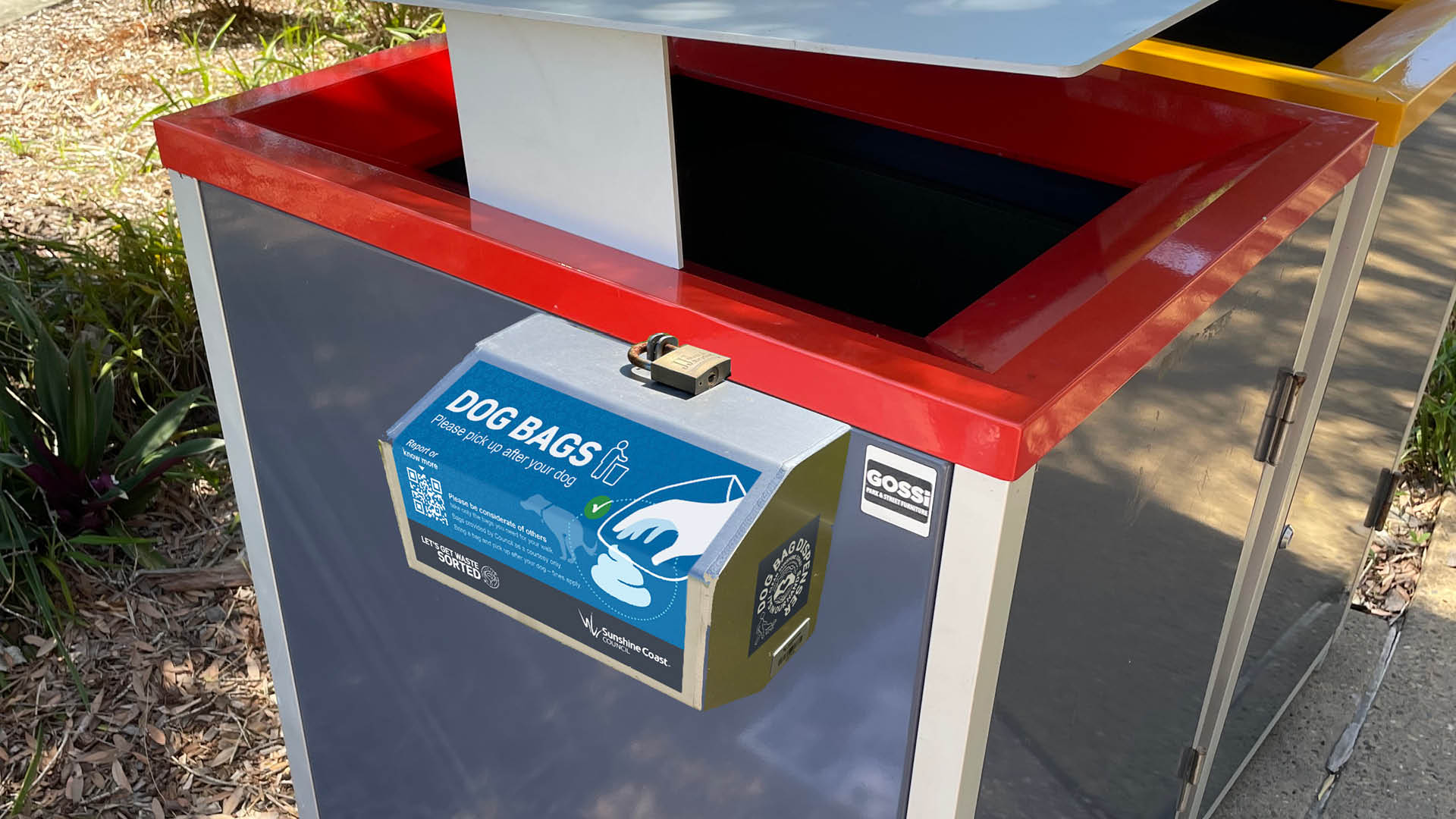 |
Dog bag dispenser attached to bin enclosure |
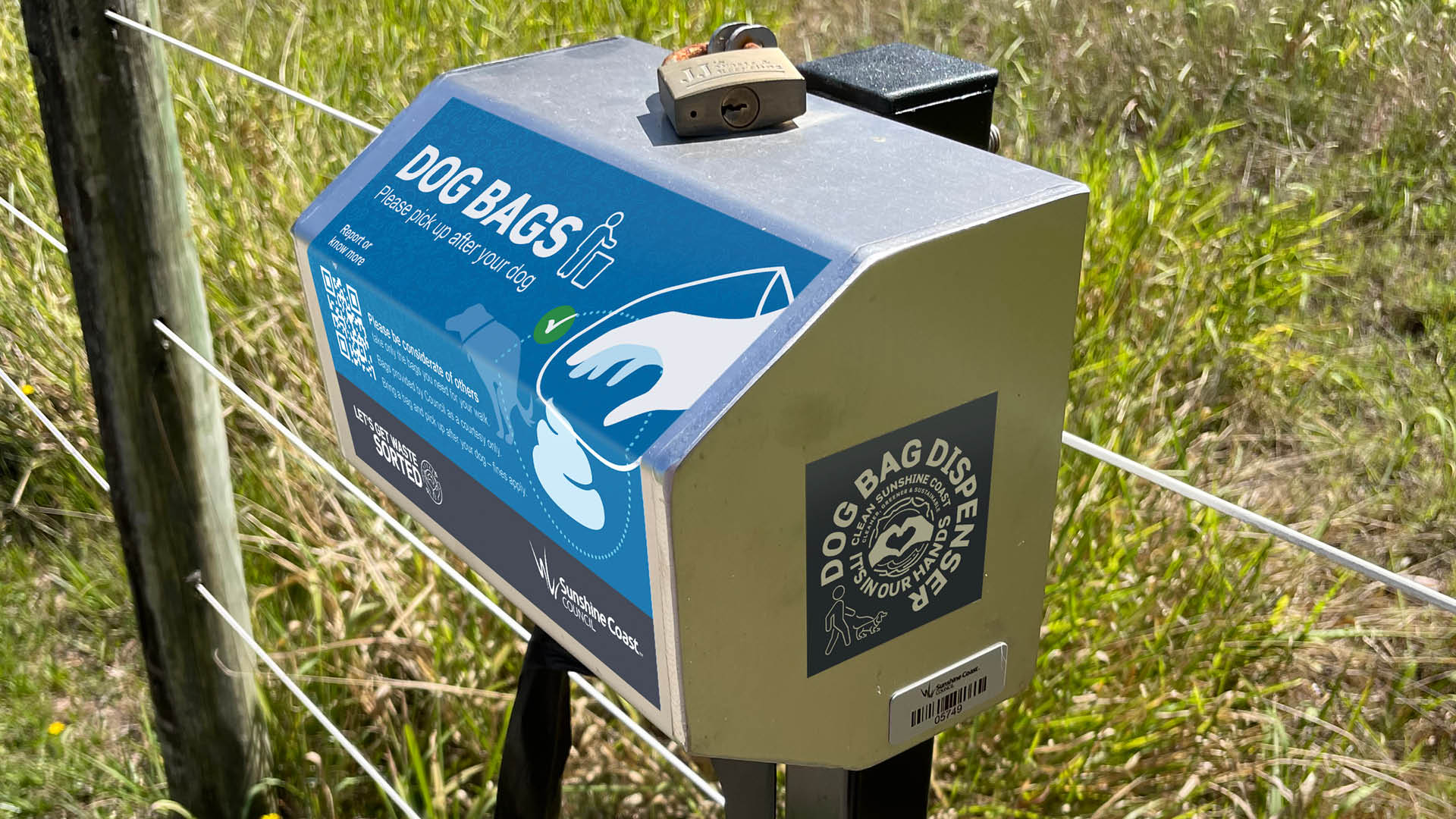 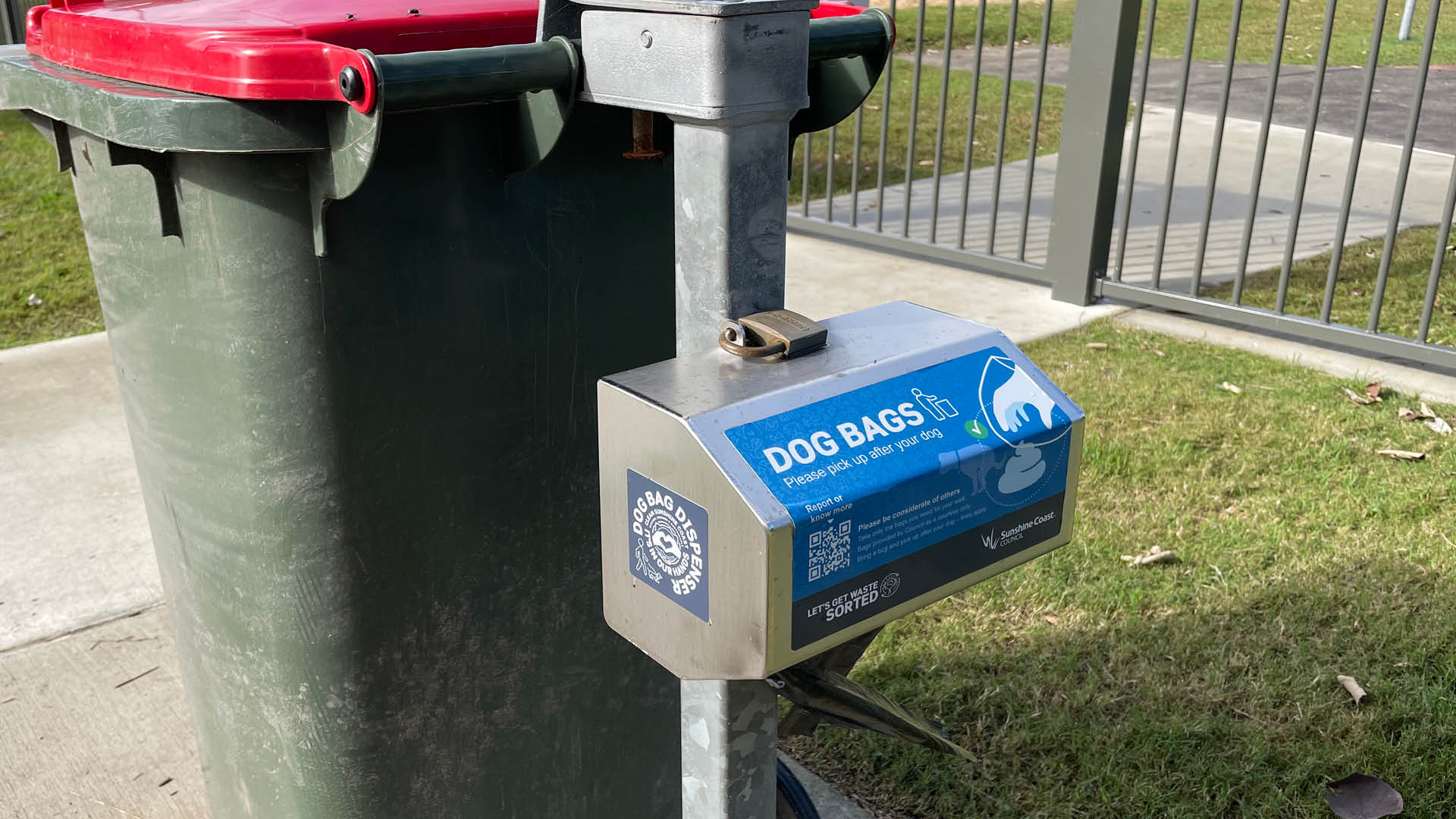 |
Dog bag dispenser attached to post |
This component is currently in development