Seats
Design
Requirements for the design, manufacture and installation of embellishments
Good design
See the following corporate documents to identify relevant project design requirements:
Sunshine Coast Planning Scheme regulates the way land, buildings and structures are used and developed on the Sunshine Coast.

Sunshine Coast Design contains 10 design principles that guide good project planning and design outcomes, that are appropriate for the Sunshine Coast.
The LIM provides further overarching design advice, refer:
- Introduction and Design Principles - e.g. sustainability, CPTED, accessibility
- Preliminaries - environmental management, tree sensitive design and site set up.
Embellishment requirements
- Universal access.
- Comfortable and suitable for the average person.
- See 'Positioning' and 'Equal access' sections for the corresponding LIM category.
- Made from materials that will be durable and can be suitably protected from exterior elements, such as salt spray and UV exposure.
- Robust and sturdy to withstand constant public use and be resistant to vandalism.
- Fixings are to be 316 marine grade stainless steel (unless otherwise stated).
- Tamper proof fixings should be used
- Graffiti protection coatings applied (where applicable)
- Fire retardant (where applicable).
- Warranties should be as listed below.
- Easily repairable or replaceable.
- Sourced locally and use standard fittings.
- Reputable suppliers should be used who keep a supply of stock parts on hand for the life of the product.
- Use sustainable materials, although sustainability needs to be considered over the lifetime of the embellishment.
- Install on paved, concrete or other hard surfaces (where applicable).
- Manufactured to engineering specifications (where applicable).
- See the 'Standards' section for the corresponding LIM category.
Warranty and asset life
Product/embellishment | Warranty (minimum) | Asset life (typical useful life) |
Seats with timber battens | 2 years | 15 years 2 |
Seats with aluminium battens | 3 years | 25 years 2 |
Source 2: Sunshine Coast Council Asset Management Plan 2017/18-2022/23 – Parks and Gardens (figure based on current data, subject to change).
Seating
Once the location of the seating has been decided, based on the Environment and Liveability Strategy (ELS) and Recreation Parks Plan (RPP) guidance, consider the appropriate embellishment level to suit the selected site.
Overarching design considerations:
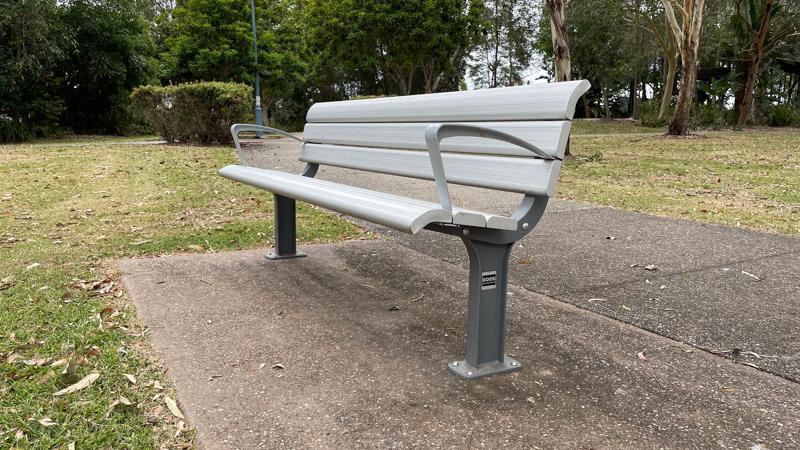
- All open spaces should include universal access (e.g. seats with backrest and armrests).
- Plan to install seats of varying heights at any location to accommodate a diverse range of users.
- Seats provide an opportunity for people to rest and socialise in open space environments.
- In areas where a high proportion of elderly users are anticipated, universal access seats should be no more than 60 m apart along a path of travel, to reduce fatigue.
Design of a seat
Seat types

Seat (with armrests)
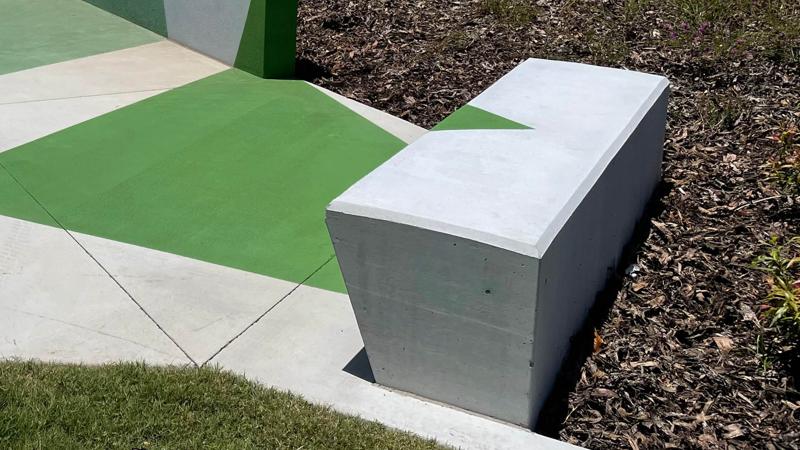
Seating wall
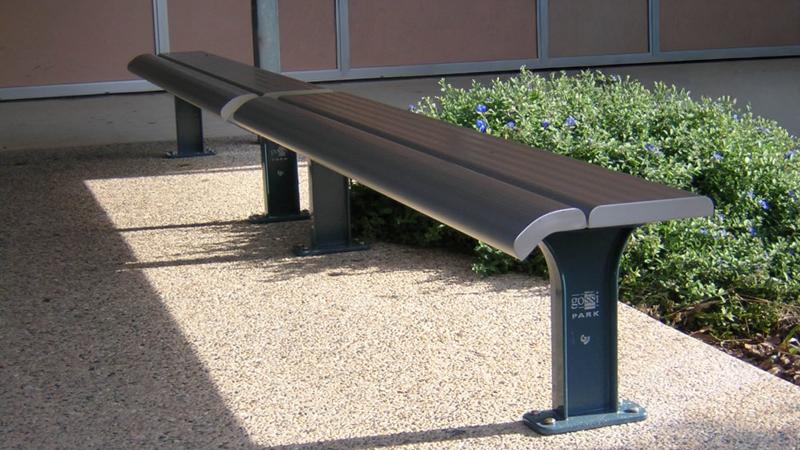
Bench seat
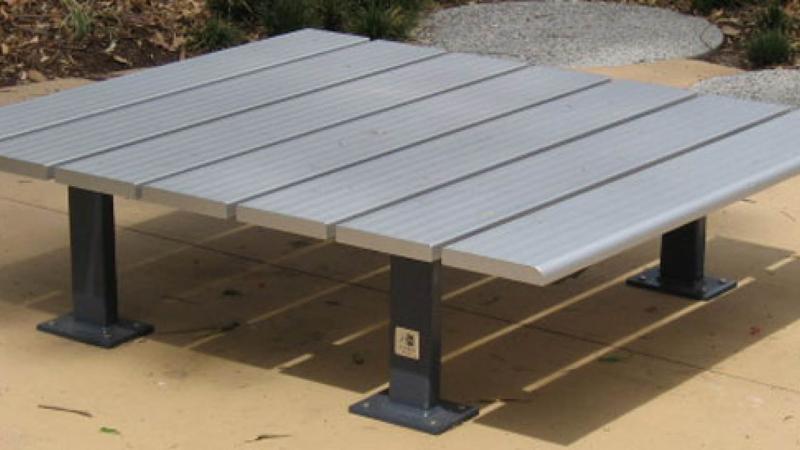
Platform seat
Seat heights
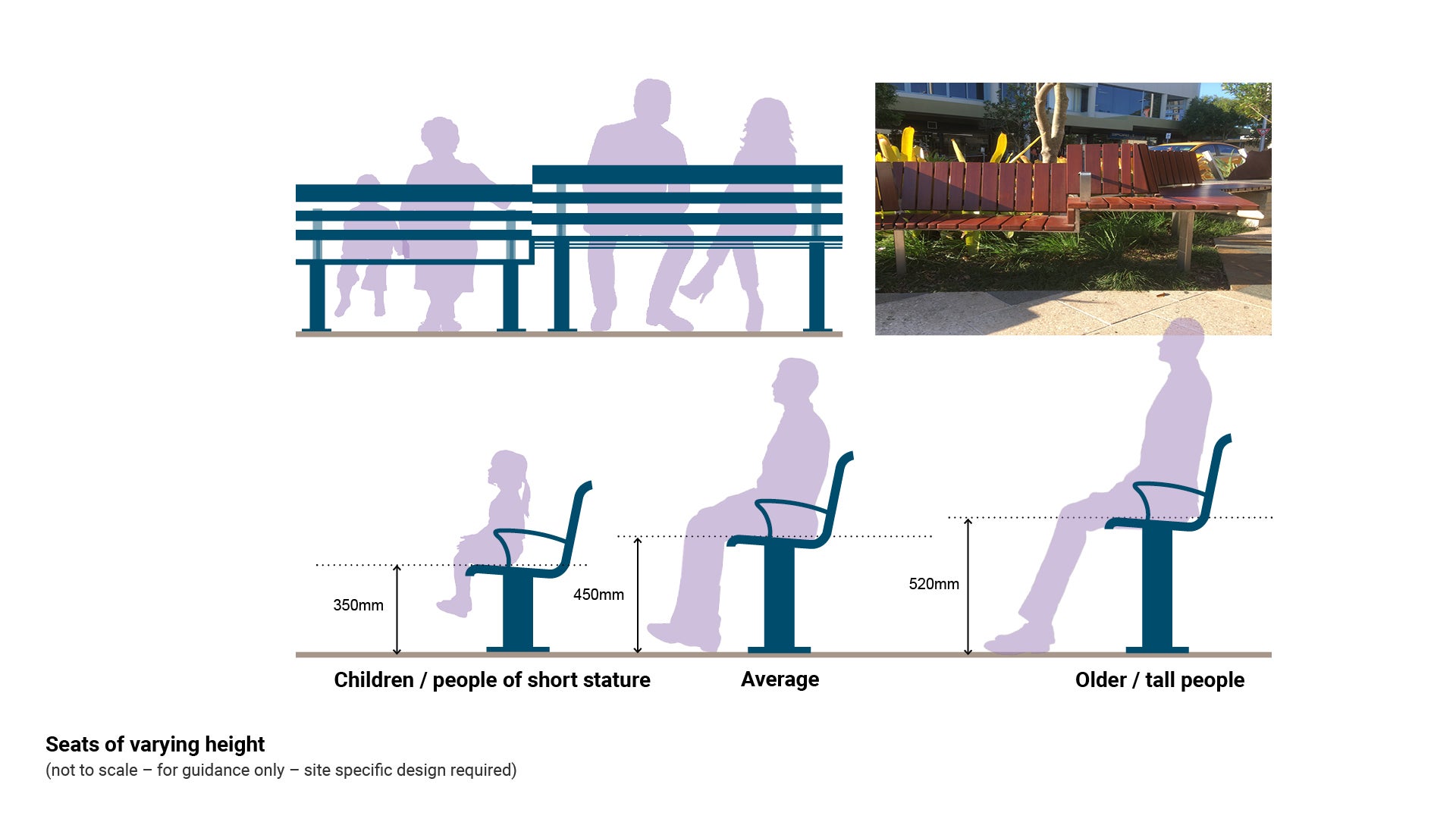
Install a mixture of seats of varying heights to accommodate the differing physical make-up of users.
- Consider that children and people of short stature may prefer seats as low as 350 mm high.
- Consider that older people may prefer seat heights up to 520 mm.
- Tall people require a higher seat height for comfort and to prevent extended legs from encroaching into a perpendicular pathway.
- Incorporate armrests to assist with rising.
- Accommodate a wide range of users of varying stature at one location.
- At least 60% of seats should be 450 mm high.
See Figure 3: Seats of varying height.
Figure 3: Seats of varying height
General

- Seats should ergonomically designed for comfort.
- Install a variety of seat heights at a single location.
- Seats should have backs where the seat is required for rest and relaxation. If a seat has a back it MUST also have armrests (except in table and seat combinations).
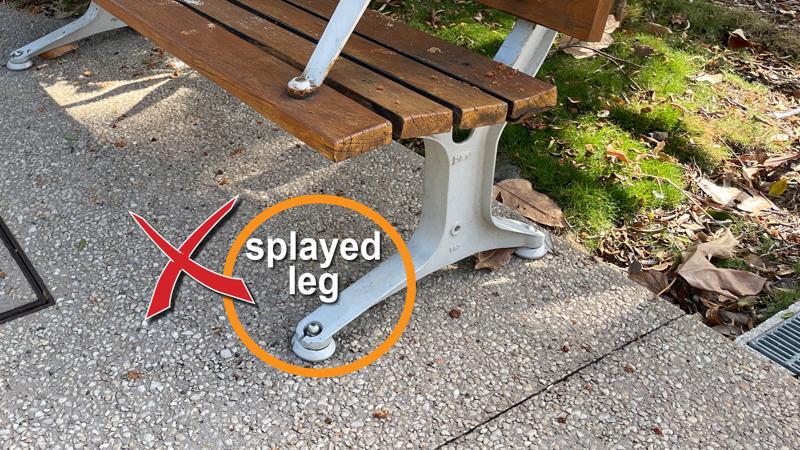
- To prevent possible trip hazard, seat leg supports should be straight and must NOT have a splayed leg design.
- A splayed leg design can be deemed acceptable in scenarios where the seat may require additional structural support (e.g. skate parks). Custodian approval is required for all splayed leg designs.
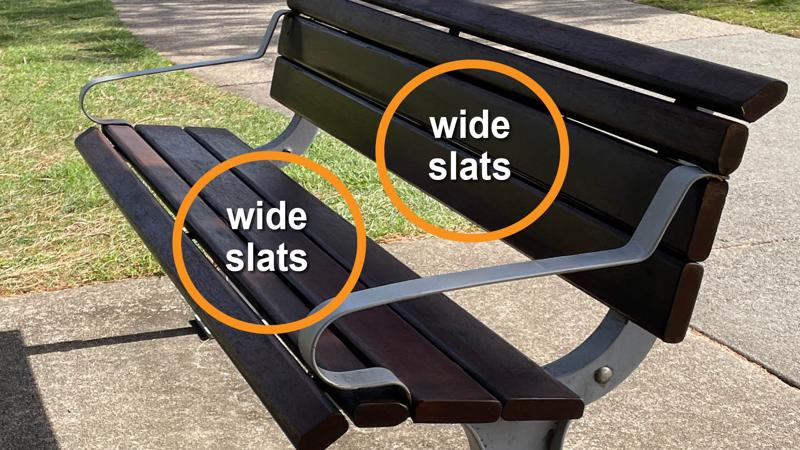
- Select seat designs with wide seat slats to accommodate larger bolts to the frame, for strength and durability.
Design for maintenance
- Select a seat design with access underneath to allow cleaning, maintenance and rubbish removal (this is particularly important for platform seats that use incorporated battens).
- Select a seat design which drains free of water.
- Use anti skate devices in appropriate locations.
Platform seats
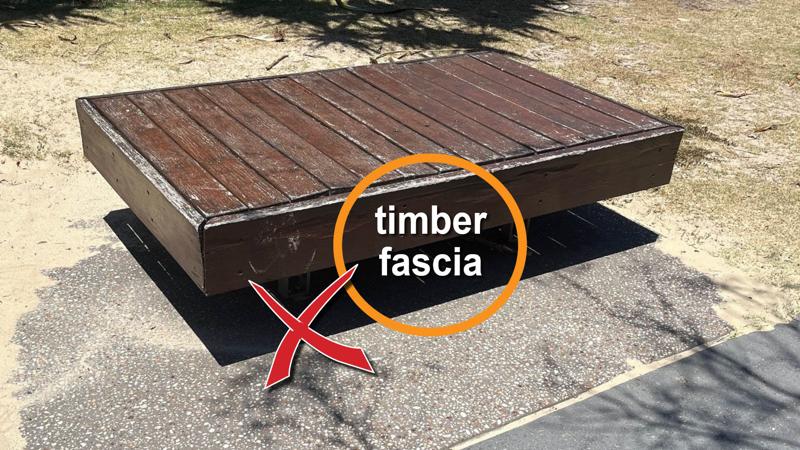
Fascia cladding is NOT accepted. This type of cladding creates a space to allow accumulation of litter and sand to build. It also allows water ingress causing the timber to swell, warp and twist.
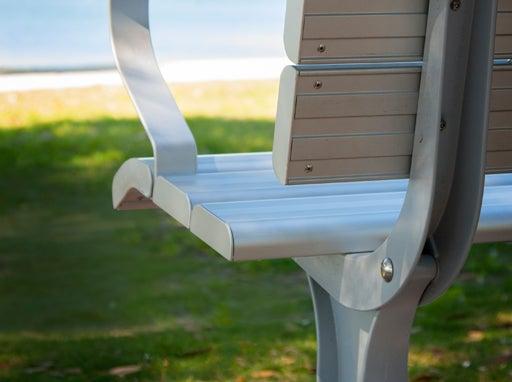
Aluminium is the preferred material for platform seats.
Materials, fixings and finishes
- Where seats are installed on a concrete slab, seats must be bolt down (surface mount) for ease of replacement.
- Use 316 stainless steel hex-head DynaBolts (sized to suit). Anti-vandal ‘armour rings’ (or equivalent) must be installed over DynaBolt head. See LIM Palettes – Materials and fixings for further guidance.
- All armrests must be bolted from underneath/back, so water does not pool on top of bolts.
Aluminium

- Aluminium seats may become hot in full sun locations (select light colours).
- Aluminium is preferred due to longevity of the product and the minimal maintenance requirements.
Timber

- Painted timber finish is preferred to reduce maintenance or use aluminium.
- Select light coloured paints as dark colours may become hot in full sun locations.
- Preferred timber sealant is Ultradeck or Lanotec (or equivalent). Minimum of 3 coats should be applied. Skin forming (non-penetrative) polyurethane coatings should NOT be used.
Seating walls
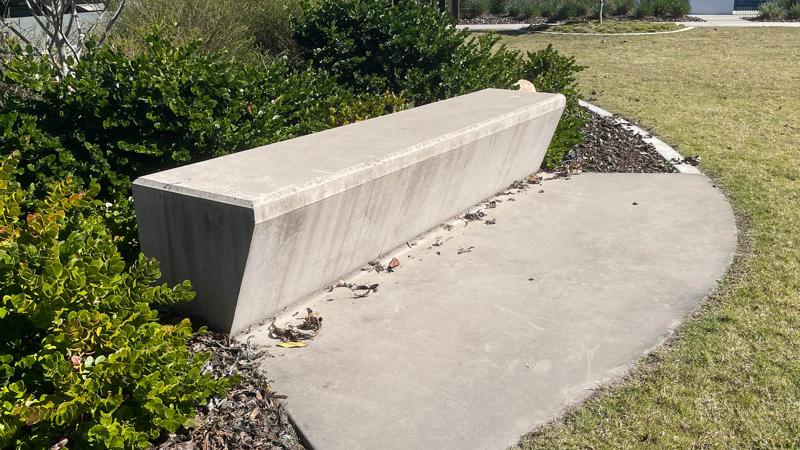
- Seating walls must include a minimum 150 mm gap for rising (for accessibility).
Seats under trees

Positioning new seats under mature shade trees is not advised due to the risk of critical tree roots being lost or damaged as part of installation. Generally, following the “drip line” method of tree protection (see reference below for guidance) will ensure critical structural roots are not impacted, however other factors including the type, age and condition of the tree, or permeable space that will remain for example, may also need to be considered.
The project arborist can provide guidance on appropriate setbacks and treatments in consideration of all factors of influence when optimal TPZs cannot be upheld. Where a seat must be installed within the designated TPZ for a tree (for example “drip line” for trees with good viability), seating blocks (for example sandstone) that only require levelling of the surface as preparation can be used as an alternative to a standard seat on slab detail, where a structured sub-base must be formed.
See the following for further guidance:
- LIM Site setup (including tree protection), specifically the drip line method of TPZ extent determination.
- LIM Tree sensitive design (existing and new trees) for tree sensitive design and delivery options.
Seats in dunal areas

Where seats are installed in dunal areas, concrete slab mounting is not appropriate. Seats are to be installed in sand, using the following modifications:
- Aluminium seats (preferred) are to be retrofitted by bolting extensions to the existing legs, with a flat bar linking the two at the base. This creates a stable seating area that is more resistant to vandalism, theft and the harsh coastal environment.
This component is currently in development