Planting (landscape)
Positioning
Best practice guidance for the placement and arrangement of embellishments
Site setout
Park users
Design planting to create opportunities for passive as well as active spaces, that are welcoming, legible, robust and comfortable.
Orientation
- Locate planting to provide shade and shelter to park embellishments, shelter from winter winds and exposure to summer breezes.
- Frame vistas and views.
- Soften structures.
- Integrate with surrounding land uses at an appropriate scale.
- Use earth mounding to achieve buffer zones and acoustic separation.
Clarify entry
- Define entry and exit points to assist with wayfinding.
Safety
- Crime Prevention through Environmental Design (CPTED) principles apply.
Vegetation
- Position tree guards to provide protection for establishing trees in high vandalism areas.
- Tree planting must maintain minimum clearances to comply with service providers guidance. Landscaping plants within these clearances must be low growing when mature, and consist of suitable approved varieties.
Considerations for deck mowers
Where landscaping is provided adjacent to/adjoining drop-offs, slopes over 15 degrees, water, roads, electricity and other critical risks, a risk assessment must be undertaken. The risk assessment must be carried out by a suitably qualified professional, and barriers or other treatments must be provided to mitigate critical risks.
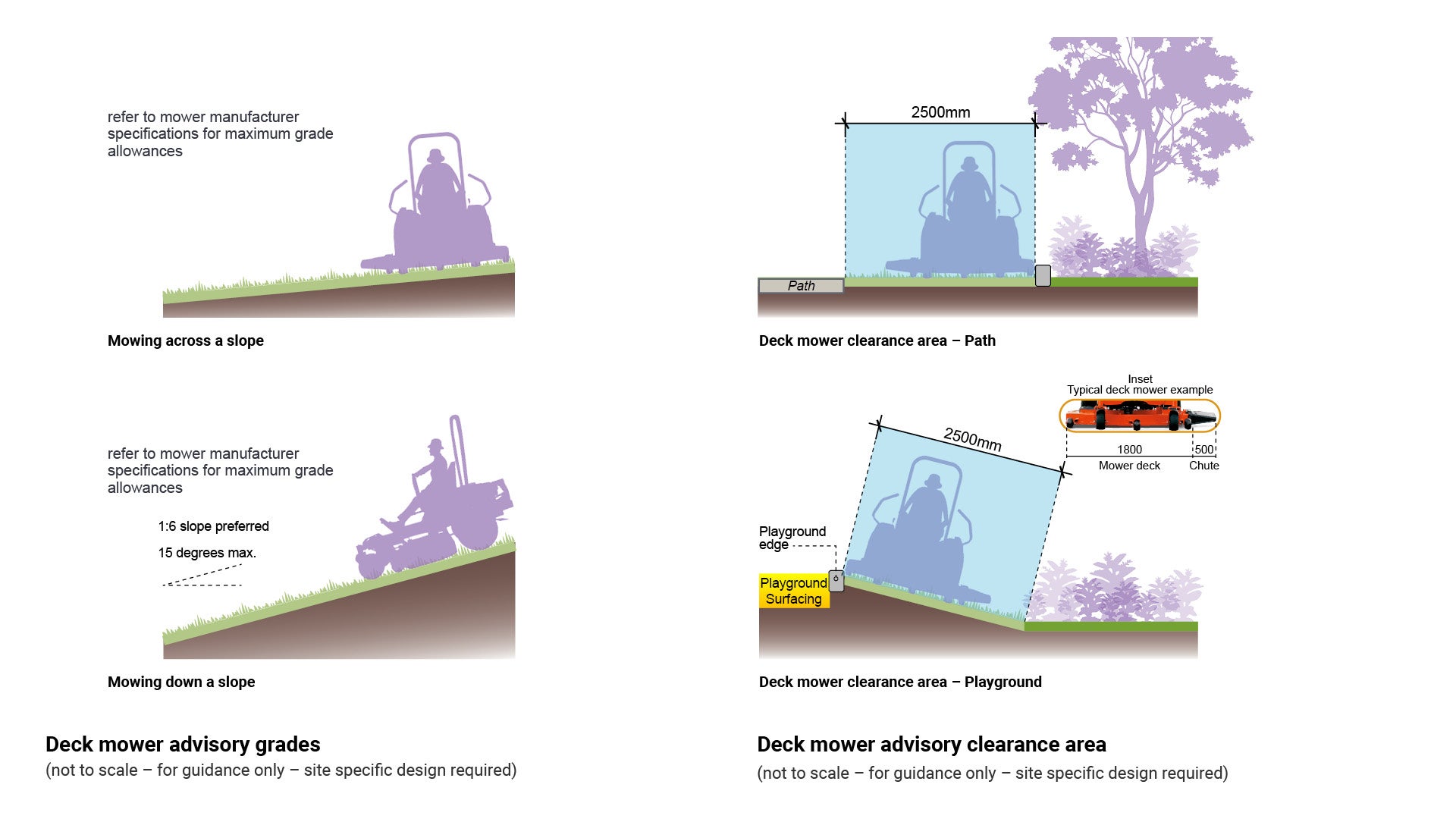
- Avoid the necessity of using push lawn mowers by ensuring sufficient width for a ride-on deck mower to access a turfed area to carry out mowing maintenance.
- Clearance area requirements include provision of sufficient space and room to manoeuvre ride on mowers, with the use of smooth flowing lines to allow machinery to manoeuvre around assets.
- Consider the maximum grade for deck mowers. Turf slopes should be no greater than 15 degrees to allow for safe maintenance.
- Lateral clearances from any obstacles provides safe width for deck mower operation and turning.
- Height clearances provide the deck mower operator with a safe unobstructed operation envelope. Refer to manufacturer specifications.
- To avoid scouring and damaging deck mowers, ensure turf finishes flush with the level height of hardscape infrastructure such as concrete paths.
- 2.5 m clear area is required (where possible) beside a pathway, concrete slab or where a turfed area will require mowing. Deck mowers widths vary (generally 2.0 m wide), chute may fold/remove.
- A flush transition from path surface to turf area may enable a deck mower to undertake edging simultaneously with mowing.
See the following for further guidance:
- Figure 2: Deck mower advisory grades and clearance area
- LIM Paths, trails and tracks - Positioning (refer Deck mower clear area and slopes) for guidance on turf beside pedestrian infrastructure - deck mower clear area and slopes.
Figure 2: Deck mower advisory grades and clearance areas
Clearances
See the following for further guidance:
- Table 2: Airport positioning guidance offsets
- Table 3: Positioning guidance offsets - new planting (Council requirements)
- Table 4: Positioning guidance offsets - new planting (Unity Water requirements)
- Table 5: Positioning guidance offsets - new planting (Seqwater requirements)
- Table 6: Positioning guidance offsets - new planting (Department of Transport and Main Roads requirements)
- Table 7: Positioning guidance offsets - new planting (Energex)
- Table 8: Positioning guidance offsets - new planting (Powerlink).
Table 2: Airport positioning guidance offsets
Distance from airport | Reason |
within 3.0 km of the boundaries of an airport | avoid the creation of large water bodies and wetlands. |
avoid the extensive planting of fruit trees and the creation of large grassed areas capable of producing abundant seed | |
within 8.0 km of the boundaries of an airport | limit the use of dense vegetation buffers around the edges of waterbodies. |
limit the planting of trees likely to form hollows. | |
include short grass open areas that drain freely. | |
keep waterways free of vegetation that might provide habitat or food sources for ducks, ibis and other medium to large water birds. | |
maintain long grass (i.e. >300 mm) in non-essential areas to reduce bird access to soil based food sources and serve to discourage feeding by limiting the birds ability to observe potential predators. | |
limit the use of signs, posts structures and the like that provide resting and perching opportunities for birds. | |
reduce opportunities for birds to scavenge from rubbish bins, composting facilities and the like by careful design and placement. | |
install anti-perching spikes and wires to deter birds, particularly magpies and raptors from roosting. | |
carefully consider the selection of plant species used in landscaping and in particular, avoiding known food trees for birds and flying foxes. | |
within 15 km of the boundaries of an airport | when proposing to erect a permanent or temporary structure (including a construction crane) within 15 km of the Sunshine Coast Airport or Caloundra Aerodrome, consult the obstacle limitation surface (OLS) diagrams included on the Airport Environs Overlay Maps. |
Source: Sunshine Coast Planning Scheme 2014.
Note: Where a proposed structure or any equipment necessary to construct, operate or maintain the proposed structure is likely to exceed the height plane (in metres AHD) of the OLS the proponent should consult Council’s planning assessment officers.
Table 3: Positioning guidance offsets - new planting (Council requirement)
Embellishment | Distance from | Minimum distance | Reason |
Tree trunk | pathway | 1.2 m |
|
Mature tree branches | ground level | 1.8 m clear trunk above the road pavement (where possible) |
|
Understory planting | from ground level | maximum 300 mm high where adjacent to pathways |
|
maximum 500 mm high for safety and surveillance |
| ||
maximum of 700 mm high above road pavement, where located immediately adjacent to pathways, entries, parking areas, street corners, street lighting and driveways. |
| ||
dense shrubby vegetation | minimise the use of dense shrubby vegetation over 1.5 m high along street frontages and adjacent to open space areas. |
| |
Trees (streetscape planting) | average centres | 8.0 m centres (where coordinated with pathways, they should be provided at 6.0 m centres where possible). |
|
Trees (pathways) | average centres | 6.0 m (recommended) |
|
Trees (shaded car parking) | N/A | 1 shade tree per 4 parking space bays. |
|
Trees | clear turf area to any other embellishment | 2.5 m |
|
Tree – any part of a tree that can be used as leverage to climb upon | shade sail | 2.5 m |
|
Trees | roads | Refer Austroads Guide to Road Design for clear zone guidance. | Refer Austroads Guide to Road Design for clear zone guidance. |
Table 4: Positioning guidance offsets - new planting (Unity Water requirements)
Embellishment | Distance from | Minimum distance | Reason |
Trees and large shrubs | Unity Water – water mains | 1.0 m | infrastructure protection and maintenance access. |
Unity Water – sewerage mains | 1.5 m | infrastructure protection and maintenance access. |
Table 5: Positioning guidance offsets - new planting (Seqwater requirements)
Embellishment | Distance from | Minimum distance | Reason |
Trees and shrubs | Seqwater – pipeline |
| infrastructure protection and maintenance access. |
Table 6: Positioning guidance offsets - new planting (Department of Transport and Main Roads requirements)
Embellishment | Distance from | Minimum distance | Reason |
Trees and shrubs | road | Apply DTMR for approvals | all state controlled roads require works permits. |
Table 7: Positioning guidance offsets - new planting (Energex)
Energex Council Memorandum of Understanding.
Vegetation Planting Agreement - Proximity to Energex Assets
- Outlines the minimum agreed clearances for planting vegetation from electricity infrastructure.
Embellishment | Distance from | Minimum distance | Reason |
Trees and shrubs | overhead powerlines | clearance of 3.0 m between mature vegetation canopy and pole |
|
See DTMR Road Landscape Manual - Vegetation Setback and Clearances for further guidance. | 7.0 m from pole base | as above | |
pole mount plant e.g:
| clearance of 3.0 m between mature vegetation canopy and pole mounted plant. | as above | |
ground mounted pole e.g:
| clear frontage access of 3.5 m (minimum) shall be maintained to allow truck and crane access for maintenance/repair. | as above | |
clearance of 2.0 m shall be maintained between vegetation canopy and any access door or hatch. | as above | ||
clearance of 1.0 m shall be maintained between vegetation canopy and the parts of transformer other than doors and hatches (above). | as above | ||
street lights | 3.0 m from pole base, however vegetation shall be selected to prevent interference with lighting. | as above | |
zone substations | site specific | as above |
Table 8: Positioning guidance offsets - new planting (Powerlink)
Powerlink: high voltage transmission network.
Embellishment | Distance from | Minimum distance | Reason |
Trees and shrubs | sub- transmission power lines (110,000 volts) | 5.0 m | safety offset |
This component is currently in development