Embellishments should be designed/selected and installed as follows:
Fit for purpose, appropriately positioned and accessible.
Durable, robust and safe (suitable for corrosive environments).
Vandal resistant with parts that are easily replaceable.
Easy to maintain (with appropriate warranty and workmanship).
Comply with relevant standards, legislation, corporate documents and approvals
Planning, design and positioning
Link shelters to a pathway where possible
Orient furniture towards views. Where possible, high side of skillion roof shelters should face toward desired views.
Consider direction of sun/rain/wind and carefully locate shelters and furniture to reduce exposure. Council has adopted 2:1 offset for furniture placement
Consider position of existing mature trees to provide natural shade.
Shelter requirements
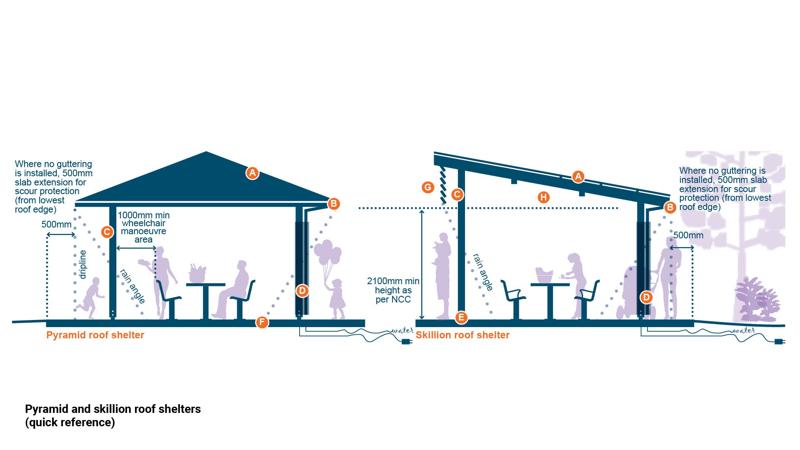
Manufactured to engineer's specifications, Australian Standards and National Construction Code (NCC). Designed to Sunshine Coast wind classification. Safety in Design requirements must be met
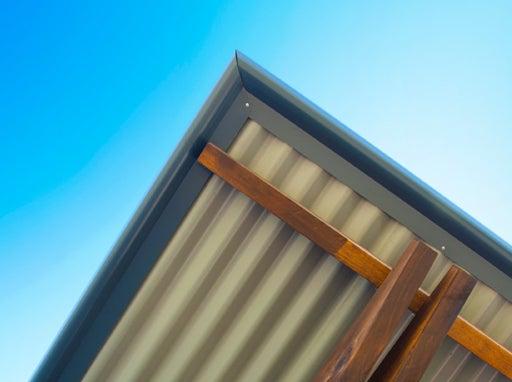
(A) Roofing – Colorbond/Colorbond Ultra/Colorbond SS (or equivalent). Light colours are preferred to reflect heat. Plastic roof sheeting (e.g. polycarbonate) must NOT be used. Roofing must not drain on, or near, a footpath
(B) Guttering – NOT preferred for local parks or environmental reserves. Where guttering is used for other open space areas, discharge appropriately. Gutter guard must be used if gutters installed
(C) Structural Elements: Post anchors - Timber posts must be installed in anchors. 316 SS anchors east of Bruce Highway, west of Bruce Highway 316/304 SS or hot dip galv (fenced dog off leash parks must use 316/304 SS). Min 75 mm clearance between underside of anchors and slab. Posts, beams, struts, rafters, battens – timber, aluminium or steel. Solid block paint colours preferred rather than stain. Posts must achieve 30% luminance contrast with ground surface. Posts must NOT be embedded into walls. Taps must NOT be located on shelter posts. Bracing - As specified by structural engineer 316 SS
(D) Shrouds – must be installed over electrical conduit. Install over downpipes in vandal prone areas or integrate into posts (with maintenance access). Aluminium or SS. Anti-vandal fixings
(E) Fixings and fasteners – All SS316. Roof screws to be correct class for roofing type. Use Nyloc nuts (or equiv). Isolate different metals to prevent galvanic corrosion
(F) Concrete slab and footings – reinforced concrete. Where there is no shelter gutter, the slab must extend minimum 500 mm beyond extent of shelter roof at lowest edges to prevent scouring of adjacent areas. Ensure equal access to slab. Slab must have sufficient cross fall so water does not pool (min 1:100). Turf to be flush to finished floor level of slab. Consider drainage to minimise areas of standing water
(G) Shade slats – optional. Timber, aluminium or steel. Select larger sized timber slats to minimise sun entering the shelter. Min height as per NCC
(H) Lighting – optional. PE cell and timed cell light must be installed in shelters where lighting is required and appropriate. Anti-vandal fixings
Rainwater tanks – NOT preferred. However, may be used at approved locations or where there is no town water.
Note: Further guidance and clarification of the content on this page, can be found in the relevant sections of this information sheet.
Page payload data
This component is currently in development
Sunshine Coast Open Space Landscape Infrastructure Manual (LIM) DISCLAIMER
Disclaimer
Information contained in this document may change without notice and you should use the current material available from Council’s website and not rely on material previously printed or stored by you.
All figures and diagrams are intended to be used as an aid to design and include Council’s preferred elements but they are not intended to be prescriptive and may need to be varied as dictated by site specific factors. While Council has exercised reasonable care in preparing this document, it does not warrant or represent that it is accurate or complete. The Council will not accept responsibility for any loss, damage, cost or expense that you may incur as a result of the use of or reliance upon any material contained in this document.
This document is produced to convey general information and is not intended to constitute advice whether professional or legal. Any reference to legislation in this document is not an interpretation of the law. It is to be used as a guide only. Consult relevant authority websites for current documents, revisions and amendments.
Where a particular product or supplier is profiled in this document, Council is NOT nominating this product or supplier as the selected choice. Product/supplier information has been provided to allow users to source products which contain the correct elements required for Council embellishments. Each product profiled states ‘or equivalent’ which means that different products may be supplied provided they satisfy the identified performance criteria, recommended standards, equal access guidance and product specifications.
Product design, manufacture and installation requires appropriately qualified people to provide site specific solutions to ensure the embellishment is appropriately adapted to local conditions and data.
This document does not override requirements stipulated in a development approval. Project specific variations may be appropriate as a result of site, environmental or other constraints. Any variations to these standards must be approved in writing by council prior to commencement of variation works. Components of this document may be used within a contract document but users should undertake their own investigations to confirm the information is suitable for this purpose.
Drawings contained in this document are NOT FOR CONSTRUCTION.
Details in this document are deemed to be the minimum standard and the user may wish to apply a higher standard subject to approval by council.
Acknowledgements
Council wishes to thank all contributors and stakeholders involved in the development of this document.
Copyright
Sunshine Coast Regional Council (Council) supports and encourages the distribution of its material however, copyright protects this document. Council has no objection to this material being reproduced but only if council is recognised as the owner of the copyright and this material remains unaltered.