Embellishments should be designed/selected and installed as follows:
Fit for purpose, appropriately positioned and accessible.
Durable, robust and safe (suitable for corrosive environments).
Vandal resistant with parts that are easily replaceable.
Easy to maintain (with appropriate warranty and workmanship).
Comply with relevant standards, legislation, corporate documents and approvals
Planning, design and positioning
Preserve existing overland flow paths
Site overland flow paths within road reserve, parks or other council controlled land
Indicate subsurface drainage, outlets and cleanouts on site drawings
Design in accordance with IPWEA (Institute of Public Work Engineering Australia) standard drawings and QUDM (Queensland Urban Drainage Manual)
General requirements
Site specific design by a drainage engineer
Design to provide safe, water free surfaces for park activities
Avoid designing drainage systems which require safety fencing (where possible)
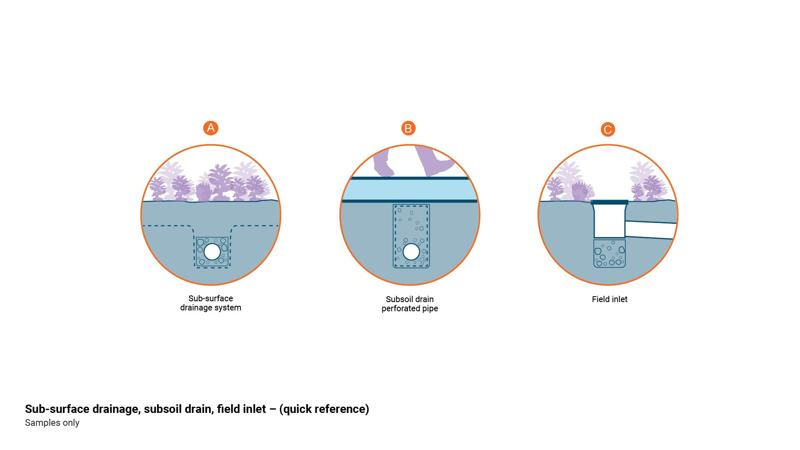
(A) Sub-surface (or sub-soil) drainage system requirements
A practice used to prevent water logging of soil
IPWEA standard drawing RS-140 Subsoil Drains Details and Locations and RS-142 Subsoil Drains Access Points
Materials – heavy duty PVC solid or PE corrugated slotted pipe suitable for buried applications
(B) Subsoil drain (perforated pipe) requirements
Designed to remove excess water from the surrounding soil profile
Materials – polyethylene corrugated slotted pipe
Geofabric may be used to line trenches
(C) Field inlet and overflow gully requirements
Field inlet and overflow gully must discharge to a soakage trench or a piped drain, appropriate for the site
Grated cover – grate size and design by qualified engineer
Materials – in-situ or pre-cast concrete pit covered with a galvanised steel lid, 316 stainless steel or aluminium grate. Where the use of metallic lids is required, lids are to be coated in a heat resistant, pedestrian grade anti-slip coating
Drainage grates and covers – must be slip resistant
Grates and pit lids – consider that metal grates and pit lids may retain surface heat
Note: Further guidance and clarification of the content on this page, can be found in the relevant sections of this information sheet.
Trench drain, swales, box and pipe culvet
Overarching requirements
Embellishments should be designed/selected and installed as follows:
Fit for purpose, appropriately positioned and accessible.
Durable, robust and safe (suitable for corrosive environments).
Vandal resistant with parts that are easily replaceable.
Easy to maintain (with appropriate warranty and workmanship).
Comply with relevant standards, legislation, corporate documents and approvals
Planning, design and positioning
Design in accordance with IPWEA (Institute of Public Work Engineering Australia) standard drawings and QUDM (Queensland Urban Drainage Manual)
Indicate subsurface drainage, outlets and cleanouts on site drawings
Site specific design by a drainage engineer
Design to ensure water free surfaces (in average weather conditions), to prevent water logged areas and to handle peak loads
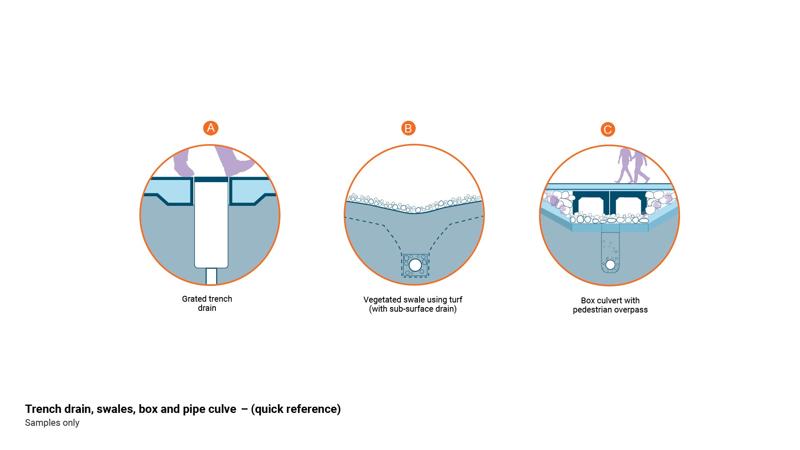
(A) Grated trench drain requirements
Materials – hot dipped galvanised steel or 316 stainless steel with box drain grate, size determined by drainage engineer. Grates must be vehicle rated where traffic may pass over. Consider that metal grates may retain surface heat, where the use of metallic lids is required, lids are to be coated in a heat resistant, pedestrian grade anti-slip coating
Trench drain – isolation joint and smooth transition required between adjacent finished surface materials
Heel guard grate required, flush with adjacent finished surfaces
(B) Open flow channel (swales) requirements
Vegetated swales – include turf (preferred), sedges and tufted grasses
Keep velocities low within swales to avoid scouring
Rock lined swales (not preferred) must be approved by asset custodian. Within 50 m of a playground, or where vandalism may be a problem rocks must be embedded in concrete or fixed with adhesive
For mowing safety plant a low buffer both sides of a rock swale
Provide maintenance vehicle access across or around a swale drain
Sub surface materials must be suitable for buried applications
(C) Box and pipe culvert with overpass requirements
Minimum recommended size 300 mm
Most effective in natural drains.
Select culverts for vehicle crossover, pedestrian bridge, fauna/fish/stock passage
Materials – reinforced concrete, hot dipped galvanised steel, aluminium or high density polyethylene. Sub surface materials must be suitable for buried applications
Culvert floor must be at the same level as natural drainage
Avoid designing drainage systems which require safety fencing
Stormwater quality management considerations
Infrastructure designed to improve or protect downstream systems from pollutants (not illustrated). Refer to LIM Water sensitive urban design (WSUD)
Note: Further guidance and clarification of the content on this page, can be found in the relevant sections of this information sheet.
Water management for paths/trails – waterbars, table drain, cross over, french drain
Overarching requirements
Embellishments should be designed/selected and installed as follows:
Fit for purpose, appropriately positioned and accessible.
Durable, robust and safe (suitable for corrosive environments).
Vandal resistant with parts that are easily replaceable.
Easy to maintain (with appropriate warranty and workmanship).
Comply with relevant standards, legislation, corporate documents and approvals
Planning, design and positioning
Surface/subsurface drainage, outlets and clean outs should be indicated on site drawings
Design by a suitably qualified professional
Designed to create water free surfaces and to prevent water logged areas
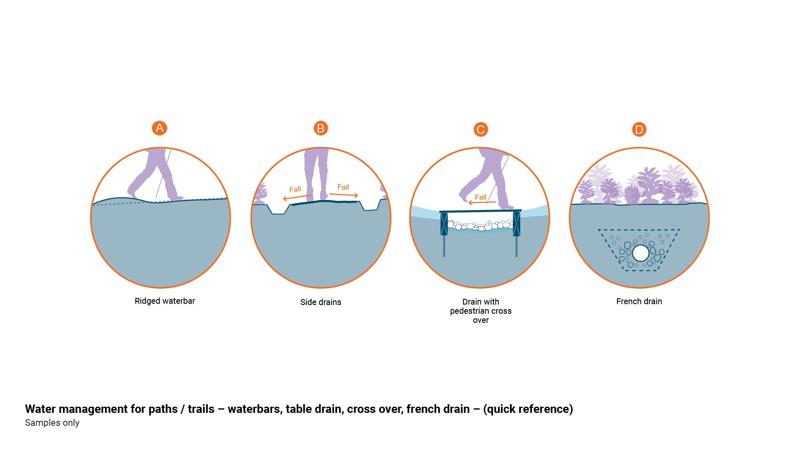
Deflectors across a path/trail to divert surface water.
Waterbars comprise a drain, a mound or a barrier full width across a path
May be difficult for people with limited mobility
(B) Table drain (side drain) requirements
Materials – natural finish lined with rock, free draining granular material/corrugated, perforated PVC pipe
Path surface should be crowned or provide sufficient cross fall to direct water towards side drains
(C) Drain with pedestrian cross over
Materials – hardwood timber crosses over a stone lined drain
Timber must be arrissed prior to installation
(D) French drain requirements
Materials – natural surface finish. Rock lined buried trench covered with gravel or rock, may be lined with geofabric suitable for steep slopes.
Suitable for low flows only
Note: Further guidance and clarification of the content on this page, can be found in the relevant sections of this information sheet.
Page payload data
This component is currently in development
Sunshine Coast Open Space Landscape Infrastructure Manual (LIM) DISCLAIMER
Disclaimer
Information contained in this document may change without notice and you should use the current material available from Council’s website and not rely on material previously printed or stored by you.
All figures and diagrams are intended to be used as an aid to design and include Council’s preferred elements but they are not intended to be prescriptive and may need to be varied as dictated by site specific factors. While Council has exercised reasonable care in preparing this document, it does not warrant or represent that it is accurate or complete. The Council will not accept responsibility for any loss, damage, cost or expense that you may incur as a result of the use of or reliance upon any material contained in this document.
This document is produced to convey general information and is not intended to constitute advice whether professional or legal. Any reference to legislation in this document is not an interpretation of the law. It is to be used as a guide only. Consult relevant authority websites for current documents, revisions and amendments.
Where a particular product or supplier is profiled in this document, Council is NOT nominating this product or supplier as the selected choice. Product/supplier information has been provided to allow users to source products which contain the correct elements required for Council embellishments. Each product profiled states ‘or equivalent’ which means that different products may be supplied provided they satisfy the identified performance criteria, recommended standards, equal access guidance and product specifications.
Product design, manufacture and installation requires appropriately qualified people to provide site specific solutions to ensure the embellishment is appropriately adapted to local conditions and data.
This document does not override requirements stipulated in a development approval. Project specific variations may be appropriate as a result of site, environmental or other constraints. Any variations to these standards must be approved in writing by council prior to commencement of variation works. Components of this document may be used within a contract document but users should undertake their own investigations to confirm the information is suitable for this purpose.
Drawings contained in this document are NOT FOR CONSTRUCTION.
Details in this document are deemed to be the minimum standard and the user may wish to apply a higher standard subject to approval by council.
Acknowledgements
Council wishes to thank all contributors and stakeholders involved in the development of this document.
Copyright
Sunshine Coast Regional Council (Council) supports and encourages the distribution of its material however, copyright protects this document. Council has no objection to this material being reproduced but only if council is recognised as the owner of the copyright and this material remains unaltered.