Introduction
Overview
An introduction to the Open Space Landscape Infrastructure Manual (LIM)
Purpose of this document
Purpose (alt)
The purpose of the Open Space Landscape Infrastructure Manual (LIM) is to provide guidance for the design, development and delivery of council controlled open space, as well as assisting with the maintenance of council assets.
Purpose
The purpose of the Open Space Landscape Infrastructure Manual (LIM) is to provide guidance for the design, development and delivery of council controlled open space, as well as assisting with the maintenance of council assets.
Guidance
The LIM provides guidance, ensuring that the land development is managed in the most sustainable, accessible, cost effective, durable and environmentally friendly way. It uses embellishments which complement the natural landscape and provide a diverse range of recreation opportunities.
Position
The LIM is referenced in the Planning Scheme, however, the LIM sits outside the Planning Scheme, allowing it to be updated regularly as improved products and technical information becomes available. It is a living document which will grow and evolve as councils’ needs change.
Outcomes
- Improved asset management outcomes
- Reduce maintenance costs – robust products and construction techniques
- Cost savings – standardising keys, locks
- Time saving – central source of guidance, drawings
- Assist with all abilities access requirements
- Promotes sustainable solutions
- Capture knowledge of experienced council officers.
Legislative framework – where the LIM fits
Sunshine Coast Planning Scheme 2014
Sunshine Coast Planning Scheme
Sunshine Coast Planning Scheme regulates the way land, buildings and structures are used and developed on the Sunshine Coast.
The Sunshine Coast Planning Scheme 2014 makes reference to the SCC Infrastructure Guidelines and Standards Manual in the following sections:
- Planning Scheme Policy for Development Works (SC6.14) which includes Landscaping Infrastructure (SC6.14.6).
The SCC Infrastructure Guidelines and Standards Manual will provide further guidance with regard to specifications for open space and landscape infrastructure.
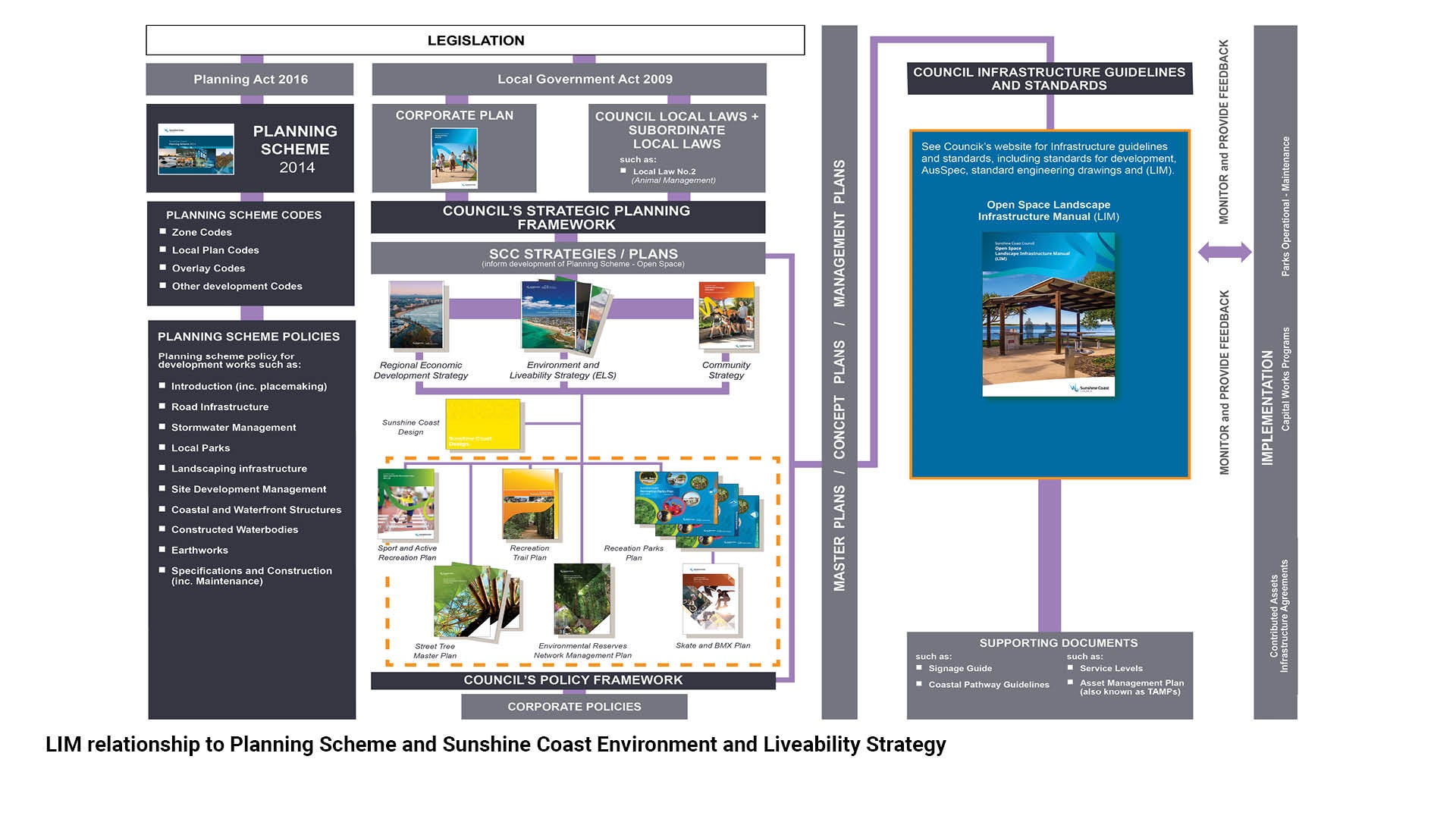
The LIM is a chapter in this manual, with other chapters addressing topics such as Centre Design Palettes. A diagram of how the manual relates to the Planning Scheme is below.
See Figure 1: LIM relationship to Sunshine Coast Planning Scheme and Sunshine Coast Environment and Liveability Strategy
Open Space Landscape Infrastructure Manual (LIM)
The LIM will provide guidance material for many open space categories. The manual to date, is mainly devoted to parks, recreation trails and environment, in the near future provision has been made to include guidance for sports grounds.
In the interim, the basic parks information in each LIM category (i.e. equal access guidance) can be adapted to suit the site specific solution required.
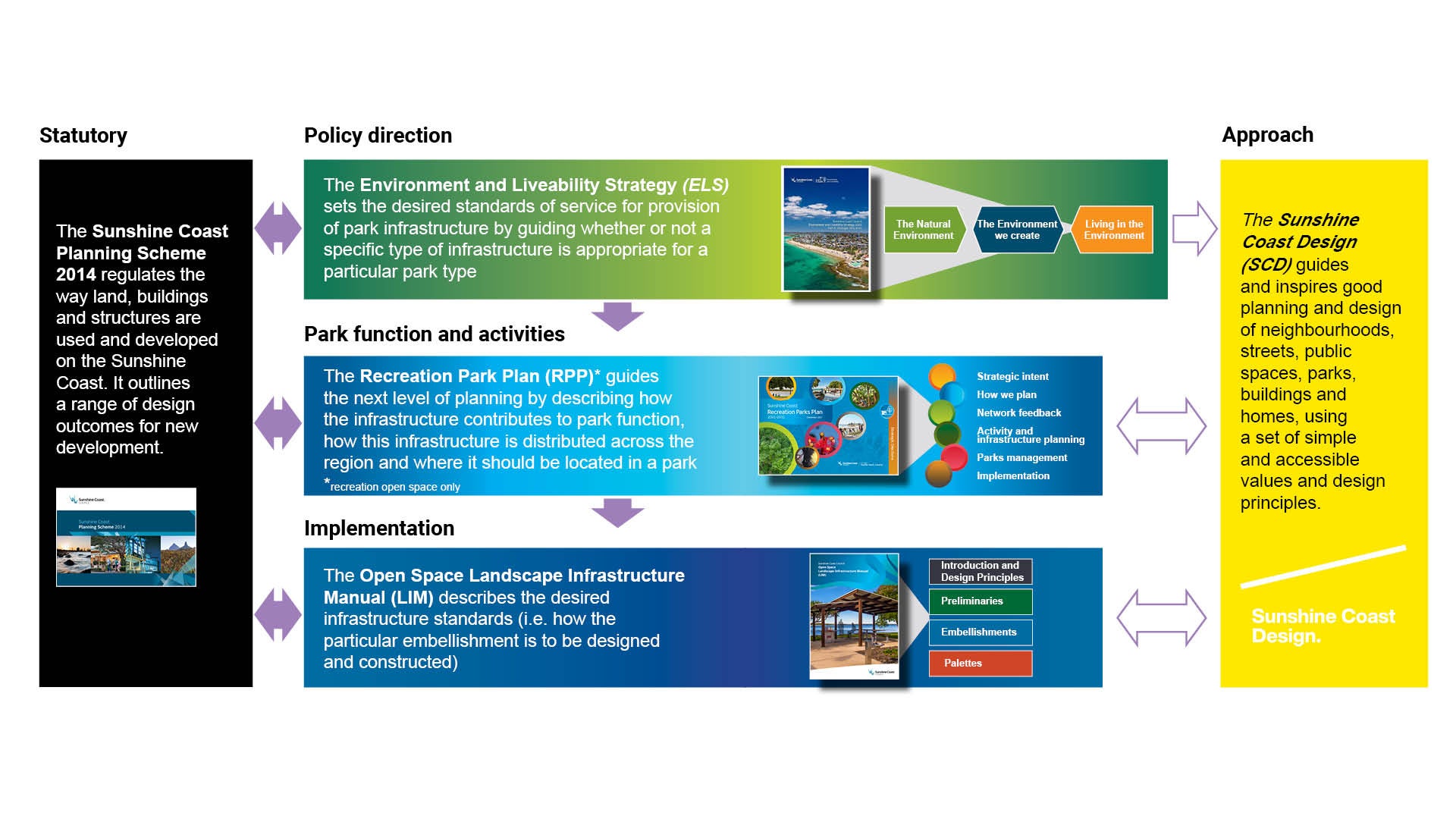
The package uses the guidance provided by the Environment and Liveability Strategy 2017 (ELS), detailing appropriate embellishments for open space types, such as recreation, landscape, sport, trails and environmental reserves.
The Recreation Park Plan 2021-2031 (RPP) provides a more detailed guide for the location, quantity, distribution and size of embellishments for Recreation Parks. Once the location/requirements are decided, based on the ELS and the RPP, the LIM provides guidance for the design and delivery.
Figure 1: LIM relationship to Sunshine Coast Planning Scheme and Sunshine Coast Environment and Liveability Strategy
Strategic planning framework - where the LIM is positioned
Sunshine Coast Council’s overall vision is ‘to be Australia’s most sustainable region – healthy, smart, creative’. Council’s strategies and plans aid in the attainment of these visions and objectives. They set the guidelines for the allocation of resources, decision making and funding that leads to the achievement of council’s vision and objectives.
The Open Space Landscape Infrastructure Manual has been prepared in line with this council documentation, including council policies, plans, strategies and manuals.
The key council documents that relate to the LIM include:
- Corporate Plan 2021 - 2025
- Planning Scheme 2014
- Environment and Liveability Strategy 2017
- Recreation Parks Plan 2021-2031
- Sunshine Coast Design
- Community Strategy 2019 - 2041.
The following figure illustrates the relevant council planning framework documents including the Environment and Liveability Strategy 2017 and the Recreation Parks Plan 2021-2031, from which the LIM stems.
Figure 2: Council’s planning context
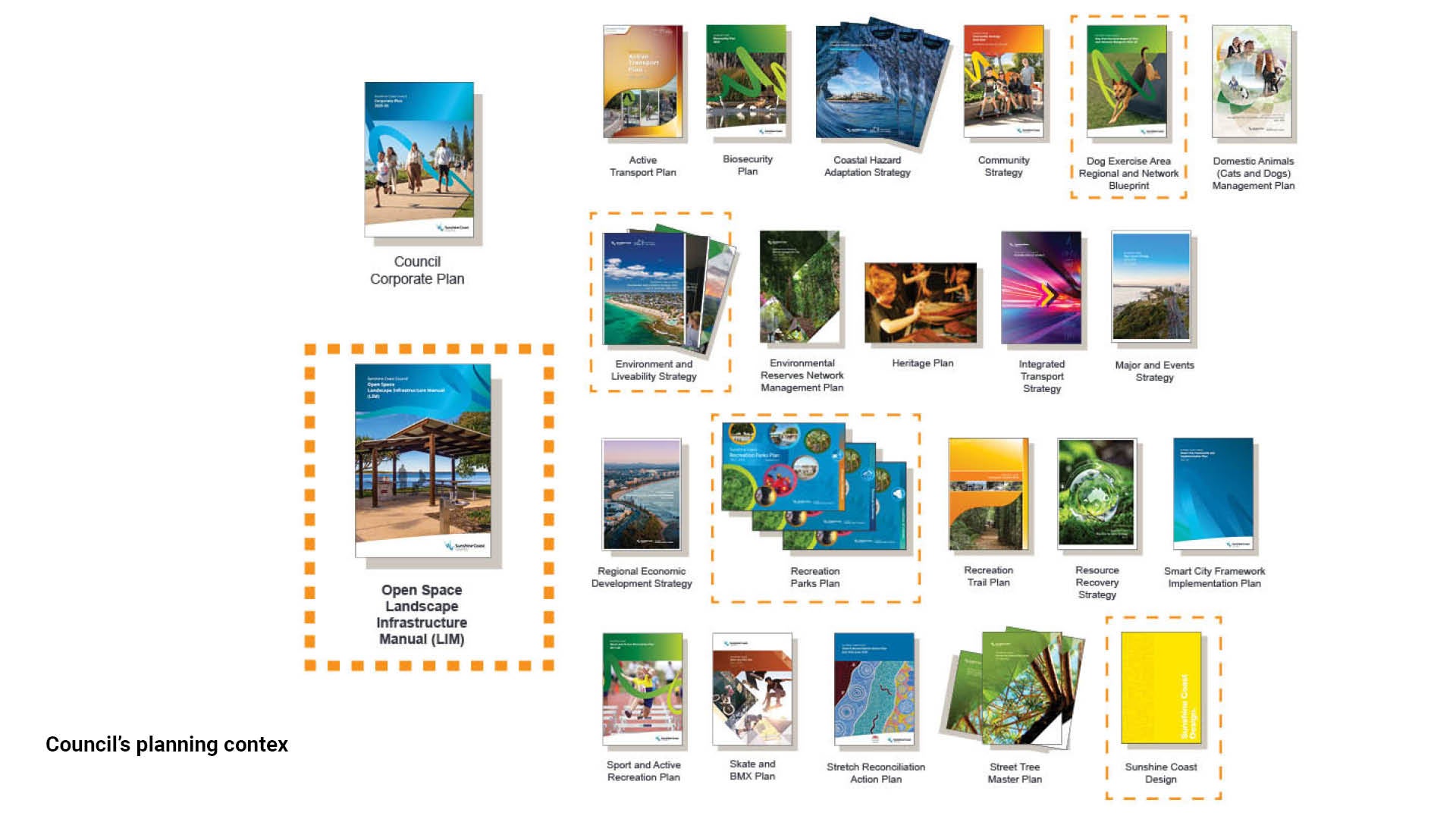
These key council documents are discussed in more detail, including emerging priorities and strategies that are relevant to design development. See LIM Relevant standards/guidelines – corporate documents.
Design framework
This flow chart demonstrates how each of the key ‘planning and design’ documents relate to one another.
Open space definitions
The Environment and Liveability Strategy 2017 ‘builds a pathway to a healthy environment and liveable Sunshine Coast in 2041’.
Listed in the highlighted box is an extract from the Environment and Liveability Strategy 2017 (ELS) that outlines the key elements used to plan open space. These elements are consolidated into council’s ‘desired standards of service’.
The LIM aligns with this strategy document, providing more detailed guidance on these desired standards of service. This gives the designer more specific design and construction advice on which embellishments should be placed in which type of open space category, such as:
Recreation
- Council-wide
- District
- Local
- Amenity reserves
- Linear parks.
Landscape
- Landscape corridors.
Sport
- Council-wide
- District
- Specific purpose.
Trails
- Recreation trails.
Environment reserves
- Conservation reserves
- Nature reserves
- Bushland reserves
- Natural amenity reserves
- Coastal reserves.
See the Environment and Liveability Strategy 2017 for further information.
Environment and Liveability Strategy 2017 (ELS) – Open Space
Open Space Open space is the network of land and water that supports recreation and sport, trails and paths, nature conservation and visual relief from the urban environment. These open spaces complement and contrast with the built environment.
Our open space network is highly valued by the community and contributes to the Sunshine Coast’s unique character, relaxed and healthy lifestyle and rich biodiversity. It gives a sense of ownership and belonging to local communities and neighbourhoods, making them desirable places to live. It provides spaces for enhancing landscape and character values, supporting biodiversity and ecological services, and active and passive sport, recreation and cultural activities. It provides the ‘green frame’ of our urban areas, edging our rivers, beaches and foreshores lining our streets and identifying our communities. It also makes the Sunshine Coast an attractive place to visit and supports tourism, events and economic growth.
Open space is owned and managed by council, the state government and numerous other public and private land managers. It is the council owned and managed open spaces that are the focus of this strategy. Open spaces managed by other landowners (e.g. national parks and forestry reserves) significantly contribute to the Sunshine Coast open space network. Policies within this strategy can be used to guide partnerships and collaborative management efforts with other open space providers.
Securing and developing open space is a high priority of council. A range of mechanisms are utilised to ensure appropriate and functional open space is publicly accessible.
The Sunshine Coast’s open space areas have been grouped into categories based on their primary use, to assist with their planning, development and management. Most have multiple uses and contribute to other categories in a secondary role.
- Recreation – recreation parks, amenity reserves, linear parks, and trails. Spaces used for informal social, recreational and cultural activities which connect people and provide visual relief from the built form.
- Landscape – landscape corridors and streetscapes. Vegetated areas/living infrastructure build on the natural character and amenity of neighbourhoods which provide key linkages.
- Sport – facilities for playing formal sports, including fields, courts and supporting infrastructure. This use includes specific purpose sports that have limited multiuse due to the nature of the sport.
- Environment and coastal – these areas support the preservation and enhancement of biodiversity and coastal protection. They can provide opportunities for people to interact with the natural environment where appropriate.
- Other – areas that contribute to open space functions, e.g. education facilities, caravan parks, waterways, riparian corridors, and drainage reserves. This category also includes open space not controlled by council e.g. national parks, state forests, state managed sports and recreation facilities, SEQ Water areas and lands managed by Unitywater.
This component is currently in development