Site set up (including tree protection)
Specifications
Scope of works - Tree protection and management during construction
The project arborist shall determine which of the activities listed below fall within the project scope and are subject to the relevant specification.
Stage | Section | Item |
Design | 11.2 | Reference documents |
Pre commencement | 11.3 | Pre-commencement meeting and inspections |
Pre commencement | 11.4 | Project hold points (arborist) |
Pre commencement | 11.5 | Site set up |
Tree works | 11.6 | Tree clearing - general |
Tree works | 11.7 | Tree clearing - tree sensitive work sites |
Tree works | 11.8 | Timber salvaging |
Tree works | 11.9 | Mulch carting and stockpiling |
Tree works | 11.10 | Tree pruning |
Construction | 11.11 | Project setout |
Construction | 11.12 | Tree protection - general |
Construction | 11.13 | Establishment of TPZs |
Construction | 11.14 | TPZ management during construction |
Construction | 11.15 | Site clearance |
Construction | 11.16 | Demolition |
Construction | 11.17 | Earthworks |
Construction | 11.18 | Tree root protection |
Construction | 11.19 | Tree planting within TPZs |
Construction | 11.20 | Run off management |
Post-construction | 11.21 | Site reinstatement |
Post-construction | 11.22 | Damage and rectification |
Post-construction | 11.23 | Post construction inspection and monitoring |
Reference documents
Reference should be made to the following documents when carrying out clearing, demolition, construction or landscape works adjacent to established trees:
- Sunshine Coast Open Space Landscape Infrastructure Manual (LIM) - site set up (including tree protection)
- Webpage with figures
- Technical drawings
- SSU-01 (type 1) - Tree protection zone (type 1) - AS 4970 method
- SSU-01 (type 2) - Tree protection zone (type 2) - drip line method
- SSU-02 - Trunk/branch and ground protection
- Specifications
- AS 4970:2025 Protection of trees on development sites
- Sunshine Coast Open Space Landscape Infrastructure Manual (LIM) - tree sensitive design (existing and new trees)
- Webpage figures/concepts
Pre-commencement meetings and inspections
Pre-tender meeting
- Project arborist to attend project pre-tender meeting to go over tree issues including clearing of trees approved for removal, TPZ establishment, project hold points, tree sensitive works methodology and site access constraints for consideration by project tenderers during pricing to help avoid contract variations.
Pre-start meeting
- Project arborist to attend project pre-start meeting to brief workers on tree protection requirements including fencing of TPZs, inspection of setout, works supervision and maintenance of TPZs during construction.
- Project arborist to confirm site compound and storage locations, access points and routes for tracking of equipment through site.
- As required, contractor to undertake:
- Preparation of a tree protection plan.
- A detailed photographic survey of existing trees to be retained.
- Notification of all suppliers and subcontractors: all workers and delivery staff to be advised of the protected and valued nature of the trees to be retained.
Project hold points
- Tabled hold point items (see Table 1: Hold points for project arborist sign off/supervision) to be acknowledged and agreed on at pre-commencement meeting. Example hold points include:
- Project arborist to confirm/tag trees for clearing prior to commencement
- Project arborist to sign off on tree protection zone and ground protection establishment
- Project arborist to inspect setout
- Project arborist to supervise works.
Table 1: Hold points for project arborist sign off/supervision - example
Hold point | Item | Description | Contact |
1 | Tree protection zone establishment | Project arborist to sign off on adequate establishment and exclusion of tree protection zones prior to commencement. | Project arborist |
2 | Setout | Project arborist to inspect project setout to determine if additional tree works or hold points for inspection or supervision of works are required. | Project arborist |
3 | Arborist supervision of works | Project arborist to supervise construction works within TPZs of trees. | Project arborist |
Site set up
- Before commencement of any site works (including tree removal and ground clearing, or movement of any equipment into site), tree protection fencing and any ground protection treatments (as identified in project documentation or during pre-tender and pre-start meetings) is to be erected - (see LIM Site set up - Specifications - 11.12 Tree protection - general) check reference xxx.
- Site yard and storage area locations should consider existing trees in the immediate area, as well as those growing in or near access points when being delineated.
- Demountables should not be set up over tree root zones as they may impede water and air flow. Where temporary buildings must be located over TPZs, these should be mounted on blocks to ensure continued air flow through the soil, in consultation with the project arborist.
Tree clearing - general
- All tree work to be undertaken by an appropriately qualified and suitably experienced tree contractor.
- No work is to be undertaken when soils are excessively wet.
- Project arborist to inspect and/or confirm trees for clearing or pruning prior to commencement of works.
- All ecological requirements including species management plan and wildlife spotter-catcher are to be arranged by the contractor prior to commencement.
Tree clearing - tree sensitive work sites
- Trees for removal should be climbed unless a light weight, caterpillar tracked/ground sensitive elevated platform (spider for example) can access the site without causing any damage to TPZs and is approved for use by the project arborist.
- Trees shall be dismantled using roping techniques to lower branches to the ground where a risk of damage to surrounding vegetation has been identified. Small branches can be “cut & thrown” if there is no risk of damage to surrounding trees.
- Tree falling is generally only permitted if falling will not cause significant divots in the ground and not contact/damage any surrounding trees for retention, including associated splitting of wood on impact.
- No large woodchippers to enter areas of the site where trees are to be retained. Smaller chippers will be permitted to enter if manoeuvring is kept to a minimum, and branches are dragged to chipper set up point instead of the chipper moving to tree locations.
- Larger equipment may be permitted onto site where suitable ground protection is in place over access routes and authorised by the project arborist.
- Areas that do not have ground protection in place are to be designated 'no go zones’ with clearing debris walked or wheel-barrowed out of the site.
- Tree stumps should be ground as opposed to extracted from the ground, taking care not to damage any part of any nearby trees for retention. Where there are potential conflicts with adjacent trees, a small machine should be used to ensure disturbance remains localised.
- Large surface roots should be chased with a small machine or manually broken up via the use of hand tools.
- Where a stump cannot be removed it should be annexed within a garden bed or mulched area (to prevent trip hazards), and poisoned using a translocated, non-residual product to prevent re-shooting.
Timber salvaging
- Where tree types and diameters and/or quality of timber dictates, the contractor is to arrange:
- Timber salvaging in-line with Council’s coarse woody debris (CWD) program, or
- Retention of millable logs in line with State government requirements.
Mulch carting and stockpiling
- Contractor to arrange:
- Stockpiling of mulch on site for reuse in landscaping works, or
- Carting of mulch to a council depot facility, designated stockpile site or other location as specified.
Tree pruning
- Project arborist to approve all required pruning work prior to commencement.
- Pliable branches may be tied back or branch wrapping may be undertaken as an alternative to pruning with approval of the project arborist.
- All tree pruning is to be carried out in accordance with AS 4373:2007 – Pruning of amenity trees.
Project setout
- Project arborist to undertake re-assessment of trees at setout and advise if any additional works are required for hazard reduction or to resolve access constraints (pruning only) based on review of project extents and contractor methodology.
- Services should be setout at the same time as general construction works as far as practicable.
- Where earthworks or similar are envisaged to increase the hazard potential of additional trees recommended for removal, works should be undertaken prior to commencement for safety of site workers.
Tree protection - general
- All existing trees specified for retention within extent of works (EOW) area to be protected from disturbance and damage in accordance with AS 4970:2025 – Protection of trees on development sites.
- Before commencement of any site works, including tree removal works, a tree protection zone (TPZ) must be established around all trees for retention within or immediately adjacent to the works area, and remain in place until works completion.
- No changes are to be made to TPZ extents for the duration of the project. Any variations to a TPZ that become necessary must be approved by the project arborist.
- The purpose of the TPZ is to formally exclude from the area all above and below ground activities that may cause tree injury. This includes mechanical damage to trunk and branches, direct damage to tree roots (grade changes, soil stripping) and indirect damage to tree roots (soil compaction, loss of permeable space).
- All demolition and construction related activities as well as stockpiling, storage of equipment or materials and activities that could cause compaction or contamination of the soil (including wash down and refuelling) must remain outside of TPZs at all times unless otherwise authorised by the project arborist.
- Tree protection zones must be maintained as 'no go zones' for the duration of the project and management of these no‐go zones will include managing the health of trees within (using mulch and water as required).
- Approved works for within TPZs must be supervised by the project arborist at all times.
Establishment of TPZs
- Tree protection zone to be established in accordance with:
- The AS 4970 method as detailed in the Council Open Space Landscape Infrastructure Manual – Site set up (including tree protection) – Technical drawing SSU-01 (type 1), or
- The drip line method as detailed in the Council Open Space Landscape Infrastructure Manual – Site set up (including tree protection) – Technical drawing SSU-01 (type 2), or
- The requirements outlined in the project tree protection plan as approved by the project arborist.
- Tree exclusion barriers may be established around individual or groups of trees.
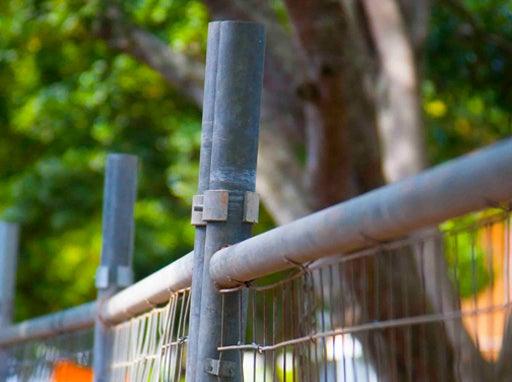
- TPZ barriers must be fit for purpose and formally exclude access to the area within at all times.
- Tree exclusion barrier to consist of:
- Temporary locking fencing panels in line with the Council Open Space Landscape Infrastructure Manual – Site set up (including tree protection) – Technical drawing SSU-01 (type 1), or
- Barrier mesh in line with the Council Open Space Landscape Infrastructure Manual – Site set up (including tree protection) – Technical drawing SSU-01 (type 2).
- A sign should be erected on the barrier stating that there is to be no access into the area.
- Apply mulch collars to trees within the exclusion area as required ensuring depth does not exceed 100 mm and mulch does not contact tree trunks.
- Ground protection is to be installed to areas of TPZs where exclusion fencing cannot be erected. Ground protection treatment to meet the requirements of the Council Open Space Landscape Infrastructure Manual – Site set up (including tree protection) – Technical drawing SSU-02, including:
- Geotextile or permeable sheeting
- 100 mm layer of aggregate or mulch
- Steel plates or rumble boards (if specified by the project arborist).
TPZ management during construction
- During low rainfall/drought, undertake weekly watering of trees to reduce stress is required until construction completion and the establishment/maintenance period is underway.
- Tree damage is to be reported immediately to the site supervisor, the superintendent and council arborist.
Site clearance
- No work is to be undertaken when soils are excessively wet.
- Attempt to retain as much understory/ground vegetation within TPZs as possible to minimise disturbance to these areas.
- Do not remove garden blend soil (topsoil), mulch, turf or leaf litter from the ground within a TPZ unless authorised by the project arborist.
- Any ground vegetation clearance that is required within a TPZ is to be authorised by the project arborist prior to removal works.
- Where understory/ground cover must be removed, undertake works gently by hand under council arborist supervision or parks operations guidance.
- Do not scalp soils. Where vegetation must be removed use hand tools and rake debris away. Horizon slash wherever possible instead of removing understory.
- Do not use heavy machinery for clearing works in TPZs.
- Where machinery must be used, ground protection to all areas of access and tracking must be in place prior and signed off by the project arborist before entry of equipment into the site.
Demolition
- Below ground infrastructure within TPZs should be left in place where possible (posts, footings, tap plumbing, etc.) To save further ground disturbance as an outcome of extraction.
- Where elements requiring demolition exist within TPZs, hand work should be utilised where possible and materials should be wheelbarrowed out.
- Where demolition equipment is necessary (for example concrete slab removal) the smallest sized equipment capable of undertaking the necessary works should be selected to minimise damage to root zones and above ground tree parts.
- Existing surfaces should be left in place for as long as possible and used to support and spread equipment loads (once hard surfaces are removed the risk of compaction is far greater than if the hard surfaces were in place).
- It’s preferable for equipment to work from outside the drip line (area beneath the canopy of the tree) of trees at all times to avoid direct conflict between equipment and branches, as well as avoiding soil compaction and damage to the tree root zone.
- Machines with a long reach should be used where existing trees conflict with work zones to keep set up points as far from trees as possible.
Earthworks
- All approved earthworks within a TPZ must be supervised by the project arborist.
- Excavation works in the root zone of trees to be retained shall be carried out by hand, vacuum excavator (vaxcavator), under bore or other method approved by council arborist.
- Where hand work has been specified, initial excavation works are to be undertaken with hand tools only, to avoid tearing or fracturing of roots beyond the works area.
- Vacuum excavation must ensure water pressure is kept low at all times to avoid damaging the bark of roots.
- Any conduits, service, or irrigation lines to be installed within TPZs of trees to be retained should be under‐bored or installed via vacuum excavated trenches with roots kept intact and lines threaded beneath (under the project arborist supervision). If this is not possible, conduits should be rerouted around trees.
- Trenchless installation methods are highly recommended for mature specimens of tree root sensitive species. These include Eucalypts, Banksias and Norfolk island pine trees.
- Preserve soil horizons when backfilling trenches i.e. return soil to trenches in its natural order (friable soils at the top and heavier soils deeper).
- Where hand compaction is specified, tamp with hand tools only.
Tree root protection
- During excavation, tree roots in excess of 50 mm diameter are not to be cut without authorisation from the project arborist. Obtain confirmation to proceed from the superintendent and the project arborist.
- Damaged tree roots are to be saw-cut back to a clean cut. Under supervision of the project arborist.
- Smaller roots are to be cut back with sharp pruning tools.
- It is unacceptable for roots to be 'pruned' with machinery such as backhoes or excavators.
- Seek advice from the project arborist if roots greater than 50mm diameter are encountered during excavation further from the tree.
- Wounds should not be treated with dressings or paints.
- Where soil profiles within the TPZ are exposed by excavation, exposed roots are to be protected from drying out by applying a jute mesh sheeting or hessian (triple layer) to extend the full depth of the root zone.
- Root protection sheeting is to be pegged in place and kept moist during the period that the root zone is exposed. If trenches are dug adjacent to a protected tree (with authorisation from the project arborist) they should be backfilled with site soil wherever possible ensuring that soil horizons remain in the correct order with hand tamping only to firm surfaces.
Tree planting works within TPZ's
- All planting works within TPZ's are to be undertaken using hand tools only and supervised by project arborist.
- Broad soil cultivation must be avoided within TPZ's, with pocket planting methods employed instead.
- Where required, relief of sub‐soil compaction should be made with a spike aerator or similar manually operated device.
- Roots within TPZ's are to be retained and protected through gentle hand work only. Large embedded stones should not be extracted due to risk of root damage in the process.
- Where fibrous roots present significant conflicts, under‐planting works should not be carried out without further direction from the contract administrator.
- Retaining natural grade is preferable for ongoing tree health, however up to 100 mm of topsoil may be loosely applied to TPZ areas beyond the mulch collar if unavoidable.
- No topsoil is to be introduced to the critical structural root zone area, which is to consist of a mulch layer only.
- Topsoil and fertiliser composition must be safe for use around mature eucalypts as approved by project arborist.
- Soil profiling to meet finished design levels should be avoided - batter down to allow for mulch to sit flush with hard adjoining surfaces instead.
- Mulch to consist of a forest blend and not exceed 100 mm in depth (total depth of mulch and topsoil should not exceed 150 mm, so reduction of either or both as required to allow for continued aeration of roots may be specified by project arborist).
Run off management
- Care is to be taken during acid wash down of exposed aggregate pathways or wash down of concrete pathways (and potential leaching of lime) to prevent run off into root zones of surrounding trees.
- Where threats to existing trees have been identified, the area should be covered prior to cleaning and runoff caught with sawdust, an absorbent berm or similar and gently removed along with all spoil (including dried slurries) following completion of wash‐down procedures.
Site reinstatement
- When backfilling trenches near trees/within TPZs, ensure soil horizons are kept in-tact/in order (i.e. deepest soils excavated returned to trench or hole first, shallow layers replaced last).
- Maintain (with care) original soil level around retained trees.
- Turf renovation beneath existing trees should ensure no sub‐grade cultivation. Hand removal of the existing turf layer is required to preserve as much of the top layer of the soil horizon as possible in accordance with the Council Open Space Landscape Infrastructure Manual - Planting (landscape) - Technical drawing PL-01 (type 3).
Damage and rectification
- All significant damage to trees that occurs by accident, or as a result of unapproved work methods, will require rectification to the satisfaction of the project arborist.
- Rectification may consist of tree pruning, soil de‐compaction, soil nourishment and improvement works, irrigation or where rectification is not possible, tree replacement planting.
- Site remediation works that may be required include:
- Restoring areas to natural grade (via hand work only).
- Vertical mulching.
- Replacing damaged soil including hand removal of rubble and dried slurries where improper laying of pathways & slabs has occurred.
- Application of specialised post construction tree health treatments may be required due to the value and relative sensitivity of damaged trees. These treatments shall be applied to all specified trees within and adjacent to construction areas, based on the direction of the project arborist or soil specialist.
- Nitrogen based fertilisers (if recommended for post construction tree nourishment) should only be applied to existing trees in slow-release format, to avoid complications with stressed existing or new trees.
Post construction inspection and monitoring
- Any trees disturbed during the course of works are to be routinely monitored for time period specified by the project arborist.
xxxxx OLD SPEC - DELETE WHEN FINALISED
Overview
FIX INTRO XXX This category of the LIM has been developed to provide guidance for the design and implementation of construction site set up.
This specification section addresses the following:
- Project specifications
- Maintenance specifications.
The specifications outline councils minimum acceptable standard, which may be above the expectations of current workplace standards.
Project specific variations may be appropriate as a result of site, environmental or other constraints.
Any variations to these standards must be approved by council prior to commencement of variation works
Construction - preliminaries
Pre-Start:
- Before works commence, Contractor to organise a pre-start meeting with the Superintendent, Environment Compliance Officer, Contractor, Designer and Project Arborist where applicable to clarify issues and establish management procedures.
Pedestrian control
- Prepare pedestrian management and traffic management plan.
- Ensure that appropriate barriers, signage and pedestrian safety measures are put in place before work commences.
- Where public access is diverted, temporary ramps and walkways must be installed, with compliance to relevant safety standards.
- If any public safety issue requires clarification, refer to Superintendent.
Site protection
- DELETE this point - Contractor to confine all works within the defined property boundaries and to take all precautions to protect adjacent property, structures and vegetation from damage during construction.
- The contractor shall confine all works within extent of works boundary and take precautions to protect adjacent property, structures and vegetation from any damage during demolition and construction.
- The contractor shall submit an existing conditions audit and dilapidation report to the superintendent prior to any works being undertaken. the report shall capture photographic evidence of the existing condition of the site and the surrounding land, infrastructure and vegetation. all parties to sign off on the report prior to commencement of site works.
- All cost for damage by contractor and immediate repair to adjacent property shall be completed by qualified persons at the contractors expense. the contractor is to obtain full written clearance from the affected property owners and scc at the completion of the works.
- The contractor shall notify the superintendent of any evidence of encroachment other than that described in the contract prior to completion of any such works.
- Where dust measures are inadequate, and dust is evident, the superintendent shall order the contractor to provide dust proof screens and covers and protect surroundings and finishes and immediate environment or properties from dust.
Services
- DELETE - Contractor to undertake ‘Dial Before You Dig’ prior to commencement of works.
- DELETE - Contractor to confirm location of all services on site prior to commencement of works.
- DELETE - Dial before you dig certificate to be retained on site at all times.
- Certificate is to be shown to any persons undertaking excavation activities and risks discussed.
- Where there is limited information available on underground services seek advice from the relevant asset owners or use another method (e.g. cable location device to identify the asset location).
- Hand dig or use non-destructive excavation to prove the asset location before starting mechanical excavation.
- Protection of all services: the location and protection of all services effected by the works are the sole responsibility of the contractor. the contractor shall be responsible for all the cost associated with the repair and re-instatement of any services damaged by the contractor.
- New service connections (water, electrical etc.) shall utilise existing trenching and conduits where possible. installation of new conduits and any trenching shall only be carried out in association with the construction of new pathways where no damage to existing trees is likely. all new service alignments are subject to approval from the Council arborist, superintendent and specialist consultants. new conduit shall generally follow the alignment of new pathways where possible.
- The locations of all electrical pits in mass planting areas and infill pits in paved areas are to be confirmed on site with superintendent prior to installation.
- Adjustment and relocation of services encountered during the work will be accomplished with the relevant authority.
- Abandoned services, including connections, not shown on the drawings and confirmed to be abandoned by the relevant service authority may be removed and/or cut off where they interfere with construction.
- Where directed by the superintendent, suitably plug and seal any abandoned service and relocate or dispose of all materials so removed to a place outside the site.
Safety
- All contractors are deemed employers and person in charge of a business and undertaking. as such there is a legal obligation to comply in full with the Queensland Work Health and Safety Act 2011, the Queensland Work Health and Safety Regulation 2011, as well as any relevant codes of practice and Australian standards.
- In addition, the sunshine coast regional Council requires that all contractors adhere to the work health and safety specifications that are issued at the time of tender. Council project and safety inspectors monitor contractor performance and adherence to Queensland legislative requirements and the Council specifications, to ensure breaches of these requirements are rectified in a timely and satisfactory manner. serious breaches and/or breaches involving a high-risk activity may result in project works being stopped pending satisfactory rectification.
- Note: Workplace health and safety specifications are reviewed for content and currency on an annual basis.
- Appropriate policies and procedures must be in place for managing site safety. These can be part of an overall management system, provided the system effectively manages and controls the risks from the work being done.
- DELETE - Each employer on-site needs to effectively manage the safety of their workers, mobile plant and equipment.
- Processes or procedures should be in place, including those to ensure:
- Safe Work Method Statements (SWMS) are developed for all high risk construction work
- Safe work procedures are developed for other tasks where there is risk to workers or the public
- Workers are competent or are directly supervised by competent workers
- The health and conditions of workers are monitored
- If using powered plant, ensure it is mechanically sound, safe for use and has the required safety documentation.
- Employers must supervise their workers and the work over which they have control. This includes directing and monitoring the work to ensure it is done safely.
- DELETE - Ensure a suitable person is available to manage day-to-day site OHS. If this person is away from the site, the role should be delegated to another suitable person.
- Before allowing new workers start at the site, supervisors should ensure they complete a site induction and receive instructions on how the work is to be done (e.g. SWMS and other work procedures).
- Workers must be consulted on OHS matters that directly affect them. This includes identifying hazards and risks, and determining risk controls. If workers are represented by a Health and Safety Representative (HSR), the consultation must involve the HSR.
- Employers must ensure workers are provided with information, instruction and training that is necessary to enable them to work safely.
- For further information visit the Work Place Health and Safety Queensland website.
Construction set
- Plans refer to the drawn plans associated with this project construction set.
- Refer all ambiguities to the Superintendent for clarification.
Setout and dimensions
- DELETE - Check all dimensions on site. Where discrepancies occur, refer to the Superintendent.
- DELETE - Except where noted otherwise, scale of drawings is correct when drawings are on A3 sheets.
- DELETE - Do not scale off drawings.
- All dimensions are in millimetres (mm) unless otherwise noted.
- Dimensions are not to be obtained by scaling from drawings.
- All dimensions are to be checked and verified on site prior to construction.
- Dimensions provided take precedence over eastings/northings and setout grids.
- Reduced levels are shown in metres u.n.o.
- All levels are to be confirmed on site with superintendent prior to construction.
- Any discrepancy in construction drawings are to be referred to superintendent for clarification.
- Set out of works and co-ordinates to be completed by a licensed surveyor using digital files provided by Council.
Levels
- Except where noted otherwise, finished surface levels are to be flush with all adjacent surfaces.
- Grade evenly between existing levels and finished surface levels.
- Tolerances:
- All paved areas 2.0 mm (unless noted otherwise).
- Turfed areas 10 mm (unless noted otherwise).
Drainage
- Direct all falls away from pavement, planted or turfed areas to sub-surface or surface storm water drains, unless noted otherwise.
- Protect existing overland flow paths.
- Stormwater drainage system, downpipe locations, hosecock wastage drains etc, are subject to onsite review by Council and/or project hydraulic engineer. where designed in, all drainage pits are to have approved hot dipped galvanised or 316 marine grade stainless steel grates with lockable tamper proof fixings.
Vegetation protection
- All works to comply with AS 4970 Protection of trees on development sites.
- All pruning works to comply with AS 4373 Pruning of amenity trees. An authorised arborist must identify and approve trees that require pruning work prior to works commencing.
- Clearance of vegetation is not permitted without consent. Refer to the Superintendent prior to commencement of works.
- Refer Tree Protection Specification for further information.
Erosion and sediment control
- Contractor to supply sediment and erosion management plan (SEMP) for approval prior to commencement of works in line with Council’s “Sediment control document”.
- International Erosion Control Association, best practice erosion and sediment control (bpesc) documents shall be applied to this project. an erosion and sediment control plan prepared and approved by a suitable qualified person (cpesc) is to be provided as part of the works.
- SEMP may include;
- Install sediment fences around stockpiles or exposed ground as required to prevent sediment entering drainage lines
- Waste water from concrete cutting to be filtered via absorbent booms/filter socks prior to discharge to a watercourse or storm water drainage system
- Waste water from hosing down exposed aggregate is not to be directly discharged to a watercourse or storm water drainage system
- Capture cement fines (suspended in runoff water) via geotextile adjacent to edge of concrete or direct waste water to sump, and pump directly to truck
- Replace turf immediately (particularly within re-contoured overland flow path)
- Make good site as soon as practicable.
- Refer Environmental Specifications
Clearing and stockpiling
- DELETE - Strip turf/topsoil from ramps, footpaths slab/footings and stockpile for later re-use on disturbed or exposed ground where required.
- Excess spoil to be removed to an appropriate stockpile or approved landfill.
- No stockpile or lay down areas to be placed under the canopy or drip line of any tree.
- Locate stockpiles or lay down areas away from drainage lines.
- Contractor to ensure stockpiles are not located in a position where they could be washed into a gutter, drain or water body.
- Contractor to ensure stockpiles are covered with a tarp or other impervious cover. long term stockpiles can be covered with mulch or temporary vegetation (grass).
- Ensure appropriate dust control measures exist for all stockpiles.
- Ensure an appropriate sediment control system is located down-slope of all stockpiles.
- Stockpile locations must be designated and be included as part of ESCP.
Treated timber
- Treated timber used in construction of any structure is to be withheld from use until external surfaces are dry from the treatment process.
- All off-cuts and residual material from treated timber is to be disposed off-site to an approved landfill facility.
Cleaning up site
- DELETE - Remove all construction waste on completion of works.
- DELETE - Make good site as soon as practicable.
- Spoil, demolition waste and waste building materials shall be removed as the work proceeds and not allowed to accumulate.
- On completion of construction, the site shall be left in a clean and tidy condition to the satisfaction of the superintendent.
Nuisance
- Ensure no undue noise or lighting results from construction activity.
- Adhere to specified work hours.
Fuels and chemicals
- Storage, handling and transport of fuels and chemicals to comply with AS 1940.
- In the event of a spill or leak of fuel or chemicals to the environment:
- Spills are to be stopped at source as soon as practicable
- Spilt materials to be contained to the smallest possible area
- Spilt material to be recovered as soon as possible, using appropriate equipment
- Contaminated soil or spill recovery materials (such as absorbent pads) shall be disposed of at an appropriate land fill.
- Spill response equipment (such as shovel, bucket, sandbag sacks) are to be kept on site
- Environmental incidents are to be reported immediately to the Environment Compliance Officer and the Superintendent.
Acid sulphate soil - minor excavation
- Where soils have the potential for acid generation, do not leave excavated soils stockpiled overnight unless treated via lime application method.
- Excavated trenches should be backfilled at the end of each day where practicable.
- Any excess excavated soil is to be removed off-site immediately to be treated via lime application method or for burial at an approved landfill.
Aboriginal Cultural Heritage Act 2023
There may be a requirement to establish a cultural heritage management plan and/or obtain approvals pursuant to the aboriginal cultural heritage act 2003. the act establishes a cultural heritage duty of care which provides that: “a person who carries out an activity must take all reasonable and practicable measures to ensure the activity does not harm aboriginal cultural heritage.” it is an offence to fail to comply with the duty of care. substantial monetary penalties may apply to individuals or corporations breaching this duty of care. injunctions may also be issued by the land court, and the minister administering the act can issue stop orders for an activity that is harming or is likely to harm aboriginal cultural heritage or the cultural heritage value of aboriginal cultural heritage. you should contact the cultural heritage unit on 13 qgov (13 74 68) to discuss any obligations under the act.
Vehicle management
- Contractor is to ensure that vehicles are not taken into park areas after periods of wet weather.
- Track or access mats are recommended where fleet or plant equipment is utilised in turf areas to ensure soil compaction is minimised.
- Compacted turf areas are to be aerated using deep tine aerating equipment. spiked/drum aerators won’t be accepted as they do not effectively penetrate compacted soil structure.
- Before you dig australia (byda) and utility locating services to be utilised before proceeding with aerating works.
- Wheel ruts are to be top dressed with a mixture of washed river sand and organics with a range of 7–15% and a ph range of 5.5 to 6.5.
- Areas where turf has failed or has been removed is to be replaced with the same turf. However where there is a blend of grasses, please contact the parks area supervisor who will provide further advice.
- Areas to be re-turfed must be top dressed with as 4454 - 2012 composts, soil conditioners and mulches compliant top soil to a depth of 50–100mm with a ph range of 5.5 to 6.5.
- Before re-turfing, the area must be level and free of undulations. the area should also be rolled after turfing.
- A minimum turf watering establishment period of six (6) weeks is required to ensure the turf survives. this requirement may be extended to twelve (12) weeks during lengthy drought periods.
Construction - environmental
Environmental management
The Environmental Protection Act 1994 states that a person must not carry out any activity that causes, or is likely to cause, environmental harm unless the person takes all reasonable and practicable measures to prevent or minimise the harm. environmental harm includes environmental nuisance. in this regard, persons and entities involved in the civil, earthworks, construction and landscaping phases of this development are to adhere to their ‘general environmental duty’ to minimise the risk of causing environmental harm.
Environmental Management Plan
- If specified, the Contractor is to submit an Environmental Management Plan (EMP) which includes a Sediment and Erosion Control Plan, seven (7) days prior to construction start. Works may not commence without EMP approval by the Superintendent. Refer to AUSPEC - 211 Control of Erosion and Sedimentation.
Pre-start
- Before works commence, contractor to organise a pre-start meeting including but not limited to Environment Compliance Officer, Contractor, Designer and Project Manager to clarify issues and establish management procedures.
Dimensioning
- Check all dimensions on-site. Where any discrepancies occur refer to Superintendent for this project.
Erosion and sediment control measures
- Measures below are a minimum requirement to control and filter runoff from areas disturbed by Contractor or by rain event. Sediment control measures are to be the first items constructed. Regular maintenance of these measures is to be undertaken during construction. Refer also notes from General Construction Specifications
Environmental standard operating procedure - minimising disturbance
Staging of earthworks
- Carefully design and plan construction sequence to minimise disturbance.
- Keep area of earthworks small.
- Stage earthworks.
- Expose only as much ground as necessary at any one time.
Reduced exposure and progressive revegetation
- Design to avoid excessive cut and fill.
- Cover bare areas as soon as possible.
- Maintain control measures until completion of earthworks.
- Progressively protect bare areas from erosion by:
- geotextile, turf or mulch
- hay bales and bark bags
- silt fencing
- sandbags
- sediment traps
- geotextile bunding, rock bunding
- kerb inlet protection
Retain existing ground cover
- Design to avoid unnecessary clearing of vegetation, turf removal and stripping of soil.
- Preserve existing site drainage patterns (where possible).
- Retain as much natural grass and vegetation as possible (particularly sides and bottom of site and over tree root zones).
- Where vegetation is removed, leave stubble to stabilise soil where possible.
- Do not mow or park equipment or vehicles on vegetation during works.
- Do not disturb riparian vegetation or interfere with bed or banks of any stream without written approval.
Prevailing weather
- Consider prevailing weather conditions and soil characteristic when scheduling works.
- Avoid sediment and erosion control issues.
- Delay removing vegetation and commencement of earthworks until just prior to start of works.
- Avoid soil disturbing activities during periods of expected heavy, extended rainfall especially over tree root zones.
- Velocity of storm water runoff across the site is to be controlled in non-erosive velocities by flow path surface protection.
- Runoff from disturbed areas likely to generate > 150 tonnes of sediment an any year is to be drained to a designed sediment basin. (calculate by Revised Universal Soil Loss Equation i.e. approximately = 1Ha level site with sandy soil.)
- No release to any waterway, storm water drain, drainage line leading to a waterway or area of native vegetation is permitted unless water quality requirements are met.
Water quality requirements
- Permissible water quality limit for water released from a sediment basin is max. 50 mg/L of Total Suspended Solids (TSS).
- Water quality design goal for water flowing across any part of the site (not served by a sediment basin) is max 50 mg/L TSS.
- The applicant must ensure that all appropriate measures are taken to prevent the pollution of tidal waters as a result of silt runoff, oil and grease spills from machinery, concrete truck washout and alike. the minimum requirements to ensure this include:
- Ensure that the construction of the works is carried out only by means of suitable plant and equipment and that specific measures are taken to limit turbidity in tidal waters as a result of the construction. cast in-situ works must be completed in a manner to ensure no damage to the surrounding environment or any discharge of contaminants into the waterway. this includes the use of a silt curtain or other device of similar design outcome as a minimum requirement. additional minimum requirements include the fitting of appropriate safety coupling locks to plant concrete hoses and the development/compliance of operational procedures identifying the requirement for the mouth of the hose to remain out of the water body during construction works.
- Ensure that the disturbance to the bed and banks of the waterway and the generation of turbidity in the water column is kept to a minimum. the use of a silt curtain or device of similar design outcome is required as a minimum to ensure minimal generation of turbidity.
- Take all appropriate measures to minimise pollution of tidal waters as a result of silt runoff, and the discharge of other contaminants, such as fuel, oil and hydraulic fluid to the waterway during construction of the works. works must include the use of adequately maintained erosion and sediment control devices both within the water body and adjacent to it during construction. operational procedures must include emergency spill response procedures and appropriate spill response materials must be readily available on the construction site.
- Assess the area with regards to the occurrence of acid sulfate soils where any excavations are made in or adjacent to tidal land or waters. if these soils are found to be present, then action must be undertaken to minimise the impact these soils will have on the water quality of the waterway.
- If as a result of carrying out the works any bank is displaced or affected by erosion the bank must be restored to its former condition and any other action as is necessary must be taken to ensure the stability of the bank.
- Concrete agitator wash out must only be conducted in a specified area to facilitate the removal of waste concrete from the area to landfill. wastewater from cleaning equipment must not discharge directly or indirectly to any watercourse or stormwater system.
Maintenance
- Inspect all sediment control works at the end of each rain period and during prolonged rainfall.
- Defects are to be rectified immediately.
Dispersible soils and high erosion
- Install sediment control e.g. silt fences as close to bare areas as possible.
- Consider the extent, nature and duration of soil disturbance. Greater disturbance = greater risk of erosion/sedimentation.
- Consider the soil type to be disturbed;
- Clayey - more likely to cause environmental harm
- Sandy - more likely to cause traffic hazards and drainage problems
- Exposed subsoils - worse than exposed topsoil
Designated work areas and approved access tracks
- Install a stabilised gravel entranceway prior to commencement of work to reduce dirt tracking onto roads.
- Ensure works stay within designated areas.
- Cordon off ‘no-go’ zones where required.
Environmental standard operating procedure - Site clean up reinstatement
Construction waste
- Remove all equipment, waste materials, flagging tape, etc. upon completion of earthworks.
- Remove large volumes of excess spoil, rock etc. off site.
- Stockpile excess material at an approved stockpile site or dispose at an approved landfill facility.
- Soil must be screened and certified weed free prior to re-use.
- After site rehabilitation remove all temporary drainage, erosion and sediment controls.
- Dispose of non-reusable drainage, erosion and sediment controls at an approved landfill site.
- Any material that is deposited outside of the alignment of the works shown on the approved plans, or any debris that falls or is deposited on tidal lands or into tidal waters during the construction of the works, must be removed.
- Chemicals are not to be used either during construction or during clean-up activities. should any construction materials be treated, construction and design must be such that potential for leaching of these chemicals is mitigated.
Re-contouring
- When backfilling, ensure soil layers are not inverted, including filling in all tyre ruts.
- Provide smooth transition (gentle gradient) from natural surface to ‘as built’ levels. Vertical edges erode.
- Reinstate natural drainage patterns as appropriate.
- Maintain (with care) original soil level around retained trees (where possible).
Compaction
- Deep rip (subsurface) or scarify (surface) compacted areas to increase water infiltration and reduce surface runoff.
Seed bed preparation
- Spread stockpiled topsoil and mulch across disturbed areas and set aside for revegetation.
Revegetation
- Revegetate/seed/turf/hydromulch disturbed areas as soon as possible.
- Refer LIM Planting (Landscape) for typical planting and specifications.
Environmental standard operating procedure - Weed control
Weed identification
- Refer to ‘South East Queensland Weed Pocket Guide’ by Land Protection, Department of Natural Resources for weed identification.
- Contact Pest Management Coordinator.
General weed control practices
- Weeds are easily transported during construction by machinery, equipment and personnel. Practices to prevent the spread of weeds may include:
- pre-construction inventory of weeds within work site
- develop weed control procedures i.e. weed wash down
- monitor weed outbreaks during construction
- dispose of weed debris and weed contaminated green waste to an approved landfill facility
- revegetate disturbed areas immediately following final reinstatement to establish a cover which minimises weeds
- monitor weeds post construction and complete follow up weed control
Weed wash down procedure
As a minimum, the following weed wash down procedure should be followed when working in weed infested areas and prior to access to environmentally sensitive or pristine areas:
- Thorough wash down is required to remove all soil or organic matter from vehicles and equipment (including undercarriage and running gear) and portable infrastructure.
- Post wash down Inspection by a nominated officer.
- Cleaned vehicles to be entered onto a ‘wash down register’.
- ‘Wash down certification’ sticker to be clearly displayed on the vehicle exterior to identify vehicles that have not passed wash down procedures.
- Wash down to occur at a purpose built wash down facility:
- source water from an approved supply
- screen waste water and dispose all organic matter, seeds etc. at an approved landfill
Disposal of weed debris
- Weed debris and green waste contaminated with weed seed to be disposed at an approved landfill.
Reinstatement
- Revegetate disturbed areas to establish a competitive cover to prevent weed establishment. Use erosion control mats.
- Undertake follow up weed control.
DELETE - Construction - Tree protection
Tree protection
- Prior to works commencement a Tree Protection Zone (TPZ) shall be established around all trees within or immediately adjacent to the works area and must remain in place until works completion.
- TPZs shall be established in accordance with AS 4970: Protection of trees on development sites as outlined in the LIM Site set up (including tree protection) – Protection of trees - construction sites.
- Temporary fencing or protective enclosures to the approval of the project arborist shall be erected on the edge of TPZs excluding access to the area within at all times. These must not be altered or removed for the duration of the project.
- All demolition and construction related activities including stockpiling, equipment storage, wash down and refuelling must remain outside of TPZs at all times.
- Works approved for within TPZs must be supervised by the project arborist at all times.
Pruning
- Tree pruning shall be in-line with AS 4373: Pruning of amenity trees.
- Root pruning (where required) shall be undertaken via the use of a clean and sharp implement minimising surface areas of wounds.
- Clumps of fibrous roots must be retained wherever possible.
- All roots with a diameter of 50 mm or greater must be inspected by the project arborist prior to severance.
- While temporarily unearthed, roots must be covered with hessian or similar and kept moist until they can be permanently covered again.
Damage
- All significant damage to trees that occurs by accident or as a result of unapproved work methods will require rectification works to the satisfaction of the project arborist.
- Rectification may consist of tree pruning, soil decompaction, soil nourishment and improvement works, irrigation or where rectification is not possible, tree replacement planting.
Pre-start meeting
- The project arborist shall attend the project pre-start meeting to confirm and approve TPZ extents, works methodology, vehicle access points and paths of travel, site office and storage set up areas and project specific hold points.
Tree protection plan
Text to be used on plan
TREE PROTECTION
Prior to works commencement a Tree protection zone (TPZ) shall be established around all trees within or immediately adjacent to the works area and must remain in place until works completion. TPZs shall be established in accordance with AS 4970 Protection of trees on development sites, as outlined in the Sunshine Coast Council Open Space Landscape Infrastructure Manual Preliminaries - Site set up (including tree protection).
Temporary fencing or protective enclosures to the approval of the project arborist shall be erected on the edge of TPZs excluding access to the area within at all times. These must not be altered or removed for the duration of the project. All demolition and construction related activities including stockpiling, equipment storage, wash down and refuelling must remain outside of TPZs at all times. Works approved for within TPZs must be supervised by the Council arborist at all times.
DAMAGE
All significant damage to trees that occurs by accident or as a result of unapproved work methods will require rectification works to the satisfaction of the project arborist. Rectification may consist of tree pruning, soil decompaction, soil nourishment and improvement works, irrigation or where rectification is not possible, tree replacement planting.
PRE-START MEETING
The project arborist shall attend the project pre-start meting to confirm TPZ extents, works methodology, vehicle access points and path of travel, site office and storage set up areas and project specific hold points.
Note: The above text and legend (right) must be used in conjunction with the Tree protection plan. All drawings must be printed in colour. If you require the above text - copy and paste into your template.
Template layout (typical example)
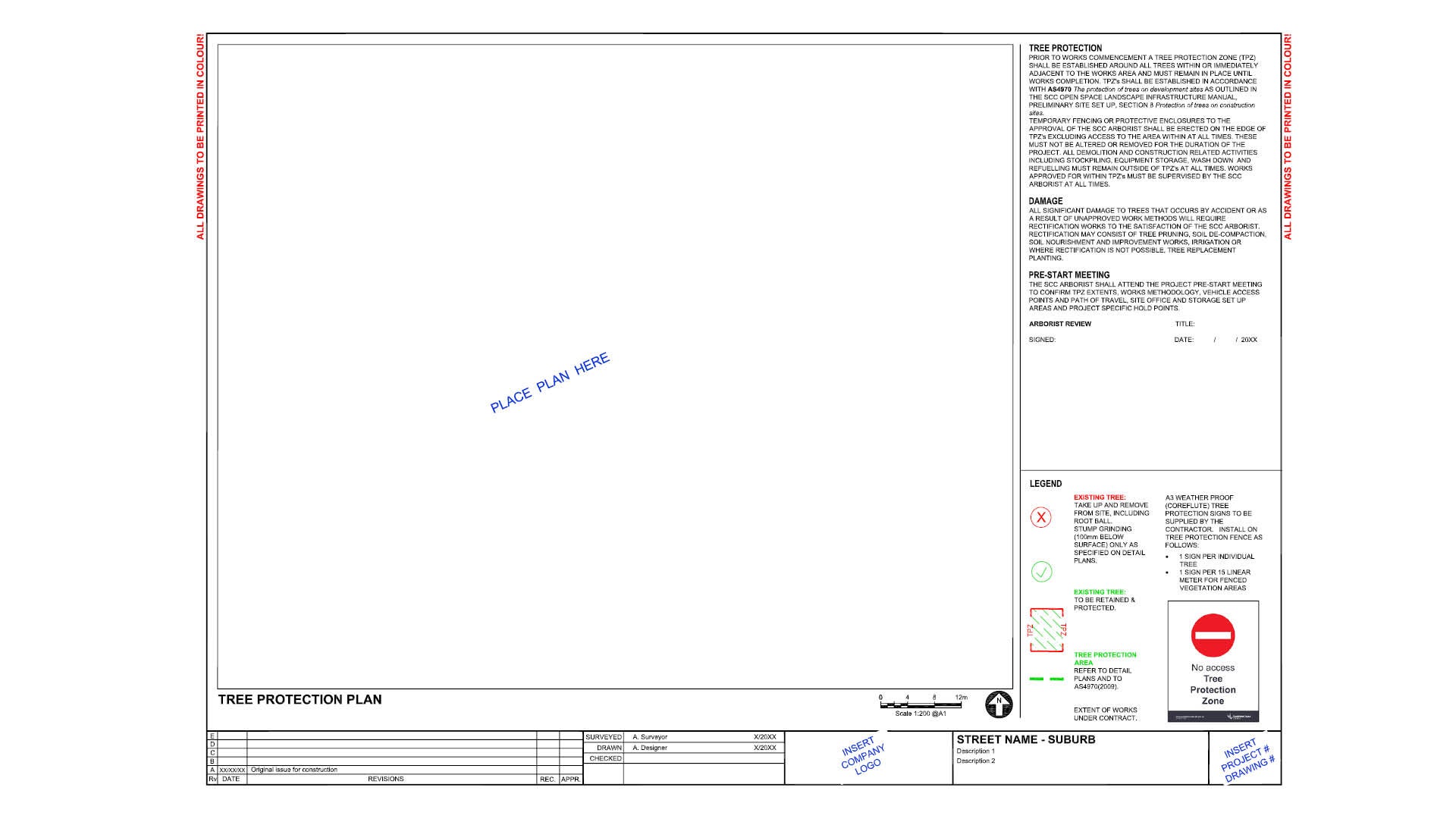
This component is currently in development