Site set up (including tree protection)
Site planning
Best practice guidance for site planning
Decision framework
Sunshine Coast Environment and Liveability Strategy (ELS)
Sunshine Coast Environment and Liveability Strategy (ELS)
The ELS contains the DSS for open space and provides a guide to what type of park/reserves are suitable for the various categories of embellishment.

Sunshine Coast Environment and Liveability Strategy (ELS)
text/html
The ELS provides guidance for Open Space including Parks and Environmental Reserves.
Sunshine Coast Recreation Parks Plan (RPP)
Sunshine Coast Recreation Parks Plan (RPP)
The RPP provides a more detailed guide for the location, quantity, distribution and size of embellishments for Recreation Parks.
The RPP outlines the importance of trees in parks.
Sunshine Coast Street Tree Master Plan
Sunshine Coast Street Tree Master Plan
The Master Plan sets the direction for street tree planting in the Sunshine Coast Council region.
Planning for sustainability
Refer Design principles – Sustainability for guidance.
Tree and vegetation management
- Protect existing trees from damage during project delivery to ensure continued environmental benefits such as oxygen production, temperature control, flood mitigation and stormwater filtration.
Site decisions
All decisions must be made in conjunction with council, including Council's Senior Arborist and other relevant officers from Council (Parks and Gardens) and/or Council (Environmental Operations) (determined by site location).
General site set up
The following pre-construction site set up measures are to be implemented:
- Confirm the location of all services on site, prior to works commencing.
- Determine a suitable compound site location for materials and equipment (if required).
- Ensure, so far as is reasonably practicable, a safe environment for all construction site workers, pedestrians and motorists, prior to any works commencing.
- Provide adequate facilities for the welfare of site workers (such as toilets and first aid facilities).
- Install appropriate barriers to delineate:
- construction zones
- safe pedestrian path of travel
- tree protection zones
- environmentally sensitive areas
- heritage areas
- fauna protection zones
- vehicle and machinery access routes.
- Display the required signage to clearly identify fenced off zones.
- Where public access is diverted, temporary ramps and walkways must be installed / delineated, with compliance to relevant legislation and disability Standards.
- Implement measures to delineate the extents of, and contain any stored materials at an approved location, outside the dripline of existing trees.
- Implement measures to ensure that waste material is appropriately transported and disposed of at licensed tips or designated recycling sites.
Tree protection
The following tree protection measures should be undertaken:
- Conduct a tree survey, followed by a project arborist's assessment, to define extents of the tree protection zone (TPZ).
- Establish (TPZs) as per project arborist's advice, in line with:
- AS 4970: Protection of trees on development sites, OR
- Dripline method.
See Determining the extent of a TPZ for further guidance.
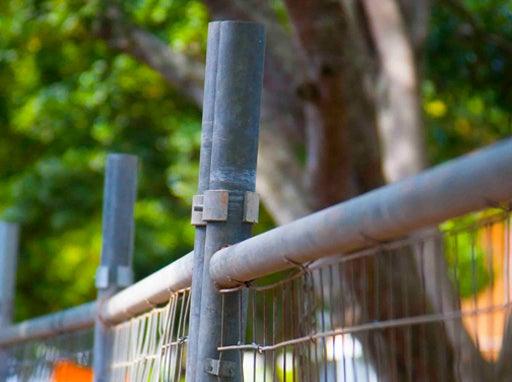
- Formally exclude TPZs from all construction related activities via erection of barriers/fencing at TPZ extents prior to commencement.
- Maintain TPZ as a 'no go zone' for the duration of the project, including managing the health of trees within (using mulch and water as required).
- Ensure that no alterations to TPZs or works are carried out on or around trees within. Any alterations must be approved by the project arborist.
See LIM Site set up (including tree protection) - Specifications for details of tree root, trunk and branch protection as well as typical protective fencing requirements.
Environmental protection
The following environmental protection measures should be undertaken:
- An environmental management plan (EMP) must be submitted if specified.
- The EMP must include an Erosion and Sediment Control Plan in line with the Erosion and Sediment Control, International Erosion Control Association (IECA), 2008 and in accordance with relevant provisions of the Environment Protection Act 1994.
- Environmental standard operating procedures shall include, but not be limited to:
- minimising disturbance
- site clean-up and reinstatement
- weed control.
- prevention of sediment into waterways.
Indigenous cultural heritage
Respect and protect indigenous cultural heritage when initiating site set up:
- Ensure site set up causes no damage to indigenous cultural sites such as:
- middens
- scar trees
- bora rings
- artefacts.
- Protect culturally sensitive and significant areas in consultation with appropriate indigenous representatives.
Heritage listed places and artefacts
Respect and protect international and Australian heritage places, physical artefacts and intangible attributes when initiating site set up:
- Ensure site set up causes no damage to international and Australian cultural heritage such as:
- places of historical significance
- monuments
- biodiversity (flora, fauna and ecosystems)
- fossils
- shipwrecks.
- Ensure site set up will cause no damage to local heritage places
- Protect sensitive and significant areas for future generations.
Safety consequence/likelihood matrix
Include risk control measures and safe design principles in the conceptual, design, and construction phase of a project by applying the workplace health and safety risk calculator.
All activities must be undertaken in accordance with the Queensland Work Health and Safety Act 2011 and subordinate legislation. To ensure a safe system of work, employers must conform to the requirements and those duties imposed on them by this legislation. These includes:
- A Workplace Health and Safety Plan is required in accordance with the Queensland Work Health and Safety Act 2011 and Queensland Work Health and Safety Regulation 2011 and all advisory standards and codes of practice.
- Provide and maintain plant and systems of work that are safe and minimise risks to health.
- Arrange for the safe use, handling, storage and transport of plant and materials.
- Employers must maintain the workplace under their management and control in a condition that is safe and without risks to health.
- Employers must provide adequate facilities for the welfare of workers at the workplace under their management and control.
- Employers must provide workers with information, instruction, training or supervision necessary for them to work safely and without risks to their health.
- Employers must monitor the conditions at workplaces under their management and control.
Employers must also, so far as is reasonably practicable, consult with their workers who are directly affected by certain health and safety matters. An employer’s legal duties cannot be removed or limited through contractual arrangements with other employers, workers or contractors. These duties remain even when they overlap with those of other employers.
See Figure 1: Work place health and safety risk calculator for further guidance.
Figure 1: Work place health and safety risk calculator for further guidance.
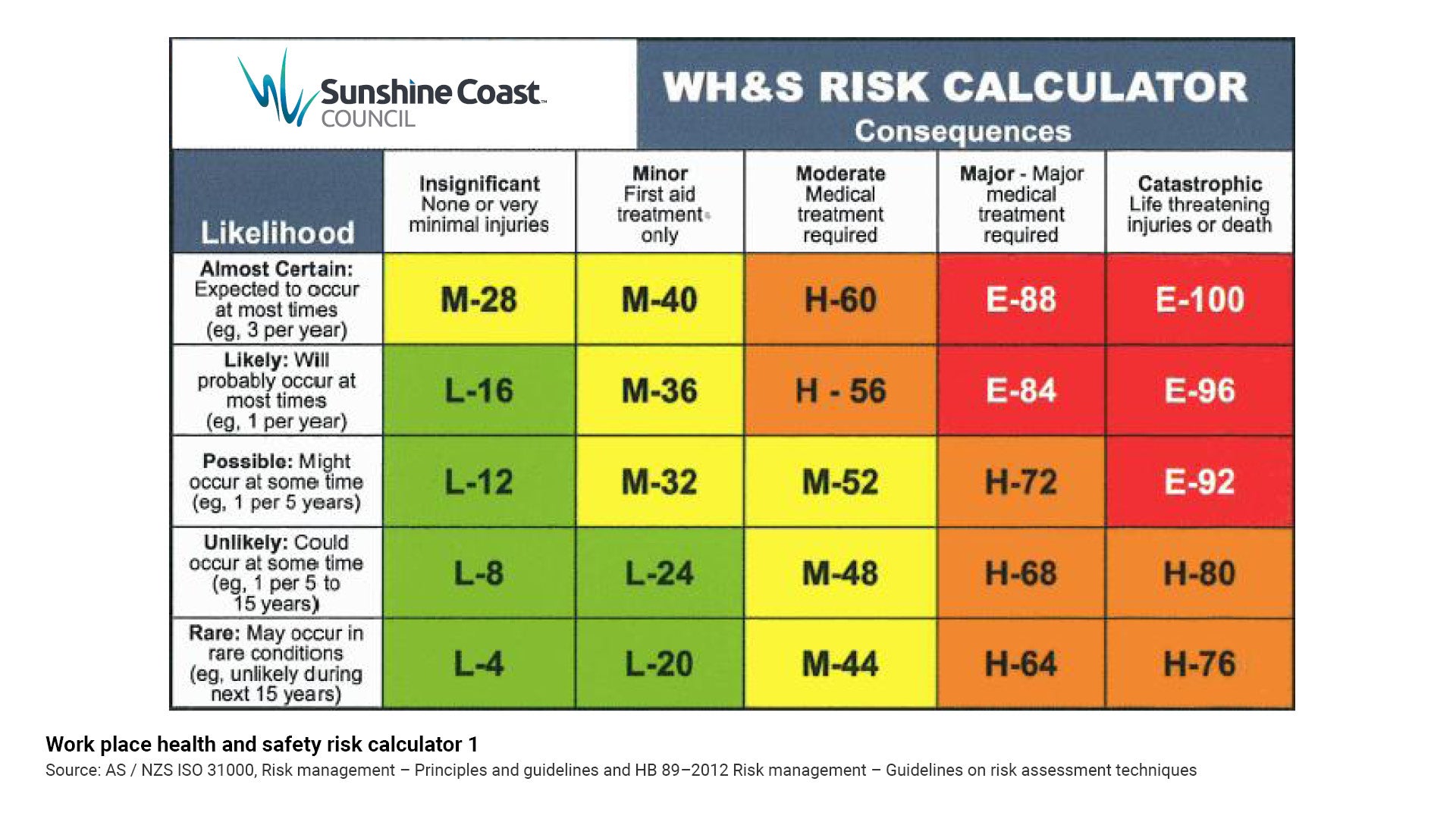
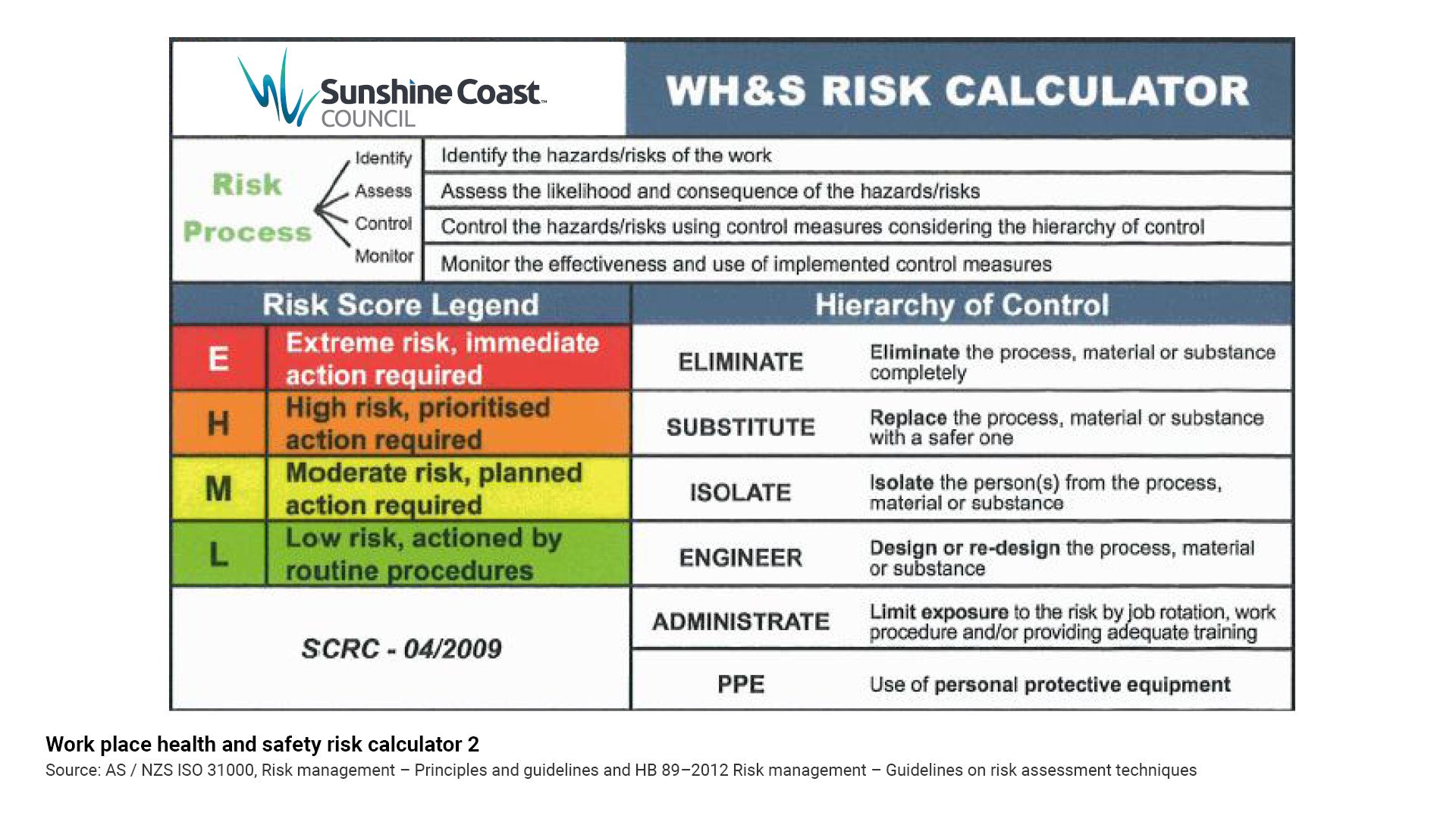
Source: AS/NZS ISO 31000, Risk management – Principles and guidelines and HB 89–2012 Risk management – Guidelines on risk assessment techniques
This component is currently in development