Bollards
Materials, fixings and finishes
Best practice guidance for the selection of materials, fixings and finishes
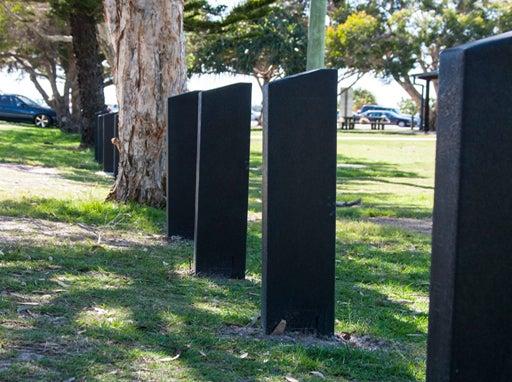
Recycled plastic

Council prefers the use of recycled plastic bollards
- Recycled bollards require minimal maintenance.
- Recycled plastic bollards are to be black or brown to minimise fading.
- Preferred for new builds or replacements.
Timber
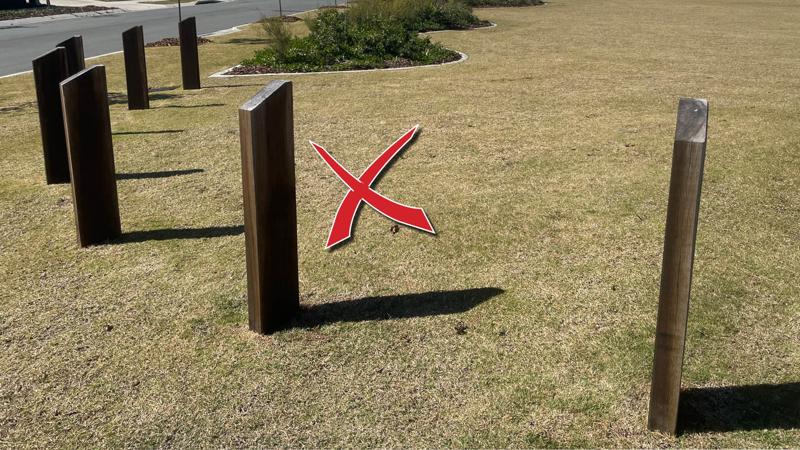
- Timber bollards are NOT preferred because they require a high level of maintenance.
- If specified, timber bollards are to be constructed from a suitable species ‘fit for purpose’ (for example suitable for in-ground subject to severe wetting) – minimum of H4 and free of all splits, knots and twists).
- For timber bollards subject to extreme wetting, minimum H5 and free of all splits, knots and twists (see Table 2: Levels of treatment).
- To determine the most suitable wood species for a particular application consider aesthetics, price, availability, size limitation, ecological impact, hardness, stability and function.
Table 2: Levels of treatment
Hazard level | Exposure | Exposure Conditions | Biological Hazard | Uses |
H1 | Inside above ground | Weather protected, ventilated, termite protected | Borer | Framing, flooring, furniture, interior joinery |
H2 | Inside above ground | Protected from wetting | Borer, termites | Framing, flooring, furniture, interior joinery, in dry conditions |
H2F | Inside above ground | Protected from wetting | Borer, termites | Framing envelope, in dry conditions, south of Tropic of Capricorn only |
H2S | Inside above ground | Protected from wetting | Borer, termites | Plywood, in dry conditions, south of Tropic of Capricorn only |
H3 | Outside above ground | Subject to periodic moderate wetting | Moderate decay Borer, termites | Weatherboard, fascia, pergola posts (above ground), window and door joinery, framing, decking |
H3A | Outside above ground | Predominantly vertical exposure, to be painted | Moderate decay Borer, termites | Fascia, bargeboards, exterior cladding, window and door joinery, non-laminated veranda posts |
H4 | Outside above ground | Subject to severe wetting | Severe decay Borer, termites | Fence posts, greenhouses, pergola posts (in-ground), landscaping timbers |
H5 | Outside, in ground, in contact with fresh water | Subject to extreme wetting | Very severe decay Borer, termites | Retaining walls, piling, house stumps, building poles, cooling tower fill |
H6 | Marine waters | Subject to prolonged immersion in sea water | Marine wood borer, decay | Boat hulls, marine piles, jetty cross bracing. |
Note: Different hazard levels require different preservatives. Source: Timber Preservers Association of Australia
Timber bollards are NOT preferred, however if specified, consider the following:
Timber bollards are NOT preferred, however if specified, Councils preference is for solid block paint colours to minimise maintenance. If a stained finish is used, Council's preference is for the bollard is to be treated with three coats of premium quality decking oil (Ultradeck or equivalent) prior to installation. An additional treatment should be used on top of a bollard to seal and prevent water penetration.
- Local level parks – natural timber with no protective coat treatment or painted finish.
- District and Council wide level parks – option to paint timber bollards with a protective coat treatment.
To assist in the selection of appropriate and serviceable timber species, the following is a list of terms used to describe timber:
- F (force) 14 refers to the working stress of timber in bending i.e. 14 MPA = 14 Megapascals. Colour marking is sometimes used to indicate ‘F’ grade e.g. F14 = orange:
- Durability rating of timber refers to the resistance of heartwood to attack by insects and fungi (e.g. when in ground).
- Durability is expressed as:
- Class 1 - Highly durable
- H3 (above ground exposed) >40 years
- H5 (in ground contact) 25+ years
- Class 2 - Durable
- H3 (above ground exposed) 15-40 years
- H5 (in ground contact) 15-25 years
- Class 3 - Moderately durable
- H3 (above ground exposed) 7-15 years
- H5 (in ground contact) 5-15 years
- Class 4 - Non-durable
- H3 (above ground exposed) <7 years
- H5 (in ground contact) <5 years.
- Class 1 - Highly durable
- Timber hazard classification level is expressed as H1 to H6 and is a guideline to determine which treatment is suitable.
Timber bollards are NOT preferred, however if specified, treatment with a preservative improves the timber’s resistance to attack. After treatment the durability is enhanced to a level suitable for the intended use.
- Generally only the sapwood of hardwood can be penetrated by preservatives.
- Generally the sapwood and some of the heartwood of most softwood species can be penetrated by preservatives.
- Council’s timber preference for bollards is to avoid the use of heartwood, due to the variability of timber preservatives to penetrate this type of timber.
- For bollards which are not in frequent and intimate contact by the public, treatment by chemical preservative application of CCA (chromated copper arsenate) is preferred, alternatively ACQ (alkaline copper quaternary).
- The level of treatment selected must be appropriate for the intended use.
- Different preservatives are used for different hazard levels.
Steelwork
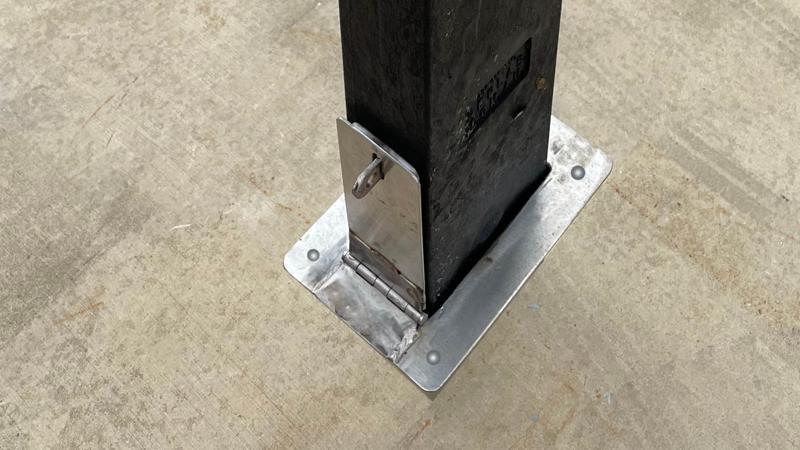
All metalwork and fixings must meet the following criteria:
- Provide a ‘very long term’ (ISO 12944-1) corrosion resistance.
- Steel coating systems must be in accordance with AS 2312 Guide to the protection of structural steel against atmospheric corrosion by the use of protective coatings, for the C5-M Zone as per AS 4312 - Atmospheric Corrosivity zones in Australia.
- Match or exceed the requirements noted in Table SC6.14.8A of the Planning scheme policy for development works.
- Where metallic surfaces are painted following the above treatment, this is to be done with a 2-pack epoxy paint, (powdercoating of steel work is not accepted).
- All stainless steel elements must be treated with a clear surface protectant to protect against discolouring and tea staining.
This component is currently in development