Bicycle racks and rails
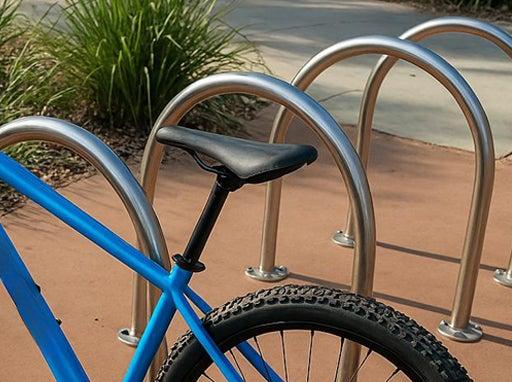
Design
Requirements for the design, manufacture and installation of embellishments
Good design
See the following corporate documents to identify relevant project design requirements:
Sunshine Coast Planning Scheme regulates the way land, buildings and structures are used and developed on the Sunshine Coast.

Sunshine Coast Design contains 10 design principles that guide good project planning and design outcomes, that are appropriate for the Sunshine Coast.
The LIM provides further overarching design advice, refer:
- Introduction and Design Principles - e.g. sustainability, CPTED, accessibility
- Preliminaries - environmental management, tree sensitive design and site set up.
Embellishment requirements
- Universal access.
- Comfortable and suitable for the average person.
- See 'Positioning' and 'Equal access' sections for the corresponding LIM category.
- Made from materials that will be durable and can be suitably protected from exterior elements, such as salt spray and UV exposure.
- Robust and sturdy to withstand constant public use and be resistant to vandalism.
- Fixings are to be 316 marine grade stainless steel (unless otherwise stated).
- Tamper proof fixings should be used
- Graffiti protection coatings applied (where applicable)
- Fire retardant (where applicable).
- Warranties should be as listed below.
- Easily repairable or replaceable.
- Sourced locally and use standard fittings.
- Reputable suppliers should be used who keep a supply of stock parts on hand for the life of the product.
- Use sustainable materials, although sustainability needs to be considered over the lifetime of the embellishment.
- Install on paved, concrete or other hard surfaces (where applicable).
- Manufactured to engineering specifications (where applicable).
- See the 'Standards' section for the corresponding LIM category.
Warranty and asset life
Product/embellishment | Warranty (minimum) | Asset life (typical useful life) |
Bicycle racks and rails | 2 years | 15 years 2 |
Source 2: Sunshine Coast Council Asset Management Plan 2017/18-2022/23 – Parks and Gardens (figure based on current data, subject to change).
Bicycle racks and rails
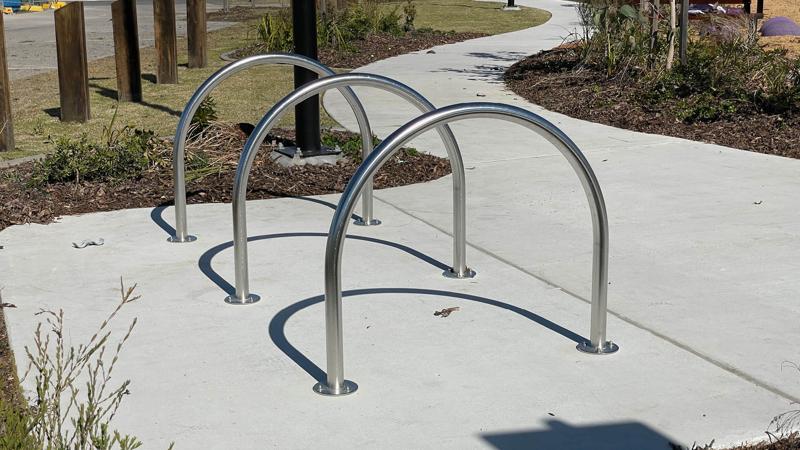
Once the location of the bike rack or rail has been decided, based on the Environment and Liveability Strategy (ELS) and Recreation Parks Plan (RPP) guidance, consider the appropriate embellishment level to suit the selected site.
Overarching design considerations:
- All open spaces should include universal access (e.g. accessible bike rails and movement around furniture)
- BPDs should consider all types of bicycles in the design and layout.
- All bicycle parking devices (BPDs) must provide safe and secure access for both the user and the bicycle.
The design of bicycle parking devices (BPDs) must accommodate and support a standard bicycle with sufficient space to minimise damage while parking and during movement into or out of the space
Parking security levels for bicycles
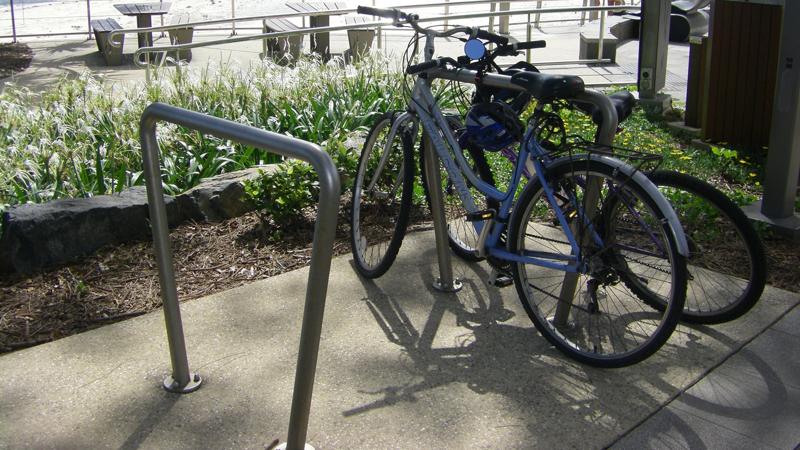
Bicycle parking facilities are classified by the level of security provided for the parked bicycle.
The focus of this document is to provide guidance for Security Level C bicycle parking devices (BPDs) – bicycle rails.
When determining the appropriate security class and quantity of BPDs, consideration must also be given to aesthetics and durability for each site.
AS 2890.3:2015 – Parking facilities provides 3 levels of bicycle parking security:
- Level A – a transport hub: these are fully enclosed, weather protected individual bicycle lockers with a high security locking mechanism.
- Level B – destination parking/all day parking/resident parking / restricted access (such as a school): These bicycle rooms and compounds are protected from the weather and accessed via key, codes or swipe cards BPDs are provided within the compound to allow secure locking of the bicycle frame and wheels of all bicycles. For individual cages, users may provide their own locking devices.
- Level C – short term parking on-street or off-street. (This level is not appropriate for longer than 2 hour parking): a bicycle parking space where the frame and both wheels can be locked to a BPD using the owner’s locking device.
Envelope spacing for bicycles
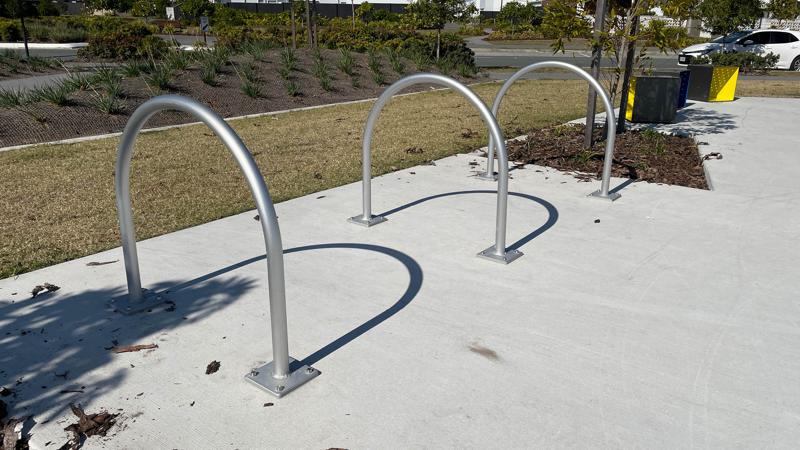
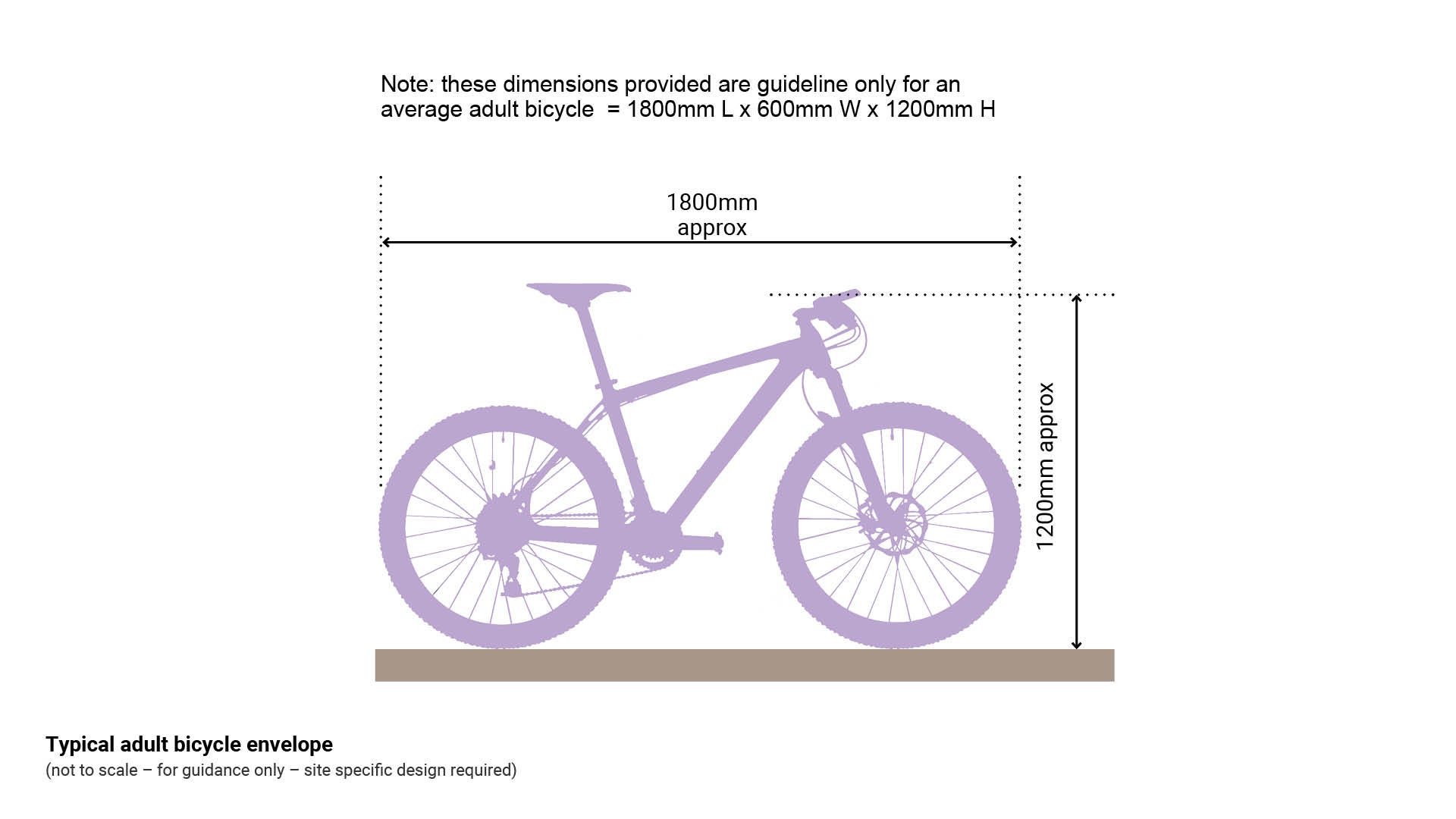
For static rails, dimensions are to comply with the bicycle spacing envelope.
- The envelope allows the cyclist access to lock both front and back wheels easily and to remove accessories such as lights and panniers.
- Handlebars will protrude beyond the envelope.
See the following for further guidance:
- AS 2890.3:2015 – Parking facilities – Bicycle parking.
- Figure 1: Typical adult bicycle envelope.
Figure 1: Typical adult bicycle envelope
Bicycle racks versus bicycle rails
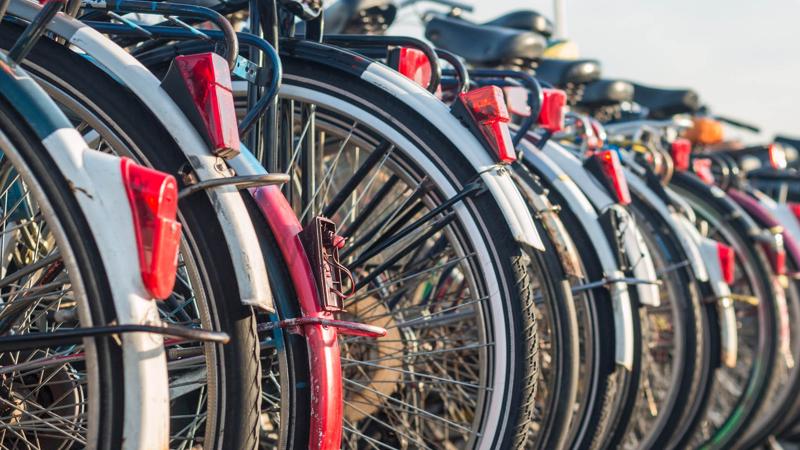
- The installation of single or multiple bicycle ‘rails’ is preferred over bicycle ‘racks’.
- Rails provide support to the bicycle frame and both wheels.
- Racks provide minimal support to the bike frame.
- Bicycle rails must have a minimum width between legs of 800 mm (small hoop designs are non-compliant).
Design of a bicycle rail
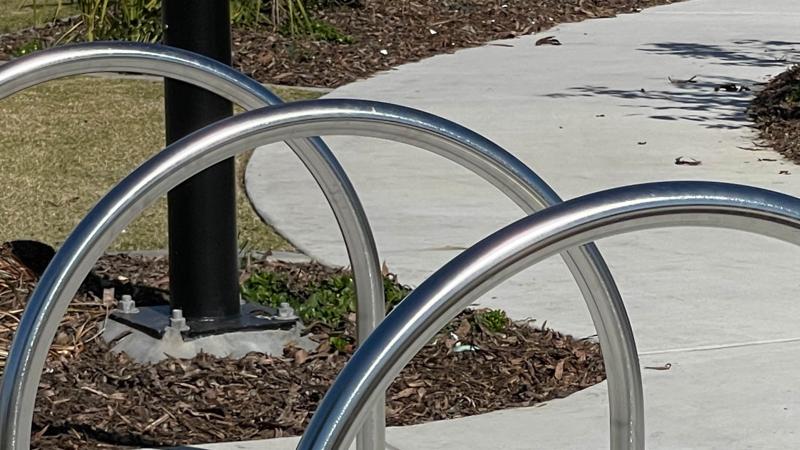
- Set out of bicycle rails near to a road or car park must include offsets as per Australian Standards to increase cyclist safety when tying up or untying bicycles.
- Bicycle rails should provide parking for two bicycles, one bicycle each side of the rail (where possible).
- Each bicycle is to be secured by both the front and back wheel, and the frame.
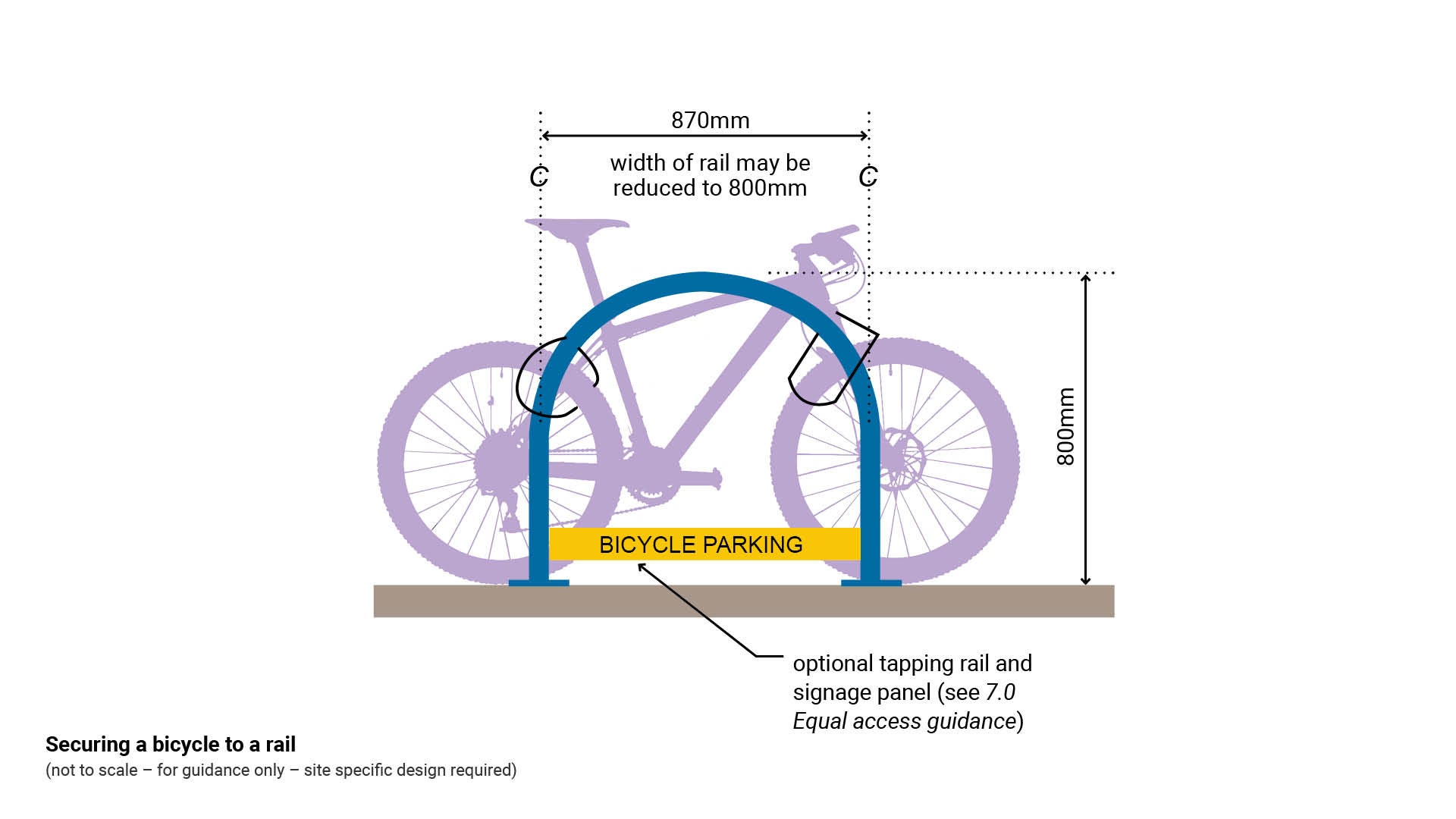
- Council recommended bicycle rail dimensions:
- Height 800 mm for improved stability.
- Bicycle rails must have a minimum width between legs of 800 mm.
- Floor surfaces for bicycle rails should have a maximum slope of 1 in 20 (5%) and be well drained.
See Figure 2: Securing a bicycle to a rail.
Figure 2: Securing a bicycle to a rail
Maintenance
- The design should have minimal joins to decrease vandalism and reduce maintenance.
- Bicycle rails designed for surface mounted installation can be easily relocated or replaced where necessary.
- A bolt down option must not include shear bolts (a shear bolt head can be intentionally sheared off to make extraction difficult). All bolt down options must use anti-vandal ‘armour rings’ or equivalent.
- A set in-ground option is available for added stability.
Materials, fixings and finishes
- Bike rails must be 316 marine grade stainless steel (e.g. satin brush finish).
- Powder-coating, 2 pack epoxy or painted surfaces are NOT accepted due to the paint chipping, requiring ongoing maintenance.
- Fixings are to be 316 marine grade stainless steel.
Tapping rail/signage panel (optional)
- An additional sign panel may be installed on the bicycle rail where the rail is located near a continuous path of travel, in order to alert white cane users of the presence of the bicycle rail.
- White cane users sweep the cane along the ground in a 180 degree angle to detect obstacles. Where there is no horizontal warning bar, they may walk straight into the bicycle rail.
This component is currently in development