Requirements for the integration of equal access for all users
The Disability Discrimination Act (DDA) defines ‘premises’ as the whole of the built environment and includes existing buildings, new or proposed buildings, transport systems, car parks, pathways, and public parks and gardens.
Note: Consult an access consultant accredited by the Association of Consultants in Access Australia (ACAA).
Embellishments must be designed in accordance with AS 1428 Design for access and mobility.
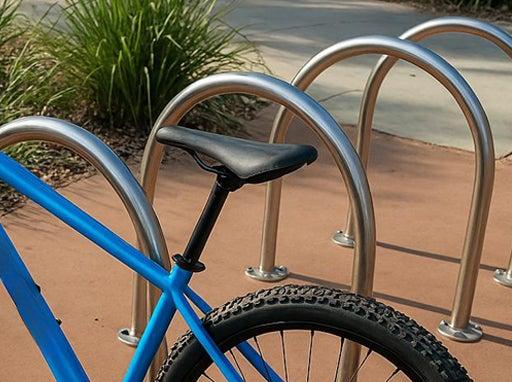
Bicycle rails located in public places should not be placed in pedestrian desire lines. If rails are not set back from primary pedestrian accessways then TGSIs are to be installed as per AS/NZS 1428.4.1.
Ensure that bicycle rail slabs are connected to a continuous accessible path of travel (CAPT) to enable equal access for people who use wheelchairs. Ensure that the path of travel is connected to an accessible car park space.
Install bicycle rails so that the minimum clear passage for pedestrians between a parked bicycle and any other obstruction is 1.2 m (where possible).
Install bicycle rails in consistent locations for ease of recognition by people with vision impairment.
When retro-fitting a bicycle rail, consider the location of existing embellishments. If there is insufficient circulation space, a new location may be required.
Avoid finished height difference between a concrete slab and adjoining surfaces to prevent trip hazards and to prevent ‘tramlining’ of pram, bicycle and wheelchair wheels.
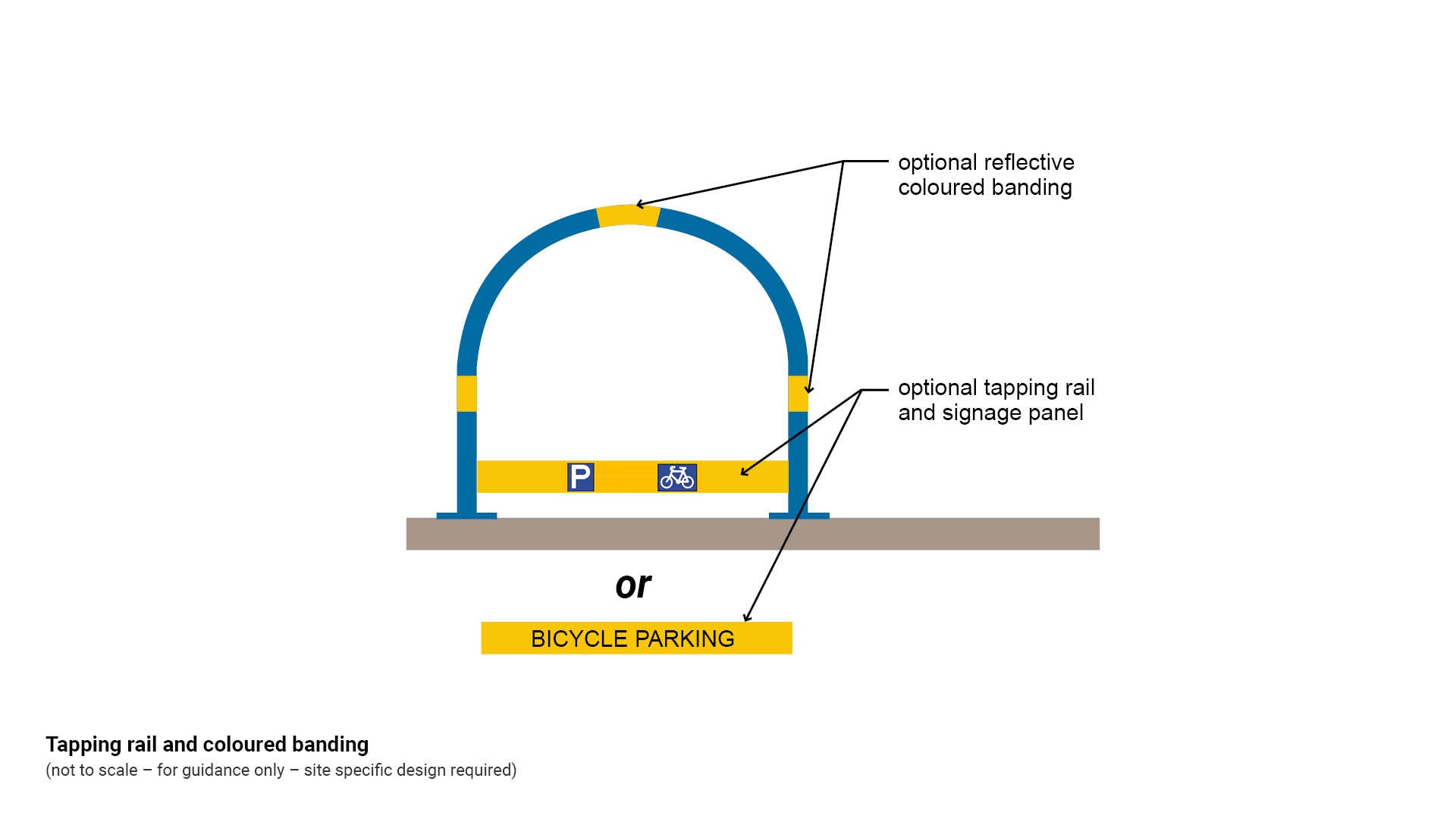
Use a sign panel integrated into the bicycle rail (tapping rail) where the rail is located near a continuous path of travel, in order to alert white cane users to the presence of the bicycle rail.
White cane users sweep the cane along the ground in a 180 degree angle to detect obstacles. Where there is no horizontal tapping rail, they may walk straight into the bicycle rail.
Consider other bicycle requirements such as recumbent bicycles and tricycles (nominal 2.0 m long x 1.3 m high x up to 1.0 m wide) when designing bicycle rails.
Where bicycle rails are installed adjacent to public accessways they should have a colour contrast to the background surface to enhance detection by people with low vision.
For people with a vision impairment, provide a minimum 30% luminance contrast between objects and the background they are viewed against, for ease of identification.
Where luminance contrast may not be achieved (such as grey aluminium furniture on grey concrete), luminance contrast can be addressed by introducing colour into the ground surface providing a minimum 30% luminance contrast with the embellishment base, resulting in the embellishment being more visible for people who have low vision.
Consider designing nodes with a contrasting coloured concrete, or a variation in surface texture, to enable people with a disability to identify the location of embellishments along a pathway.
Where BPDs include a tapping rail consider reflective colour contrast bands and information signage to enhance detection by people with low vision.
It is preferred that any colour contrast bands are not reflective tape but permanently coloured, or coloured, patterned stainless steel bands.
See Figure 5: Tapping rail and coloured banding.
Figure 5: Tapping rail and coloured banding
Page payload data
This component is currently in development
Sunshine Coast Open Space Landscape Infrastructure Manual (LIM) DISCLAIMER
Disclaimer
Information contained in this document may change without notice and you should use the current material available from Council’s website and not rely on material previously printed or stored by you.
All figures and diagrams are intended to be used as an aid to design and include Council’s preferred elements but they are not intended to be prescriptive and may need to be varied as dictated by site specific factors. While Council has exercised reasonable care in preparing this document, it does not warrant or represent that it is accurate or complete. The Council will not accept responsibility for any loss, damage, cost or expense that you may incur as a result of the use of or reliance upon any material contained in this document.
This document is produced to convey general information and is not intended to constitute advice whether professional or legal. Any reference to legislation in this document is not an interpretation of the law. It is to be used as a guide only. Consult relevant authority websites for current documents, revisions and amendments.
Where a particular product or supplier is profiled in this document, Council is NOT nominating this product or supplier as the selected choice. Product/supplier information has been provided to allow users to source products which contain the correct elements required for Council embellishments. Each product profiled states ‘or equivalent’ which means that different products may be supplied provided they satisfy the identified performance criteria, recommended standards, equal access guidance and product specifications.
Product design, manufacture and installation requires appropriately qualified people to provide site specific solutions to ensure the embellishment is appropriately adapted to local conditions and data.
This document does not override requirements stipulated in a development approval. Project specific variations may be appropriate as a result of site, environmental or other constraints. Any variations to these standards must be approved in writing by council prior to commencement of variation works. Components of this document may be used within a contract document but users should undertake their own investigations to confirm the information is suitable for this purpose.
Drawings contained in this document are NOT FOR CONSTRUCTION.
Details in this document are deemed to be the minimum standard and the user may wish to apply a higher standard subject to approval by council.
Acknowledgements
Council wishes to thank all contributors and stakeholders involved in the development of this document.
Copyright
Sunshine Coast Regional Council (Council) supports and encourages the distribution of its material however, copyright protects this document. Council has no objection to this material being reproduced but only if council is recognised as the owner of the copyright and this material remains unaltered.