Handrails and balustrades
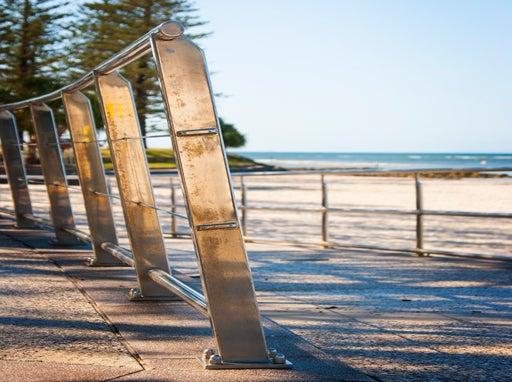
Materials, fixings and finishes
Best practice guidance for the selection of materials, fixings and finishes
Overview
All materials, fixings and finishes must be made from robust heavy duty materials that are vandal and corrosion resistant and suitable for use in public places.
Materials must be manufactured and constructed to operate in exposed, high energy environments to achieve the required design life.
Select stainless steel considering the following:
- True grade stainless steel has been graded by ASSDA (Australian Stainless Steel Development Association), and manufactured by an ASSDA accredited manufacturer.
- Stainless steel components must be manufactured to engineering specifications (where applicable).
- 316 marine grade stainless steel is required in coastal areas east of Bruce Highway
- note that stainless steel is low maintenance and has a longer asset life
- other material such as 304 marine grade stainless steel and galvanised steel may be selected for use in hinterland areas west of the Bruce Highway.
Wire barrier infill
- Stainless Steel horizontal wire barrier must comply with installation provisions of the BCA (Building Code of Australia) and is not preferred due to ongoing maintenance requirements to re-tension loose wires. This option is available at the designer's discretion.
- Where stainless steel wire barrier is used, tamper proof fittings to terminations are required. Add clamps at intervals along horizontal wires to deter theft.
- Zig-zag wire barrier design is not preferred as it is installed as a continuous section which creates difficulties with replacement of damaged sections.
Flat sheet steel barrier
- Consider perforated metal sheeting with bespoke/patterning/colouring for barrier adjacent to cycleways. Examine the extra cost involved.
Fixings and fasteners
Fixing must be in accordance with the relevant Australian Standards:
- All steelwork is to be true 316 marine grade stainless steel, particularly coastal sites east of the Bruce Highway.
- For hinterland sites west of the Bruce Highway, true 304 marine grade stainless steel fixings are appropriate.
- For other applications hot dipped galvanised steel may be suitable.
- Fixings are to include flat washers, spring washers and nuts, secured with thread lock compound or Nyloc nut or equivalent (suitable for removal by hand tools). This will prevent loosening of nuts and loss of structural integrity, while allowing replacement of parts.
- Nyloc nuts (or equivalent) are a type of lock nut which contains a nylon collar insert that resists turning. These are preferred to prevent release or loosening of thread joints due to vibration, corrosion or temperature fluctuations.
- Dyna bolts must be installed and tightened to manufacturers recommendations to ensure they do not work loose.
- At locations where bolts would be in contact with corrosive materials (treated timber) or in pivot points, pre-grease all bolts with Lanotec lubricant grease (or equivalent) prior to installation. Remove excess grease from end of thread before applying locking compounds.
- Excess bolt protrusion is to be covered with a dome nut, to reduce risk of persons scalping skin when walking past.
- Metal brackets are to be flush and free of sharp protruding edges, to avoid injury.
- All fixings (fasteners) are to be checked for tightness prior to handover, and re-tightened where required.
Fixings for treated timber
- Minimum HDG bolts (may rust in CCA treated hardwood and pine)
- Dip HDG bolts in Dulux Durebuild GPE ZP (or equivalent) and drill oversize holes.
- HDG especially with cut edges will corrode (within 8-10 km of salt water).
- Select true 304 or 316 marine grade stainless steel bolts and stainless steel washers and nuts.
Finishes
Metalwork
- Provide ‘very long term’ (ISO 12944-1:2017 Paints and varnishes Corrosion protection of steel structures by protective paint systems) corrosion resistance.
- Steel coating systems must be in accordance with AS 2312 Protection of structural steel against atmospheric corrosion, for the C5-M Zone per AS4312 - Atmospheric Corrosion Zones.
- Match or exceed the requirements noted in Table SC6.14.8A of the Sunshine Coast Planning scheme policy for development works.
- Where metallic surfaces are painted following the above treatment, this is to be done with a 2-pac paint (powdercoating of steel work is not accepted).
Welding
- All welding shall comply with AS/NZS 1554 Set: 2010 Structural steel welding (Set).
- All welds to be category SP (Structural Purpose) unless otherwise shown.
- Welding consumables are to be marine grade 316 L for 316 L and 316 base metals.
- Structural Purpose (SP) welds are defined as:
- having tighter constraints on permissible level of welding defects and higher inspection levels than GP (general purpose).
- a higher load carrying capacity is permitted due to increased confidence in the weld quality.
- generally selected where the weld is subject to dynamic loading within the limits specified in AS/NZS 1554.1:2011 Welding of steel structures.
Corrosion protection
Corrosion is the oxidation (breaking down) of a metal substance. A barrier such as paint provides a protective coating which prevents water or oxygen from coming into contact with the metal.
All metal used in structural timber connections is to include corrosion protection appropriate for the particular conditions of use.
- Where corrosion protection of steel is required it is to be in accordance with the relevant Australian Standards.
- The level of corrosion protection provided must take into consideration weather exposure, timber treatment, moisture and presence of salt.
- The minimum corrosion protection applied to metal fixings is to be Z 275 (zinc coating measured in grams/m2).
- The minimum steel grade for metal fixings is to be G 300 (hot dipped zinc coated structural steel with a minimum yield strength of 300 Mpa).
See Table 2: Materials suitable for handrails and balustrade.
Table 2: Materials suitable for handrails and balustrade
Materials | Key considerations |
Stainless steel (316 marine grade) |
|
Galvanised steel |
|
Aluminium (marine grade) |
|
Recycled plastic and fibre composite materials |
|
Timber (new and recycled) |
|
Stainless steel grade/finish
The choice of grade and finish stainless steel is determined by the application, the desired aesthetic outcome, and maintenance considerations.
Corrosion resistance
The smoother the surface the higher the corrosion resistance, resulting in reduced maintenance.
Tea staining
The first sign of corrosion of stainless steels in marine applications is often a brown discolouration called tea staining.
Tea staining is a discolouration of the surface that does not affect the structural integrity or longevity of the material. Rough surface finishes promote tea staining.
Applied coatings of a clear nylonic polymeric resin such as Nycote (or equivalent) are not a preferred option. They may increase corrosion resistance however they must be applied frequently.
Glare
Glare can be described as extreme brightness.
Blinding glare results from light reflecting off smooth, shiny surfaces. It can block vision to the extent that the person's vision is compromised.
Consider the effects of glare when selecting materials which will be exposed to high levels of natural lighting.
See Table 3: Stainless steel finishes.
Table 3: Stainless steel finishes
Finish | Attributes/advantages | Disadvantages | Common use |
No 4 - brushed |
|
|
|
No 8 - mirror |
|
|
|
Colouring |
|
|
|
2D - satin NOT suitable for open space application –included for information only |
|
|
|
2B - matt NOT suitable for open space application –included for information only |
|
|
|
BA or No. 2BA NOT suitable for open space application –included for information only |
|
|
|
This component is currently in development