Handrails and balustrades
Positioning
Best practice guidance for the placement and arrangement of embellishments
Site setout
Orientation
- Handrail and balustrade should be located to facilitate the safe use of pedestrian access areas.
- Consider potential flood debris blockages when handrail and balustrade is installed across a waterway.
- Flood modelling may be required to assess impacts.
- Partial barrier or collapsible balustrade may manage impacts.
Clearances
Handrail terminations
Where the ramp or stairs handrail abuts a continuous accessible path of travel (CAPT):
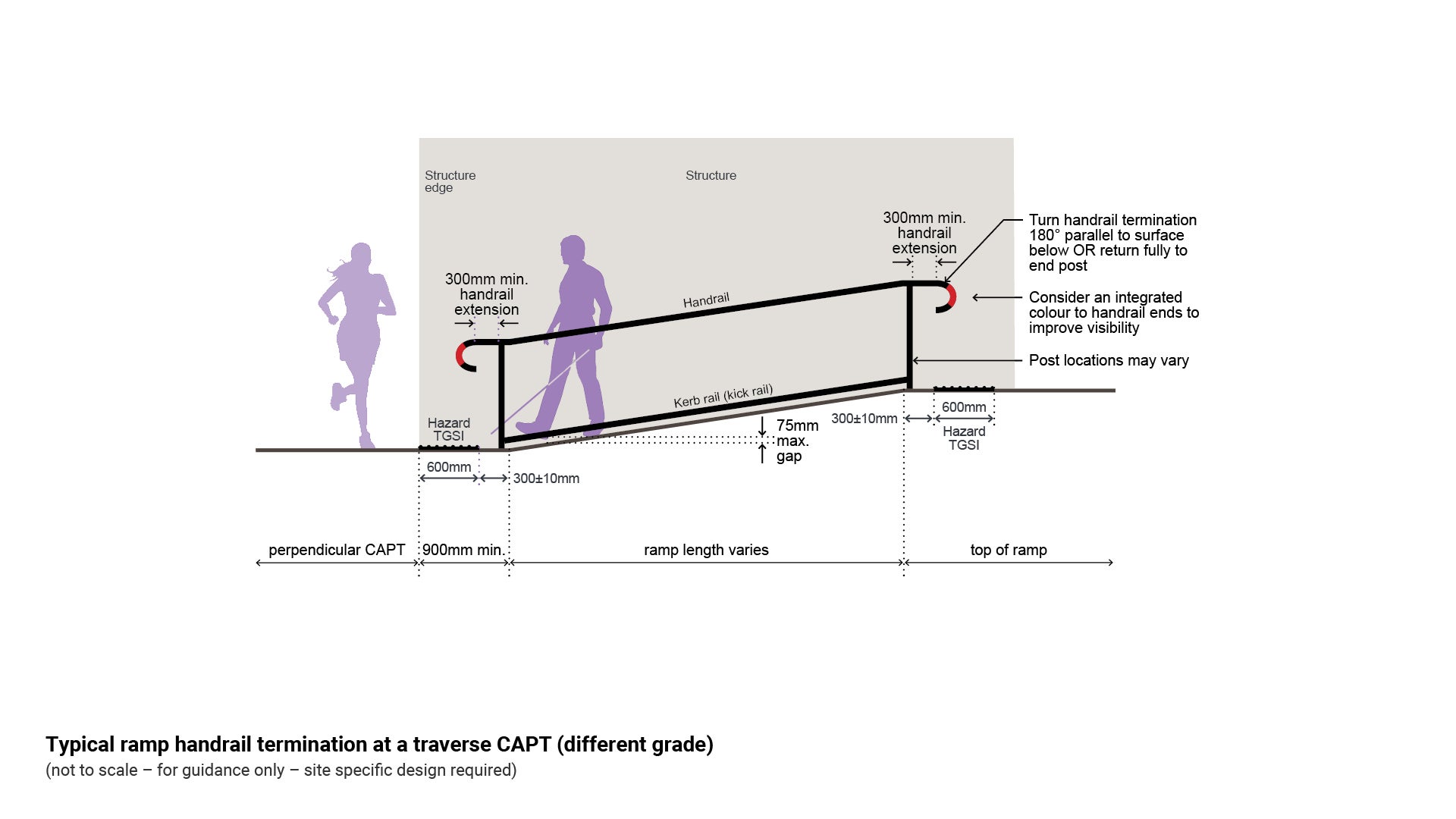
- Handrail return and tactile ground surface indicators must not encroach upon the traverse path of travel to prevent potential pedestrian injury.
See the following for further guidance:
- Table 4: Pedestrian and cyclist handrail offsets
- Figure 4: Typical ramp handrail termination at a traverse CAPT (different grade).
Figure 4: Typical ramp handrail termination at a traverse CAPT (different grade).
Handrail | Distance from | Minimum distance | Reason |
Pedestrian ramp handrail return clearance to CAPT (where the ramp is at a different grade to the path). | Traverse path of travel | 900 mm | For pedestrian/cyclist safety |
Pedestrian handrail return clearance to CAPT (where both paths are at the same grade). | Traverse path of travel | In-line | For pedestrian/cyclist safety |
Pedestrian stairs handrail return clearance to CAPT (where the stairs are at a different grade to the path) | Traverse path of travel | Dependent on stairs design | For pedestrian/cyclist safety |
Figure 4: Typical ramp handrail termination at a traverse CAPT (different grade)
Encroaching handrail termination at the same grade as a CAPT
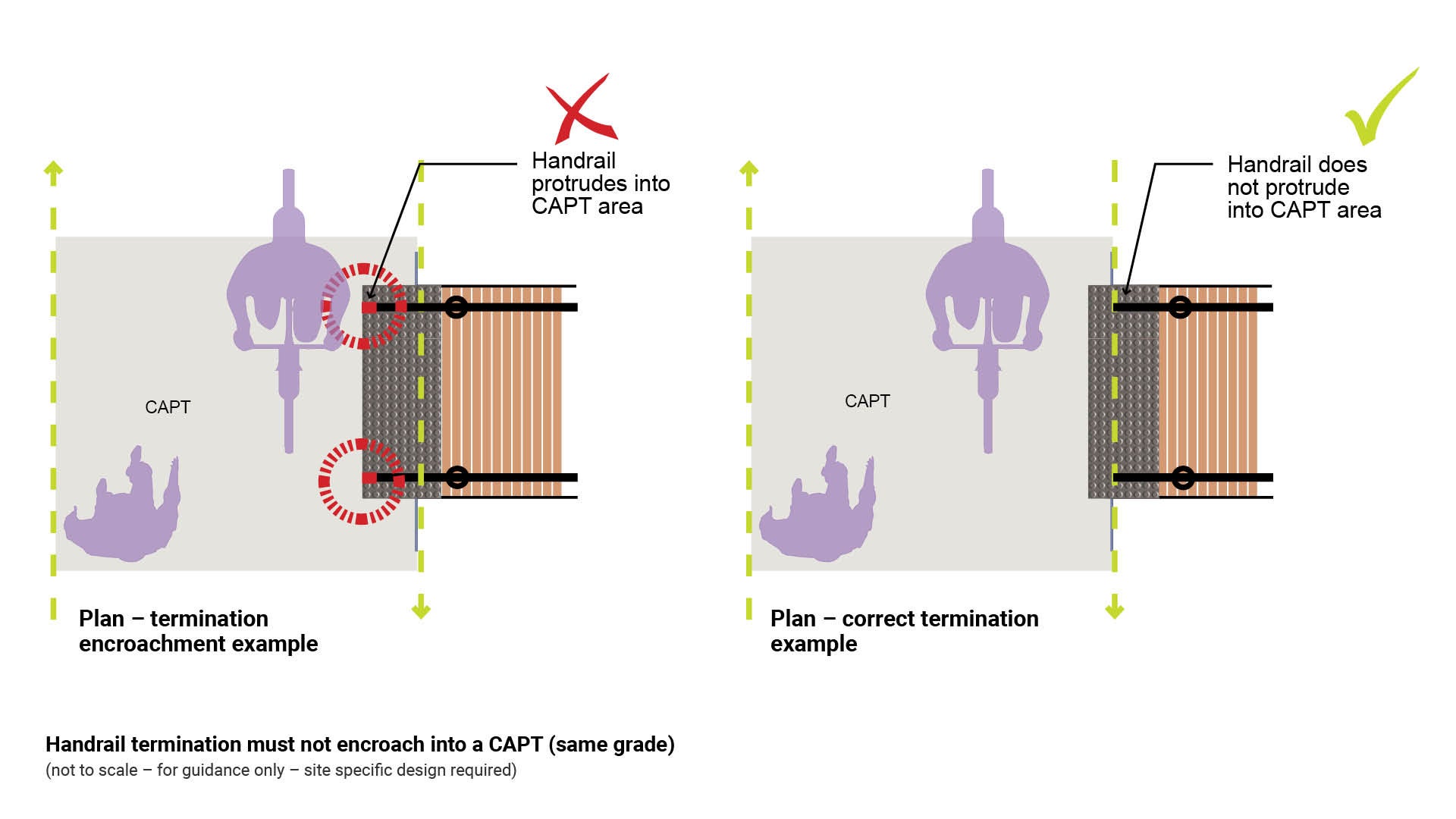
Where an existing handrail post encroaches into a traverse CAPT (continuous accessible path of travel), consider that:
- The handrail may create a hazard for cyclists, injured people, older people, people with low vision and disabled people.
- Add high visibility tape or paint to an existing handrail to improve visibility.
See Figure 5: Termination must not encroach into a traverse CAPT (same grade).
Figure 5: Termination must not encroach into a traverse CAPT (same grade).
Handrail termination at the same grade as a CAPT
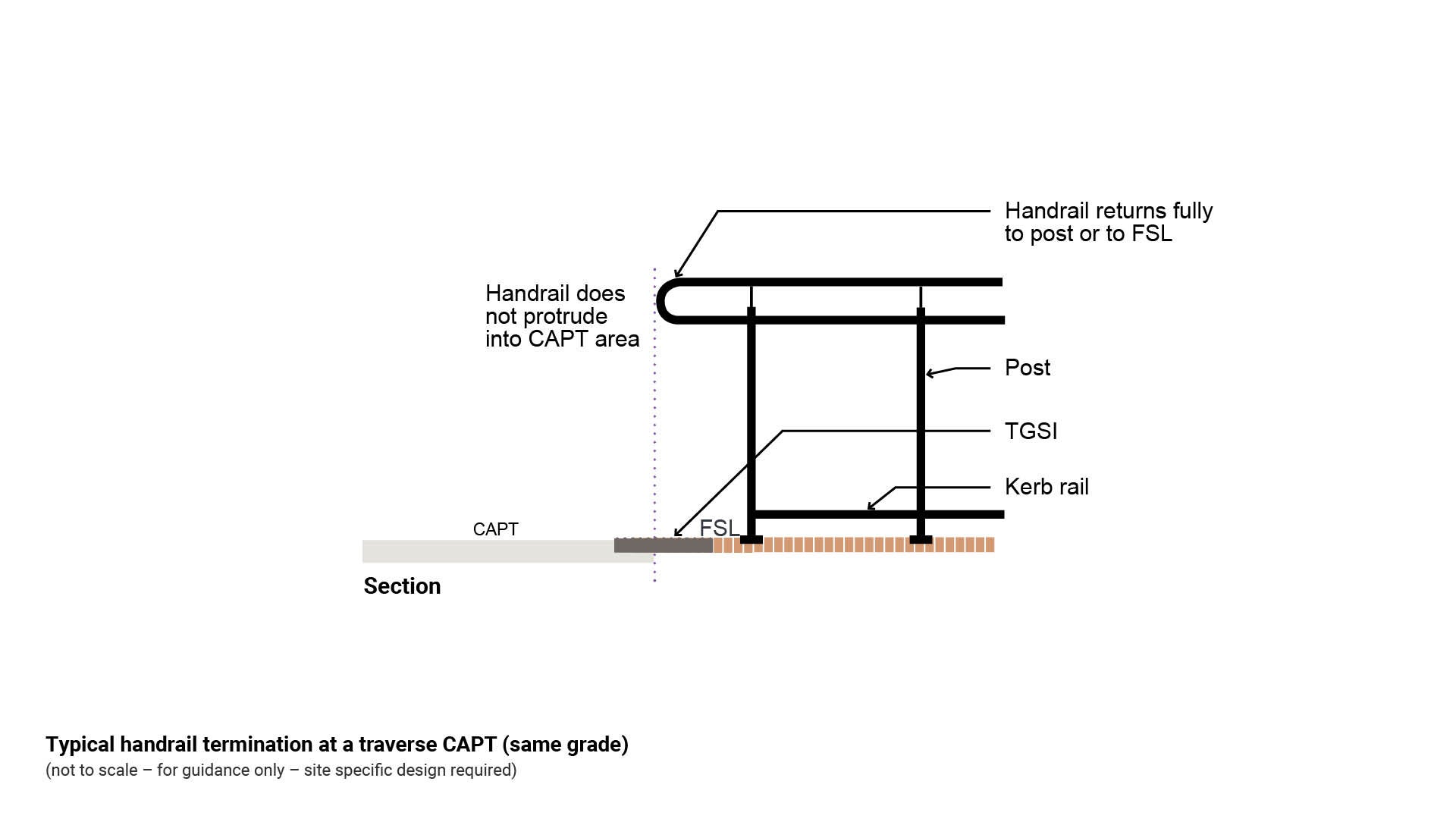
Where a boardwalk or bridge with handrail and the connecting CAPT are at the same grade:
- The handrail return must not encroach into the connecting CAPT to minimise risk to pedestrians.
- It is preferable to return the handrail fully to the final post which should be set back a sufficient distance to ensure that no part of the handrail return protrudes into the CAPT.
- Select an integrated stainless steel colour system to improve new handrail visibility.
- TGSI should not encroach into path of travel (where possible).
See Figure 6: Typical handrail termination at a traverse CAPT (same grade).
Figure 6: Typical handrail termination at a traverse CAPT (same grade).
Stairs termination at a CAPT
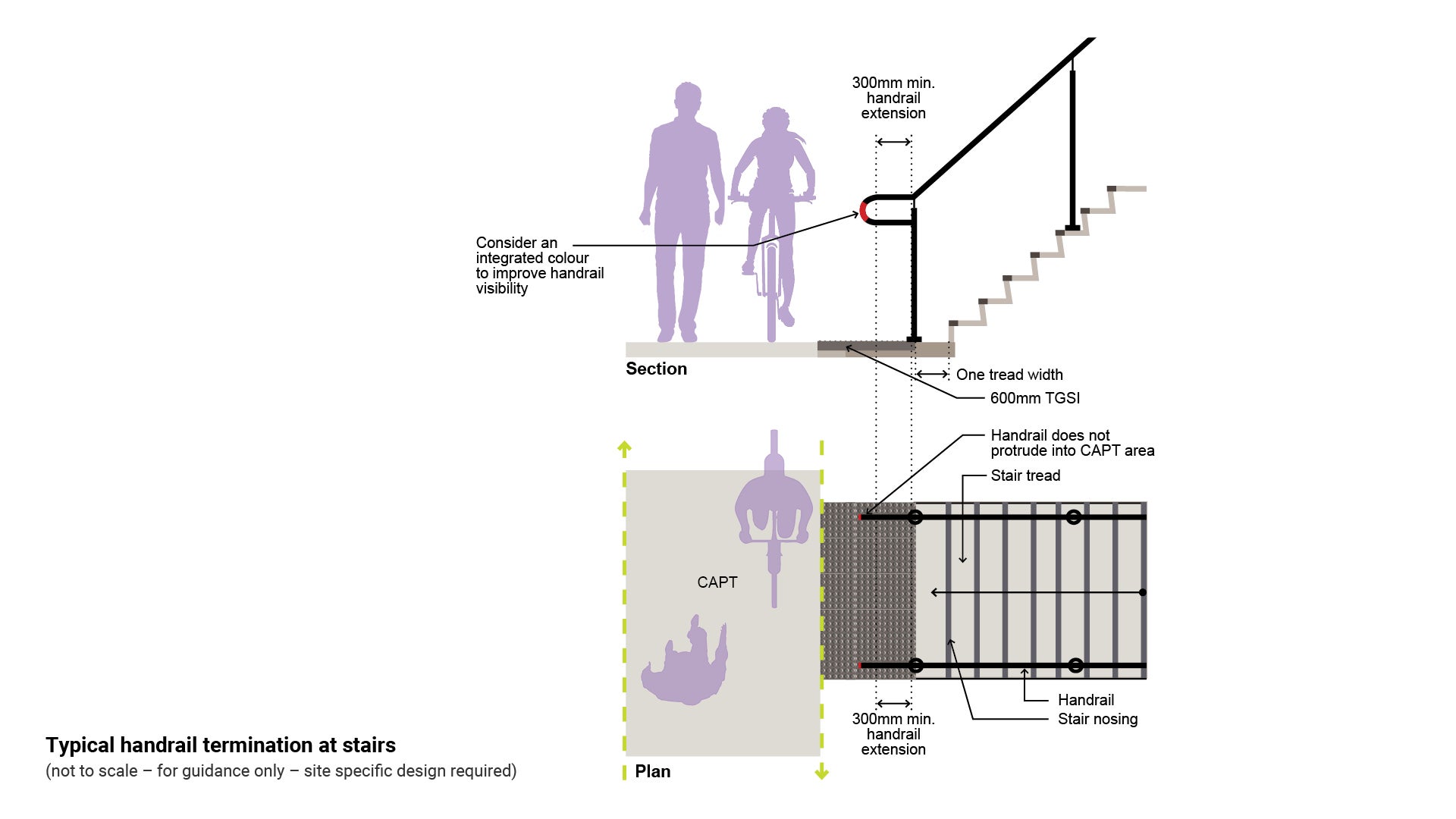
Stairs and handrail design must include consideration of any traverse path to ensure that the resulting handrail termination does not encroach into the continuous accessible path of travel (CAPT):
Handrail terminations within a CAPT have the potential to present a hazard for path users.
- Design stairs so that the run of stairs commence a minimum full stair tread width off the perpendicular path of travel (to allow the balustrade post to be positioned outside the path of travel).
- Handrail return must not encroach into path of travel.
- TGSI should not encroach into path of travel (where possible).
See Figure 7: Typical handrail termination at stairs.
Figure 7: Typical handrail termination at stairs.
This component is currently in development