Tactiles
Equal access
Requirements for the integration of equal access for all users
The Disability Discrimination Act (DDA) defines ‘premises’ as the whole of the built environment and includes existing buildings, new or proposed buildings, transport systems, car parks, pathways, and public parks and gardens.
Note: Consult an access consultant accredited by the Association of Consultants in Access Australia (ACAA).
See Clear Focus – The Economic Impact of Vision Loss in Australia in 2009 by Access Economics Pty Ltd June 2010. The majority of people who are vision impaired have some vision. Sufficient luminance contrast in the selection of TGSI enhances access for everyone.
Elements required for equal access
Select TGSI which comply for design dimensions and installation with the provisions of AS 1428.4.1:2009 Design for access and mobility: Means to assist the orientation of people with vision impairment – Tactile ground surface indicators.
- Professional interpretation and judgement is required to determine the type of TGSI most suitable for installation.
- Consider both the beginning and the end of a journey, together with a safe path of travel through the built environment. Consider carefully where you are directing people.
- Consider that uneven surfaces such as TGSI can be detrimental to the balance and secure footing of people with the following:
- various musculoskeletal disease such as arthritis and osteoporosis
- multiple sclerosis
- cerebral palsy
- lower limb or foot deficiencies
- frail, older people.
- Avoid finished height difference between a concrete slab and adjoining surfaces to prevent trip hazards and to prevent ‘tramlining’ of pram, bicycle and wheelchair wheels.
- Consider that people who use wheelchairs may also experience further discomfort when crossing over tactiles.
- Consult an access consultant accredited by the Association of Consultants in Access Australia (ACAA) to determine an appropriate solution.
- Consider the use of alternative products such as Lumo Solutions Buttons (or equivalent) and Trackntrim (or equivalent) to increase legibility of infrastructure for people with low vision.
Visual/sensory wayfinding
- For people with a vision impairment, provide a minimum 30% luminance contrast between objects and the background they are viewed against, for ease of identification.
- Where luminance contrast may not be achieved (such as grey aluminium furniture on grey concrete), luminance contrast can be addressed by introducing colour into the ground surface providing a minimum 30% luminance contrast with the embellishment base, resulting in the embellishment being more visible for people who have low vision.
- Consider ‘glow in the dark’ TGSI products to enhance tactiles visibility for people with low vision.
- Apply luminance contrast requirements to determine the appropriate TGSI colour for the background material.
- Select more than one TGSI colour where required to provide effective luminance contrast.
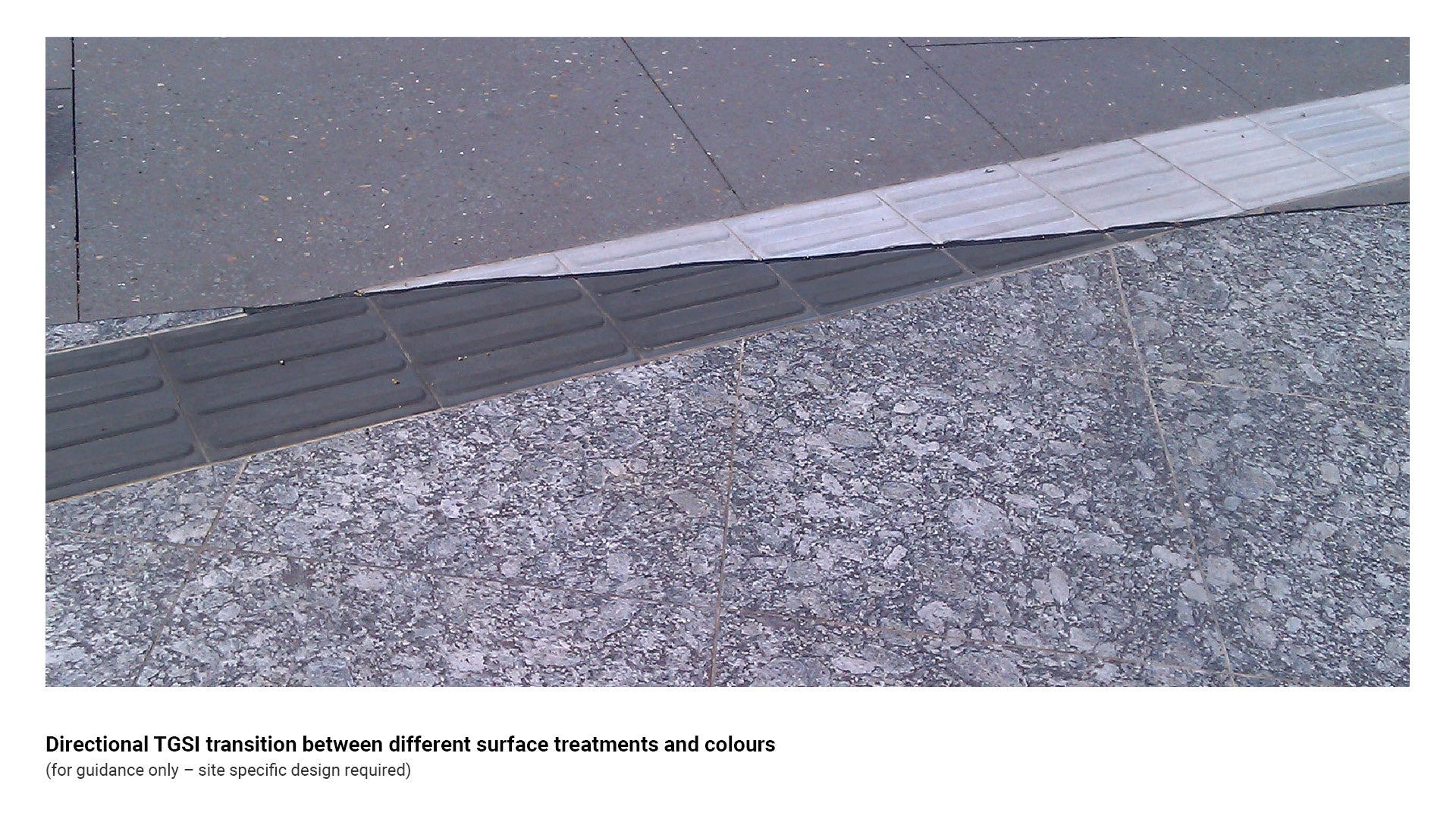
See Figure 25: Directional TGSI transition between different surface treatments and colours.
Figure 25: Directional TGSI transition between different surface treatments and colours
This component is currently in development