Tactiles
Standards
Compliance requirements for embellishments
Note:
- Where Australian Standards or part thereof have been adopted by legislation, they are a legal requirement.
- This list may not be exhaustive. Please refer to the relevant authority websites for updated information and current document distribution dates. These documents are subject to amendments from time to time.
Legislation
Refer Legislation for guidance.
Australian Standards/industry guidelines
National Construction Code (NCC)
The embellishment shall be developed in accordance with the NCC (current edition):
- Building Code of Australia (BCA) Volumes 1 and 2
- Plumbing Code of Australia (PCA) Volume 3.
Safety in design (SiD)
Include Safety in Design (SiD) principles to eliminate, or if not reasonably practical, minimise risks to health and safety throughout the design, construction and life of the embellishment.
See Legislation – Work Health and Safety Act 2011 for additional safety guidance.
Erosion and sediment control
- Best Practice Erosion and Sediment Control (BPESC) documents - IECA Australasia. Erosion and sediment control documents by the International Erosion Control Association (IECA).
- Queensland Acid Sulfate Soil Technical Manual: Soil Management Guidelines. Technical and procedural advice to avoid environmental harm and to assist in achieving best practice environmental management (BPEM).
- Procedural guide (Environmental Protection Act 1994) - Releases to waters. Best practice guide to achieve water quality objectives and management goals:
- from building sites and small construction sites less than 2500 m2
- from land development sites and construction sites greater than 2500 m2.
Tactiles
- AS ISO 13006:2013 – Ceramic Tiles. Definitions, classification, characteristics and marking, the set. To classify ceramic tiles and determine if a ceramic tile is the best commercial quality (first quality).
- AS 4459:1999 – Methods of Sampling and Testing Ceramic. Tiles the set determines the physical and chemical properties required when testing ceramic tiles.
- AS 1683:2002 – Methods of Test for elastomers - Rubber latex - Sampling.
- AS 4586:2013 – Slip Resistance Classifications of New Pedestrian Surface Materials. Testing of new products and floors. This Standard is referenced in legislation.
- AS 4663:2013 – Slip Resistance Measurement of Existing Pedestrian Surfaces.
- CSIRO Hand Book (HB) 197:1999 – An introductory Guide to the Slip Resistance of Pedestrian Surface Materials.
- CSIRO HB 198:2014 – Guide to the Specification and Testing of Slip Resistance of Pedestrian Surfaces.
- ISO13006 – Ceramic Tiles. Definitions, classification, characteristics and marking (tiles).
- IPWEA (Institute of Public Works Engineers Australia) standard drawings - Kerb Ramps.
- Road Planning and Design Manual (2nd Edition) Queensland Department of Transport and Main Roads.
- Austroads Guide to Road Design promotes ‘context-sensitive design’ to allow designers flexibility to promote ‘fit for purpose’ designs.
Designing for access and inclusion
- AS 1428 (Set) – Design for access and mobility. Design requirements for new building work to provide access for people with disabilities. This Standard is referenced in legislation.
- Note that figures contained in this information sheet have been formulated using AS 1428 Set – Design for Access and Mobility. Design requirements for new building work to provide access for people with disabilities. This Standard is referenced in legislation.
Designing for safety (CPTED)
- Queensland Government – Crime Prevention Through Environmental Design (CPTED) – Guidelines for Queensland, 2021. Provides guidelines about designing a safe environment to assist in the prevention of the opportunity for crime.
Trees
- AS 4970:2025 – Protection of trees on development sites. Provides guidance on the principles for protecting trees on land subject to development.
- AS 2303:2018 – Tree stock for landscape use. Specifies the criteria for the assessment of above-ground and below-ground characteristics of tree stock that are to be supplied for landscape use.
- AS 4373:2007 – Pruning of amenity trees. Specifies methods for pruning trees and gives guidance on correct and uniform practices.
Approvals/authorised person
Assessable development
A shade sail is deemed ‘assessable development’ and requires building approval from a private building certifier, and must meet all of the requirements of the Building Regulation 2006, the Building Code of Australia (current edition) and the Sunshine Coast Planning Scheme 2014.
- BCA Volume 1 and 2 are a uniform set of technical provisions for the design and construction of buildings and other structures throughout Australia.
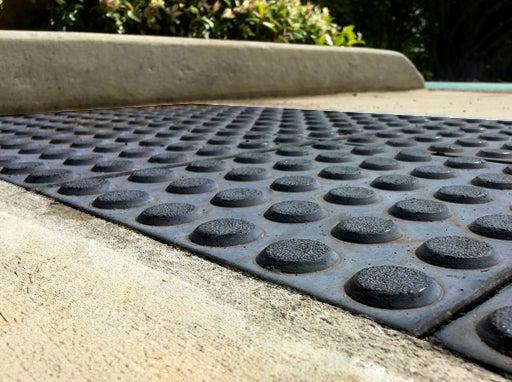
- BCA Volume 2 requires minimum ‘deemed to satisfy’ requirements for levels of luminance contrast to building elements in an accessible path of travel, including TGSI.
Tactiles
- Substantiate the installation is compliant by:
- For works covered by the National Construction Code (NCC) (current edition) all certificates of classification must be supported by a Form 16 (confirms luminance contrast has been achieved).
- For all other works, a test report from National Association of Testing Authorities, Australia (NATA), an accredited testing laboratory which confirms either a laboratory test of all surfaces or an in-situ test has been satisfactorily completed. Test report to be attached to the design drawings.
- Test criteria must be in accordance with AS 1428.4.1:2009.
- To remove doubt, engage an accredited access consultant to review or design TGSI design and set out.
Other
- Ensure all relevant approvals are obtained from the appropriate governing bodies and all conditions are observed.
- Department of Transport and Main Roads (DTMR) approval is required for works near state controlled roads. This applies to any part of the road reserve including pathways, kerb and channelling, nature strip and traffic island.
Council additional requirements
Corporate documents
- Refer Overview of corporate documents for guidance.
Corporate liaison
Developer delivered assets
- Council (Development Services) – all works associated with any development application.
Council delivered assets
- Council (Parks and Gardens) – recreation parks, amenity reserves, linear parks, landscape corridors, sports grounds and recreation trails enquiries relating to asset management, business planning and direction.
- Council (Environmental Operations) – recreation trails, foreshore infrastructure, environment reserves, constructed waterbodies and wetlands.
- Council (Design and Placemaking Services) – recreation parks, amenity reserves, linear parks, landscape corridors, sports grounds, specific purpose (sports), recreation trails and streetscape/centres enquiries relating to design.
- Council (Transport Network Management) – technical and design solutions to facilitate ongoing management and safe operations of road and assets. Water management and drainage solutions. Plus street lighting and electrical infrastructure.
This component is currently in development