Skate parks

Design
Requirements for the design, manufacture and installation of embellishments
Good design
See the following corporate documents to identify relevant project design requirements:
Sunshine Coast Planning Scheme regulates the way land, buildings and structures are used and developed on the Sunshine Coast.

Sunshine Coast Design contains 10 design principles that guide good project planning and design outcomes, that are appropriate for the Sunshine Coast.
The LIM provides further overarching design advice, refer:
- Introduction and Design Principles - e.g. sustainability, CPTED, accessibility
- Preliminaries - environmental management, tree sensitive design and site set up.
Embellishment requirements
- Universal access.
- Comfortable and suitable for the average person.
- See 'Positioning' and 'Equal access' sections for the corresponding LIM category.
- Made from materials that will be durable and can be suitably protected from exterior elements, such as salt spray and UV exposure.
- Robust and sturdy to withstand constant public use and be resistant to vandalism.
- Fixings are to be 316 marine grade stainless steel (unless otherwise stated).
- Tamper proof fixings should be used
- Graffiti protection coatings applied (where applicable)
- Fire retardant (where applicable).
- Warranties should be as listed below.
- Easily repairable or replaceable.
- Sourced locally and use standard fittings.
- Reputable suppliers should be used who keep a supply of stock parts on hand for the life of the product.
- Use sustainable materials, although sustainability needs to be considered over the lifetime of the embellishment.
- Install on paved, concrete or other hard surfaces (where applicable).
- Manufactured to engineering specifications (where applicable).
- See the 'Standards' section for the corresponding LIM category.
Warranty and asset life
Product/embellishment | Warranty (minimum) | Asset life (typical useful life) |
Concrete | 10 years | 40 years 2 |
Sealant (concrete) | N/A | Not available |
Accessories (aluminium) | 10 years | 40 years 2 |
Stainless steel | 10 years | 25 years 2 |
Source 2: Sunshine Coast Council Asset Management Plan 2017/18-2022/23 – Parks and Gardens (figure based on current data, subject to change).
Skate parks
Once the location of the skate park area has been decided, based on the Environment and Liveability Strategy (ELS) and Recreation Parks Plan (RPP) guidance, consider the appropriate embellishment level to suit the selected site.
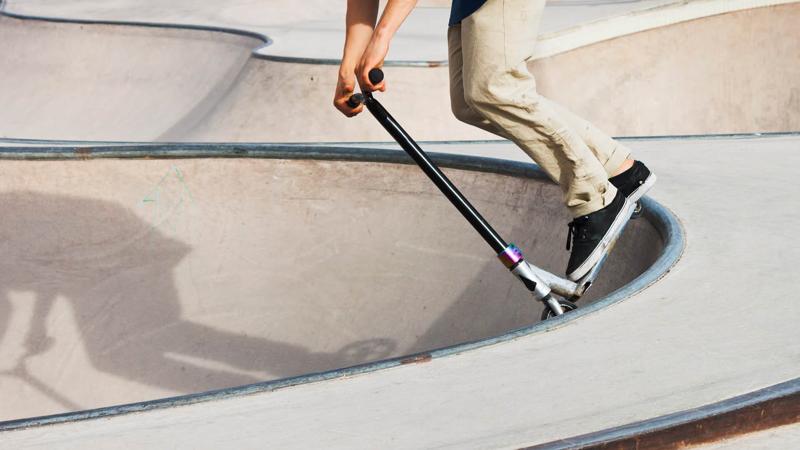
Size considerations:
The RPP provides guidance as to which level of park is suitable for skateparks and minimum size as follows:
- Council wide park (including Major): 1,000-5,000 m2
- District level park (including Local): 500-1,000 m2
The Sunshine Coast Skate and BMX Plan includes four levels of skatepark – Council Wide, Major, District and Local.
Overarching design considerations:
- All open spaces should include universal access (e.g. provide safe clearances, movement around skate elements and access to elements).
- Elements including footing design for skate parks to be designed by a suitably qualified engineer.
- Building approval is required.
- Drainage must be designed to prevent water pooling on facilities.
- Select designs which allow maintenance access to remove any rubbish which may collect.
- The design is required to accommodate different skill and ability levels and should provide for skate boards, BMX bikes, scooters, wheelchair users and other suitable roller sports equipment. Each facility should provide multiple skate skills options (where possible), to attract the widest possible usage. Ensure the expected numbers of people who will participate in the activities can be accommodated.
Skate park design
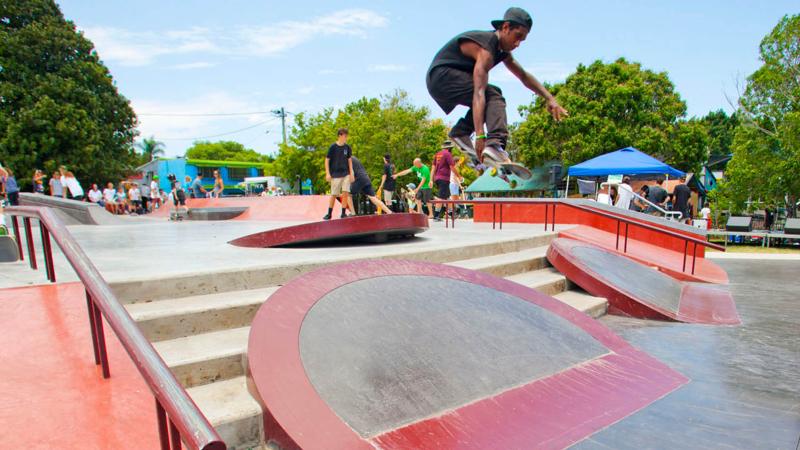
Skate parks are to be designed and constructed to comply with AS EN 14974:2021 Skateparks - Safety requirements and test methods.
The standards provide skate park guidance on:
- materials
- fastenings
- safety requirements
- testing/test report
- marking.
Skate elements
- Skate elements must be designed and constructed with sufficient stability, be firmly fixed to the ground, or be secured against displacement or toppling over.
- It must not be possible to dismantle skate elements without tools.
- No pointed or sharp parts are to protrude from the externally accessible parts of the skate elements.
- The ends of all tabular parts, including coping, are to be capped.
- Construction should preferably be formed smooth surface concrete or modular concrete pieces.
- Skate park materials are to be selected and protected so that the structural integrity of the equipment does not deteriorate before the next relevant maintenance inspection.
Ancillary embellishments
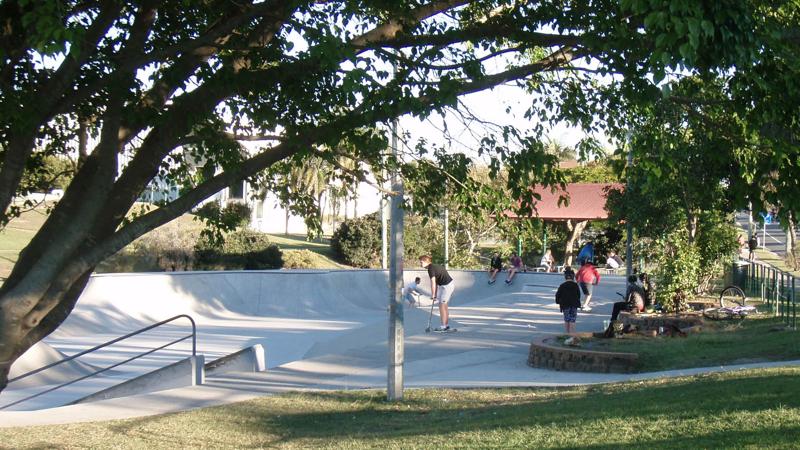
Utilise the ELS and RPP guidance, to determine what ancillary facilities should be provided with a skate park.
Seats
- Provide shaded seating areas for respite.
- Seats must have anti-skate design features.
See LIM Seats for further guidance.
Drinking fountain
- A drinking fountain is preferred near skate parks.
See LIM Drinking fountains for further guidance.
Bins
- Wheelie bins must be installed with a wheelie bin enclosure at skate parks, as bins can be removed and used to gain access to high areas.
See LIM Bins for further guidance.
Shade (natural/artificial)
General
Shade is the best way to provide maximum protection against UV radiation.
- Provision should be made in each skate park for areas of sun protection and shade, both for the users of the skate park as well as for any caregivers present.
- Natural shade is preferred, however shade sails shelters may be considered.
- Provide site specific shade modelling (shade diagram). Refer LIM Shade Sails for shade requirements.
Shade sails
This category should be read in conjunction with LIM Shade sails for further guidance for specifications and clearance heights.
Shelters
This section should be read in conjunction with LIM Shelters for further guidance.
Landscape Planting
Shade trees
As a general rule, trees with a canopy that is dense and closer to the ground provide the best protection from direct UV radiation.
- Ensure that mature trees do not screen off the facility and create an unsafe environment.
- Plant shade trees at the time of skate park installation, particularly in local parks.
- Install shade trees to the north and west to protect equipment at the hottest part of the day.
- Use existing trees for shade where the design can be sensitive to tree root requirements, under guidance of a qualified arborist. It is preferable to plant trees at the time of play space installation.
- Ensure tree roots do not compromise the surfacing or create trip hazards. For guidance on tree roots and specific treatments contact qualified arborist.
See the following for further guidance
- Preliminaries - LIM Tree sensitive design (existing and new trees).
- LIM Planting (landscape).
Planting
- Choose low plants (maximum 500 mm) that will provide clear sight-lines for parent and carer supervision (CPTED guidelines), as well as clear sightlines from the road to the site for surveillance.
- As per AS EN 14974, plants within the ‘safety zone’ are permitted if they are arranged in a way that does not pose a risk to users.
- Avoid planting plants and trees which cause hazards on hard surfaces For example, dropped berries or flowers which may become slippery when wet.
- Avoid plants with leaves with cutting edges, sharp thorns, spikes, poisonous parts, fragile tree limbs or prone to limb drop.
- Avoid fruit bearing plants that may attract significant levels of birds and bats as this becomes a maintenance issue.
See LIM Planting (landscape) for further guidance.
Site drainage
Skate parks must have adequate sub-surface and surface drainage to avoid nuisance water pooling.
- Sub-surface drainage plans must be provided.
- Surface runoff must be directed away from equipment and pathways.
- Drainage grates are to comply with AS 1428.1 Design for Access and Mobility set. Sub-surface drainage is to be installed and connected as per Council plumbing advice.
See LIM Landscape drainage for further guidance.
Pathways
Pathways must provide a continuous accessible path of travel (CAPT) to a skate park, as defined in AS1428 Design for Access and Mobility. This enables equal access for all users.
- Consider that a 1.8 m wide pathway is required for two wheelchairs to pass each other.
See LIM Paths, trails and tracks for further guidance.
Internal paths
- Provide internal path connections to other sporting facilities.
Connection paths
- Provide a connection path from the car park to the exercise equipment.
- Consider connecting park pathways to existing pedestrian and cycle networks.
- Consider connecting park pathways to shopping and public transport hubs.
Fencing (including pedestrian and vehicle gates)
- Provide maintenance and emergency vehicle access to skate park:
- minimum 3.6 m open gate width
- ensure clear path of travel i.e. no obstacles.
- As per AS EN 14974:2021, where a skate park is built in combination with other facilities such as playgrounds, sports grounds, and similar establishments, they must be physically separated by an appropriate distance using structural or spatial measures. Separation measures minimise the risk for users of the other facilities.
- Fencing is not required, unless there are site specific requirements, such as separation of facilities or public safety.
- Where fencing is required, it is to be commercial quality, heavy duty and vandal resistant.
See the LIM Fences and gates for further guidance.
Lighting
- Consider providing night lighting to extend hours of use and to increase security where the skate park is not located in residential areas.
See the LIM Electrical for further guidance.
Signage
This section should be read in conjunction with LIM Signage suite for a complete suite of suitable signage, from the carpark to activity area.
Activity entry sign - Park
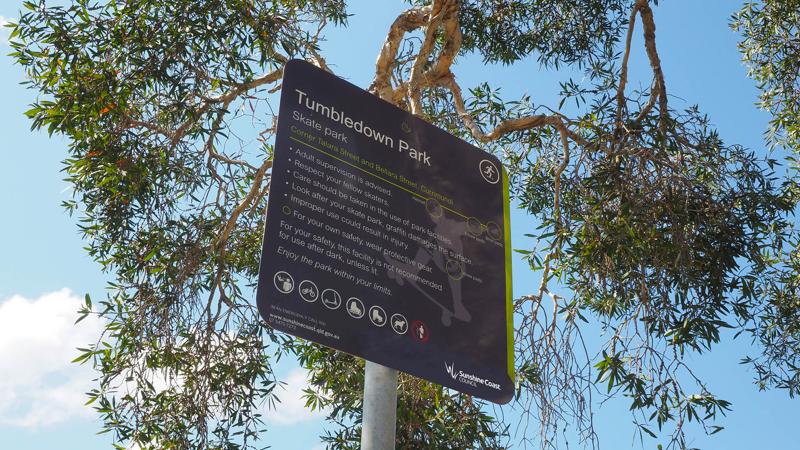
- A park activity entry sign must be installed for compliance at the skate park, in a visible location. Ensure the sign posts do not create collision points. The sign may require building certification (consider mounting heights).
- AS EN 14974:2021 outlines the minimum information that shall be provided on the sign, at skate park facilities.
This component is currently in development