Suite of signs

Vehicle entry signs
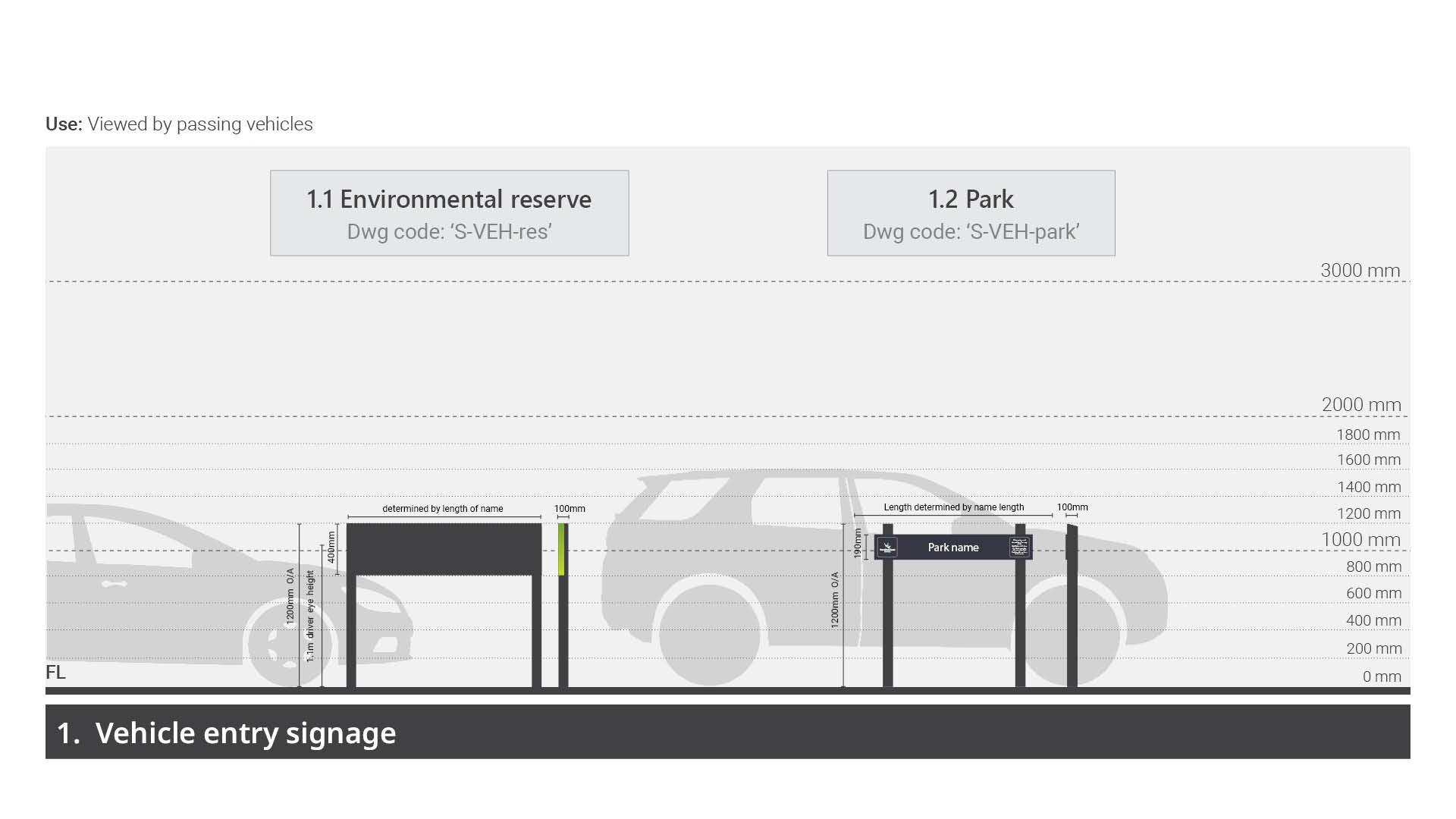
A Vehicle entry sign is designed for drivers to identify a parcel of land while approaching or entering. It may also be read by passing pedestrians for the same purpose. To ensure visibility and legibility from a distance, this sign must feature large, clear fonts suitable for viewing from a moving vehicle.
Download the full LIM Signage suite Catalogue.
Technical drawings and artwork templates
Embellishment | Technical drawing (DWG)/Artwork template and samples | Supplier | Internal use (How to place an artwork order) | Internal use (Artwork design instructions) |
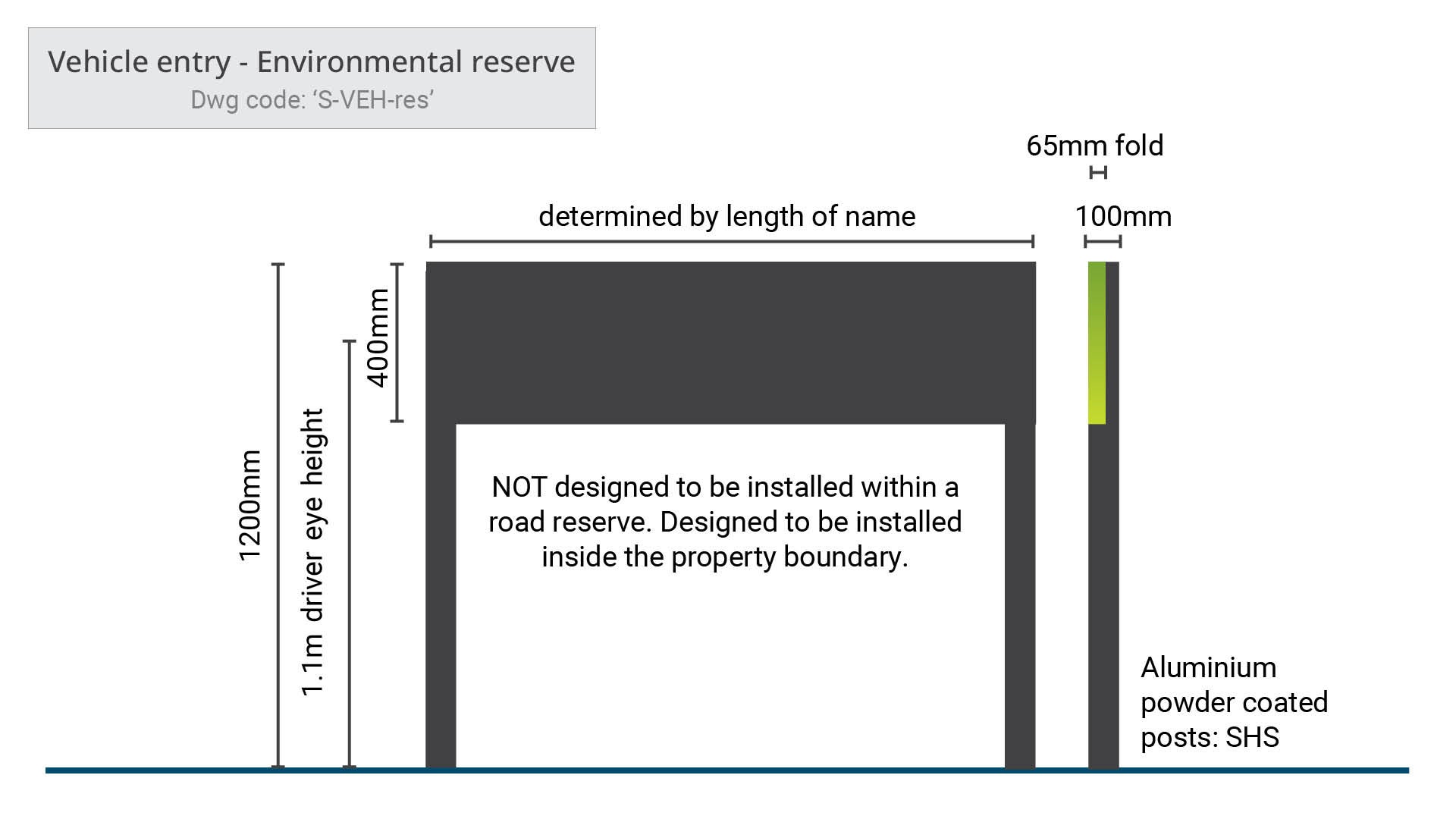 Vehicle entry sign - Environmental reserve |
| No supplier specified | Artwork creation: place an order using Councils internal asset management and maintenance systems. Attached the following:
* ASH MAYBE WE DELETE COST CODE TBC |
* ASH MAYBE MODIFY TO SUIT EXTERNAL AUDIENCE AS WELL (INCLUDING TITLE) |
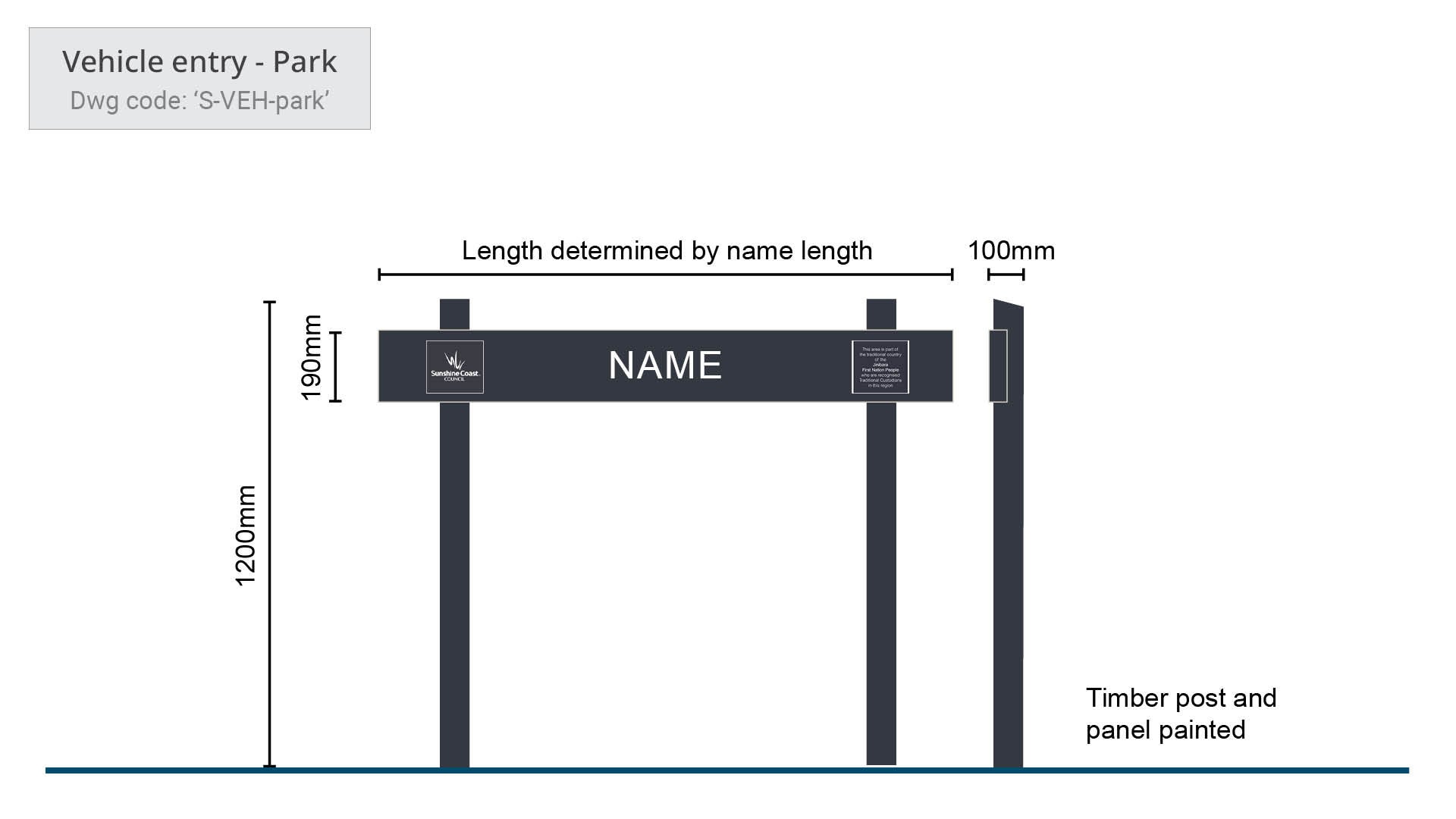 Vehicle entry sign - Park |
| No supplier specified | Artwork creation: place an order using Councils internal asset management and maintenance systems. Attached the following:
|
|
Purpose
A Vehicle entry sign is predominantly aimed at vehicle occupants. It may also be read by passing pedestrians.
The sign is usually located on the property boundary:
- at a prominent location.
- in view of passing vehicles.
- at driver eye height (950 mm to 1.1 m from FL).
- close to the entrance of a car parking facility.
- to be read from a pathway (where possible).
The sign is designed to clearly identify a parcel of land for the following purposes:
- use by the general public/community use
- marketing purposes (public open space name, council logo and branding
- maintenance personnel.
There are two choices of vehicle entry signs designed to suit specific locations:

Environmental reserve vehicle entry sign

Park vehicle entry sign
Note: The Vehicle entry sign for vehicles is NOT designed to be installed within a road reserve. The sign is designed to be installed inside the property boundary. Where the sign is installed within a road reserve, the sign must comply with the MUTCD and DTMR Guide to Roadside Signs.
Engage a Civil Engineer - Council (Design and Placemaking Services) - Engineering Design Services for site specific advice and construction documentation.
Planning
The following should be considered prior to the installation of a Vehicle entry sign:
- The number of entry points at the site.
- Determine which entry points require signage.
- Consider the best location/s to position the sign/s at the selected entry point/s.
- Plan to incorporate Crime Prevention Through Environmental Design Guidelines (CPTED) such as ‘retain sight lines’ at the design stage of a sign project, to avoid ongoing maintenance costs such as, lift pruning of trees and vegetation, or costly re-design to enhance public safety.
Design
Legal, standards and guidelines, requirements
Sign construction
- Technical drawings (DWGs) - for typical construction details for each sign type. See Technical drawings and artwork templates table (above - top of page).
- Artwork templates and samples - for approved graphic design templates and samples for alternative options (where applicable) for each sign type. See Technical drawings and artwork templates table (above - top of page).
See LIM Signage – Overarching guidelines – for Standards such as, designing for access and inclusion, traffic and road standards (where applicable).
Content and corporate branding
- Sunshine Coast Council corporate branding logo must be displayed on all signs as per Artwork templates.
- All colours must be selected from the Council corporate colour palette or otherwise approved for specific purpose. e.g. some colours, such as red, yellow and black, (not part of the corporate palette) may be used for regulatory purposes.
See LIM Signage – Graphic design guidelines – for essential guidance on components that make up signs. e.g. colour application, pictogram integration, text sizing and spacing, map implementation etc.
Content general
- Reserve/park name and spelling must be checked against council records to ensure accuracy.
Additional requirements - Environmental reserve
- All sign artwork is to be professionally designed (by a qualified graphic designer or equivalent) as vector files.
All vehicle entry signs must include the following:
- Public open space name (environmental reserve).
- Corporate branding banner
- Council logo.
Additional requirements - Park
All vehicle entry signs must include the following:
- Public open space name (park or environmental reserve).
- Lettering is to be computer routed into the hardwood timber (upper case Arial).
- Corporate branding banner
- Council logo (stacked format mounted onto plate).
- Logo plates are preferred to be routed into the sign panel. This minimises vandalism and reduces maintenance by preventing foreign objects becoming trapped behind the plate.
- Existing signs which contain a superseded council logo sign plate, must be updated by removing the old plate and installing the new logo plate in place of the existing plate position.
- Where a routed area already exists, place the new plate in the same routed location.
- New signs - position and route an area suitable to fit the logo plate. The Sunshine Coast Council logo plate is to installed to the left side of the sign panel. See Technical drawing.
- Existing signs which contain a superseded council logo sign plate, must be updated by removing the old plate and installing the new logo plate in place of the existing plate position.
Positioning
General
- For optimum viewing from a motor vehicle, install signs in a highly visible location as close to a road entrance as possible.
- Signs must not obstruct the line of sight of any motor vehicle which is exiting or entering the area.
- When considering potential sign locations, avoid positions where the sign may interrupt or block a prominent view. Signs should be secondary to a natural view. However, safety is paramount.
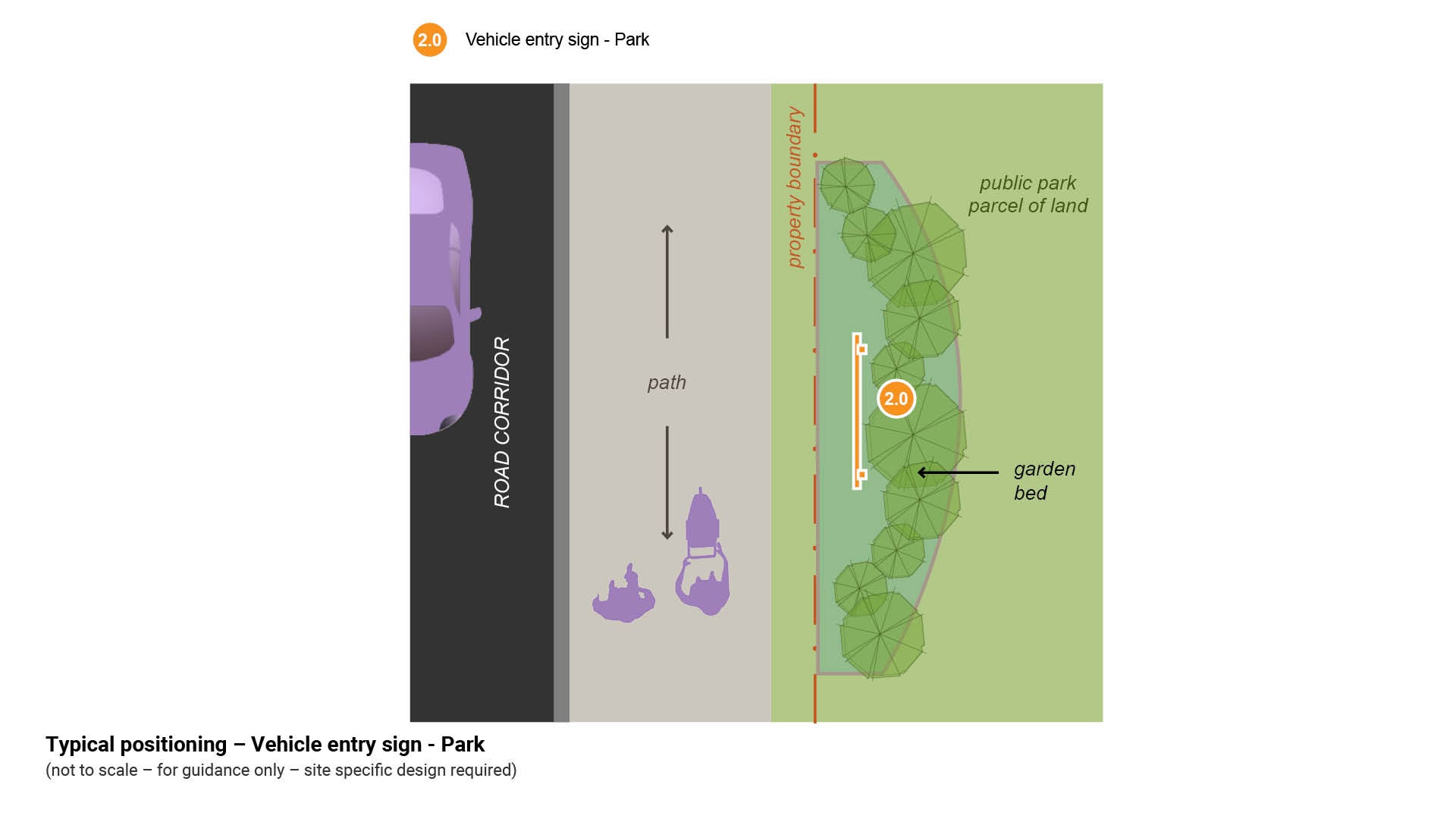
- Position signs in a planted area where possible, for ease of maintenance mowing, and to potential for avoid pedestrian collision.
- To ensure a sign panel will not be obscured in future, consider mature size of surrounding vegetation.
- To protect trees from potential damage, all signs should be installed outside of their canopy areas (drip lines). Where this is not possible, the Project Arborist should be contacted to provide advice. See LIM Site set up (including Tree protection) for further guidance.
- Where there is an existing or new pathway, all signs must meet Austroads minimum 500 mm safety offset from any path edge, to avoid collision with the sign while using the pathway.
- Position signs a minimum of 200 mm in from any slab or compacted surface edge for mowing offsets (where applicable) and visual appearance.
Vehicle entry signs (roadside signs)
Roadside signs should comply with Manual of Uniform Traffic Control Devices (MUTCD) and Austroads. Installation of roadside signs requires consideration of the following:
- Lateral placement and mounting heights
- Clear zones
- Sight lines.
In the instance where a sign is installed at an intersection, see LIM Signage – Graphic design guidelines - Clearances and viewing heights.
See the following for further guidance:
- Figure 1: Typical positioning – Vehicle entry sign - Environment reserve
- Figure 2: Typical positioning – Vehicle entry sign - Park
- MUTCD Part 1:2016 – General Introduction and Sign Illustrations
- Austroads Guide to Road Design Part 6: Roadside Design, Safety and Barriers
- Design Guide for Roadside Signs 2001 Department of Transport and Main Roads (DTMR)
- Austroads Guide to Road Design Part 3: Geometric Design
- Austroads Guide to Road Design Part 4: Intersections and Crossings – General.
Figure 1: Typical positioning – Vehicle entry sign - Environment reserve
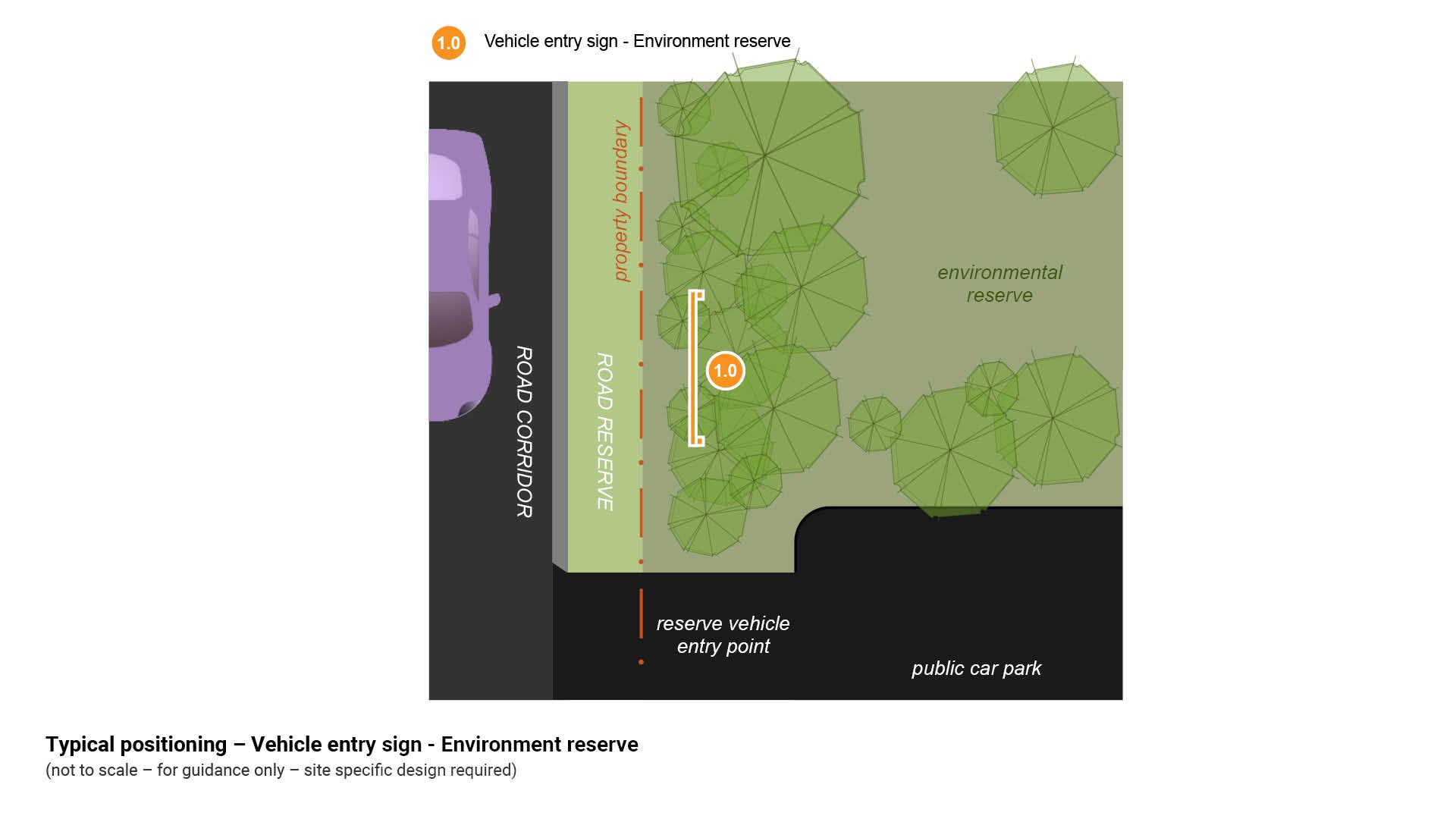
Figure 2: Typical positioning – Vehicle entry sign - Park
Sign construction instructions
Vehicle entry sign - Park
- Signs are to be constructed by Council (Parks and Gardens) to contain costs and ensure uniformity (including routed letters and painting/staining of timber).
Note: Where Vehicle entry sign in installed beside a high speed road environment (80 km/h or greater), consider mounting the sign panel onto CHS galvanised posts to comply with the MUTCD and TMR Guide to Roadside Signs.
Delivery
For all developer delivered assets, contact Council (Development Services) – this includes all works associated with any development application.
For all council delivered assets, the following process should be used:
Site investigations
- Confirm council land tenure and approval process.
- Identify sign location.
- Identify physical/technical constraints.
- Obtain arborist advice (where required).
Community engagement/stakeholders
- Where applicable.
Corporate liaison and approvals
See the Technical drawings and artwork templates table in each sign type page for guidance - How to place an artwork order (internal use only) and Artwork design instructions (internal use only).
- Council (Parks and Gardens) and or Council (Environmental Operations).
- initial approval for use/application of sign.
- approval and guidance of artwork content.
- approval to manufacture signs.
- approval of location of signs.
- Council (Community Response)
- approval of any regulatory signage/componentry.
- Council (Communication)
- editing of templates
- supply of proofs for approval
- approval of corporate branding.
Deliverables
- Site plan – for sign installation.
- Technical drawings (DWGs) – sign construction details.
- Schedule of signs.
Manufacture
See the Technical drawings and artwork templates table in each sign type page for guidance - How to place an artwork order (internal use only) and Artwork design instructions (internal use only).
- In-house manufacture – Council (Transport Network Operations) - Civil Operations (Signs Technical Officer).
OR
- External manufacture – select a suitable sign fabricator.
Installation
- All relevant key stakeholders are to be notified (including contractors), and where required, attend a pre-start meeting.
- Sign location as per approved site plan.
- Installation as per technical drawings and schedule.
Finalisation
- Assets captured.
- As designed as constructed drawings (ADAC) supplied.
- Hand over to asset custodian.
This component is currently in development