Suite of signs

Regulatory signs
Regulatory signs clearly display a message advising the reader about desired behaviours, risks in the immediate area, and potential infringement fines. These signs are to be used sparingly to avoid visual clutter.
Download the full LIM Signage suite Catalogue.
Technical drawings and artwork templates
Embellishment | Technical dwg/artwork template | Supplier |
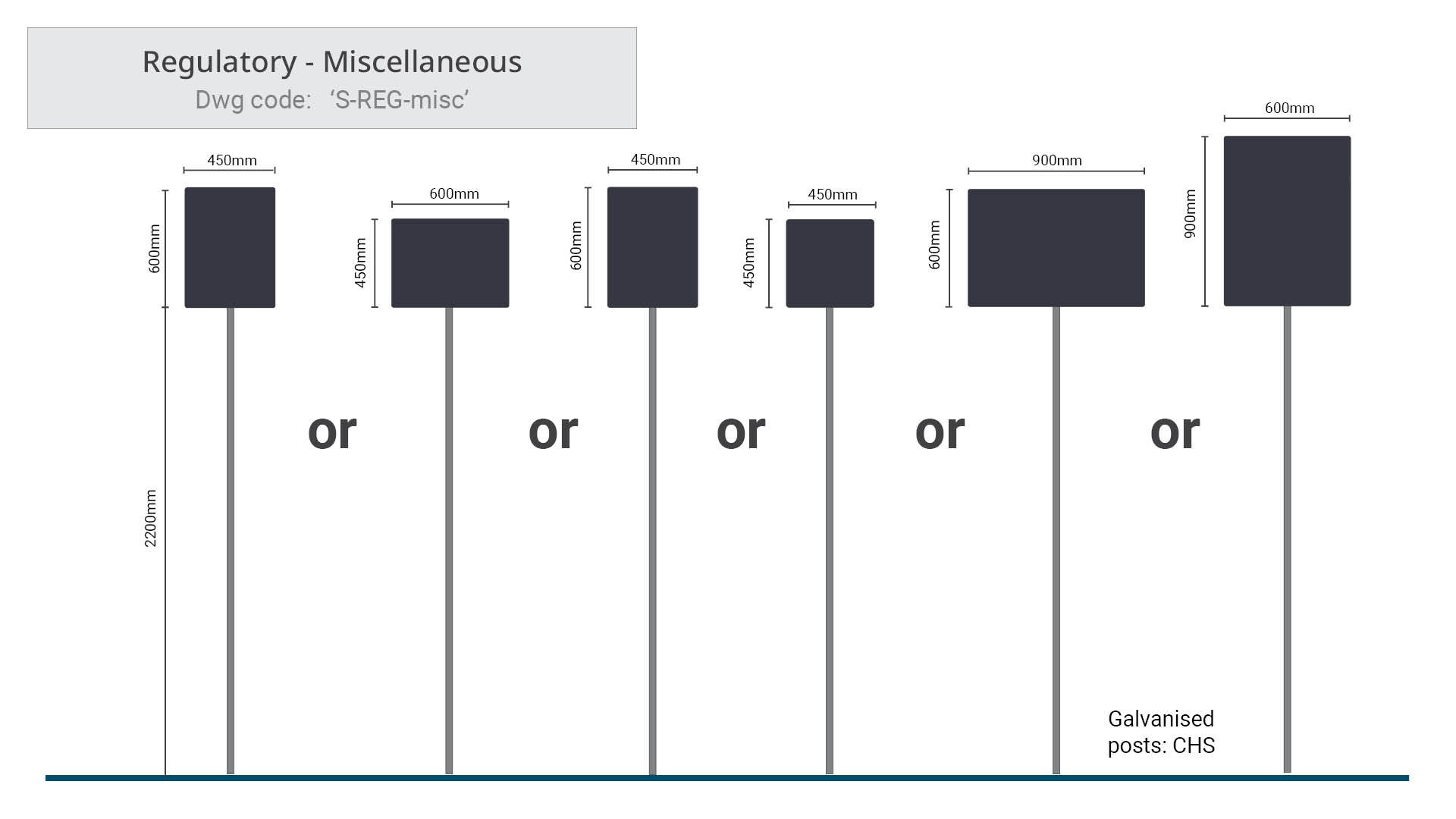 | Regulatory - Miscellaneous (general use, environment use, marine use)
| No supplier specified |
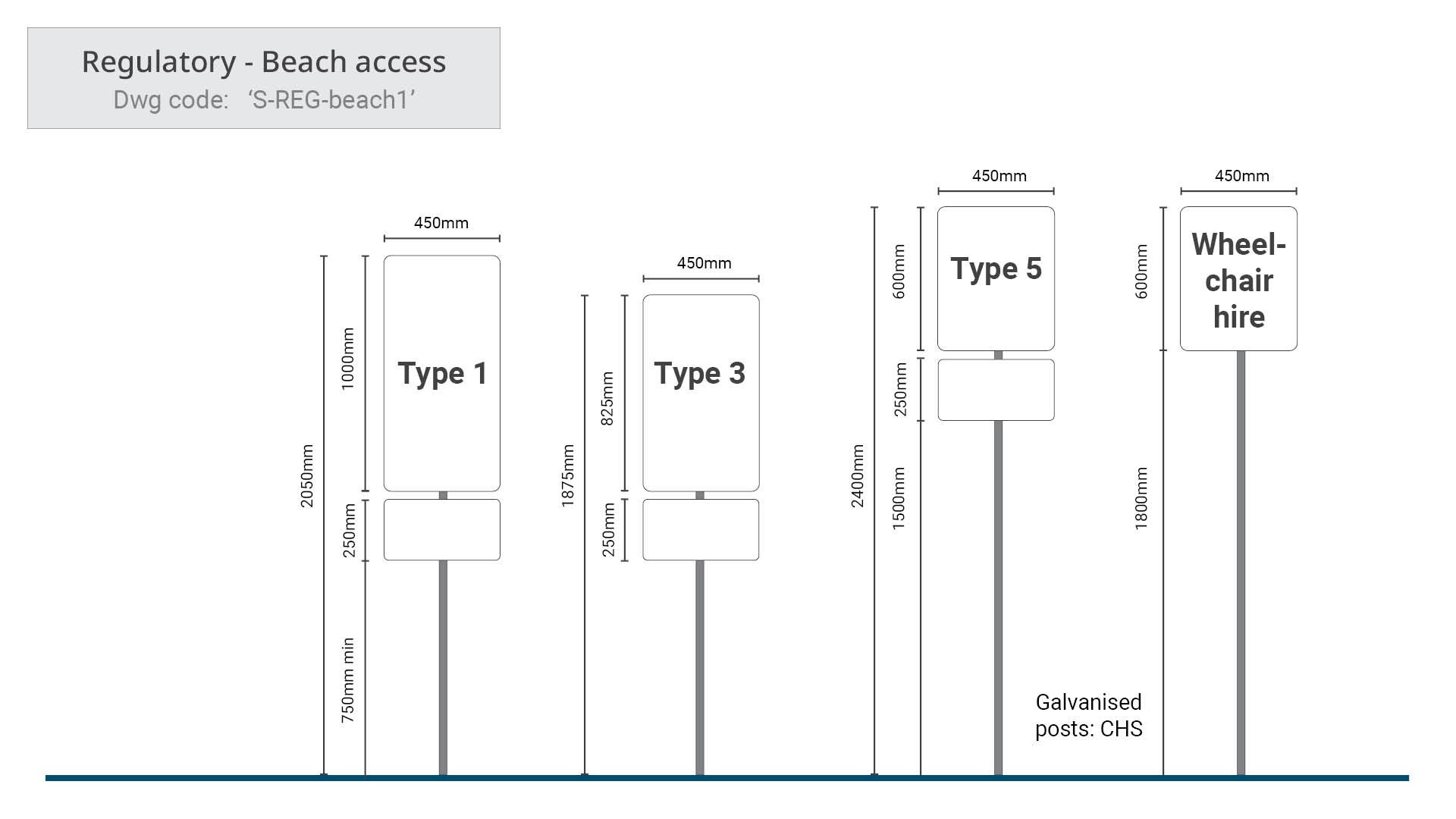 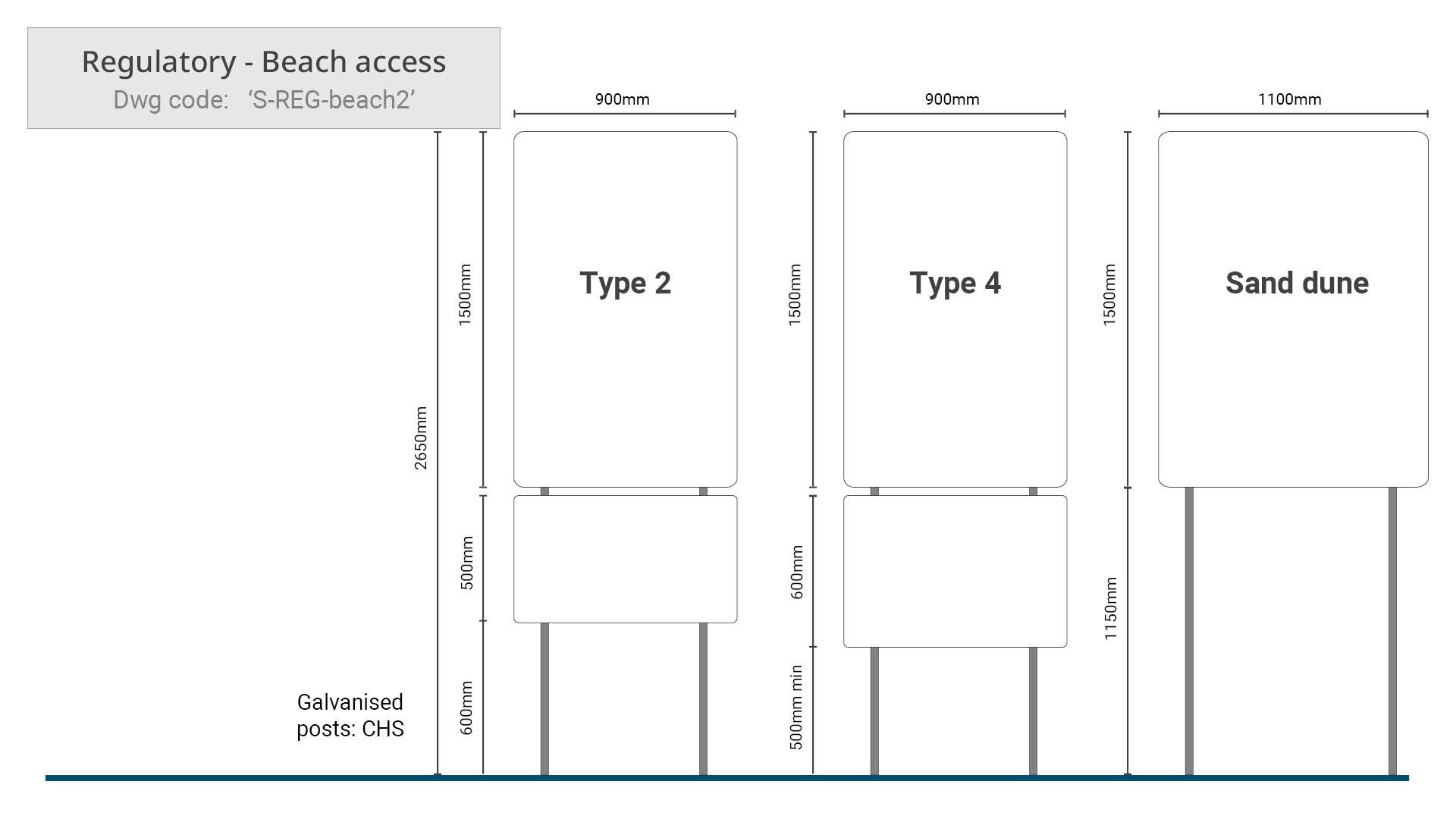 | Regulatory - Beach access
| No supplier specified |
Purpose
Regulatory signs (also known as prohibited use/warning and safety signs) are short message signs that target all recreational users. The signs are designed to manage risk, and to identify known hazards.
Regulatory signs may be located in all open spaces. These signs are to be installed where a hazard requires notification, an activity is prohibited, activities are permitted (such as a dog off leash area), an environmental message is required or where regulations apply.
The suite provides various sizes to cater for multiple requirements. They are not limited to the artwork shown, other signs may be designed and approved by Council (Communication). The signs are divided into the following categories:
- General use
- Environment use
- Marine use
- Fenced dog off leash area
- Dog open spaces
- Beach access.
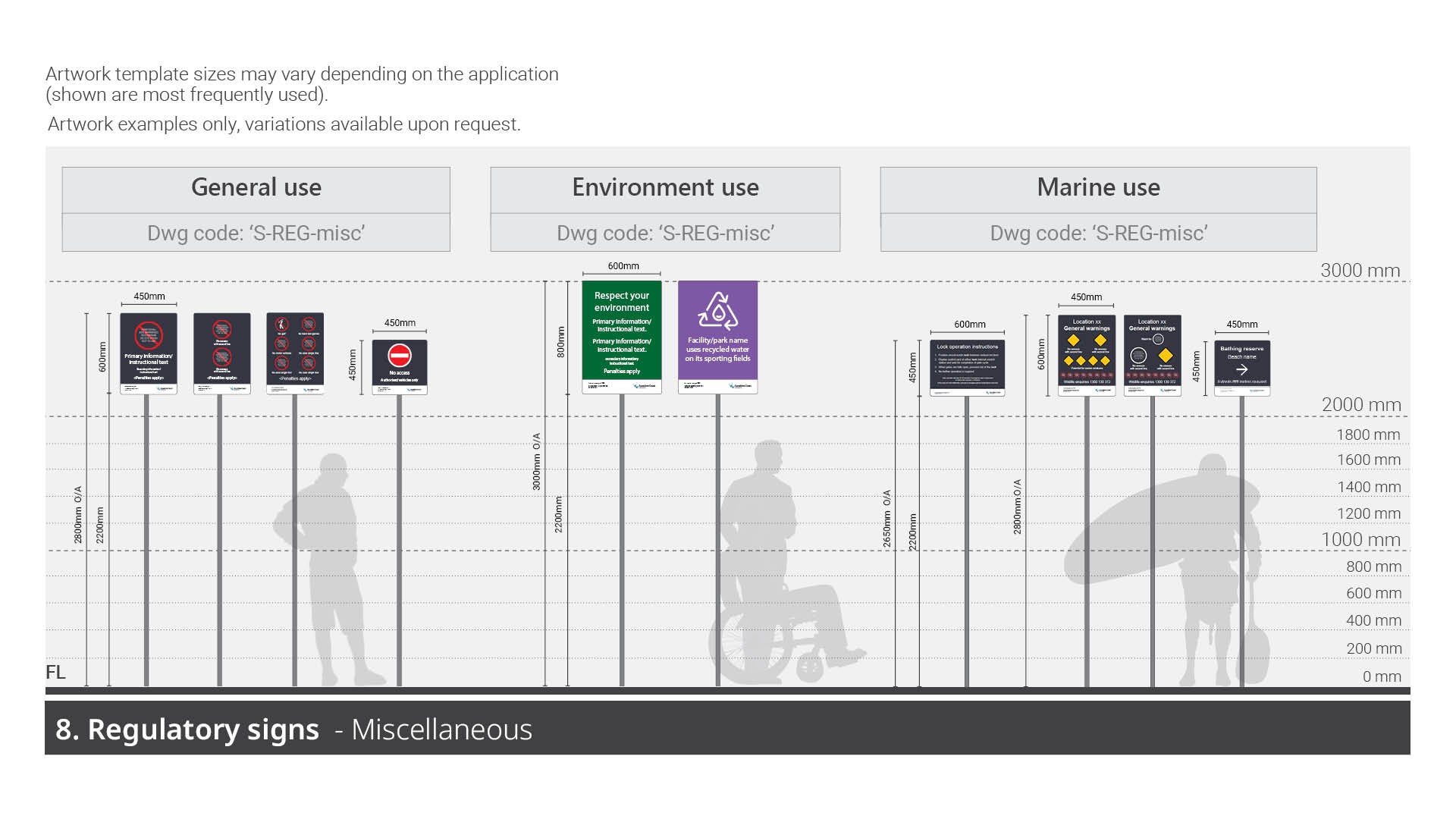
General use - includes a variety of types of signs for different purposes and messaging across general open spaces.
Sizes vary:
- 400 mm wide X 600 mm height
- 400 mm wide X 400 mm height.
Environment use - includes sign types specifically designed for environmental purposes and messaging.
Size: 600 mm wide X 800 mm height.
Marine use - includes sign types specifically designed for marine environments.
Sizes vary:
- 600 mm wide X 450 mm height
- 450 mm wide X 600 mm height
- 450 mm wide X 450 mm height
- 900 mm wide X 600 mm height.
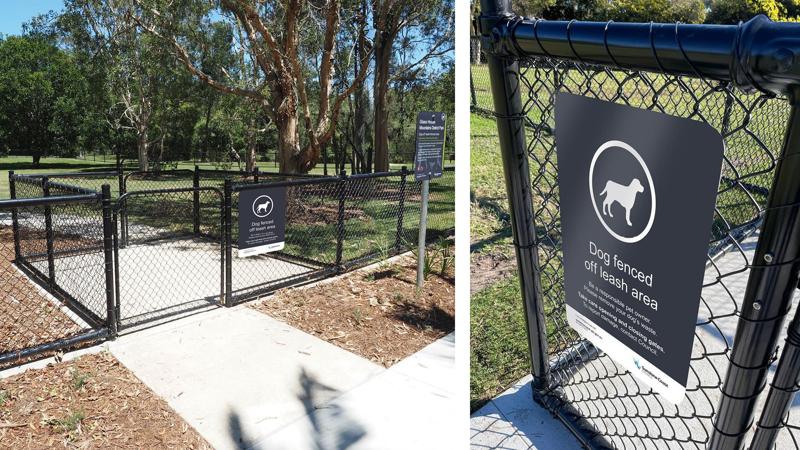
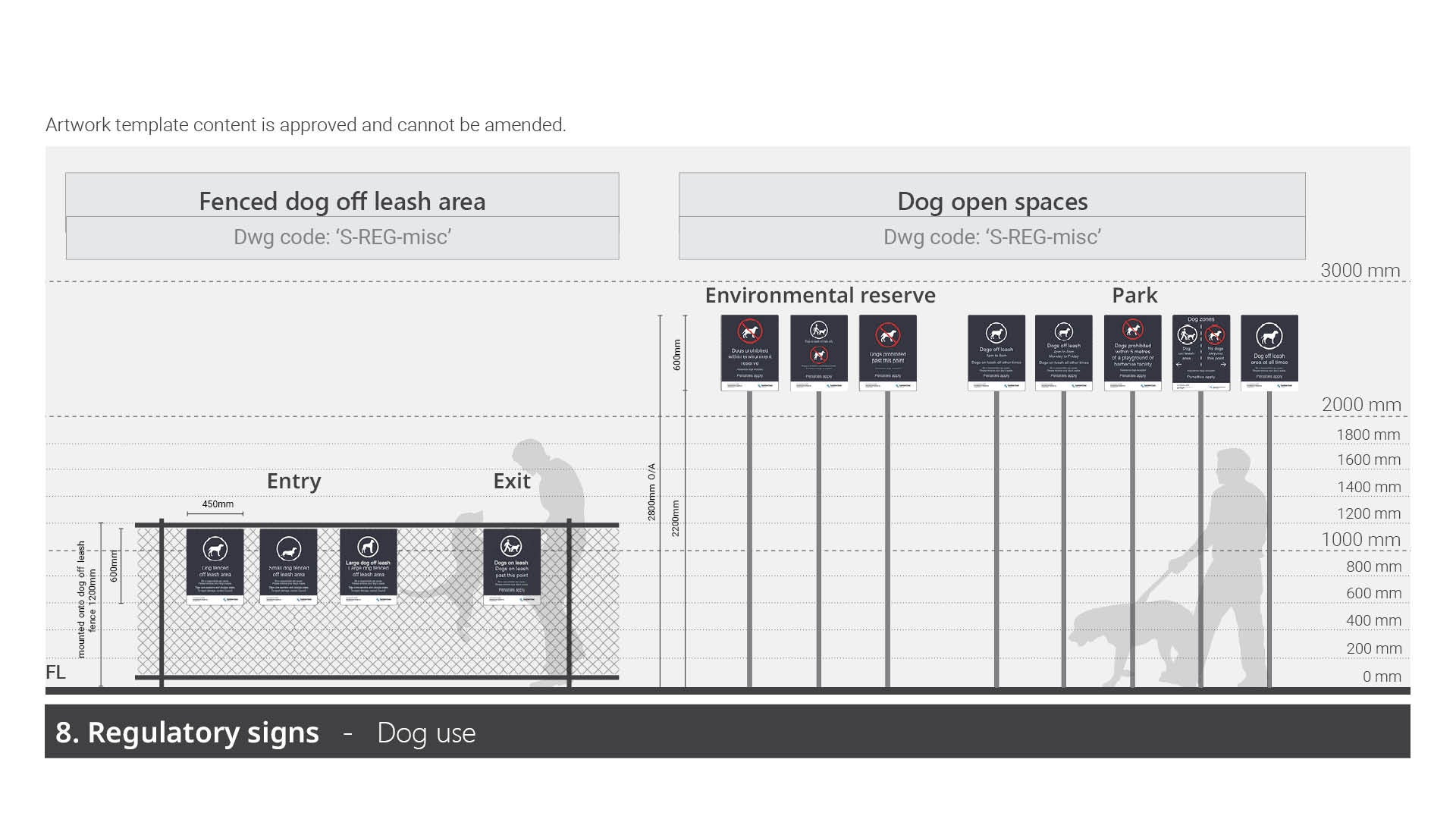
Fenced dog off leash area and Dog open spaces - includes sign types specifically designed for use for dog exercise areas in open spaces.
Size: 450 mm wide X 600 mm height.
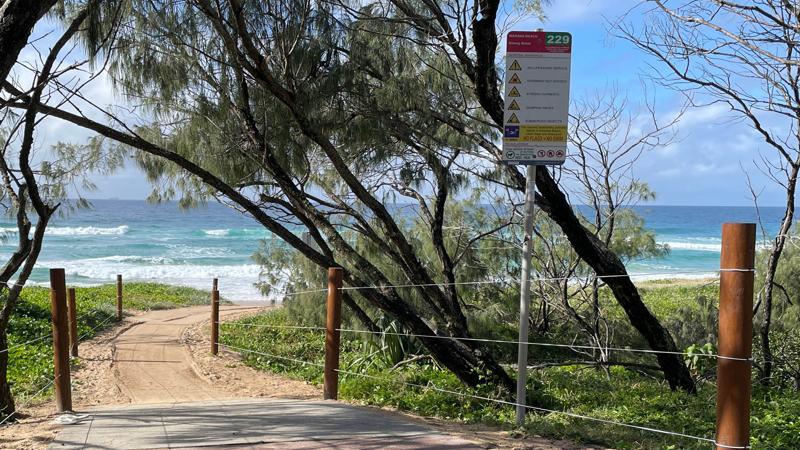
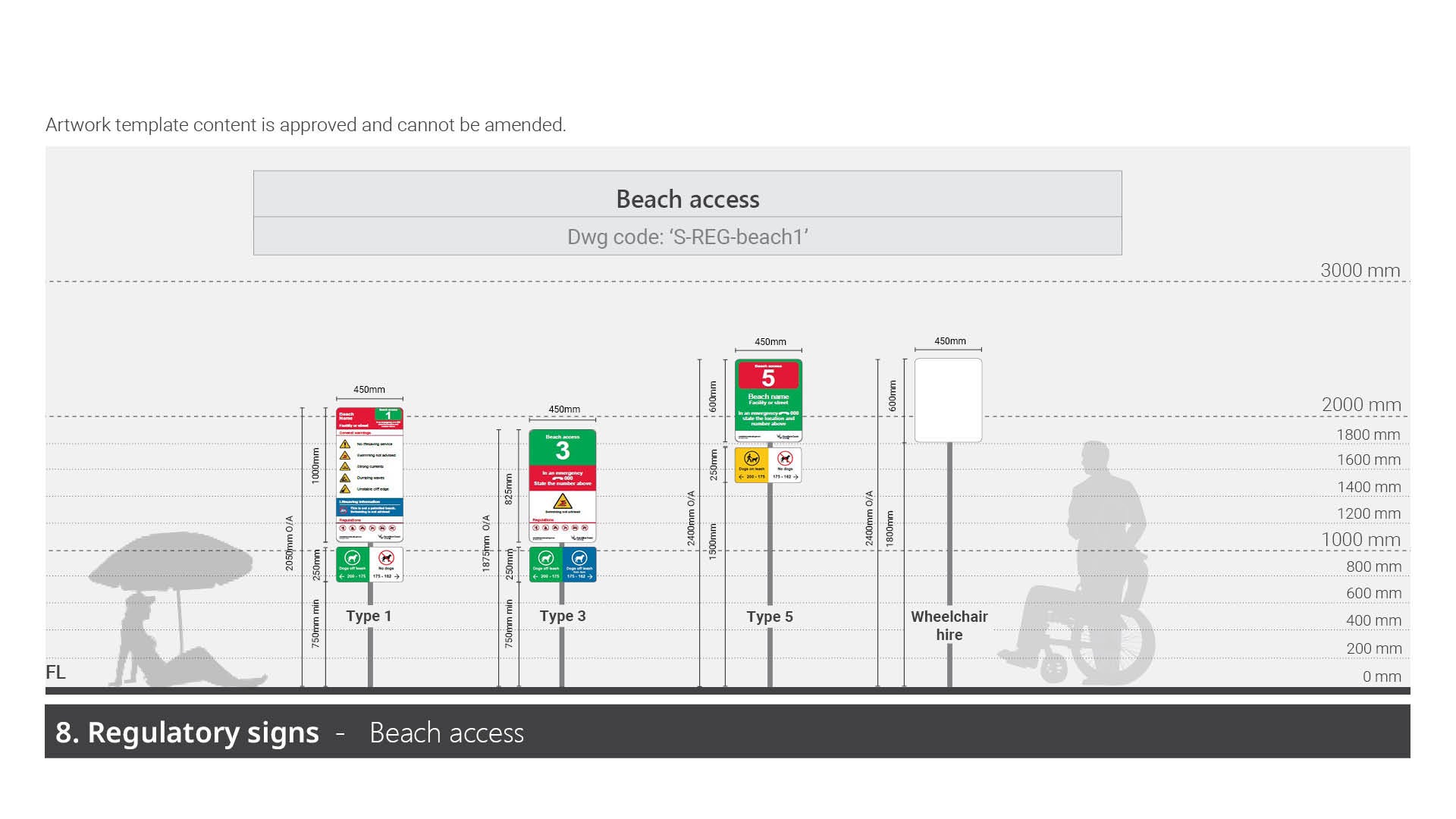
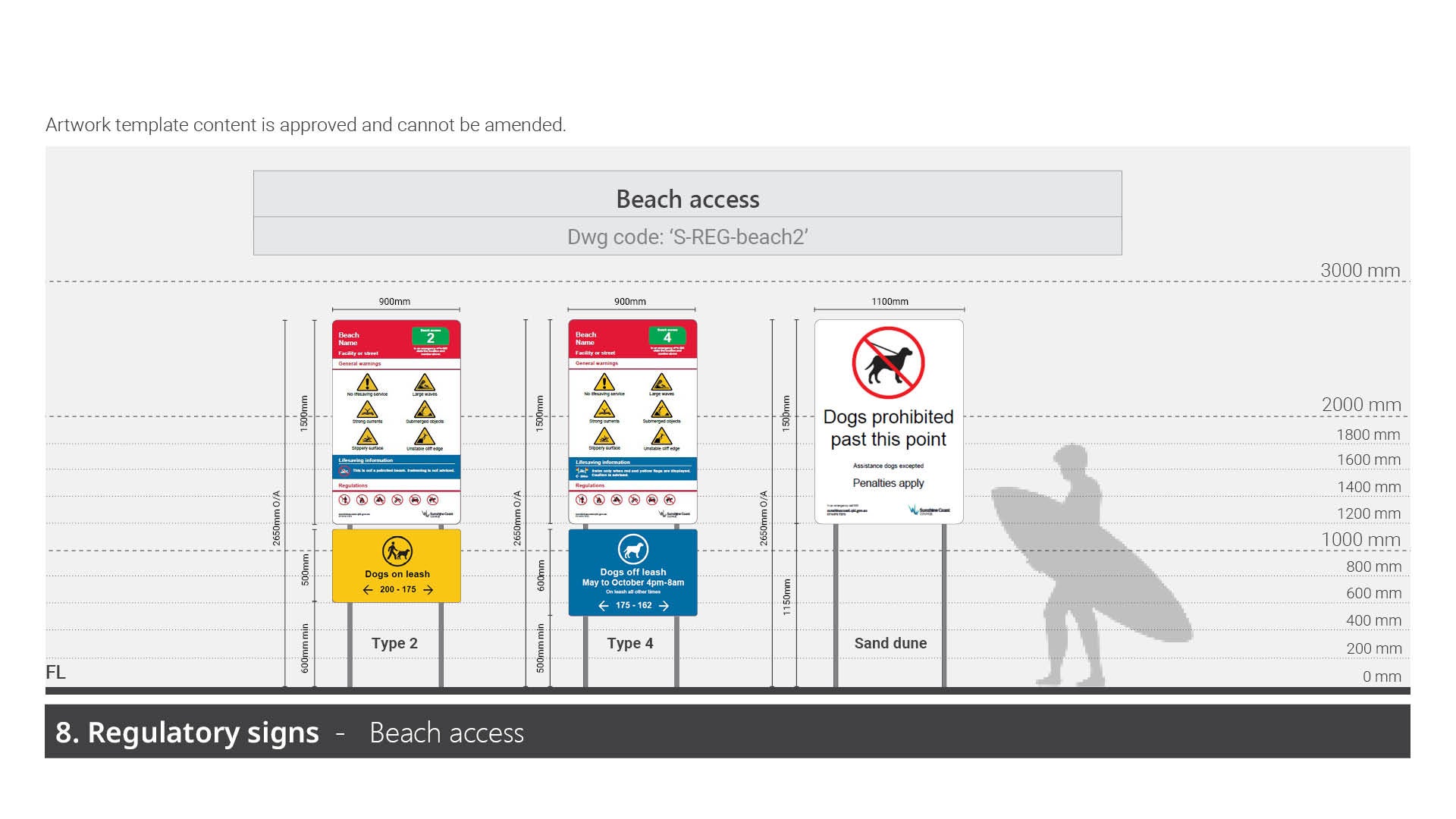
Beach access - includes sign types specifically designed for beaches and beach accesses.
Sizes vary:
- 450 mm wide X 1000 mm height
- 450 mm wide X 825 mm height
- 450 mm wide X 600 mm height
- 870 mm wide X 1500 mm height.
Planning
General
The following should be considered prior to installing the sign:
- Establish the purpose of the sign.
- Determine if the problem or hazard can be controlled by other means, before a sign is installed.
- Assess existing site signs.
- Determine whether existing signs can be incorporated into a new sign to minimise clutter.
- Identify and assess the most visible and easily accessible locations that can be observed by the largest number of people.
- Calculate the number of signs required.
Choosing between sign types
Standard – avoid over-use. Only install when absolutely necessary. Only install additional regulatory signs to:
- Address an on-going problem (that cannot be solved another way)
- Improve public safety
- Manage risk.
Environment miscellaneous – installed where there is a need to deliver a strong message about protecting the environment. These signs specify prohibited behaviour (such as rubbish dumping) and the resulting fines that may apply.
Marine use – installed to improve safety and minimise risk in marine environments (such as at bathing reserves).
Dog fenced area and Dog open spaces – Additional signs containing supporting information to that provided on the Activity entry sign - Park. Typically used at dog off leash fenced parks.
Miscellaneous regulatory dog use – An additional sign used within open space areas relating to permitted dog zones, such as playgrounds and barbecue facilities.
Beach access – these signs are a legal requirement to be installed at all beach access points. They are vital to pinpoint a location for emergency services attendance (such as Queensland Ambulance Service). The numbered signs are also used to identify the location for beach users as well as provide, safety and regulatory information.
Design
Legal, standards and guidelines, requirements
Sign construction
- Technical drawings (DWGs) - for typical construction details for each sign type. See Technical drawings and artwork templates table (above - top of page).
- Artwork templates and samples - for approved graphic design templates and samples for alternative options (where applicable) for each sign type. See Technical drawings and artwork templates table (above - top of page).
See LIM Signage – Overarching guidelines – for Standards such as, designing for access and inclusion, traffic and road standards (where applicable).
Content and corporate branding
- Sunshine Coast Council corporate branding logo must be displayed on all signs as per Artwork templates.
- All colours must be selected from the Council corporate colour palette or otherwise approved for specific purpose. e.g. some colours, such as red, yellow and black, (not part of the corporate palette) may be used for regulatory purposes.
See LIM Signage – Graphic design guidelines – for essential guidance on components that make up signs. e.g. colour application, pictogram integration, text sizing and spacing, map implementation etc.
Content general
- All sign artwork is to be professionally designed (by a qualified graphic designer or equivalent) as vector files.
- Sign content must use a positive tone. This will influence the reader to embrace the message.
- All regulatory pictograms must be approved by Council (Community Response) prior to printing.
- Corporate branding banner
- Emergency contact information
- Council contact details (report defects/issues).
- Items not regulated by Council should not be included. Campaign content should not be included as they are subject to change.
- Optional elements to consider - for certain site-specific regulatory signs, it may be advantageous to specify High Intensity Prismatic (HIP) Grade Reflective Sheeting. This material is engineered to deliver superior long-term retroreflectivity and durability, particularly for vertically mounted signs exposed to varying environmental conditions.
Positioning
General
- When considering potential sign locations, avoid positions where the sign may interrupt or block a prominent view. Signs should be secondary to a natural view. However, safety is paramount.
- Position signs in a planted area where possible, for ease of maintenance mowing, and to potential for avoid pedestrian collision.
- To ensure a sign panel will not be obscured in future, consider mature size of surrounding vegetation.
- To protect trees from potential damage, all signs should be installed outside of their canopy areas (drip lines). Where this is not possible, the Project Arborist should be contacted to provide advice. See LIM Site set up (including Tree protection) for further guidance.
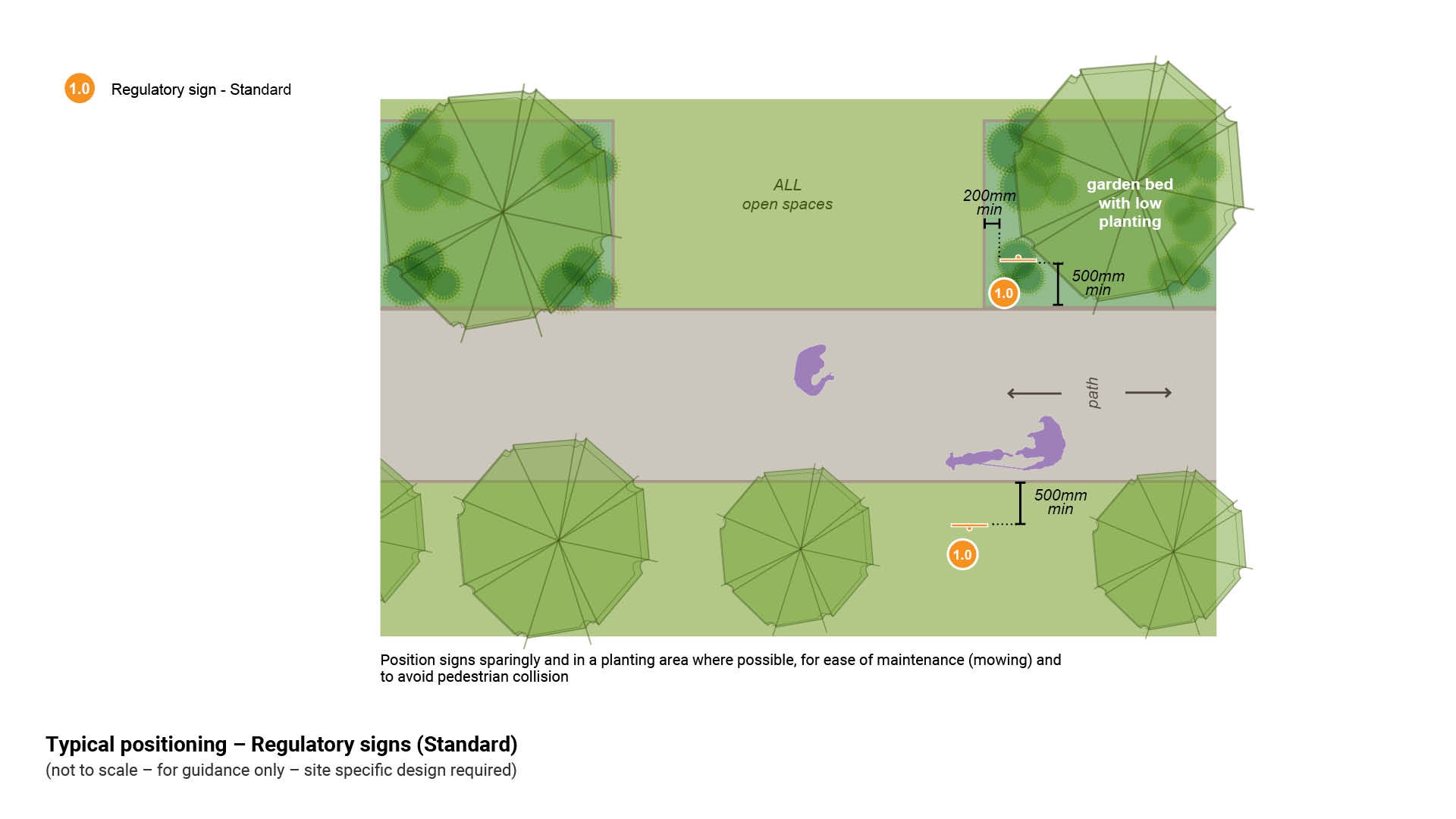
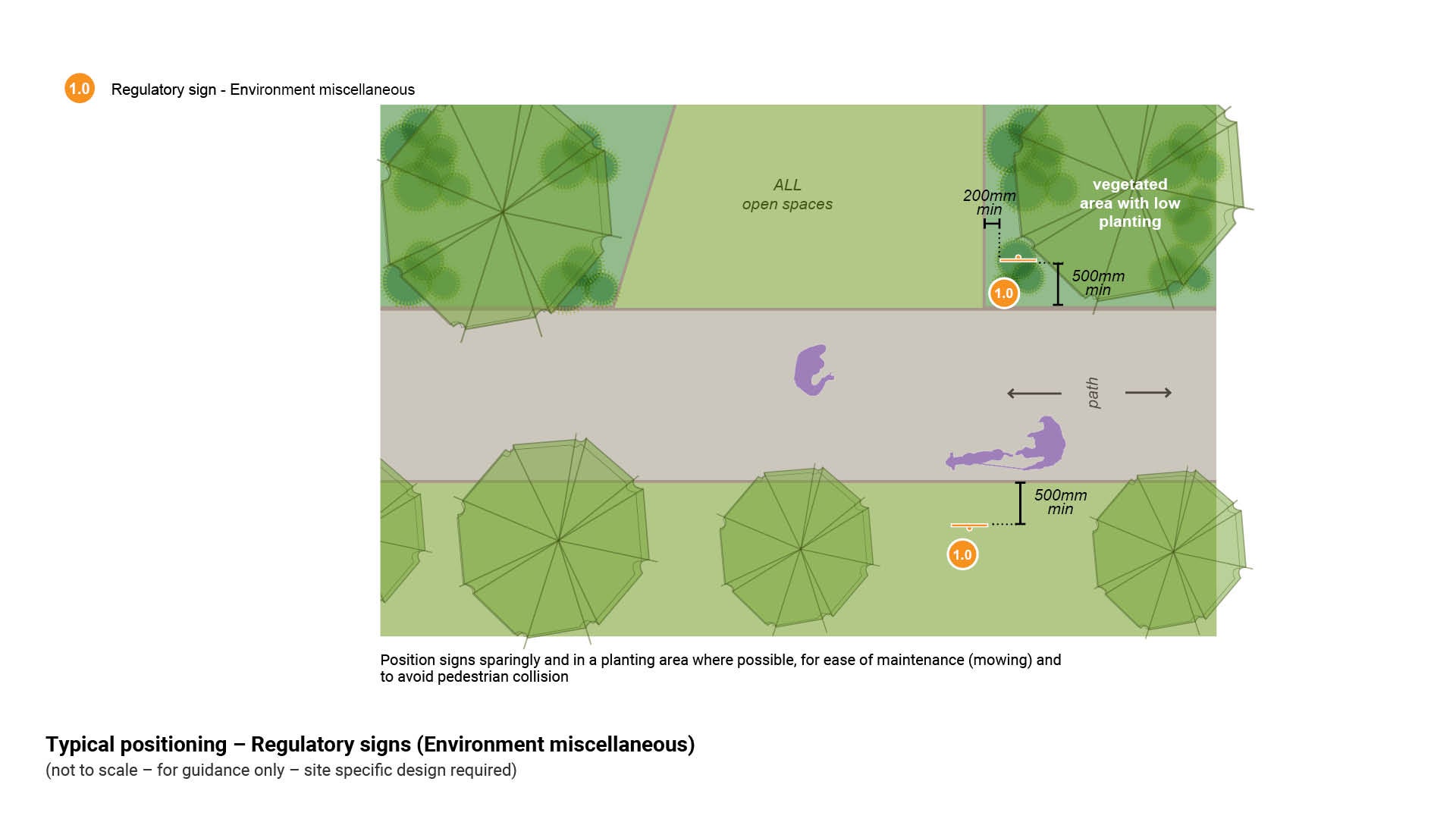
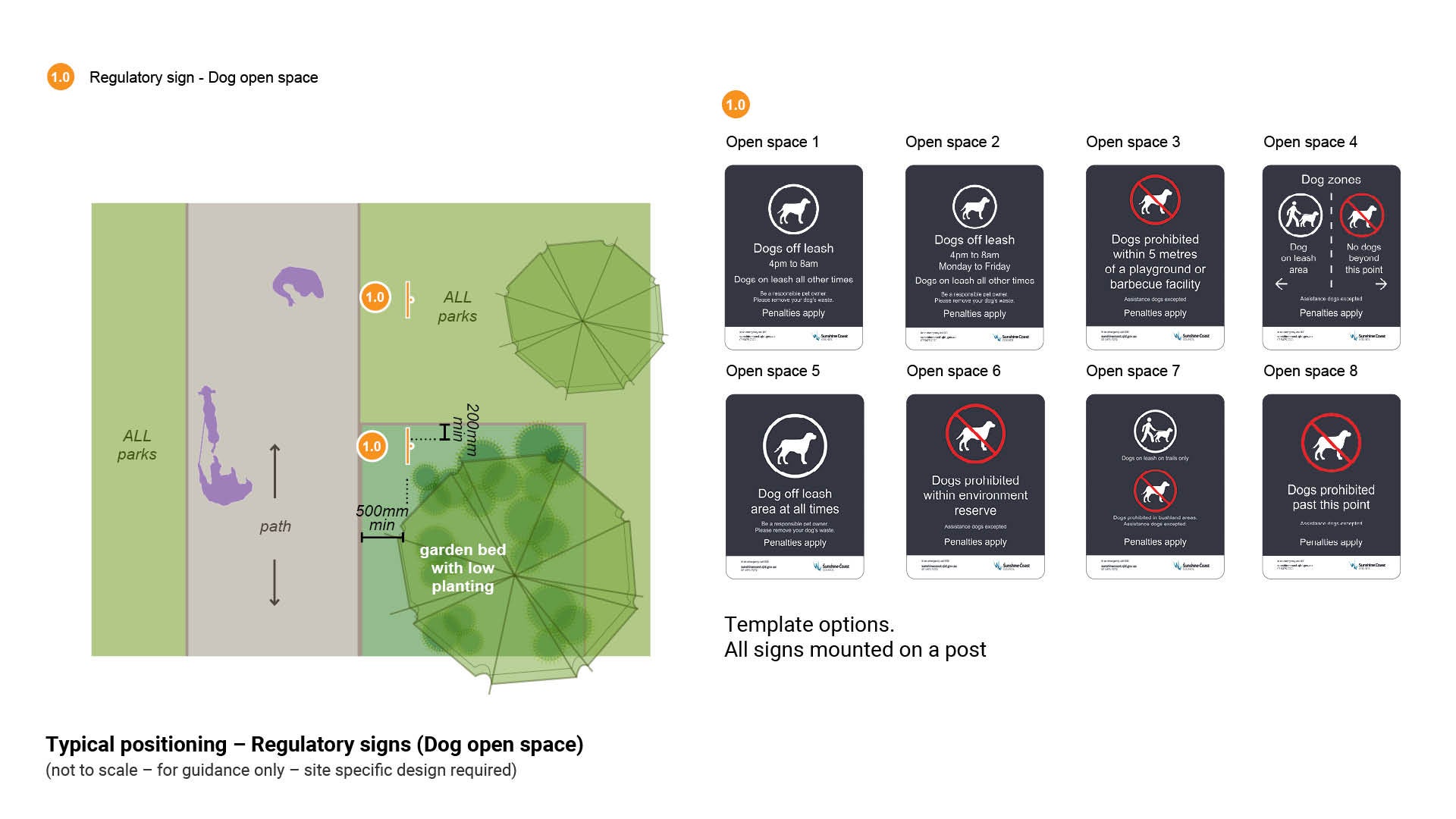
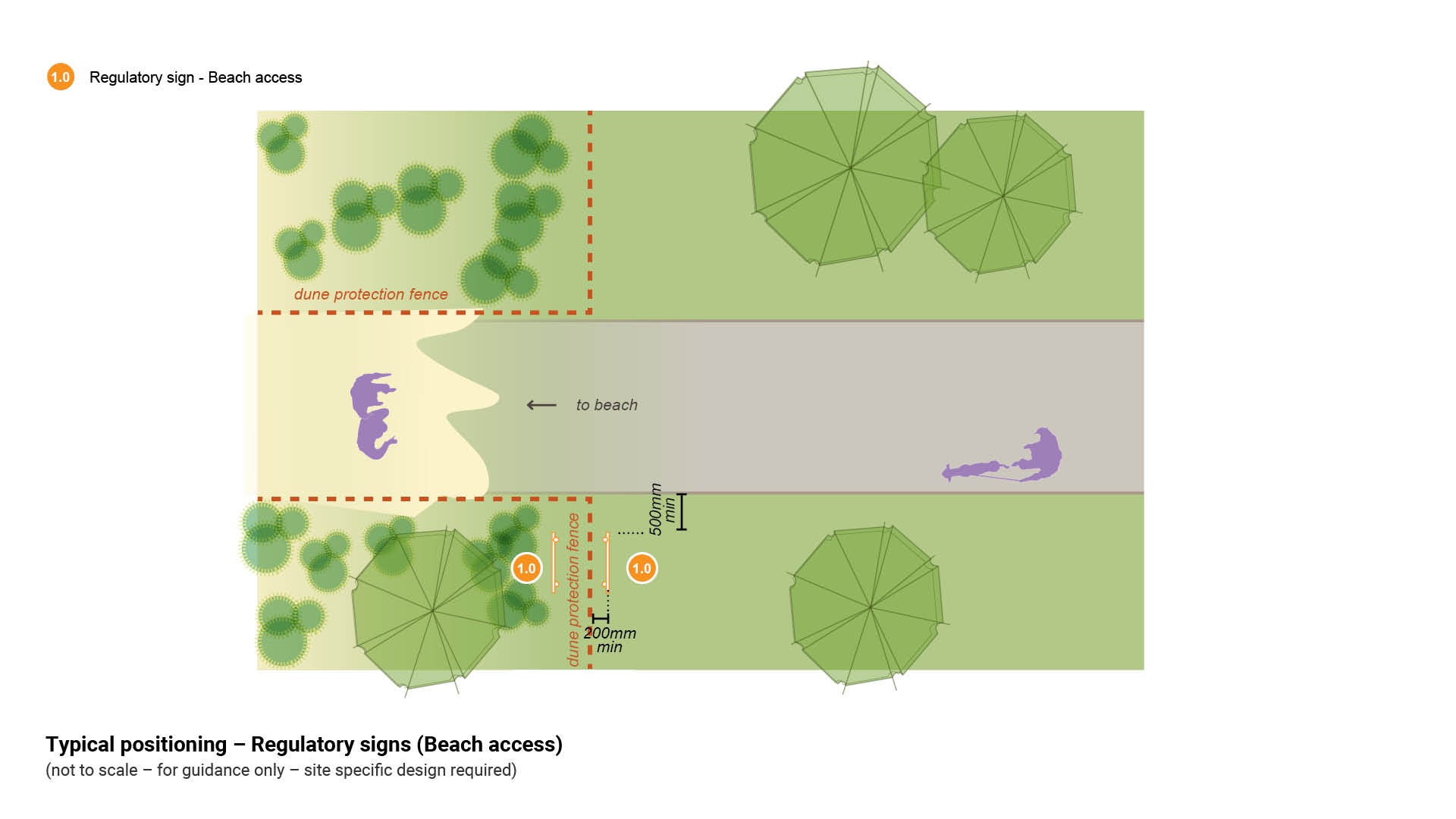
- Where there is an existing or new pathway, all signs must meet Austroads minimum 500 mm safety offset from any path edge, to avoid collision with the sign while using the pathway.
- Position signs a minimum of 200 mm in from any slab or compacted surface edge for mowing offsets (where applicable) and visual appearance.
- Positioning signs on pathways or any pedestrian surface is not recommended for the following reasons:
- The sign posts can blend into the background and may not always been visible.
- If a sign is installed on a pathway, Tactile Ground Surface Indicator (TGSIs) must be positioned around the full pedestrian surface in accordance with AS 1428.4.1:2009. This is not a desirable outcome.
- Minimum height clearance of signs must comply with the Manual of Uniform Traffic Control Devices (MUTCD) guidelines. Signs must be erected a minimum of 2.2 m from finished kerb level. This height considers vehicles and cyclist heights.
- The height at which any Regulatory sign is installed must take into consideration changing environmental conditions, such as sand movement.
- All signs within this suite (excluding 'Dog fenced area' and 'Beach access' signs) are only to be installed as additional signage where there may be an on-going problem or hazard that can only be managed by a sign.
Additional requirements
Standard
Position these signs in a planting area where possible, for ease of maintenance (mowing) and to avoid pedestrian collision.
See Figure 24: Typical positioning – Regulatory signs (Standard)
Figure 24: Typical positioning – Regulatory signs (Standard)
Environment miscellaneous
Position these signs in a planting area where possible, for ease of maintenance (mowing) and to avoid pedestrian collision.
See Figure 25: Typical positioning – Regulatory signs (Environment miscellaneous)
Figure 25: Typical positioning – Regulatory signs (Environment miscellaneous)
Marine use (internal Council use)
- Boundaries of bathing reserves are marked on Council's GeoHUB (Maps) bathing reserves layer 'Society and Culture' (Secure) – Bathing reserves.
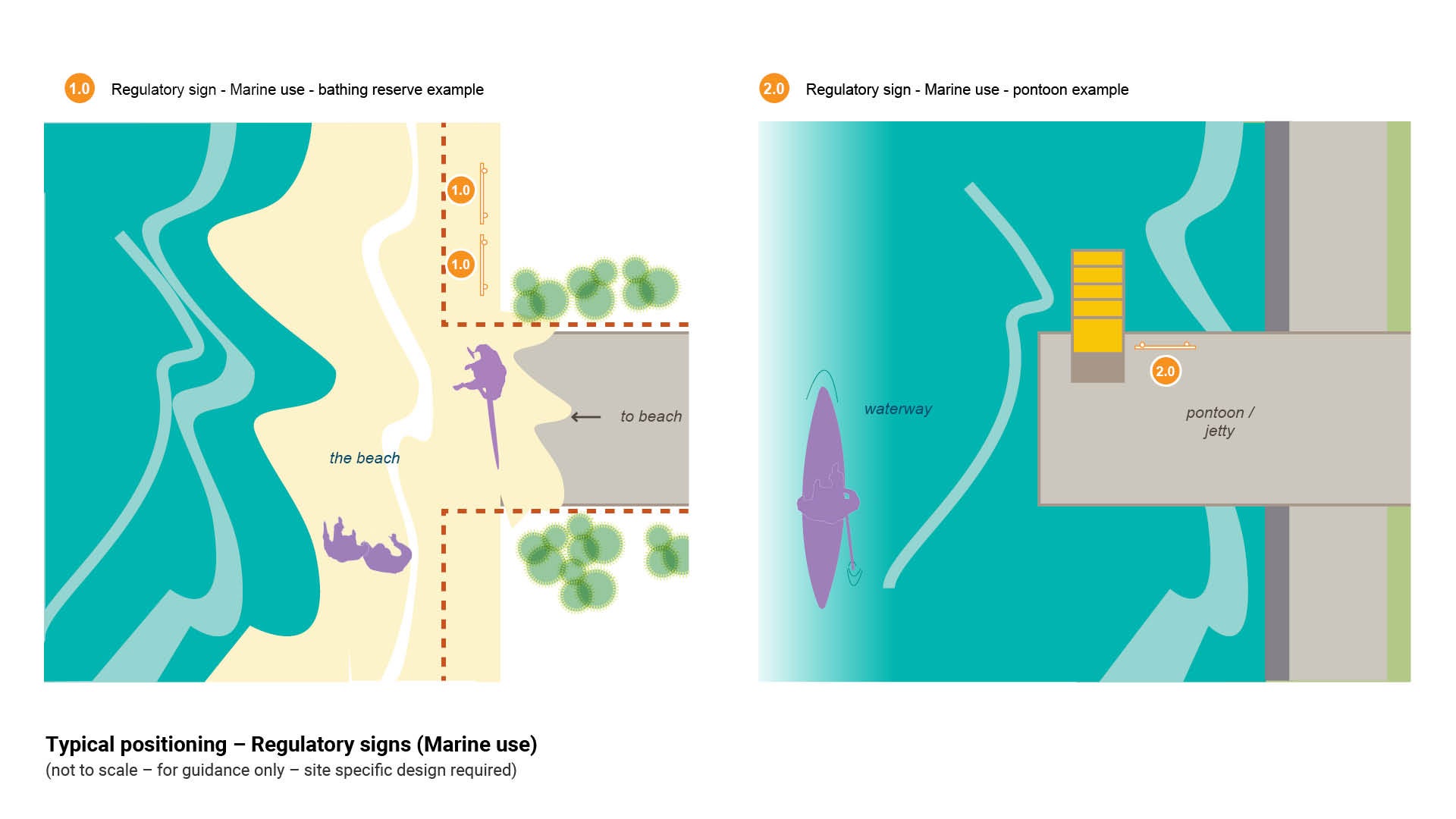
- Bathing reserve sign – South of the Mooloolah River, bathing reserves signs are installed to delineate the reserve. Dogs are prohibited in these areas, unless otherwise signed. Owners and dogs must exit the beach and access the beach again at a permitted access. Signs face seawards and shorewards.
- Bathing reserve sign – North of the Mooloolah River the entire beach from Beach Access 67 to 195 is a bathing reserve. Within this area the lifeguard’s flags designate bathing areas which are moveable. North of the river dogs are prohibited between the flags. Dogs are only allowed to traverse through the flagged areas where denoted on beach access signs.
- All beaches have signs posted at extremities. To facilitate sign installations, an ortho photo capture from Council's GeoHUB (Maps), together with a marked position can be provided for delivery staff.
- Golden Beach (Gemini Resort) has floating navigation markers which identify seaward boundaries to reduce conflict between watercraft (particularly jet skis) and swimmers.
See Figure 26: Typical positioning – Regulatory signs (Marine use)
Figure 26: Typical positioning – Regulatory signs (Marine use)
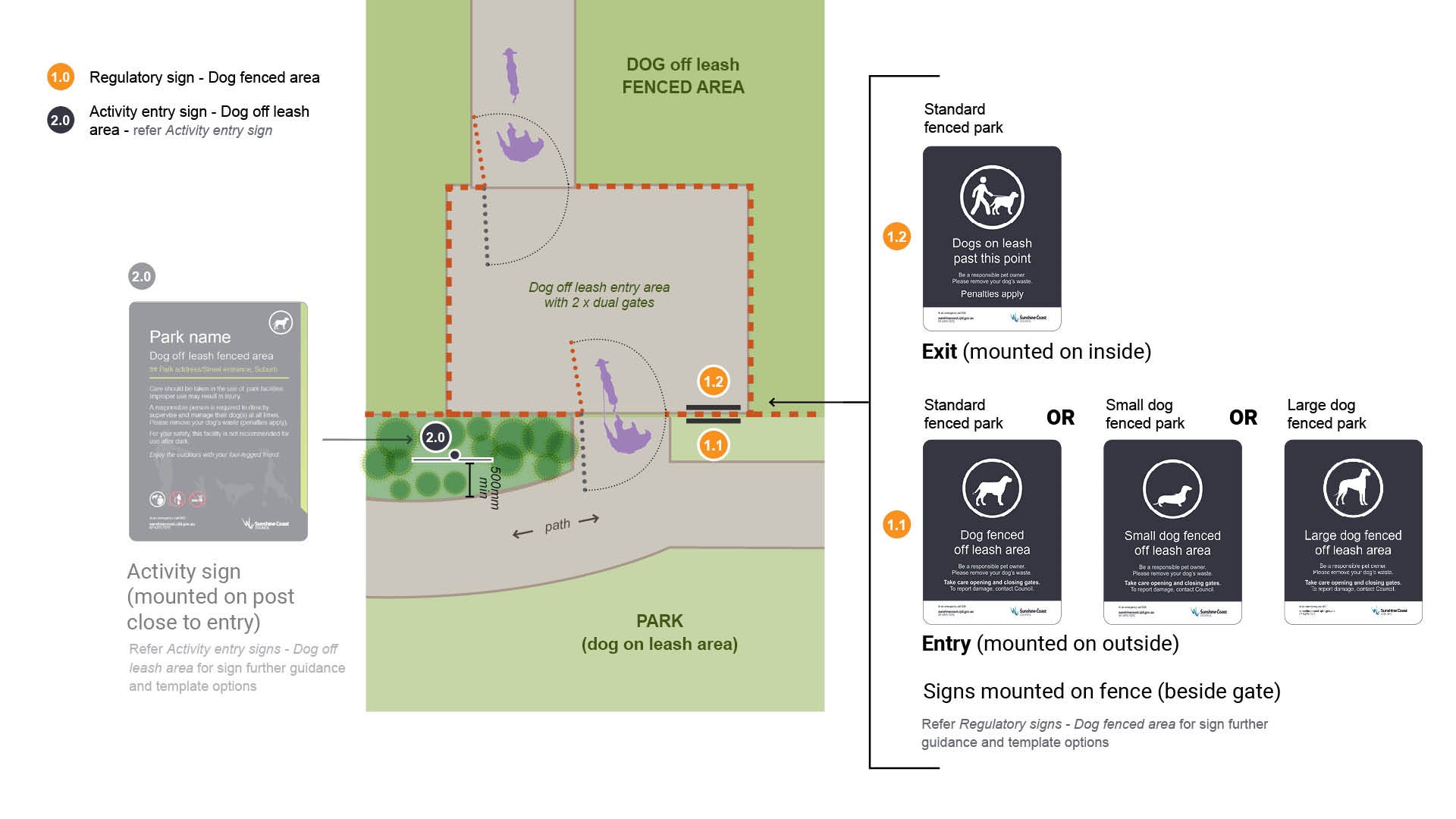
Dog fenced area
- Dog fenced area signs may be mounted onto walls, fences or posts.
- Where the sign is mounted onto a fence, it must not create footholds for climbing.
See Figure 27: Typical positioning – Dog fenced area
Figure 27: Typical positioning – Dog fenced area
Dog open spaces
- Position these signs in a planting area where possible, for ease of maintenance (mowing) and to avoid pedestrian collision.
See Figure 28: Typical positioning – Dog open spaces
Figure 28: Typical positioning – Dog open spaces
Beach access (type 1-9)
- Beach access signs (excluding type 2, 6 and 9) perform the task of an entry sign and are therefore required to be accessible for people with low vision and people who use wheelchairs. Accessible signs should be installed for an optimum viewing height of 1.2 m – 1.7 m, considered on a site specific basis.
- Place beach access signs in a fenced area where possible to retain clear beach access pathways.
- Consider that when installing a sign in dunal areas, wind blown sands may result in clearance heights that are less than that required by Australian Standards.
- Install beach end signs on a high point with maximum visibility from the beach and as close as possible to the end of the beach access ensuring.
- Beach access sign locations vary to suit the information they provide:
- Type 9: can be used at the park entry to assist with wayfinding for those arriving at the park and transitioning to the beach.
- Types 2 and 6: used on the beach, facing the water to provide information on the Beach Access number in the event of an emergency.
- Type 2: located at an unpatrolled beach.
- Type 6: located at a patrolled beach.
- Types 1 and 3, 4, 5, and 7, 8: used to provide important information about beach conditions and whether the beach is patrolled. These signs are located at the entry to the beach.
See Figure 29: Typical positioning – Regulatory signs (Beach access)
Figure 29: Typical positioning – Regulatory signs (Beach access)
Delivery
For all developer delivered assets, contact Council (Development Services) – this includes all works associated with any development application.
For all council delivered assets, the following process should be used:
Site investigations
- Confirm council land tenure and approval process.
- Identify sign location.
- Identify physical/technical constraints.
- Obtain arborist advice (where required).
Community engagement/stakeholders
- Where applicable.
Corporate liaison and approvals
See the Technical drawings and artwork templates table in each sign type page for guidance - How to place an artwork order (internal use only) and Artwork design instructions (internal use only).
- Council (Parks and Gardens) and or Council (Environmental Operations).
- initial approval for use/application of sign.
- approval and guidance of artwork content.
- approval to manufacture signs.
- approval of location of signs.
- Council (Community Response)
- approval of any regulatory signage/componentry.
- Council (Communication)
- editing of templates
- supply of proofs for approval
- approval of corporate branding.
Deliverables
- Site plan – for sign installation.
- Technical drawings (DWGs) – sign construction details.
- Schedule of signs.
Manufacture
See the Technical drawings and artwork templates table in each sign type page for guidance - How to place an artwork order (internal use only) and Artwork design instructions (internal use only).
- In-house manufacture – Council (Transport Network Operations) - Civil Operations (Signs Technical Officer).
OR
- External manufacture – select a suitable sign fabricator.
Installation
- All relevant key stakeholders are to be notified (including contractors), and where required, attend a pre-start meeting.
- Sign location as per approved site plan.
- Installation as per technical drawings and schedule.
Finalisation
- Assets captured.
- As designed as constructed drawings (ADAC) supplied.
- Hand over to asset custodian.
This component is currently in development