Suite of signs

Navigation signs (water)
Navigation signs are used in marine environments to relate information about potential risks and requirements, such as maximum speed while driving a boat on a waterway.
This suite contains two types of non-standard traffic control signs and a navigational markers:
- Non standard traffic control signs
- Water markers.
Catalogue sample
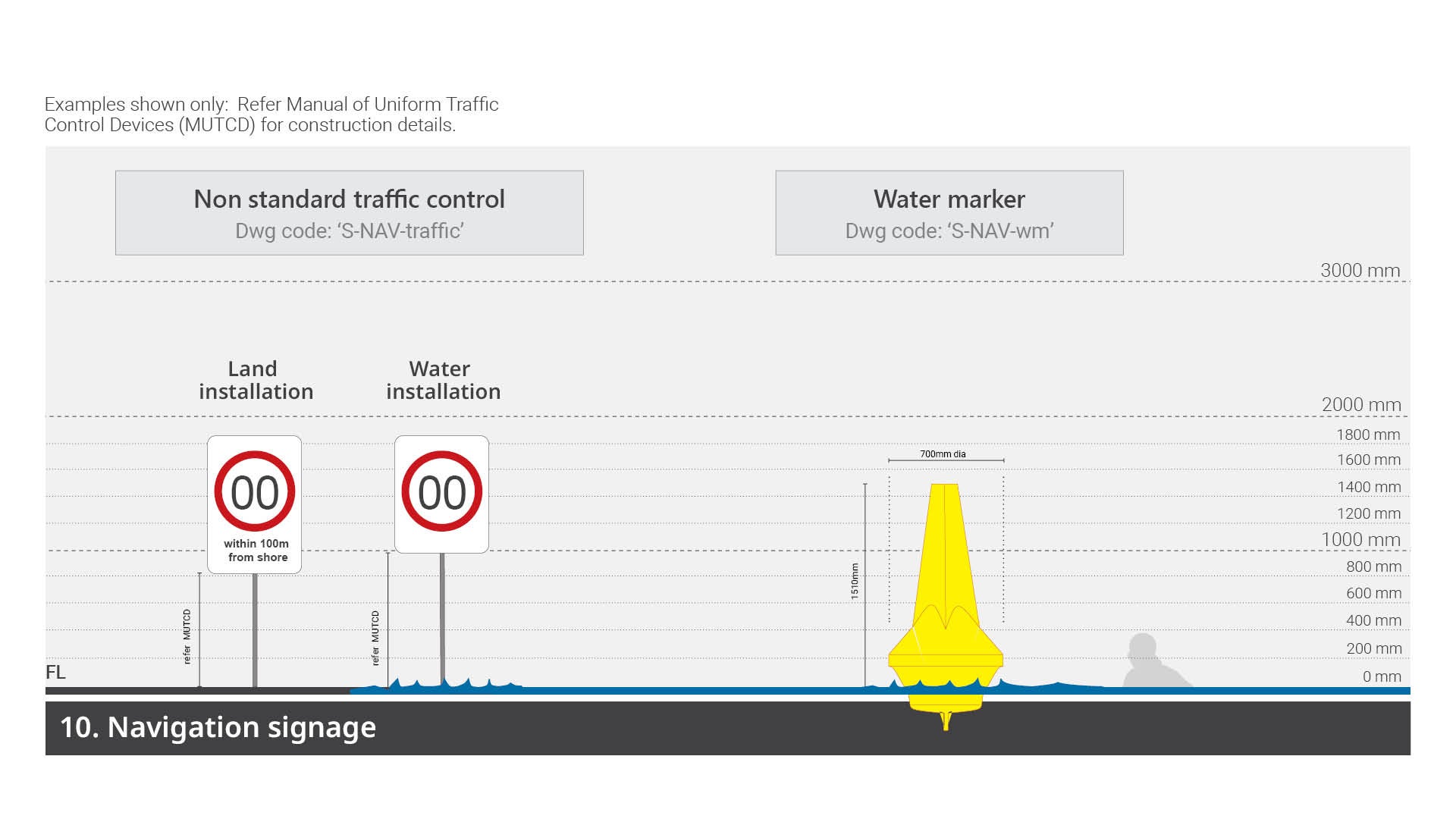
Download the full LIM Signage suite Catalogue.
Technical drawings and artwork templates
Embellishment | Technial dwg/artwork templates | Supplier |
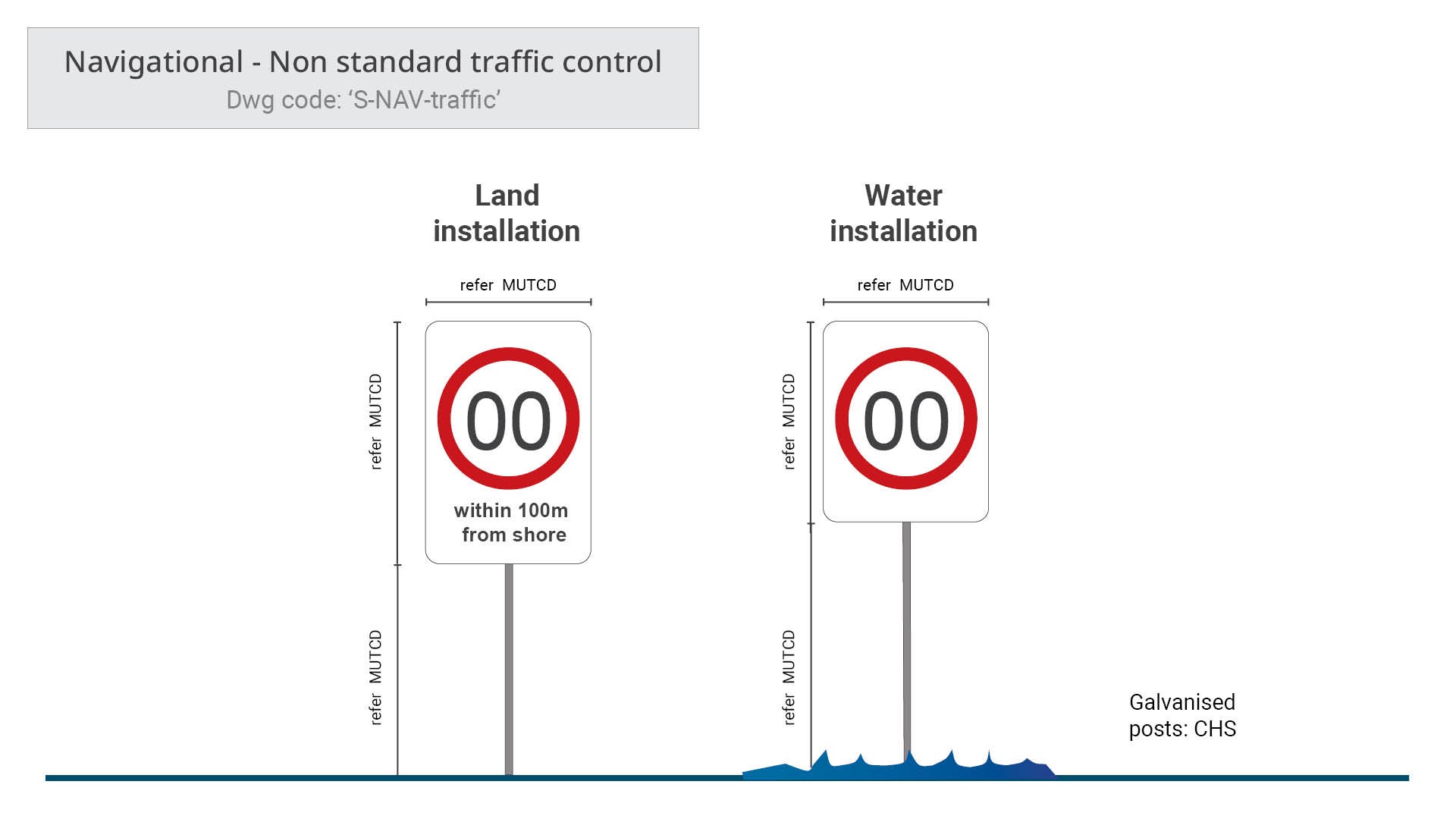 | Navigation signs - Non standard traffic control
| No supplier specified |
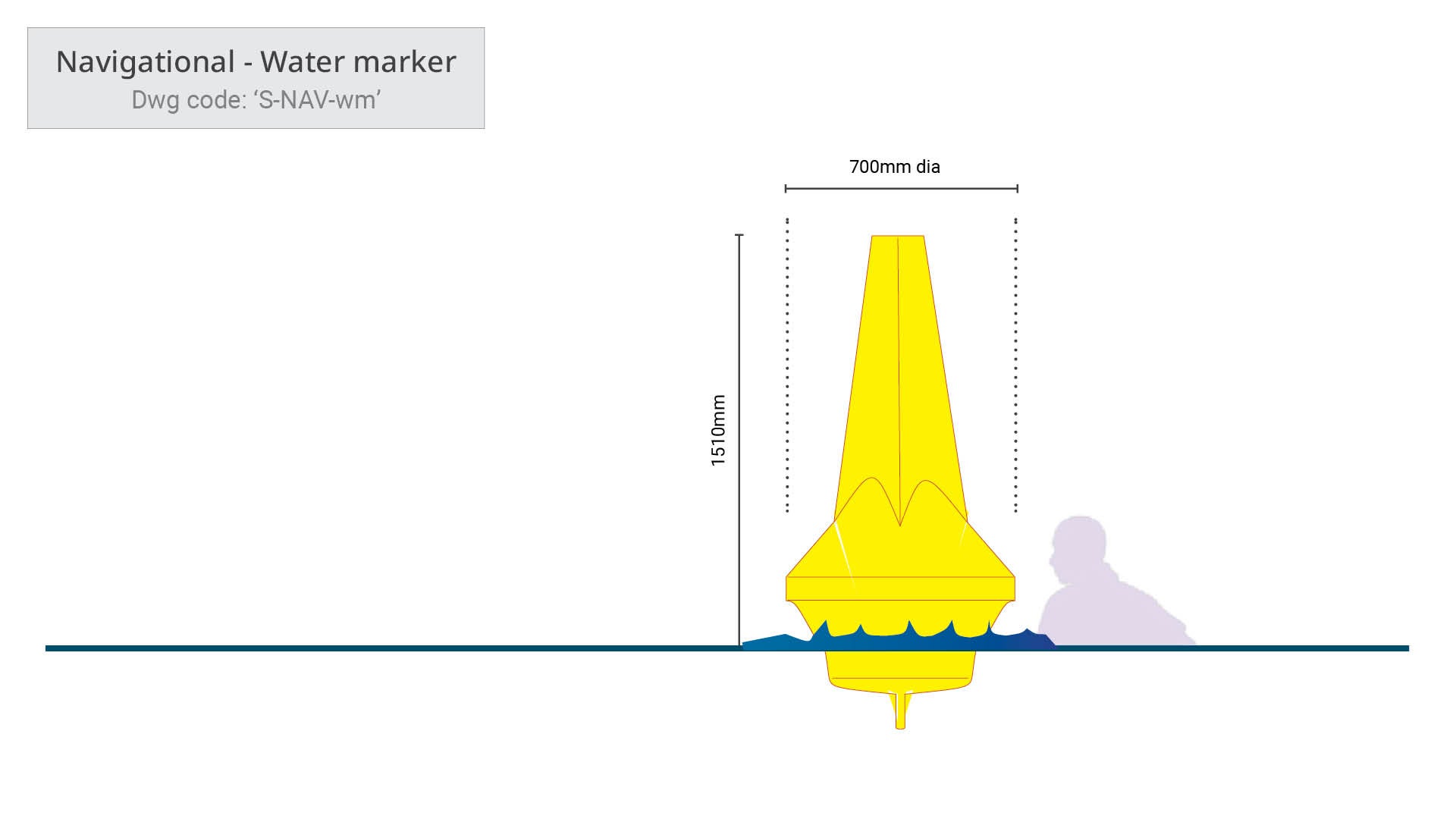 | Navigation signs - Water marker
| No supplier specified |
Purpose
Council is responsible for Navigational signs throughout constructed inland waterways such as canals and lakes. All other waterways are the responsibility of Maritime Safety Queensland (MSQ).
The signs may be installed for the following users:
- Watercraft, such as boats and jet skis users.
- Beach goers, such as swimmers and body surfers.
This suite contains two types of non-standard traffic control signs and a navigational markers:
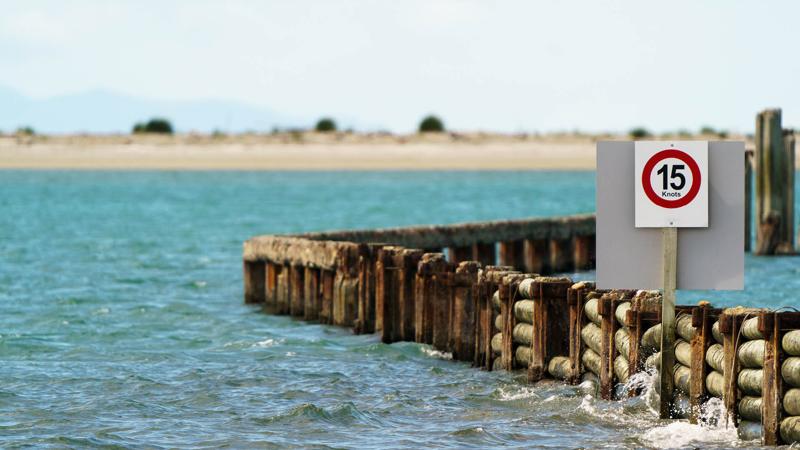
Non standard traffic control signs – used at boat ramps, pontoons, access points and associated environments. These signs can be used on both land and in water.
See the following:
- Transport and Main Roads Manual of Uniform Traffic Control Devices (MUTCD) for sign design and construction.
- TMR Design Guide for Roadside Signs for sign post construction and footing design.
Transport and Main Roads Design Criteria for Boat Ramps for signs standard drawings, sign post design and sign locations.
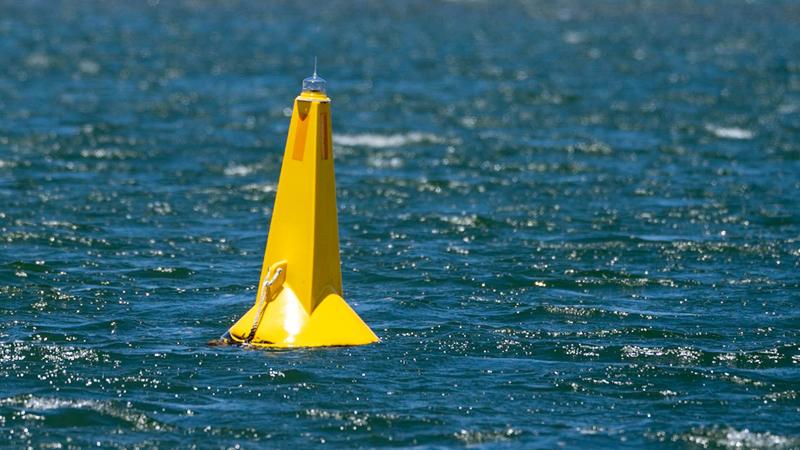
Water markers – floating devices that indicate boundaries for activity areas, such as bathing reserves.
See Maritime Safety Queensland Buoys, markers and beacons (IALA) International Association of Marine Aids to Navigation and Lighthouse Authorities.
Planning
General
The following should be considered prior to installing/positioning the sign:
- Determine if the sign is required.
- Confirm the intent for installing the sign.
- Consider existing signs.
- Consider if the new sign can be incorporated onto existing signs to minimise visual clutter.
- Determine accessible, highly visible locations to calculate the number of signs required.
Design
Legal, standards and guidelines, requirements
Sign construction
- Technical drawings (DWGs) - for typical construction details for each sign type. See Technical drawings and artwork templates table (above - top of page).
- Artwork templates and samples - for approved graphic design templates and samples for alternative options (where applicable) for each sign type. See Technical drawings and artwork templates table (above - top of page).
See LIM Signage – Overarching guidelines – for Standards such as, designing for access and inclusion, traffic and road standards (where applicable).
Content and corporate branding
- Sunshine Coast Council corporate branding logo must be displayed on all signs as per Artwork templates.
- All colours must be selected from the Council corporate colour palette or otherwise approved for specific purpose. e.g. some colours, such as red, yellow and black, (not part of the corporate palette) may be used for regulatory purposes.
See LIM Signage – Graphic design guidelines – for essential guidance on components that make up signs. e.g. colour application, pictogram integration, text sizing and spacing, map implementation etc.
Content general
- All sign artwork is to be professionally designed (by a qualified graphic designer or equivalent) as vector files.
- Short message - content must be clear and concise
- Sign content must use a positive tone. This will influence the reader to embrace the message.
- All regulatory pictograms must be approved by Council (Community Response) prior to printing.
Positioning
General
When selecting potential sign locations, it is important to balance visibility, aesthetics, and safety. Signs should never obstruct or dominate prominent natural views, landmarks, or marine vistas. Instead, signage should remain secondary to the natural environment and marine movement, ensuring that it complements rather than detracts from the visual experience of waterways.
However, safety is paramount. Signage must be positioned where it is clearly visible to marine traffic under all conditions, including varying light, weather, and tidal changes. Consider the following factors when determining placement:
- Sight lines and approach angles: Ensure signs are visible from typical navigation routes and at appropriate distances for safe decision-making.
- Avoid visual clutter: Do not place signs where they compete with multiple other signs or structures, which can cause confusion.
- Environmental integration: Position signs to minimise impact on scenic views while maintaining compliance with safety standards.
- Maintenance access: Choose locations that allow safe and practical access for inspection, cleaning, and replacement.
Delivery
For all developer delivered assets, contact Council (Development Services) – this includes all works associated with any development application.
For all council delivered assets, the following process should be used:
Site investigations
- Confirm council land tenure and approval process.
- Identify sign location.
- Identify physical/technical constraints.
- Obtain arborist advice (where required).
Community engagement/stakeholders
- Where applicable.
Corporate liaison and approvals
See the Technical drawings and artwork templates table in each sign type page for guidance - How to place an artwork order (internal use only) and Artwork design instructions (internal use only).
- Council (Parks and Gardens) and or Council (Environmental Operations).
- initial approval for use/application of sign.
- approval and guidance of artwork content.
- approval to manufacture signs.
- approval of location of signs.
- Council (Community Response)
- approval of any regulatory signage/componentry.
- Council (Communication)
- editing of templates
- supply of proofs for approval
- approval of corporate branding.
Deliverables
- Site plan – for sign installation.
- Technical drawings (DWGs) – sign construction details.
- Schedule of signs.
Manufacture
See the Technical drawings and artwork templates table in each sign type page for guidance - How to place an artwork order (internal use only) and Artwork design instructions (internal use only).
- In-house manufacture – Council (Transport Network Operations) - Civil Operations (Signs Technical Officer).
OR
- External manufacture – select a suitable sign fabricator.
Installation
- All relevant key stakeholders are to be notified (including contractors), and where required, attend a pre-start meeting.
- Sign location as per approved site plan.
- Installation as per technical drawings and schedule.
Finalisation
- Assets captured.
- As designed as constructed drawings (ADAC) supplied.
- Hand over to asset custodian.
This component is currently in development