Suite of signs

Noticeboard
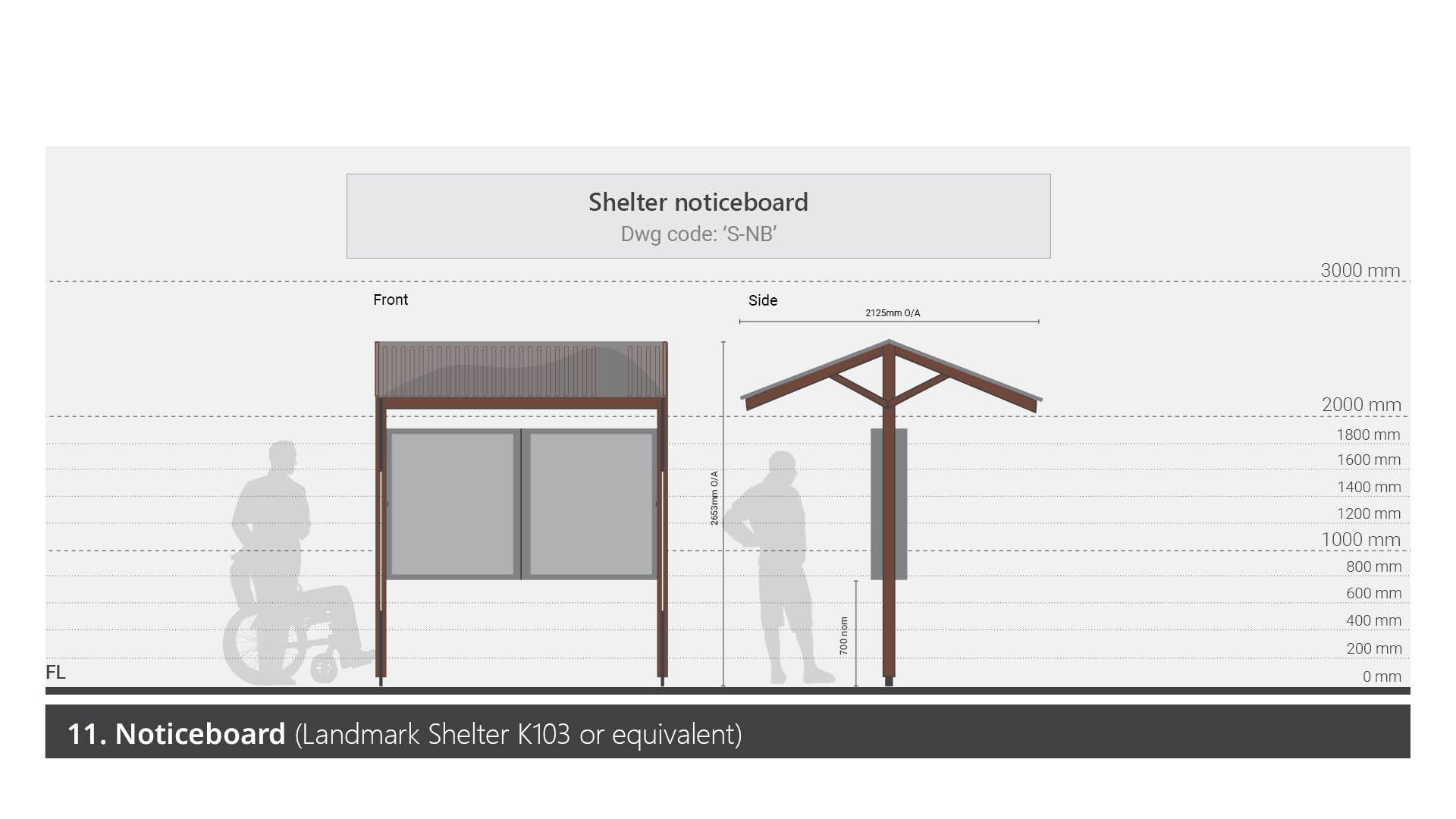
A Noticeboard sign type provides an area to display material for community information. They can be used by community groups, individuals or approved organisations. These are typically in the form of an enclosed weather proof case housed in a shelter.
Catalogue sample
Download the full LIM Signage suite Catalogue.
Technical drawings and artwork templates
Embellishment | Technical dwg/artwork templates | Supplier |
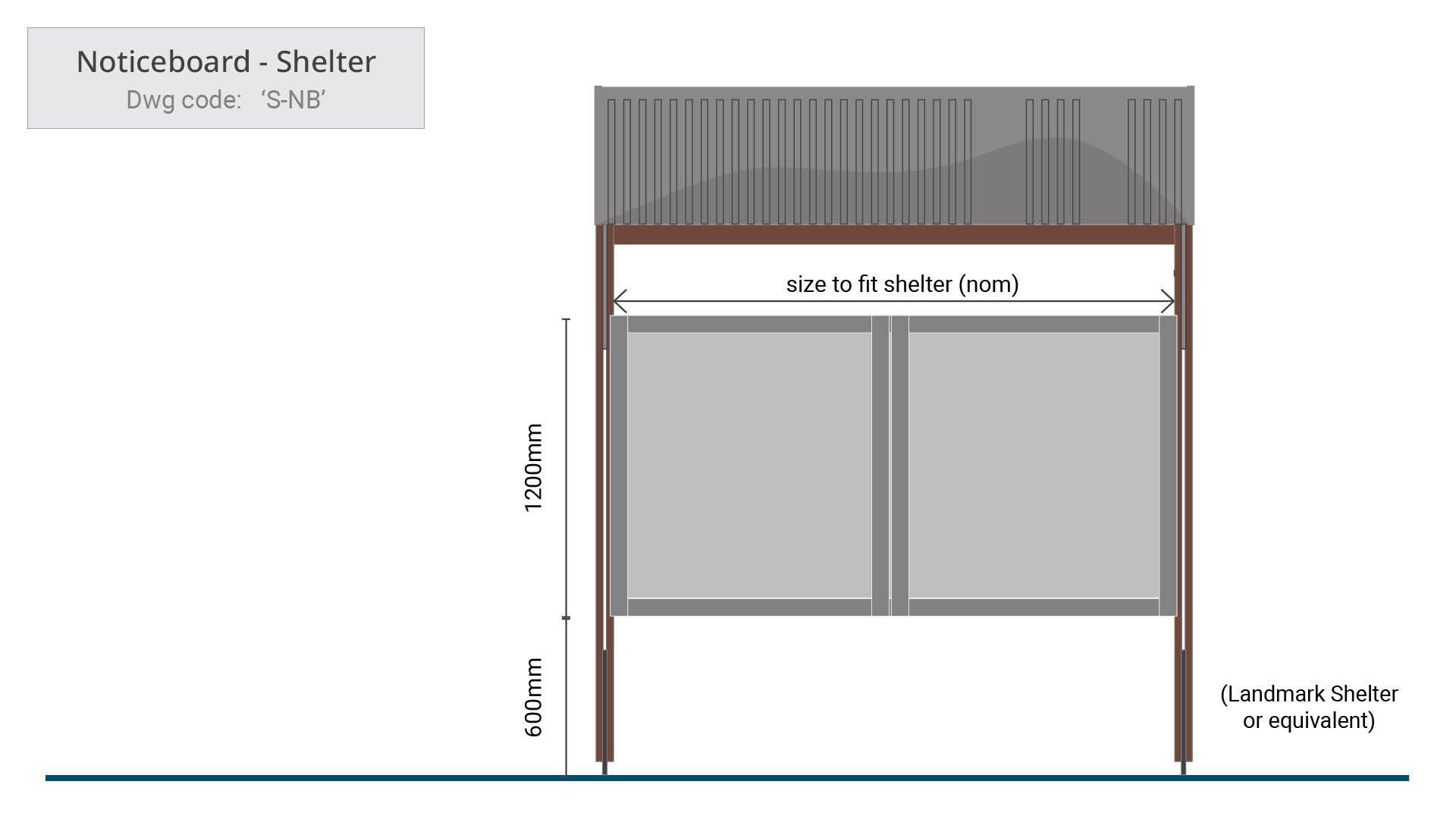 | Noticeboard - (Landmark shelter K103 or equivalent)
| Landmark (or equivalent) |
Purpose
A Notice board is typically housed in a weatherproof case, under a shelter. The Notice board provides an area to display material for community information. Brochures, leaflets or advertising may be placed by the community, by Council or by community organisations.
Notice boards may be installed on Council-owned land, including parks and open spaces. Typical configurations may include:
- Frame: An aluminium frame enclosing the display area for posting messages.
- Backboard: A solid backboard, optionally fitted with a header panel for branding (e.g., company logo) or decorative motifs.
- Protective Case: A transparent polycarbonate enclosure (Lexan or equivalent) with high impact resistance, optionally equipped with a security locking mechanism.
- Shelter: A weatherproof structure providing protection for the notice board.
Notice boards may be managed and accessed under the following arrangements:
- Council-controlled: Maintained and monitored by Council staff.
- Restricted access: Managed by an individual or group with a locked cabinet system.
Planning
General
The following should be considered prior to installing a notice board:
- Plan to incorporate Crime Prevention Through Environmental Design Guidelines (CPTED) such as ‘retain sight lines’ at the design stage of a notice board project, to avoid ongoing maintenance costs for lift pruning of trees and vegetation or costly re-design to enhance public safety.
- Consider who will use the notice board:
- general public
- council access only
- community organisation access only
- combination of more than one of the above.
- Establish if the notice board is to be double or single sided. Double sided is preferred to maximise the capacity of the sign and space.
- Where a notice board is to be single sided, consider co-locating with the Map/information sign (trailhead entry sign) if applicable.
- Verify who will manage the notice board and the management process to be used (such as monitoring of material which may be considered offensive, removal of out of date material).
- Confirm the most appropriate location.
- Consider the impacts of the chosen location. The site must be in full view and easily accessed by passing pedestrians and visible to passing motorists.
- A highly visible location will provide a safe environment to display and read information as well as result in the notice board being well used.
Design
Legal, standards and guidelines, requirements
Sign construction
- Technical drawings (DWGs) - for typical construction details for each sign type. See Technical drawings and artwork templates table (above - top of page).
- Artwork templates and samples - for approved graphic design templates and samples for alternative options (where applicable) for each sign type. See Technical drawings and artwork templates table (above - top of page).
See LIM Signage – Overarching guidelines – for Standards such as, designing for access and inclusion, traffic and road standards (where applicable).
Content and corporate branding
- Sunshine Coast Council corporate branding logo must be displayed on all signs as per Artwork templates.
- All colours must be selected from the Council corporate colour palette or otherwise approved for specific purpose. e.g. some colours, such as red, yellow and black, (not part of the corporate palette) may be used for regulatory purposes.
See LIM Signage – Graphic design guidelines – for essential guidance on components that make up signs. e.g. colour application, pictogram integration, text sizing and spacing, map implementation etc.
- A weatherproof Lexan (or equivalent) clear polycarbonate case is preferred. The case should be lockable and wide enough to comfortably house pins or clips used to attach information to an internal board.
- The case must be wide enough to comfortably house pin used to hold information to an internal board, or an alternative notice attachment system such as flexible clips.
- The case must include an option to be locked or a fixing for a lock.
Detailed design
Consider the level of security required for the notice board and the contents.
- Where the notice board is to be managed by a community, individual or group it will require:
- a lockable case
- guidelines for approval of the content of notices posted.
- Where the notice board is to be use for the general community, self regulated use, it may include:
- a weatherproof case with no lock
- no case and a method for attaching notices
- guidelines about use and content
- a mechanism for removal of material which may be considered offensive.
Positioning
General
- When considering potential sign locations, avoid positions where the sign may interrupt or block a prominent view. Signs should be secondary to a natural view. However, safety is paramount.
- Position signs in a planted area where possible, for ease of maintenance mowing, and to potential for avoid pedestrian collision.
- To ensure a sign panel will not be obscured in future, consider mature size of surrounding vegetation.
- To protect trees from potential damage, all signs should be installed outside of their canopy areas (drip lines). Where this is not possible, the Project Arborist should be contacted to provide advice. See LIM Site set up (including Tree protection) for further guidance.
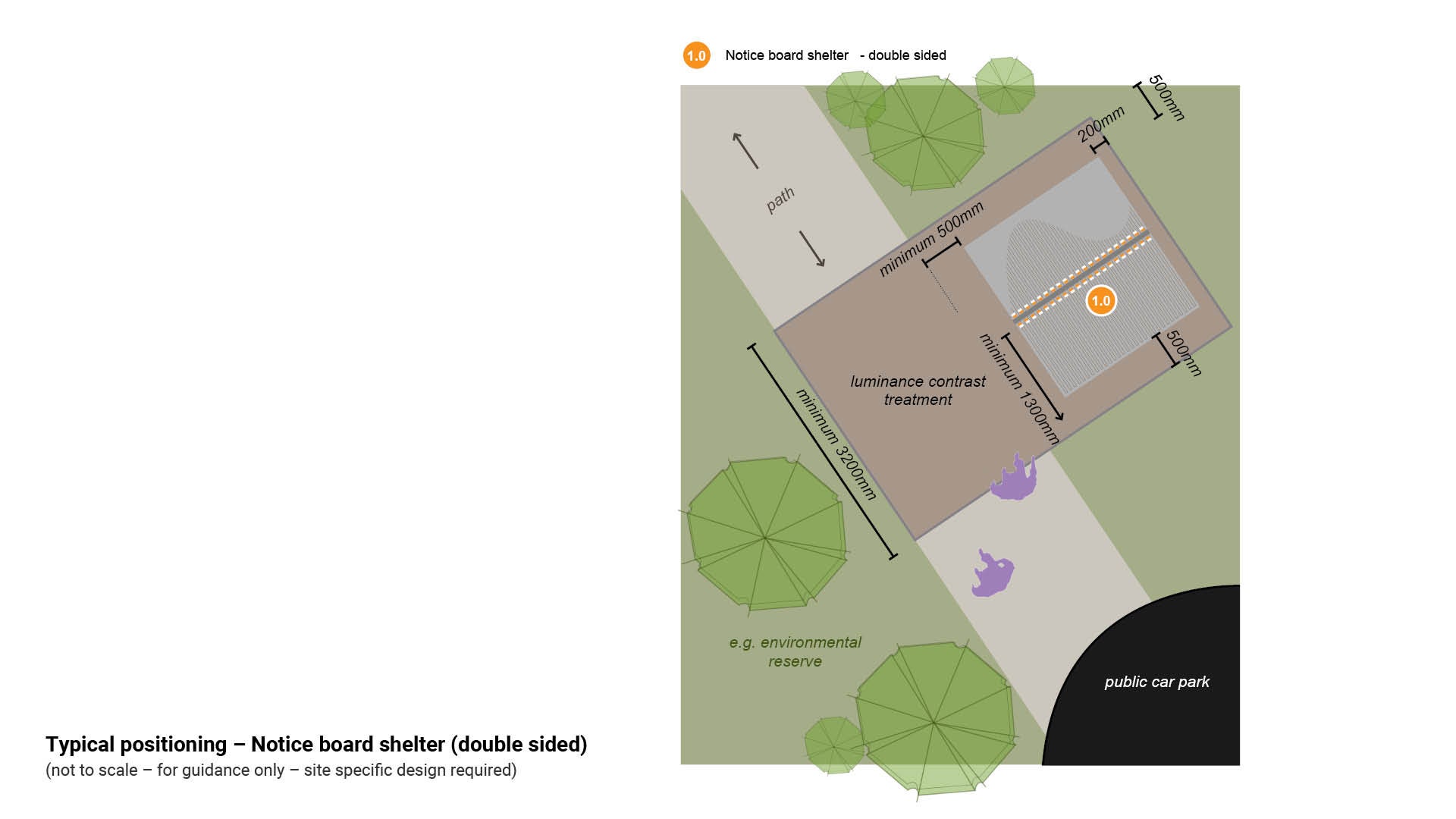
- Where there is an existing or new pathway, all signs must meet Austroads minimum 500 mm safety offset from any path edge, to avoid collision with the sign while using the pathway.
- Position signs a minimum of 200 mm in from any slab or compacted surface edge for mowing offsets (where applicable) and visual appearance.
- Position the notice board in view of passing pedestrians and motorists. A highly visible location will:
- increase engagement with the board.
- provide a safe environment to display and manage information.
- provide a safe environment to read information.
- Where a notice board is to be surface mounted under an existing shelter, position the board to retain views.
- A notice board slab must extend 500 mm past the shelter drip line. This will prevent washout on surrounding grass or planted areas. See LIM Shelters for further guidance.
See the following for further guidance:
- Figure 30: Typical positioning – Notice board shelter (single sided)
- Figure 31: Typical positioning – Notice board shelter (double sided)
Figure 30: Typical positioning – Notice board shelter (single sided)
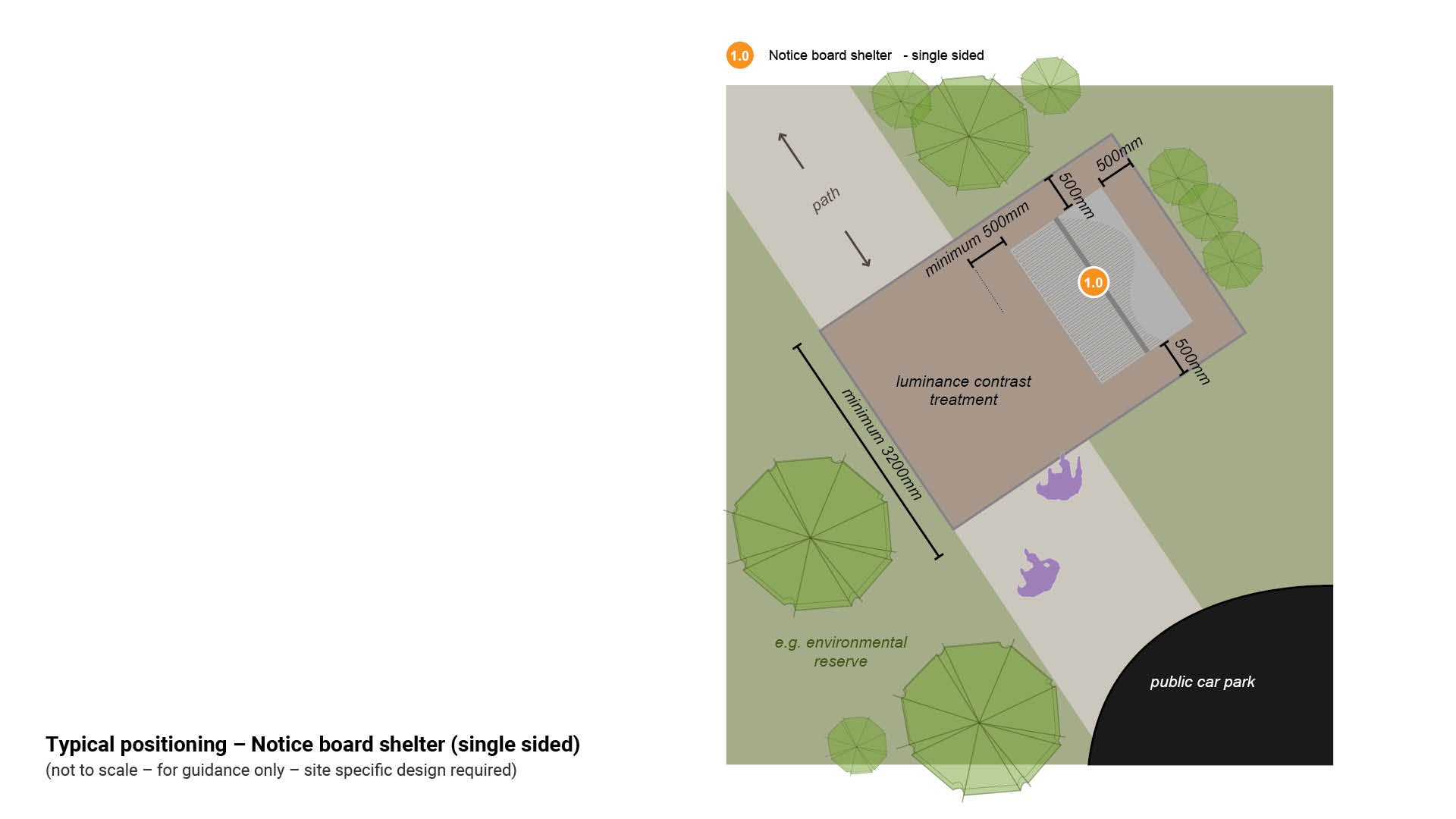
Figure 31: Typical positioning – Notice board shelter (double sided)
Delivery
For all developer delivered assets, contact Council (Development Services) – this includes all works associated with any development application.
For all council delivered assets, the following process should be used:
Site investigations
- Confirm council land tenure and approval process.
- Identify sign location.
- Identify physical/technical constraints.
- Obtain arborist advice (where required).
Community engagement/stakeholders
- Where applicable.
Corporate liaison and approvals
See the Technical drawings and artwork templates table in each sign type page for guidance - How to place an artwork order (internal use only) and Artwork design instructions (internal use only).
- Council (Parks and Gardens) and or Council (Environmental Operations).
- initial approval for use/application of sign.
- approval and guidance of artwork content.
- approval to manufacture signs.
- approval of location of signs.
- Council (Community Response)
- approval of any regulatory signage/componentry.
- Council (Communication)
- editing of templates
- supply of proofs for approval
- approval of corporate branding.
Deliverables
- Site plan – for sign installation.
- Technical drawings (DWGs) – sign construction details.
- Schedule of signs.
Manufacture
See the Technical drawings and artwork templates table in each sign type page for guidance - How to place an artwork order (internal use only) and Artwork design instructions (internal use only).
- In-house manufacture – Council (Transport Network Operations) - Civil Operations (Signs Technical Officer).
OR
- External manufacture – select a suitable sign fabricator.
Installation
- All relevant key stakeholders are to be notified (including contractors), and where required, attend a pre-start meeting.
- Sign location as per approved site plan.
- Installation as per technical drawings and schedule.
Finalisation
- Assets captured.
- As designed as constructed drawings (ADAC) supplied.
- Hand over to asset custodian.
This component is currently in development