Public amenities

Design
Requirements for the design, manufacture and installation of embellishments
Good design
See the following corporate documents to identify relevant project design requirements:
Sunshine Coast Planning Scheme regulates the way land, buildings and structures are used and developed on the Sunshine Coast.

Sunshine Coast Design contains 10 design principles that guide good project planning and design outcomes, that are appropriate for the Sunshine Coast.
The LIM provides further overarching design advice, refer:
- Introduction and Design Principles - e.g. sustainability, CPTED, accessibility
- Preliminaries - environmental management, tree sensitive design and site set up.
Embellishment requirements
- Universal access.
- Comfortable and suitable for the average person.
- See 'Positioning' and 'Equal access' sections for the corresponding LIM category.
- Made from materials that will be durable and can be suitably protected from exterior elements, such as salt spray and UV exposure.
- Robust and sturdy to withstand constant public use and be resistant to vandalism.
- Fixings are to be 316 marine grade stainless steel (unless otherwise stated).
- Tamper proof fixings should be used
- Graffiti protection coatings applied (where applicable)
- Fire retardant (where applicable).
- Warranties should be as listed below.
- Easily repairable or replaceable.
- Sourced locally and use standard fittings.
- Reputable suppliers should be used who keep a supply of stock parts on hand for the life of the product.
- Use sustainable materials, although sustainability needs to be considered over the lifetime of the embellishment.
- Install on paved, concrete or other hard surfaces (where applicable).
- Manufactured to engineering specifications (where applicable).
- See the 'Standards' section for the corresponding LIM category.
Warranty and asset life
Product/embellishment | Warranty (minimum) | Asset life (typical useful life) |
Amenities | N/A | 40 years 2 |
Substructure | 20 years | 40 years |
Superstructure | 15 years | 40 years |
Roof | 15 years | 20 years |
Hydraulic elements | 15 years | 20 years |
Electrical elements | 15 years | 20 years |
Source 2: Sunshine Coast Council Asset Management Plan – Building and Facilities (figure based on current data, subject to change).
Public amenities
Once the location of the public amenity has been decided, based on the Environment and Liveability Strategy (ELS) and Recreation Parks Plan (RPP) guidance, consider the appropriate embellishment level to suit the selected site.
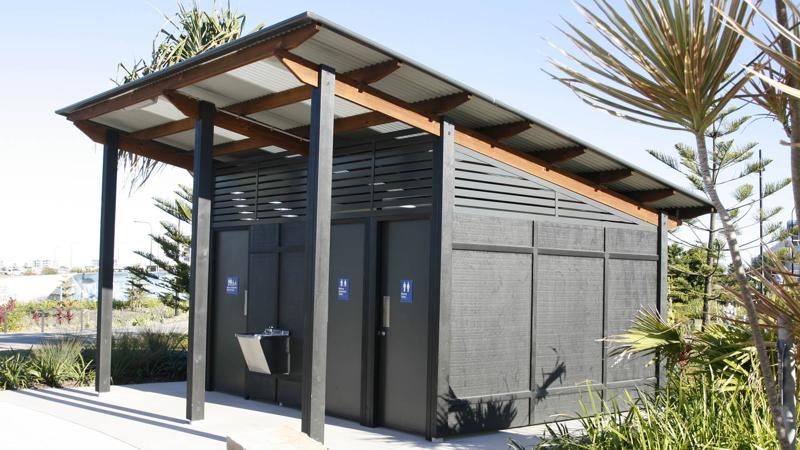
Overall design considerations:
- All open spaces should include universal access (e.g. equitable access)
- The provision of modern, attractive, safe and accessible public amenities is an important function of local government.
- Having clean, well designed facilities in public spaces helps create a sense of welcoming as well as promoting place activation and visitation. This essential infrastructure promotes well-being by encouraging active community participation in economic, social and recreational activities.
- The design of modern public amenities needs to focus on safety, equity of access, environmental sustainability, ease and economy of maintenance into the future.
Wind classification
Wind classifications for building sites are determined based on the following factors:
- Wind region
- Terrain category
- Shielding factor
- Topography.
The Sunshine Coast Council area sits wholly within wind speed region B (non-cyclonic). Wind region B ultimate wind speed is 51.9 m/s or 186.84 m/h.
Site specific building design is to be undertaken by an architect and structural engineer due to variations in terrain, topography and shielding class.
See AS 4055 - Wind loads for housing and A/NZS 1170.2 Structural design actions - Part 2 Wind actions for further information in regards to wind classifications.
Design principles
The purposes and outcomes of the planning scheme refer to the ‘Local Character’ of places:
- In hinterland areas the local building character is likely to incorporate traditional external building materials such as timber cladding and corrugated metal roofs. Roof designs reflect traditional Queensland styles including:
- gables
- Dutch gables
- hips
- or a combination of all the above forms.
- In coastal areas the local building character is likely to incorporate sub-tropical and sustainable design with lightweight building materials. Roof designs reflect the coastal Queensland style including:
- articulated
- pitched
- skillion.
- The building should incorporate features of Subtropical design including:
- big overhangs
- weather protection for sun, wind and rain
- external screens
- shading devices
- integrated landscaping
- Other design components that can reflect the local character include the use of local materials, such as:
- stone facing
- locally inspired artwork.
Environmentally sustainable design
Council requires the following environmentally sustainable measures be implemented into the public amenities design:
- Water saving flush systems and pans
- Water regulators on taps and taps on timers
- Natural lighting and ventilation
- Use of sustainable materials in construction
- Aim for low to zero waste during construction
- Water tanks and solar panels (in suitable applications)
- Water Sensitive Urban Design techniques
- Septic treatment and dispersal area system (in suitable applications).
General requirements
The design is to provide a modern, safe and secure environment accessible to all persons. This applies to refurbished buildings as well as new facilities.
Buildings are to be designed and detailed to minimise damage and the need for undue maintenance, without undermining the aesthetic and functional qualities that make places attractive to the community.
Amenities should be designed for a life cycle of 40 years.
Sustainable sub-tropical design is to be emphasised utilising natural light and ventilation.
The proposed new designs comprise two categories:
- Standard
- Iconic.
Generally, standard designs will be adopted in most public parks. Where there are locations that have special requirements or significance, an iconic design may be requested. Council will advise which facilities will require an iconic design.
Layout – unisex cubicles (preferred)
The general layout is to provide unisex cubicles with direct access to a common area that contains one or more hand basins. The common area is to be open, light and airy and consist of semi-transparent screening for passive surveillance and air circulation.
Changing places facilities (public amenities) should be considered at appropriate locations. They provide additional features such as; a height adjustable adult-sized changing bench and hoist systems.
See Changing Places Transforming Lives website for technical specifications and resources.
Layout – gender segregation (not preferred)
Although gender segregation is not preferred for most public amenities, there may be locations where segregation might be considered for example:
- areas of high demand and where separation may assist in efficient turnover of cubicle usage. The allocation of unisex or gender separated facilities will be assessed by Council on a site-by-site basis.
Urinals
Urinals are generally not required in most amenities. Exceptions will be considered for high use locations and in areas where public events are held regularly. The allocation of urinals will be assessed by Council on a site-by-site basis.
Facilities for persons with disability (PWD)
The facilities are to provide for a minimum of one PWD compliant cubicle and one Ambulant compliant cubicle. Compliance is to be in accordance with AS 1428.1 Design for access and mobility – General requirements for access – New building work.
The overall number of fixtures required is to be determined by Council.
The design is to ensure all circulation spaces have been provided and comply with the minimum requirements of the relevant codes.
A PWD compliant car park and circulation space must be provided in close proximity to the amenity with
a compliant pathway to the building. Car park must comply with AS 2890.6 Parking facilities - Off-street parking for people with disabilities. Pathway must comply with AS 1428.1 Design for access and mobility - general requirements for access - New buildings.
Service corridor/store room
Most facilities, dependent on the location, will have a service corridor, while others will require a storeroom. These rooms will be separate with individual access doors, and shall have adequate circulation space and ventilation for safe occupancy. The rooms are to be secured with a solid hinged door and mortice lock or a commercial grade metal roller door if vehicular access is required. Contact Council Property Management Branch for details regarding public amenities locking requirements.
Building management systems
The design of public amenities must allow for the future installation of Councils Building Management System (BMS) monitoring hardware and associated equipment. The installation of this system is separate to the building contract. This system includes people counting sensors, water usage monitors and water and effluent tank sensors. A system controller is installed in the custom made electrical switchboard. The building contractor is to supply and install all cabling in conduits from the switchboard to the monitors and sensors locations as required.
Smart Technologies
Public amenities may include motion sensors (for lighting and people counting), loT gateways (for wireless connectivity) and other sensors and devices where appropriate and when approved by asset custodian. See LIM Smart technologies for further guidance, including key considerations for installation.
Exterior requirements
Walls
To be robust flat surfaces (e.g. aluminium or rendered masonry block) and finished with anti-graffiti paint coatings. Block walls are to be used where support for bespoke or iconic designs are to be used. Exterior walls to be minimum height of 2400 mm above floor level. The front dwarf wall to the basin area is to be a feature wall and the treatment varies depending on the location of the facility. This treatment may comprise the following alternatives:
- Stone faced
- Tiled
- Honed coloured in-situ concrete
- Render with feature colour.
Aluminium screens (preferred)
Aluminium screens are to be a combination of RHS (rectangle hollow section) battens, fixed elliptical louvres and perforated panels. Screens to be fabricated in powdercoated aluminium. Gaps and holes are to be no greater than 10 mm. Powder coating finish to be Dulux Duratec Eternity (or equivalent).
Refer to the schedules for the preferred sizes. Where perforated aluminium panels are used, the screens should be either the Coastal or Hinterland designs.
Contact Council (Asset Management) for details regarding screen design details.
Timber screens
Timber Screens are to be used as an alternative to aluminium where agreed. Gaps and holes are to be no greater than 10 mm. Refer to the schedules for the preferred sizes.
The specification of aluminium or timber screening is to be assessed on a site-by-site basis.
Gates
Gates are to be provided to all access points of the amenities. Gates can be either hinged or top hung sliding and must be able to be locked in both open and closed positions with a council issue padlock. The material of the gates is to be either powder coated aluminium perforated panels or vertical elliptical louvres. Contact Council (Asset Management) for details regarding public amenities locking requirements.
Roof
Roofs are to be Colorbond metal (or equivalent), custom-orb profile in either sheeting or sandwich panels. The grade of Colorbond finish (or equivalent) is dependent upon the proximity to the coastline.
Translucent panels may be used to improve lighting in cubicles, service corridors and storerooms. Panel material should be approved by Property Projects before inclusion in scope documents.
Generally, the following material selection is to apply, see Table 1 below.
no. | Location | Material |
1 | Within 100 m of the breaking surf | Colorbond Stainless Steel (or equivalent) |
2 | 100 to 200 m of breaking surf | Colorbond Ultra (or equivalent) |
3 | Beyond 200 m of breaking surf | Colorbond Steel (or equivalent) |
Note: If a sandwich panel is to be used, the bottom sheet material is to be in accordance with the manufacturer’s recommendation for the applicable location. Minimum roof pitch to be 60 degrees
Roof skylights and ventilators
Roof skylights and ventilators are to be fitted to each cubicle, service corridor and storeroom (where applicable). Combination skylight/passive ventilator units can be used.
Insulation/sarking
Foil faced glasswool insulation blanket is to be installed below the roof sheeting to the cubicle area only. Note: not applicable for sandwich panel roof installations.
Gutters
Gutters are to be Colorbond (or equivalent) metal 150 half round with a compatible mesh type gutter guard. Downpipes are to be PVC painted to match the adjacent wall colour. Where water harvesting is required, a first flush diverter system is to be used.
Roof framing members
Rafters, beams and battens are to be dressed hardwood with arrissed edges and finished with natural timber oil. The use of roof bracing straps is to be restricted to the roof area above ceilings.
Fixtures
Steel columns, steel fixing brackets, bolts, straps, screws and anchors are to be specified in accordance with Table 2.
Table 2: Fixture materials to suit location
Location | Material |
All locations | 316 Marine grade stainless steel |
Note: The use of cross bracing sets should be avoided.
Electrical
See LIM Electrical for further guidance.
Lighting
Provide vandal resistant LED lighting to exterior areas for safety and security. Light fixtures are to be connected to a PE cell or controlled by the BMS lux sensor (where fitted) for automatic operation and energy efficiency. On/off timers should not be used.
See LIM Electrical for further guidance.
Showers
Generally, showers are not provided externally to public amenities. There may be some facilities near the beaches, however that may require external showers. In this case, wall mounted anti-vandal shower heads will be provided with time restricted flow taps. Council will confirm which facilities will require external showers.
See LIM Showers for further guidance.
Signage
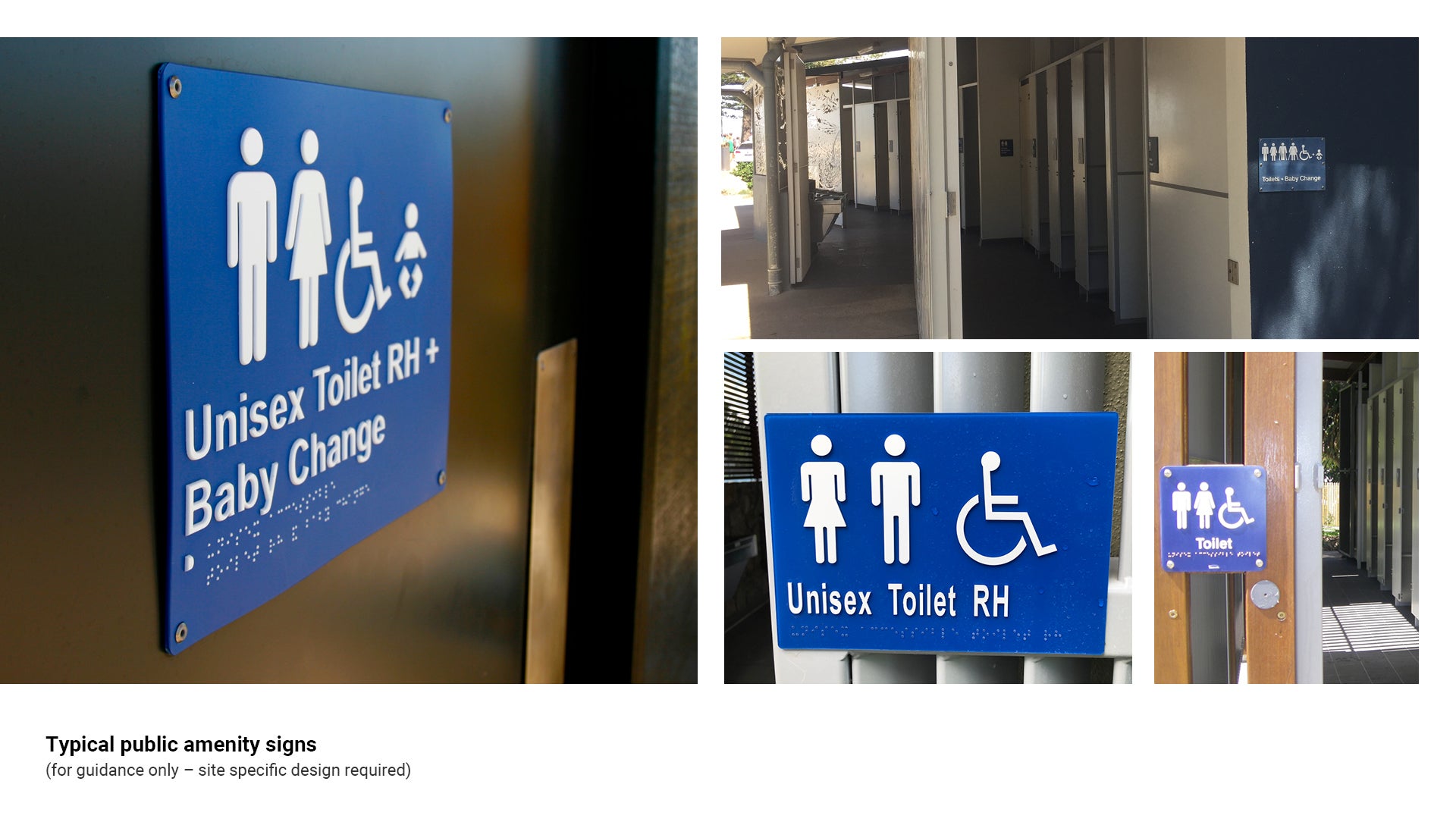
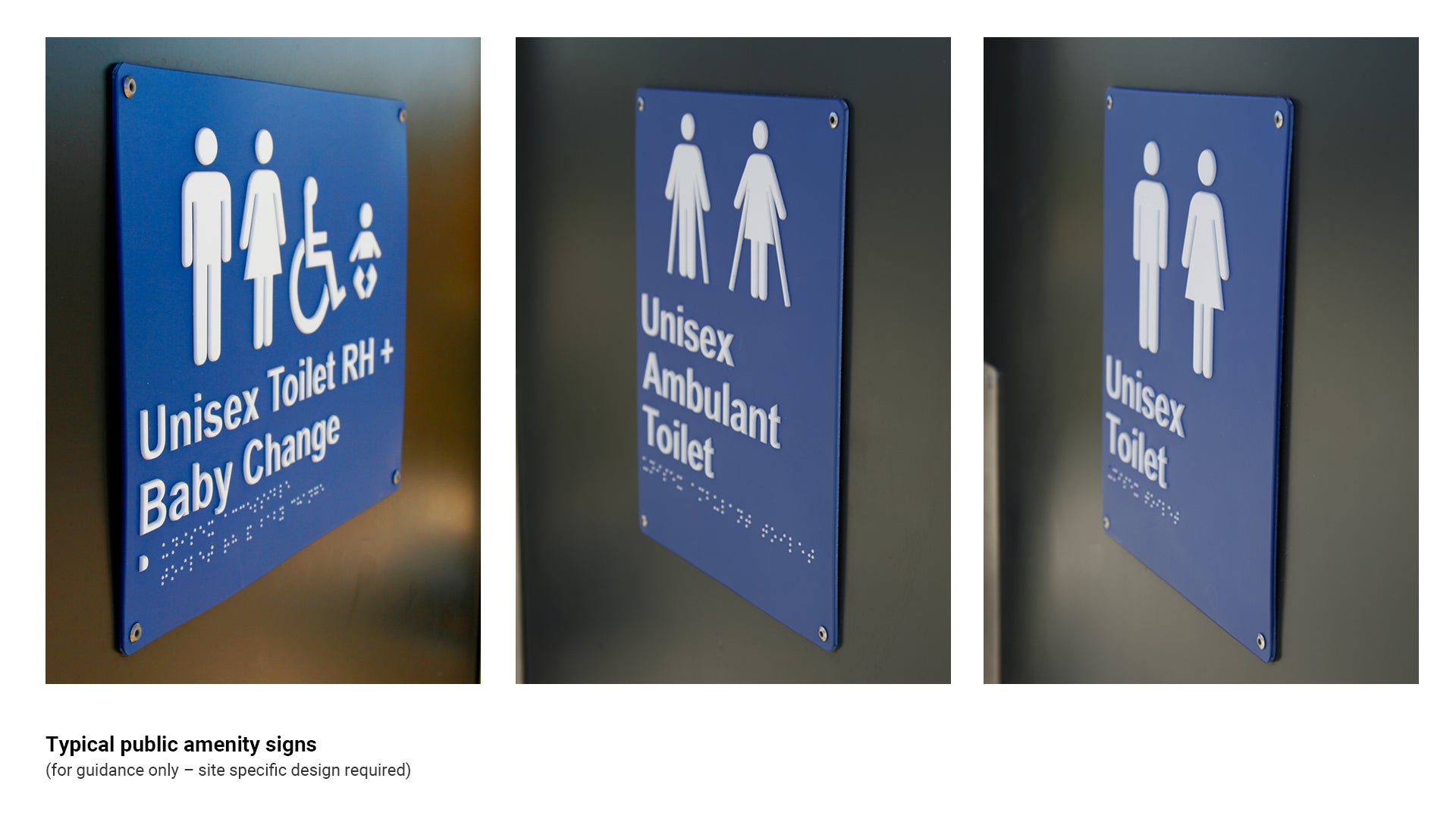
All exterior signage is to comply with AS 1428 and is to identify the facility as public unisex toilets with PWD provision. Signage is to be rigidly fixed using stainless steel fixings. The use of glues is not acceptable.
Where signage is mounted onto the access door, the door must open away from the person reading the sign. If the door opens towards the person reading the sign, the sign must be mounted on the latchside wall.
Accessible signage to be located within a zone of 1200 mm to 1600 mm AFFL with the top of the sign located at 1600 mm AFFL .
See Figure 1: Typical public amenity signs.
Figure 1: Typical public amenity signs
Pathways
Concrete pathways should be provided to the amenity from the public area, car park area or nearest road. Pathways are to comply with AS 1428.1:2009 as well as Councils own requirements for pathways in public parks. Concrete shall match the material palette for the site and where none is established, shall be natural grey with broom finish, while joints are to be grouted.
Water supply systems
In certain locations, alternative water supplies may need to be provided if there is no reticulated water supply. The following should be considered as alternative water supplies:
- Non-potable water systems using onsite tanks. Tanks are to be above ground, slimline Colorbond metal with a custom orb profile. Tank size to be determined by the anticipated daily usage calculations provided by Council
- A water bore installation.
Tanks are to be in a services compound behind the amenities building on a concrete slab, and be enclosed in a 2.0 m high black PVC coated link wire fence with a lockable personnel gate. Adequate circulation spaces must be provided in the services compound for accessibility and servicing (such as tank cleaning), where a 2.0 m clearance from the fence and amenities should be provided.
An electric water pump, for both the bore and non-potable water options, is to be specified to suit fixture numbers and located within the services compound. The pump sizing should consider current and expected future demand, flow capacity, and provide a minimum 480 kPa cut-off pressure. The pump is to be located within the services corridor.
Effluent disposal systems
In certain locations there may be no available infrastructure to easily connect the amenities for sewerage disposal. In this case, investigations are to be undertaken to determine the most appropriate disposal system to be used. The following options should be considered:
- On-site sewerage treatment system with an approved, designated and fenced dispersal area. The dispersal arrangement should be either a sub-surface arrangement, or a surface sprinkler system.
- On-site sewerage pumping station with appropriate connections to the nearest main sewerage network.
The appropriate disposal system is to be assessed on a case-by-case basis.
Interior requirements
Floor
300 mm x 300 mm Ceramic floor tiles are to be provided to the concrete slab. A slip resistance rating of R10 is required when there are no showers provided. Please note: Epoxy surface coverings are not to be used.
When showers are provided, a slip resistance rating of R11 will be provided.
A 300 mm x 100 mm matching coved skirting tile is to be provided to the external perimeter walls. Skirting tiles are not to be provided to the partition system walls.
Walls
Inside face of exterior masonry block walls to be rendered and finished with anti-graffiti paint coatings. A stud framed wall is to be provided between the PWD and Ambulant cubicles lined with 7.5 mm fibre cement-sheet (FC) flush set and finished with anti-graffiti paint coatings. Noggins to be provided for grab rails, fixtures and fittings where required.
The front dwarf wall to the basin area is to be a feature wall and the treatment varies depending on the location of the facility. This treatment may comprise the following alternatives:
- Stone faced
- Tiled
- Honed coloured in-situ concrete
- Render with feature colour.
Where high, horizontal wall ledges are part of the design, a canted ledge should be included to minimise anti-social behaviour.
Ceiling
A 6.0 mm fibre cement (FC) ceiling is to be provided over the cubicle area only. Ceiling to be flush set and finished with anti-graffiti paint coatings.
Partitions
Partitions are to be 18 mm compressed fibre cement finished with stipple profile anti-graffiti paint coatings. All fittings attached to the FC partitions, e.g. coat hooks, grab rails, etc., are to be fixed with fully penetrating stainless steel bolts with washers both sides. All partitions and stud framed walls between unisex cubicles are to be full height floor to ceiling in accordance with National Construction Code: Section F, Part F2.5.
- The front partition wall is to be a minimum height of 2400 mm above floor level while a small floor level cut-out to aid cleaning is to be provided.
- Partition doors are to have a 100 mm gap to the base and 200 mm gap to the top.
- Outward swinging doors are to be avoided.
Hardware: Provide three gravity hinges per door and privacy snibs.
The cubicle door snibs are to be heavy duty, durable door components, while a pull handle inside the cubicle is to be provided.
Consideration should be given to providing a change bench to each cubicle (except the ambulant cubicle) for amenities that are located at the beach.
All fittings and pipes (tapware) must have WaterMark approval - a mandatory certification scheme for plumbing and drainage products to ensure products are fit for purpose.
Fixtures, fittings and equipment
Provide items as listed in the Fixtures, Fittings and Equipment Schedule. Generally, glass mirrors are not to be provided. Some facilities may require a mirror in the PWD cubicle and if so, a stainless steel mirror is to be specified.
Where stainless steel is required, the grade should be 316, where possible.
Toilet pans
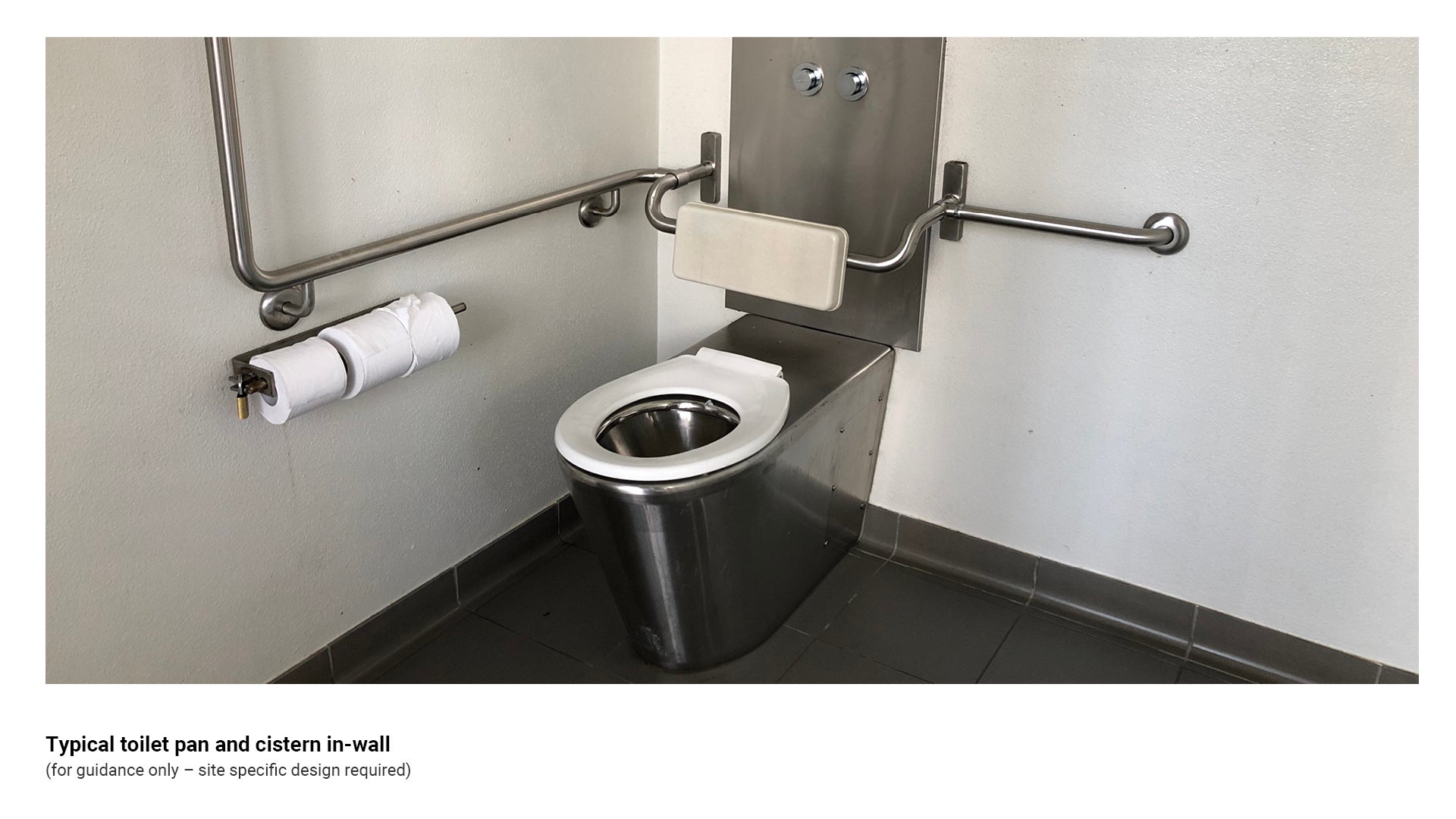
Toilet pans are to be stainless steel wall faced type with concealed pipework.
- Robust, fit for purpose moulded PVC seats are to be provided as factory fitted.
- No lids are required.
- Pans for the PWD and ambulant cubicles to comply with AS 1428.1.
See Figure 2: Typical toilet pan and cistern in-wall.
Figure 2: Typical toilet pan and cistern in-wall
Cisterns
Toilet cisterns are to be in-wall type with integrated flush buttons, utilising the service corridor.
See Figure 2: Typical toilet pan and cistern in-wall.
Urinals
Urinals are to be wall mounted individual stainless steel units with sensor flushing system. Provide a robust privacy partition screen between each urinal to provide a level of privacy particularly for children.
Where more than one urinal is required, position one at the recommended height for children.
Hand basins
Hand basins are to be wall hung stainless steel units with knee operated anti-vandal spout with time restricted water flow. Support frames to be heavy duty steel. Waste pipes are to be concealed within the wall. The design and installation of hand basins and tapware to comply with AS 1428.1:2009.
Hand washing
Unless noted otherwise, soap dispensers are not provided in public park amenities due to the risk of vandalism. Confirmation is to be sought from Council.
Hand drying
Typically towel dispensers or dryers are not provided in public park amenities due to the risk of vandalism. As there may be some exceptions to this rule, confirmation should be sought from Council.
Grab rails
Grab rails are to be provided to the PWD and ambulant cubicles in accordance with AS 1428.1:2009. Rails to be stainless steel and securely fixed to the walls.
- When fixing to stud walls, noggins are to be provided.
- When fixing to partition walls, bolts are to penetrate the partitions and be secured with washers and nuts.
Baby change tables
Some amenities may require the inclusion of a baby change table. If required, the fixture will be a horizontal, fixed bench of stainless steel construction. To minimise opportunities for anti-social behaviour (including the concealment or lodgement of sharps), horizontal ledges are to be canted to reduce flat surfaces. Locate the baby change table in the PWD cubicle. Please note: this installation is not to impact the circulation space within the PWD cubicle.
Design and installation must comply with AS 1428 Design for access and mobility set. In particular:
- AS 1428.1 – maximum height of 820 mm and minimum clearance underneath of 720 mm when in the open position.
- AS 1428.2 – common zone of reach with operable parts less than 1350 mm AFFL where side reach is possible and 1120 mm AFFL where forward reach is possible.
Lighting
Provide vandal resistant LED lighting to interior areas for safety and security. Light fixtures are to be connected to a PE cell or controlled by the BMS lux sensor (where fitted) for automatic operation and energy efficiency. On/off timers should not be used.
Disposal containers
Sharps, sanitary and nappy/incontinence disposal containers shall be supplied and installed by Council after practical completion where assessment indicates a need.
Drainage
In certain locations it will be required to provide stainless steel strip drains to the passageway to prevent water and cleaning chemicals migrating into the surrounding areas. Council will confirm which facilities will require these drains. All drain covers are to be lockable to prevent removal.
Amenities that are located in close proximity to the beach are to be provided with an adequate drainage system to reduce the risk of sand penetrating and blocking the floor drains.
Showers
Typically, showers are not provided internally to public amenities.
Signage
All interior signage is to comply with AS 1428.1:2009. and is to identify the facilities available within the building as unisex toilets with ambulant and PWD provisions.
Where signage is mounted onto the access door, the door must open away from the person reading the sign. If the door opens towards the person reading the sign, the sign must be mounted on the latchside wall.
Accessible signage to be located within a zone of 1200 mm to 1600 mm AFFL with the top of the sign located at 1600 mm AFFL .
See Figure 3: Typical public amenity signs.
Figure 3: Typical public amenity signs
This component is currently in development