Electrical (including lighting)
Appendix
Additional supporting information
See the following appendices for further information and guidance:
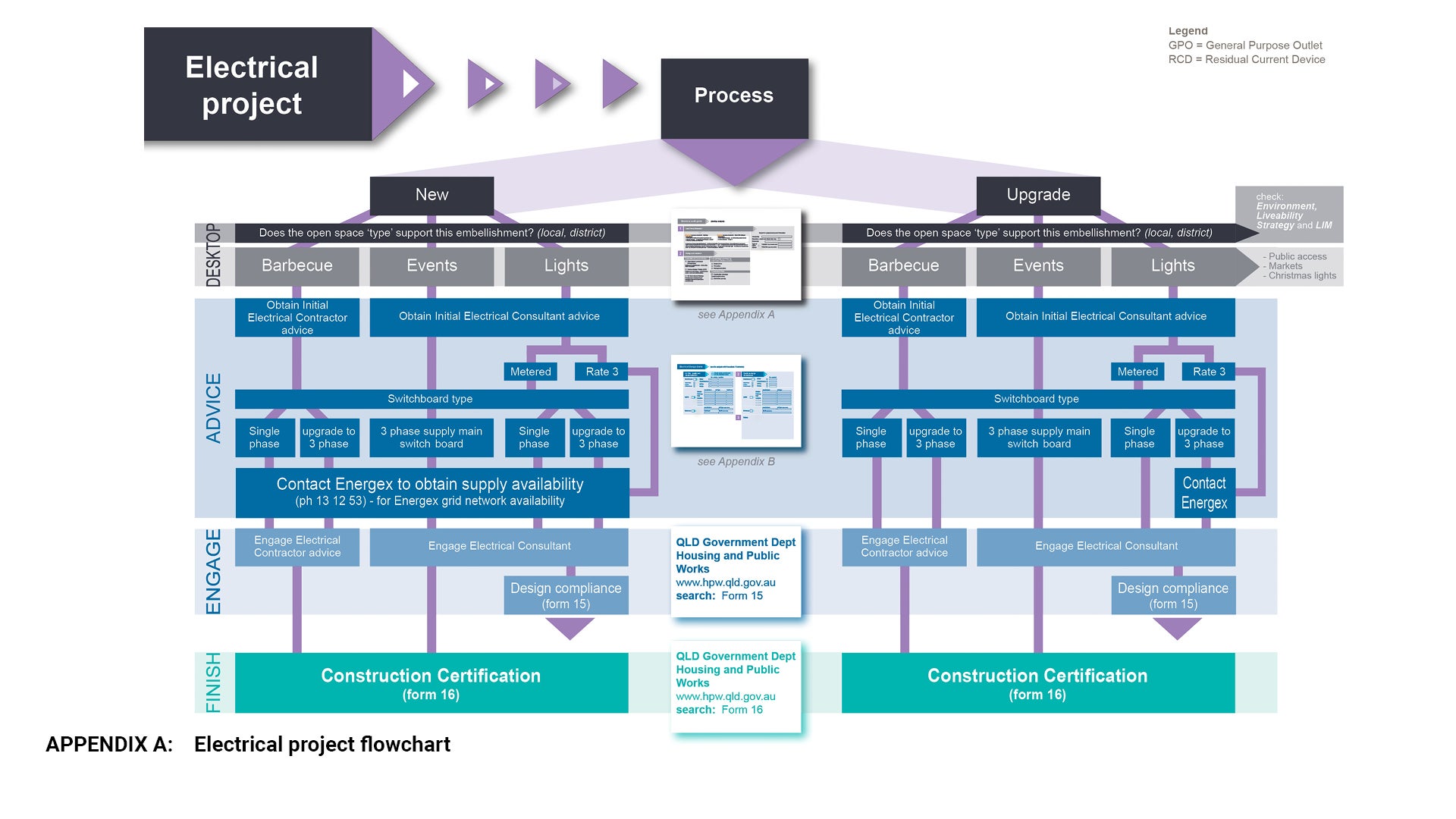
- Appendix A - Electrical project flowchart
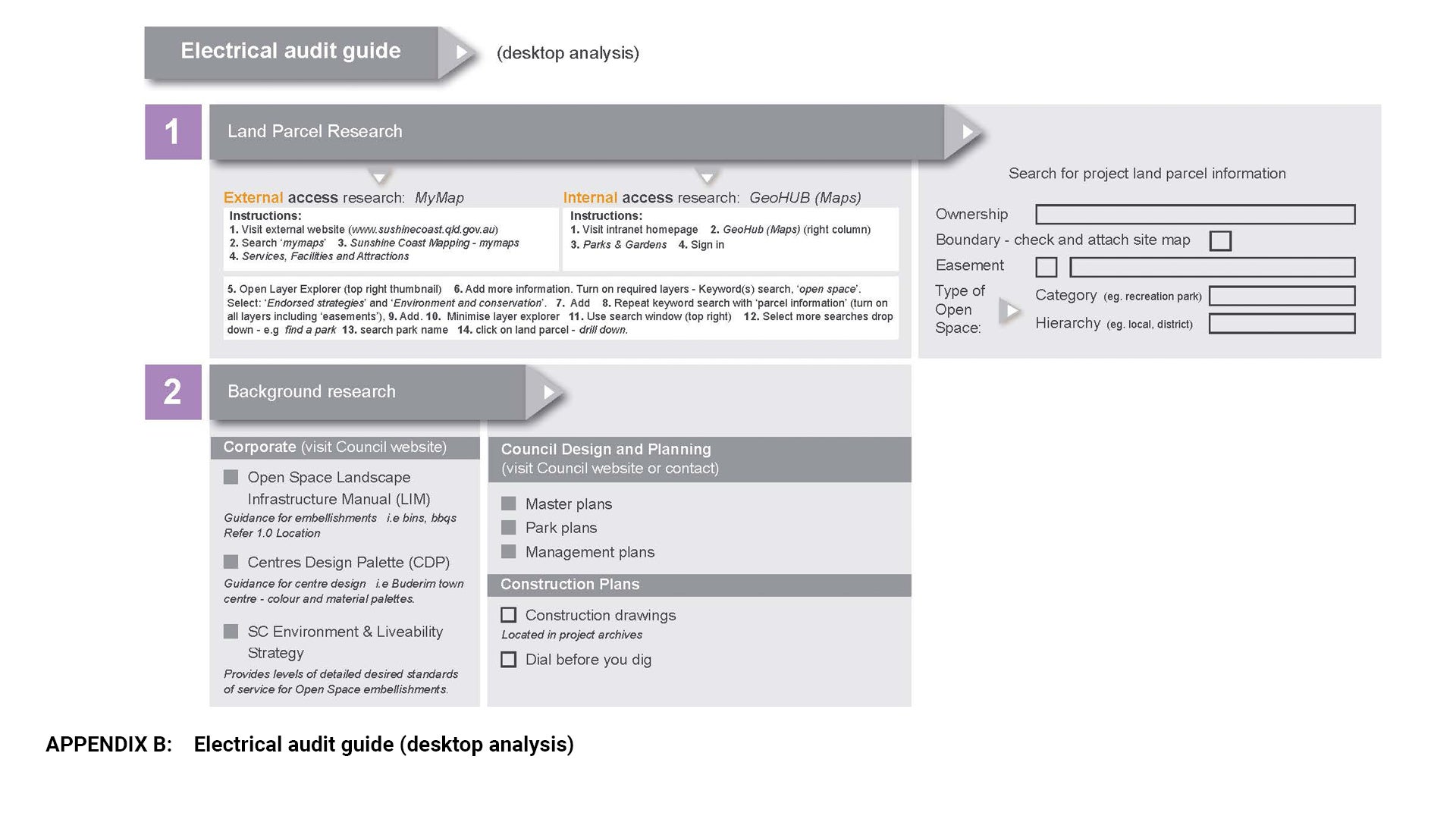
- Appendix B - Electrical audit guide (desktop analysis)
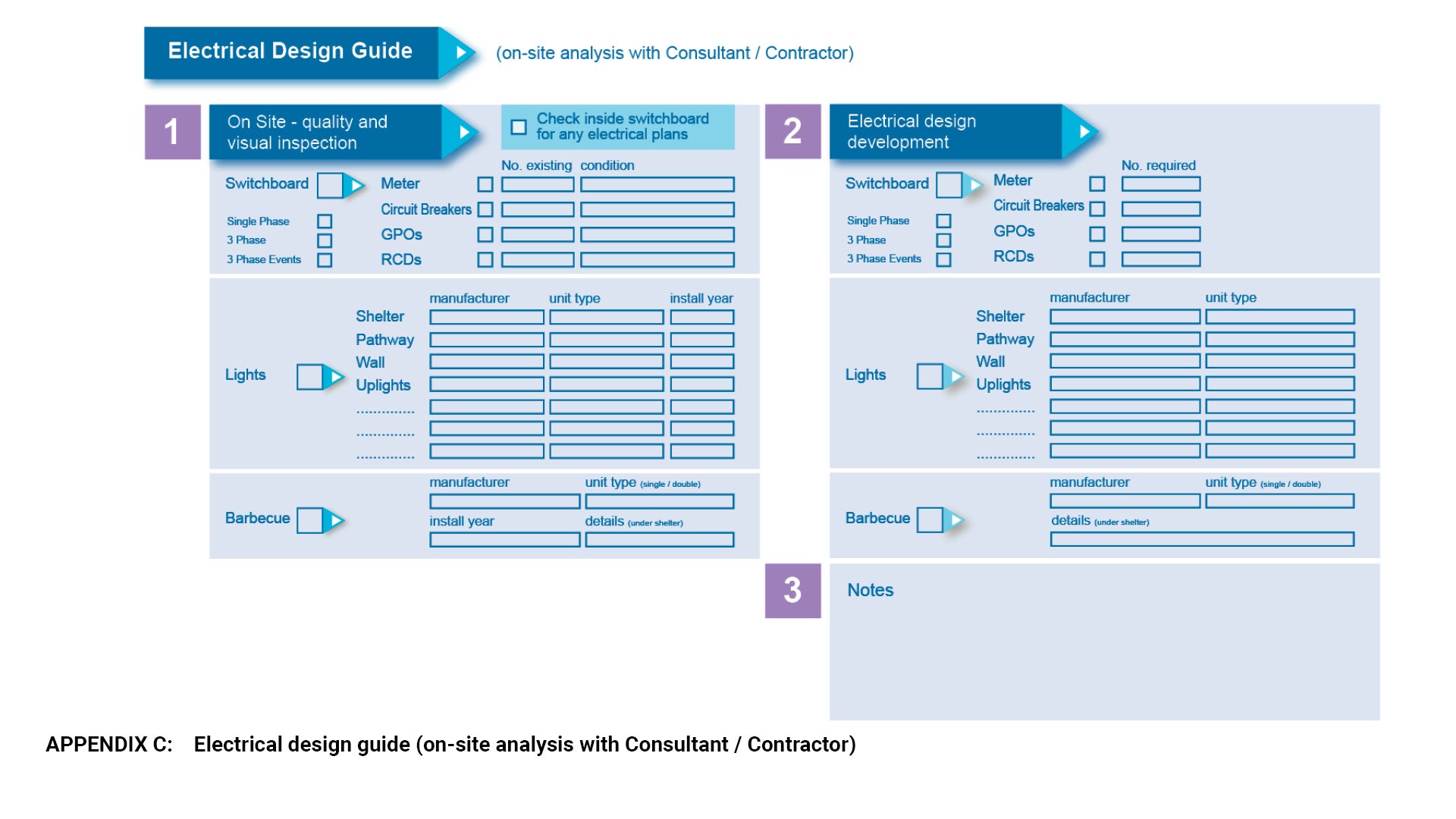
- Appendix C - Electrical design guide (on-site analysis with Consultant/Contractor)
- Appendix D - Turtle safe lighting (light management for marine turtles).
Appendix A: Electrical project flowchart
Appendix B: Electrical audit guide (desktop analysis)
Appendix C: Electrical design guide (on-site analysis with Consultant/Contractor)
Appendix D: Turtle safe lighting (light management for marine turtles)
Note: This section should be read in conjunction with:
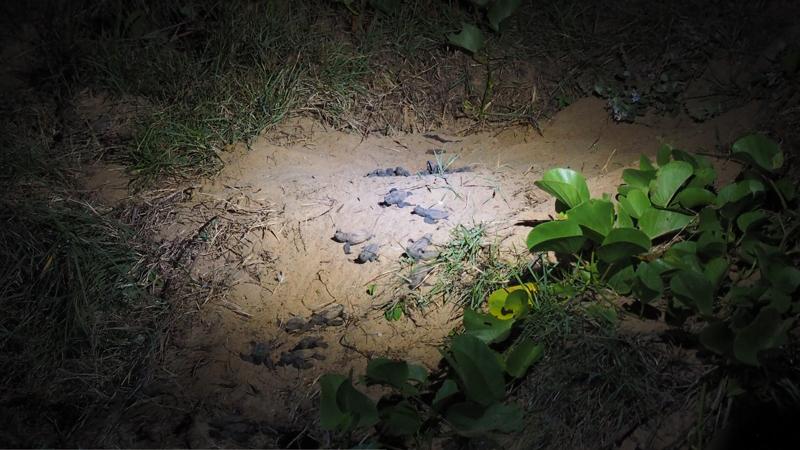
Marine turtle nesting occurs on ALL Sunshine Coast beaches from November to March. Marine turtles and their nests are protected under Commonwealth and State legislation.
Not all beaches are suitable incubators or safe nesting sites. To nest successfully, marine turtles require sandy beaches with access to the ocean. When sexually mature, breeding female turtles migrate back to the general area (within approximately 100 km) of the beach where they were hatched, to nest.
Lighting is a significant threat to marine turtles. The disturbance caused by brightly illuminated coastal communities can force marine turtles to move to a darker beach to lay their eggs.
Artificial light impacts nesting beaches from as far away as 20 km. Any projects within this area should consider the lighting principles discussed below.
High priority nesting beaches include (but all beaches are a priority for light mitigation):
- Buddina
- Shelly
- Yaroomba and
- North Bribie beaches.
Hatchlings emerge from their nest between January and March each year. This emergence is most commonly at night and on naturally dark beaches. They crawl seaward, towards the lowest and brightest horizon illuminated by moon and star light. At marine turtle nesting beaches close to urban or industrial locations, the brightest horizon is landward originating from artificial lights on man-made structures and street lights. This artificial light can disrupt a turtle hatchling’s capacity to see the natural seaward horizon. The impact of the light causes disorientation (confusion) and misorientation (misdirection) when they crawl toward artificial light sources and reduces their chance of survival. In addition, hatchlings that reach the sea can be enticed back to land by strong artificial lights.
The long term survival of a breeding population may be jeopardised if too few hatchlings from a nesting area survive to maturity.
Lighting types
Darkness is the best lighting management option at turtle nesting beaches.
- All industrial and urban light types, including tungsten, fluorescent, mercury vapour, high pressure sodium, low pressure sodium and amber LED can be disruptive to sea turtle ocean finding behaviour if not managed correctly.
- High intensity bright white lights rich in short wavelength blue light are typically the most disruptive to marine turtles. Any uncontrolled light may be scattered by sea spray and reflected from clouds, causing sky glow over large areas of the sky above nesting beaches.
- In Australia, amber LEDs are the most available and preferred light types for coastal areas adjacent to turtle nesting beaches.
See the following for further guidance:
- Recovery Plan for Marine Turtles in Australia - Australian Government in conjunction with the Queensland Government
- National Light Pollution Guidelines for Wildlife Including Marine Turtles, Seabirds and Migratory Shorebirds, Commonwealth of Australia 2020.
Planning to protect turtles
It is recommended that all developed areas along the coastline of the Sunshine Coast comply with the advice given under the UNEP SSAP (United Nations Environment Program Single Species Action Plan):
Objective | Actions |
Manage coastal lighting at significant loggerhead turtle nesting beaches to create a dark coastline | Ensure there is no direct light source visible to the nesting beaches. Reduce reflected light illuminating the sky/salt spray above and behind nesting beaches. |
Turtle biologists have predicted that over the next 50-100 years, loggerhead turtles may undertake a southward shift in nesting in response to climate change, specifically identifying the Sunshine Coast as a potential major rookery for the species. Therefore, the protection of coastal habitat and management of light impacts associated with development adjacent to potential nesting beaches on the Sunshine Coast is of national and international importance to the loggerhead turtle.
Design to protect turtle nesting
Lighting and other infrastructure must be installed to ensure there is no interference with known nesting sites.
Marine turtles are a threatened species, protected under State and Federal legislation and International agreements and action plans.
The Commonwealth Recovery Plan for Marine Turtles and UNEP Single Species Action Plan for the loggerhead turtle (South Pacific Genetic Stock) advocate the following - All designs within 100 metres of a nesting beach must follow the four guiding principles to minimise light impacts on turtles:
Keep it off
- Consider motion activated light sensors, or timers on lights. Timers may be adjusted during critical nesting times to minimise disruption.
- Consider turning lights off for short periods. At particularly sensitive sites, turning lights off manually during hatching periods, would minimise the disruption caused by artificial lights. Extra volunteers would be required to help direct pedestrians.
- The Single Species Action Plan for Loggerhead Turtles in the South Pacific Ocean recommends that an ‘8 pm lights off’ initiative is a realistic and consistent goal to ask of local residences, businesses and visitors that are located near nesting beaches (within 2.0 km).
Keep it shielded
- Position lights to face away from the beach.
- Direct lights downwards.
- Design facilities to avoid light spill onto the beach and sea surface.
- Shield light bulbs to control excess light spill into the atmosphere and to prevent sky glow.
- Use natural topography, plant vegetation buffers / screens to shield the beach from light.
- Design surfaces on structures and ground coverings to avoid reflection, so light is not reflected towards beaches or upwards (to reduce sky glow).
Keep it low
- Reduce heights of car park and pathway lights where possible. Consider a shorter pole height of 3.5 m for car park lighting to reduce travelling glow (typical car park pole height 4.5 m).
- Use 3,000 K or lower colour temperature light fixtures. Pathway lighting should use PP4 (pedestrian and cyclist paths) and PR3 or PR4 (local roads) Category lighting.
- Minimise the wattage and the number of light fixtures.
- Use reflective materials to delineate pathways and embed lighting where possible.
- Design lighting to avoid ‘over the horizon glow’ above significant nesting areas.
- Design light fixtures that are mounted low, shielded and aligned to direct light onto the target area only. Examples include:
- Embedded LED stud lights (not pointed into sky)
- Recessed lighting.
Keep it long
- Use light fixtures that emit long wavelength (e.g. 550 - 700 nanometres) yellow, orange and red light and is less intense (so less visible to turtles), then a white, blue or green light at the same wattage.
- Consider using amber LED lighting. This type of lighting minimises disturbance to the surrounding environment and are the best choice for nesting turtles.
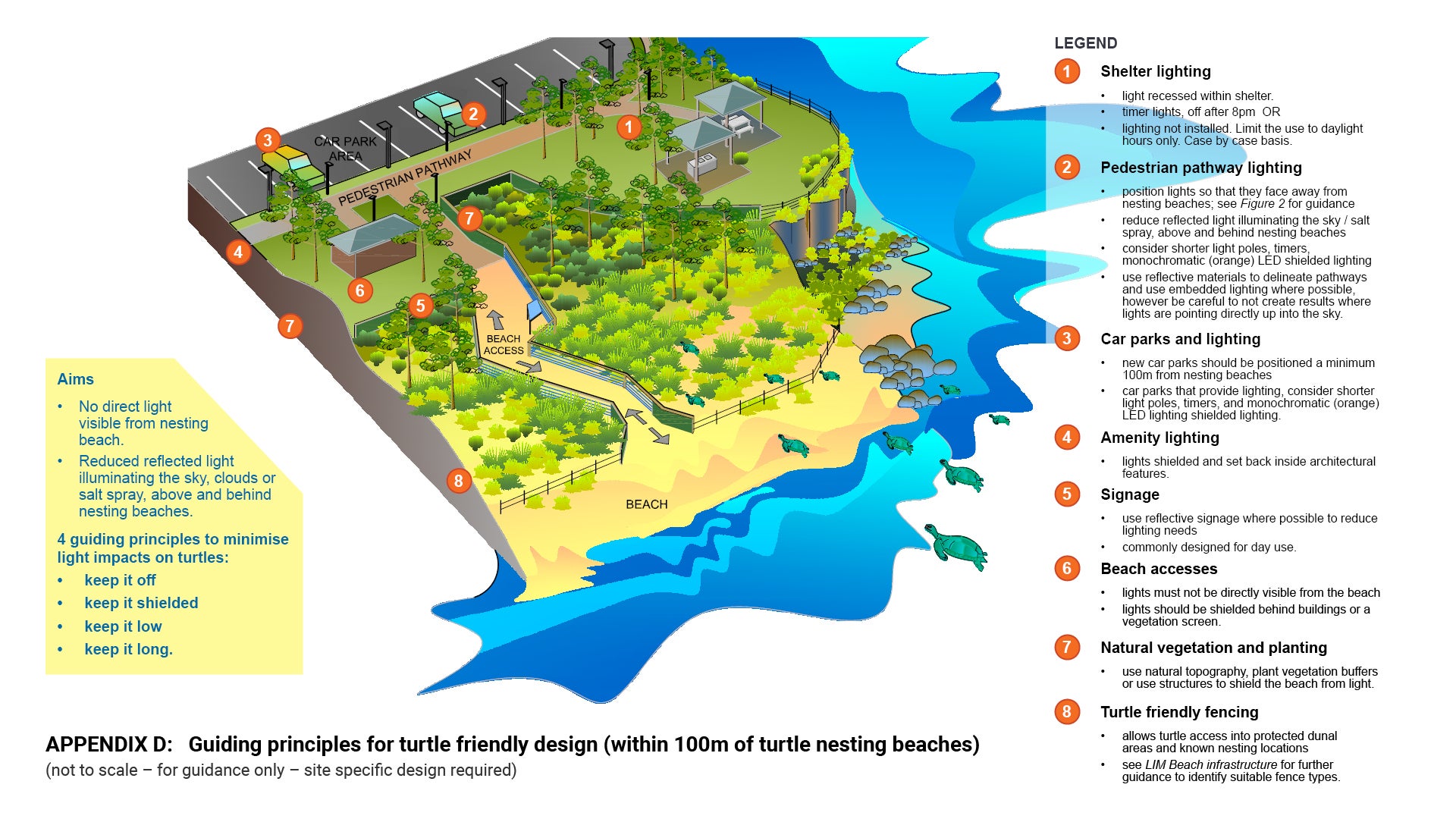
See Figure A: Guiding principles for turtle friendly design (within 100 m of turtle nesting beaches) for further guidance.
Figure A: Guiding principles for turtle friendly design (within 100 m of turtle nesting beaches)
Additional strategies
Additional strategies and elements that should also be considered to minimise the effects of artificial lighting on turtle nesting beaches while maintaining safety standards include:
- LED lights provide good ‘cut off’ lighting, meaning there is no excess light throw outside the light beam. This allows better control of light in unwanted areas
- Generally, council does not provide lighting to beach accesses
- Consider use of window tinting to reduce emission of internal lights
- Avoid white halogen, metal halide or fluorescent lights where possible and only use white lights in contained areas where colour rendition is required
- Plan construction and maintenance activities for daylight hours only or avoid turtle nesting season where possible
- Design for the minimum number, height and intensity of lights necessary
- Signage or lighting should be accompanied by substantial vertical shielding to reduce sky glow
- Signage designed to be read at all hours of the day, including after dark (e.g. turtle awareness, educational content) should contain reflective surfaces to reduce the need for artificial lighting
- Using bollard lighting as the only light source for pathways, does not meet Australian Standards because they do not provide enough light to identify pedestrian faces. They are also prone to damage by mowers and vandalism.
Site risk assessment and budget
Each individual site located near a nesting beach must be assessed for risk, such as impact from existing and future uses relating to lighting and site function. In most cases, potential conflicts and elements that may disrupt and disorientate turtles, can be designed out of a proposed development.
Budget should be allocated to allow for the potential additional costs to achieve turtle friendly outcomes. All final designs must be assessed and approved by a Council’s TurtleCare Coordinator prior to finalisation. The designer must ensure the turtle friendly elements agreed upon are carried through to construction.
- Once infrastructure is built, undertake an audit of the lights visible from nesting beaches and where possible, the project related sky glow overhead.
- Where lights illuminate nesting beaches or the sea:
- Screen the affected habitat from the light source.
- During the nesting season, arrangements should be made to turn off lights that are impacting upon the nesting site.
For further information contact Department of Environment and Science.
See the following LIM categories for further guidance:
- LIM Beach infrastructure (for turtle friendly fence designs)
- LIM Environmental management of fauna and flora (Preliminaries).
This component is currently in development