Irrigation
Site planning
Best practice guidance for site planning
Decision framework
There are a range of Australian Standards/best practice guidelines, relating to this category. Key documents are referenced throughout and in the LIM Irrigation - Standards.
Irrigation systems
Irrigation services should be designed to the site conditions. They should supply effective and efficient irrigation to garden beds, planter boxes, landscape areas, landscape turf areas and sports grounds.
Smart Irrigation Control System
Council has acquired a Smart Irrigation Control System. The Hydra-Wise platform is a cloud based system that allows the scheduling and management of irrigation through a smart device or browser application (PC). It is essential that all future irrigation infrastructure align with this smart irrigation control system.
- There are many efficiencies that are achieved by using a smart irrigation control system:
- Reduced water usage – monitoring devices link back to central controller, and calculate correct amount of water to be supplied.
- Reduced labour and associated costs – daily review of watering schedules and data allows a planned approach to maintenance and labour organisation.
- Improved plant health, and reduced repair to turf surfaces – accurate control of irrigation allows optimum moisture levels to be maintained, resulting in healthier, stronger plants.
- Provision of data for analysis – irrigation scheduling, reports, weather data and water usage can be provided by a smart irrigation control system.
- Flow monitoring (via smart meter) – to accurately determine water consumption, and to identify leaks or issues occurring within the system.
- Remote access – app or browser based controller linked by mobile phone network to multiple field controllers, to coordinate the irrigation of multiple sites
- Weather data access – on site weather stations or online global weather data, to determine future irrigation requirements
As part of the Smart Irrigation Control System, a number of objectives will be achieved:
- All existing irrigation systems irrigation controllers upgraded to smart irrigation and browser functionality
- Identify and upgrade existing irrigation systems currently experiencing performance issues.
- Install new irrigation systems in high profile and critical sites that currently have no irrigation assets.
For further guidance on specific components required for Council’s smart irrigation control system see the following:
Smart City Implementation Program
The Smart City Implementation Program lays out a structure for the implementation of the Smart City Framework into Council projects.
One of the key initiatives of the Sunshine Coast Smart City Program is a fully integrated system. Higher value results can be achieved through a networked system combining multiple elements, rather than individual components.
- Council is working towards ways to improve long term objectives of controlling the irrigation network. A networked system allows information from the Bureau of Meteorology to determine weather forecasts to ascertain appropriate irrigation schedules which can be updated in real time.
As the Smart City Implementation Program progresses, this LIM category continues to be updated to reflect changes relevant to council’s irrigation network.
Site decisions
All decisions, including the location of the embellishment and related infrastructure, must be made in conjunction with council (determined by site location), including officers from such areas as:
- Council (Parks and Gardens)
- Council (Sport and Community Venues)
Users
Consult with council stakeholders, neighbouring properties and identified park users in the planning stage of a project.
Site conditions
Consider the physical characteristics of a site and requirements of the activities to be conducted:
- location of utilities
- well drained site
- level surface
- flood immunity requirements
- environmental outcomes
- vegetation choice - native versus exotic plants
- local weather data, including rainfall and evaporation
- initial costs versus ongoing maintenance/replacement costs
- aesthetic qualities
- locations of existing infrastructure within open space.
Co-location of facilities
- Facilities, including parking and pathways, are often already established and need to be considered in the overall park design.
Safety
- Safety clearances must be met.
- Adopt principles of Crime Prevention Through Environmental Design (CPTED) Guidelines for Queensland. Locate irrigation systems to allow users to feel safe, and to provide an opportunity for casual surveillance.
Potential site conflicts
Locate irrigation systems away from:
- Pathways and furniture i.e. seats, bike rails, barbecues (to minimise overspray).
- High use bikeways and busy roads, to avoid accidents.
Smart technology
Smart infrastructure must be installed only where appropriate and only when approved by the asset custodian. See LIM Smart technologies for further guidance, including key considerations for installation.
Planning for sustainability
Refer Design principles – Sustainability for guidance.
Planning for future works
- Co-locate embellishments requiring similar services e.g. water, to reduce infrastructure, where possible.
- Where underground utilities are installed, set brass markers to concrete slab edges to indicate the location.
- Consider installation of additional conduits under concrete slabs for future provision, where utilities (e.g. electrical, water) and irrigation systems are planned. Ensure additional conduit is capped to prevent ingress of water and debris.
- Consider climate change impacts on the embellishment location and construction 1.
- In coastal areas, or near waterways, design should consider rise in sea level predictions, storm tide, salt inundation and severe storm events.
- Positioning should also consider flooding, seasonal/ephemeral water bodies and water table changes.
- Near bushland areas, design should consider the occurrence of bushfires.
Source 1: Sunshine Coast Environment and Liveability Strategy 2017.
Irrigation project flowchart
This flowchart has been developed to guide the design and delivery of irrigation projects in Council open space areas.
See Appendix A: Irrigation project flowchart.
Irrigation of open space
Irrigation should be located in road reserves, parks or other council controlled land, and should not traverse private property, unless an easement has been arranged.
- More specifically, irrigation systems should be designed to:
- Provide uniformity in relation to other council irrigation systems.
- Be vandal proof and durable to environmental conditions.
- Provide uniform distribution and coverage of irrigation to all landscape embellishments contained within the entire open space.
- Apply the correct amount of water within the requested watering window.
- Minimise overspray to paths and seating areas, thus avoiding discomfort to users, impeding pedestrian movements and creating slip hazards.
- Ensure components or fixings are flush with the finished surface level, to prevent any trip hazards.
- Have the ability to be maintained and controlled, in a user friendly manner.
- Provide suitable water quality (fit for the irrigation purpose) from a consistent, sustainable and reliable water supply.
- Ensure ongoing plant health.
- Provide effective and efficient irrigation distribution.
- Ensure existing surface levels and percolation rates are preserved, where possible.
- Provide adequate irrigation without compromising existing surface levels through installation or trench subsidence.
- Prevent waterlogging of open space through incorrect irrigation design or irrigation controller programming.
- Allow for peak irrigation demand based on relevant rainfall and evaporation data combined with correct crop factors for the plants to be irrigated. Irrigation designer is to consult with Landscape Architect to confirm plant watering requirements.
- Consider locations that are prone to flooding carefully. There is significant risk to the public, contractors and council staff through flood damage to electrical services.
- Clearly indicate the location of subsurface irrigation systems on design drawings, including nominal depth and width of all trenching, and locations of all irrigation components, from water supply point to the emitters.
Irrigation of parks and gardens
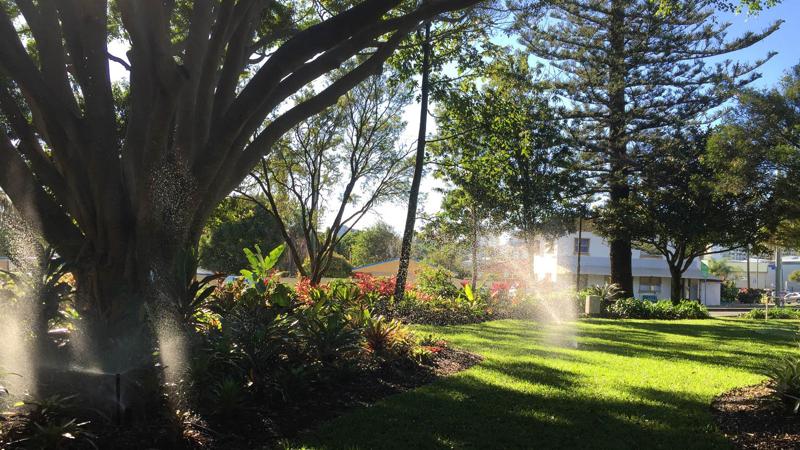
The installation of irrigation systems in parks and gardens should consider the following:
- Different irrigation requirements for specific soil types, plant types, layout and species.
- Does not interfere with the overall amenity and functionality of the intended usage and open space type.
Irrigation of sports grounds
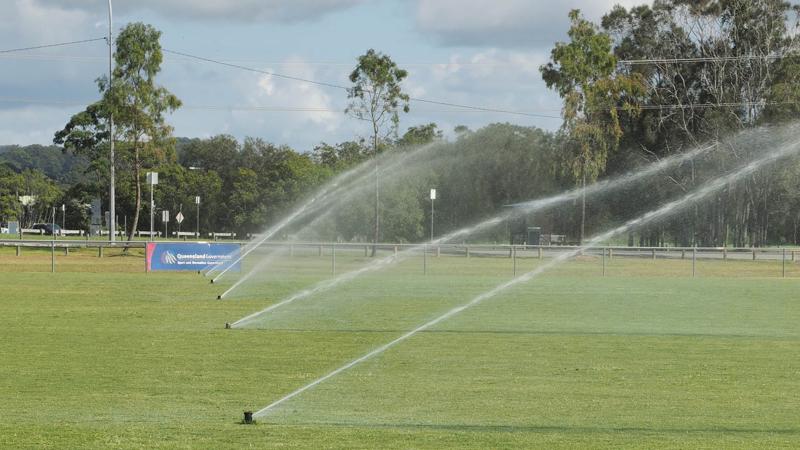
The installation of irrigation systems in sports grounds should consider the following:
- Main playing areas and surrounding areas shall be separated to allow for a more efficient and targeted irrigation schedule.
- Irrigation/valve boxes are to be installed away from the main playing surfaces.
- Different irrigation requirements for specific turf species (dependent on the type of use/intensity).
- Does not interfere with the overall amenity and functionality of the sporting activity and is safe for all users.
Electrical supply
Where irrigation systems are to be installed in an open space area, considerations are to be made to include electrical supply to the irrigation controller, housed in the same enclosure.
Electrical supply is to be 240V mains power, to enable controller to be plugged directly into the GPO.
Irrigation controller and related componentry shall run on a 24V system.
Irrigation water supply
Where appropriate, council encourages the use of non-drinking water for landscape irrigation and establishment.
Non-drinking water can include capture and storage of rainwater and storm water runoff and the use of recycled water (treated effluent).
Only collected and recycled water graded as suitable for human contact should be used in public spaces.
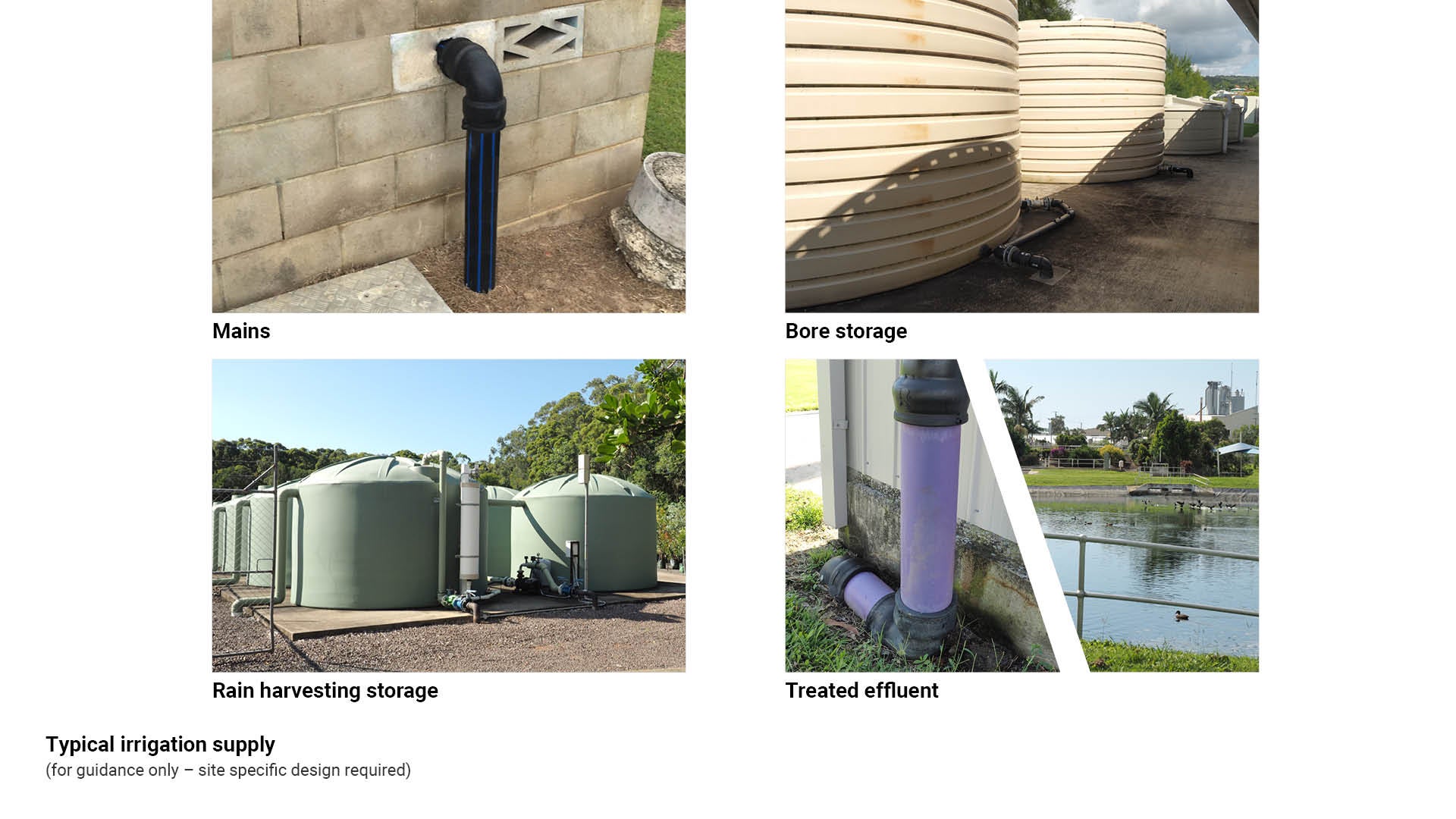
The following examples outline different methods of water supply possible for use in an irrigation system.
See Figure 1: Typical irrigation supply.
Figure 1: Typical irrigation supply
This component is currently in development