Waterways (watercraft facilities)
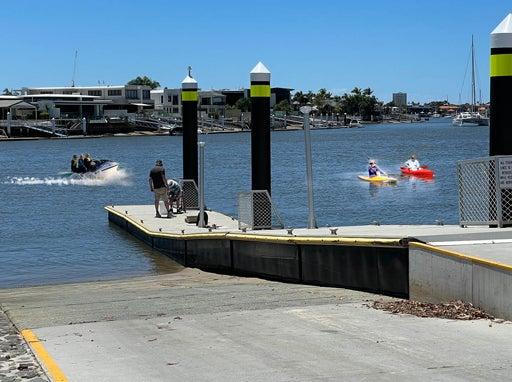
Equal access
Requirements for the integration of equal access for all users
The Disability Discrimination Act (DDA) defines ‘premises’ as the whole of the built environment and includes existing buildings, new or proposed buildings, transport systems, car parks, pathways, and public parks and gardens.
Note: Consult an access consultant accredited by the Association of Consultants in Access Australia (ACAA).
Elements required for equal access
Structures which will be used by the public are to be designed to provide equal access in accordance with AS 1428 Design for access and mobility the set and Disability Standards for Accessible Public Transport Guidelines 2001.
Private tourism/event operators need to consider that any new structures which will be used by the public are to be designed to provide equal access.
- Where watercraft facilities are constructed, consider equal access for all open spaces associated embellishments such as:
- Stairs
- Ramps
- Pathways
- Seats
- Shelters
- Barbecues
- Fish cleaning tables
- Public amenities (toilets).
- Stairs require tactile ground surface indicators (TGSI) at upper and lower landings where handrails are not continuous.
- TGSIs are not required on the lower landing of stairs where the landing is designed to be submerged as part of access to bodies of water.
- Stairs to be designed with consideration of the content of AS 1657 Fixed platforms, walkways, stairways and ladders – Design construction and installation.
- All stairs rises and goings must be a uniform dimension as differing rises and going dimensions can create a trip hazard.
- Terminate stairs and ramps a minimum 900 mm back from any perpendicular path of travel so that handrail ends and TGSI do not protrude into the path of travel.
- Where the lower landing of stairs is designed to be submerged, include a raised dome on the handrail, 150 mm from the termination.
- Handrails are to be positioned/designed outside of 3.0 m from the edge of any road lane due to the potential for the handrail to become a ‘spearing hazard’ in the event of an accident.
- Provide a continuous accessible path of travel (CAPT) from an equal access car parking space to watercraft facilities.
- Ramps or walkways which provide access to a floating pontoon should be designed to ensure that gradients do not exceed 1:20 based on mean maximum high and low tides.
- Avoid finished height difference between a concrete slab and adjoining surfaces to prevent trip hazards and to prevent ‘tramlining’ of pram, bicycle and wheelchair wheels.
Visual/sensory wayfinding
- For people with a vision impairment, provide a minimum 30% luminance contrast between objects and the background they are viewed against, for ease of identification.
- Where luminance contrast may not be achieved (such as grey aluminium furniture on grey concrete), luminance contrast can be addressed by introducing colour into the ground surface providing a minimum 30% luminance contrast with the embellishment base, resulting in the embellishment being more visible for people who have low vision.
- Where embellishments are predominantly in shade, consider the use of high visibility painted components or high visibility tape to increase awareness for people with low vision.
- Add paint, tape or integrated high visibility colour treatment to handrail ends to improve visibility. See LIM Handrails and balustrades for further guidance.
Equal access paths
Beach wheelchair access
People who use wheelchairs require a firm surface to enable equal access to the waterfront across sand or other soft surfaces.
Removable beach access facilities are suitable for high profile locations where personnel are available to deploy, recover and store the product.
Sites are preferred where life saving services are located and beach wheelchair hire is available.
- Beach wheelchairs and accessible matting are provided at:
- Alexandra Headland Surf Life Saving Club (SLSC).
- Metropolitan-Caloundra SLSC
- Coolum Beach SLSC
- Mooloolaba SLSC.
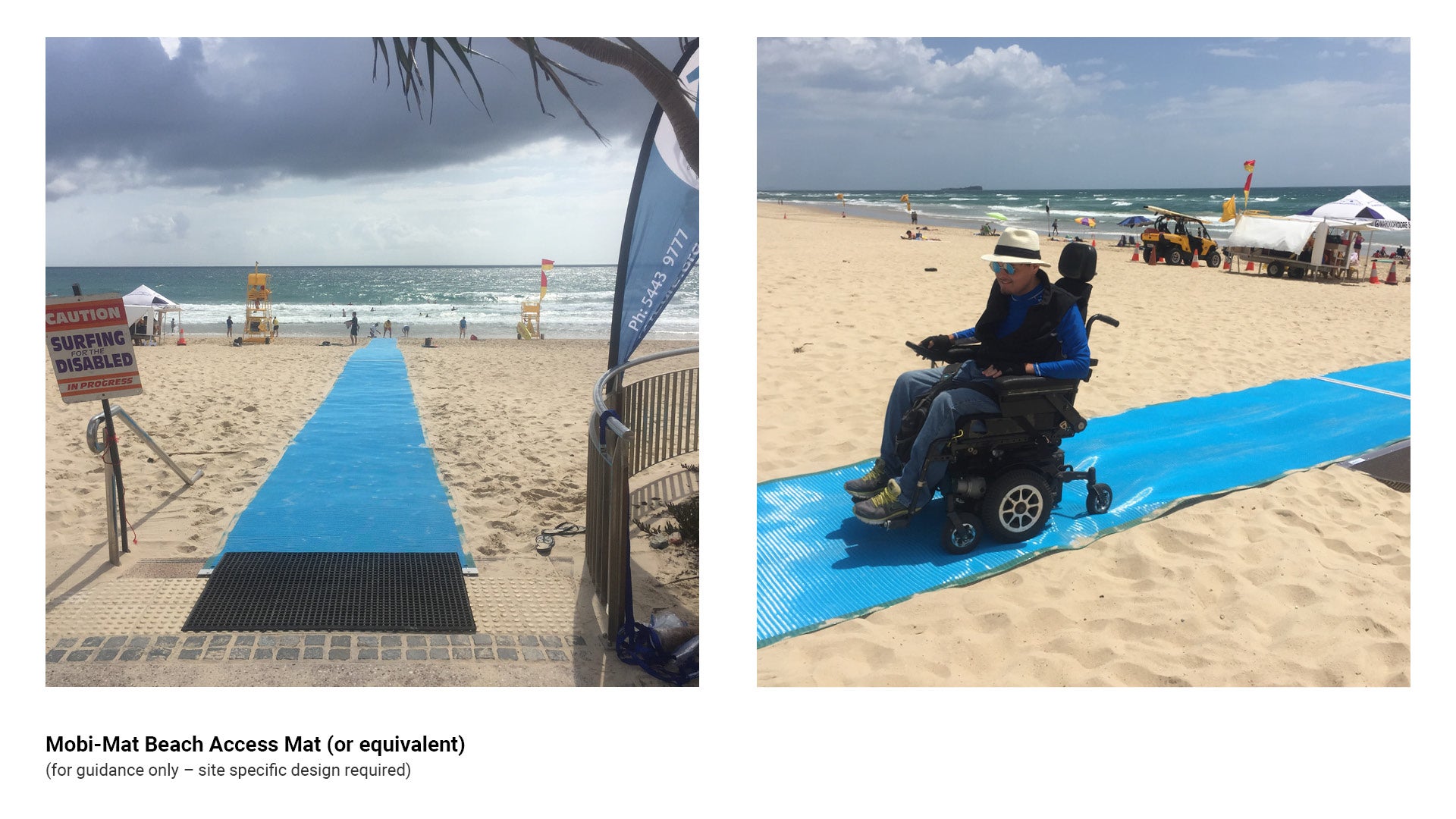
Mobi-Mat Beach Access Mat (or equivalent)
A portable roll-out, removable beach access mat.
- The mat can extend into the water to allow people who use wheelchairs to transfer into a beach wheelchair to access the sea.
- Made from 100% recycled PET bottles. This product is a non-slip, tear resistant, firm and stable surfacing.
- Weight 1.3 Kg/m2.
- Mat is available in 2 widths - 1.53 m and 1.98 m. Lengths range from 5.0 m to 30 m, interconnecting lengths joined by a tongue and groove arrangement to allow the length to suit the beach and the tide conditions.
- Mat length 50 m x 1524 mm wide.
- Recyclable material.
- Bobi-Mat Wing (or equivalent) is an add-on which can be attached to the side of the main mat path to provide a rest / viewing area for a person who uses a wheelchair.
- Mobi-Roll’N Stow (or equivalent) roll up dispenser (weight 45 Kg) is constructed from corrosion resistant materials and may be dismantled for storage.
- Designed to be deployed forward or backward by one person.
- Life expectancy 10+ years.
Refer Safe Work Australia National Code of Practice for Manual Handling for further guidance.
Rubber mat beach access
Envirobelt 40 (or equivalent) is disused woven and or ply conveyor belt from Australian mines.
- Thickness is 7.0 mm to 18 mm, width is 1000 mm to 1800 mm.
- Provides a firm surface over sand to facilitate access by older people, injured people, people with limited mobility and people who use mobility devices.
See the following:
- Figure 10: Envirobelt 40.
- Figure 11: Mobi-Mat Beach Access Mat.
Figure 10: Envirobelt 40
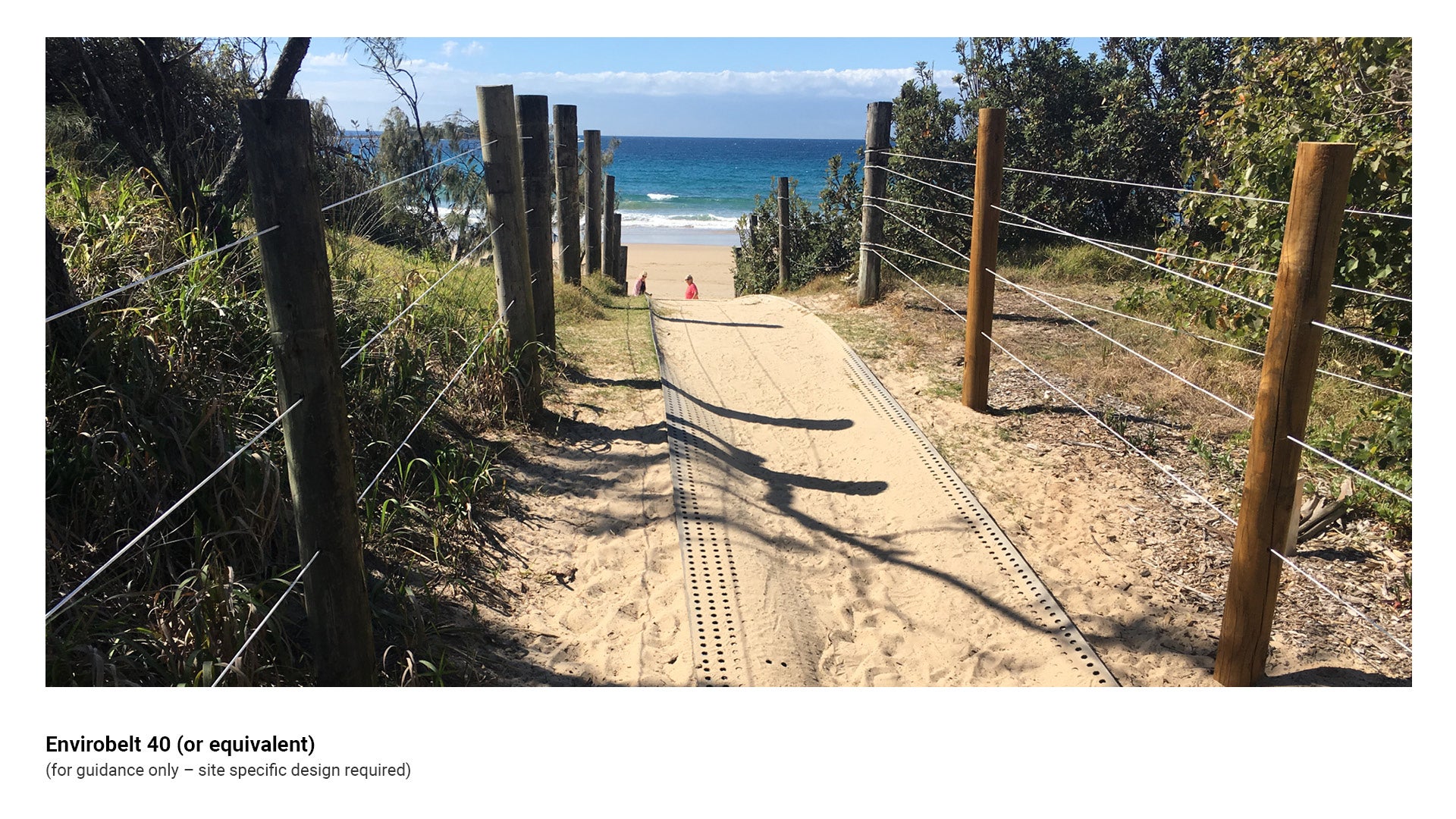
Figure 11: Mobi-Mat Beach Access Mat
This component is currently in development