Waterways (watercraft facilities)
Standards
Compliance requirements for embellishments
Note:
- Where Australian Standards or part thereof have been adopted by legislation, they are a legal requirement.
- This list may not be exhaustive. Please refer to the relevant authority websites for updated information and current document distribution dates. These documents are subject to amendments from time to time.
Legislation
Refer Legislation for guidance.
Australian Standards/industry guidelines
National Construction Code (NCC)
The embellishment shall be developed in accordance with the NCC (current edition):
- Building Code of Australia (BCA) Volumes 1 and 2
- Plumbing Code of Australia (PCA) Volume 3.
Safety in design (SiD)
Include Safety in Design (SiD) principles to eliminate, or if not reasonably practical, minimise risks to health and safety throughout the design, construction and life of the embellishment.
See Legislation – Work Health and Safety Act 2011 for additional safety guidance.
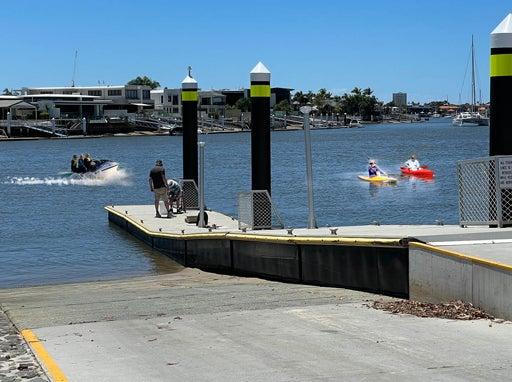
Watercraft facilities
- AS 4997:2005 – Guidelines for the design of maritime structures. Includes the preservation of estuarine, near-shore and on-shore structures
- AS 3962:2001 – Guidelines for the design of marinas. Design guideline of marinas for vessels up to 50 m in length.
- AS 1604.1:2012 – Specification for preservation treatment Part 1 Sawn and round timber. Treatment to protect against decay, insect or marine borer attack.
- AS 5604:2005 – Timber natural durability ratings. Durability ratings for timber species.
- AS 1657:2013 – Fixed platforms, walkways, stairways and ladders – Design construction and installation – maintenance stairs design.
- AS 2156.1:2001 – Walking tracks Part 1: Classification and signage – classify a path for barrier requirements.
- AS 2156.2:2001 – Walking tracks Part 2: Infrastructure design – barrier design based on path classification, to prevent the risk of falls.
- AS 4586:2013 – Slip resistance classification of new pedestrian surface materials. Provides means of classifying pedestrian surface materials according to their frictional characteristics when determined in accordance with the test methods set out in Appendices A, B, C, D and E. The test methods enable characteristics of surface materials to be determined in either wet or dry conditions. This Standard is referenced in legislation.
- AS 4663:2013 – Slip resistance measurement of existing pedestrian surfaces. Provides methods of measuring the frictional characteristics of existing pedestrian surfaces in wet and dry conditions.
- HB 197:1999 – Standards Australia Handbook - An introductory guide to the slip resistance of pedestrian surface materials. Provides guidelines for the selection of slip-resistant pedestrian surfaces classified in accordance with AS/NZS 4586.
- HB 198:2014 – Standards Australia Handbook Guide to the specification and testing of slip resistance of pedestrian surfaces. Provides guidance for designers, specifiers, manufacturers and suppliers in the application of AS 4586:2013 and AS 4663:2013.
- Design Criteria for Floating Walkways and Pontoons: October 2015 – Department of Transport and Main Roads. Design for modular floating walkways that are to be constructed on boat ramps lanes and standalone pontoons with gangways.
- Design Criteria for Boat Ramps: October 2015 – Department of Transport and Main Roads. Boat ramp design for recreational trailer boats where the trailer with vessel and tow vehicle does not exceed 8,000 kg.
- Manual of Uniform Traffic Control Devices:2003 and amendments – Department of transport and Main Roads Queensland.
- Queensland Tide Tables Standard Port Tide Times: (current edition) – Maritime Safety Queensland.
- QUDM (Queensland Urban Drainage Manual), Australian Rainfall and Runoff 1999.
- Australian Rainfall and Runoff (AR&R). Guidance to produce flood studies and mapping across Australia.
- PIANC (The World organisation for Waterborne Transport Infrastructure) - Guidelines for the design of Fendering Systems:2002. Design of fenders - a buffer, made of a material to protect vehicles and structures against damage during berthing.
- AS/NZS 2416.1: 2010 Water safety signs and beach safety flags – Specifications for water safety signs used in workplaces and public areas. Safety signs where water sports may be undertaken such as at the seaside, rivers, creeks, dams and open drains.
- AS/NZS 2416.2: 2010 Water safety signs and beach safety flags – Specifications for beach safety flags – Colour, shape. meaning and performance.
- AS/NZS 2416.3: 2010 Water safety signs and beach safety flags – Guidance for use.
- Queensland Recreational Boating Facilities Demand Forecasting Study 2017, Sunshine Coast Regional Council Assessment – Department of Transport and Main Roads. A tool to select and prioritise sites for development of watercraft facilities.
Note: Queensland Department of Transport and Main Roads (DMTR) works in partnership with local government and port / water authorities to provide new and improved recreational boating facilities throughout Queensland. Under these long-standing arrangements, Transport and Main Roads build the in-water components of a facility and councils and port/water authorities provide the land-based components and then manage the whole facility when completed.
Designing for access and inclusion
- AS 1428 (Set) – Design for access and mobility. Design requirements for new building work to provide access for people with disabilities. This Standard is referenced in legislation.
Designing for safety (CPTED)
- Queensland Government – Crime Prevention Through Environmental Design (CPTED) – Guidelines for Queensland, 2021. Provides guidelines about designing a safe environment to assist in the prevention of the opportunity for crime.
Erosion and sediment control
- Best Practice Erosion and Sediment Control (BPESC) documents - IECA Australasia. Erosion and sediment control documents by the International Erosion Control Association (IECA).
- Queensland Acid Sulfate Soil Technical Manual: Soil Management Guidelines. Technical and procedural advice to avoid environmental harm and to assist in achieving best practice environmental management (BPEM).
- Procedural guide (Environmental Protection Act 1994) - Releases to waters. Best practice guide to achieve water quality objectives and management goals:
- from building sites and small construction sites less than 2500 m2
- from land development sites and construction sites greater than 2500 m2.
Trees
- AS 4970:2025 – Protection of trees on development sites. Provides guidance on the principles for protecting trees on land subject to development.
- AS 2303:2018 – Tree stock for landscape use. Specifies the criteria for the assessment of above-ground and below-ground characteristics of tree stock that are to be supplied for landscape use.
- AS 4373:2007 – Pruning of amenity trees. Specifies methods for pruning trees and gives guidance on correct and uniform practices.
Approvals/authorised person
Assessable development
- Where watercraft facilities are located in a lake and deemed ‘assessable development’ (requires building approval from a private building certifier) or it may be ‘self assessable’ / ‘exempt development’. In both cases it must meet all of the requirements of the Building Regulation 2006, the Building Code of Australia (current edition) and the Sunshine Coast Planning Scheme 2014.
- The access requirements for new building works are outlined throughout various sections of the NCC (current edition), BCA Volume 1 and these apply to car parking, external paths to buildings, building entrances and accessibility requirements within a building (such as accessible or ambulant toilets, stairs, ramps and exit signs).
- Works may require other approvals such as an authorisation under the Land Act 1994 to occupy and use state owned or managed land (Owners Consent).
- Works are to be certified by a Registered Professional Engineer of Queensland (RPEQ).
QBCC licensed builder
In Queensland, individuals and companies must hold a Queensland Building and Construction Commission (QBCC) license to carry out:
- Any building work valued over the QBCC amount (includes all labour and material costs regardless of who supplies the materials).
Coastal management district, natural waterways and canals
Waterways are not to be altered without written approval of the relevant administering authority.
- Ensure appropriate environmental approvals are obtained and the conditions observed where any building work is proposed in the Coastal Management District, natural waterways and in canals.
- Under the Coastal Protection and Management Regulations 2003, the definition of tidal work includes: ‘tidal work that is completely or partly within a local government tidal area and includes integral parts of the structure that extends onto land above high water mark’.
- Federal approvals may be triggered.
- Consult with Queensland Government Department of State Development, Manufacturing, Infrastructure and Planning (DSDMIP) – State Assessment and Referral Agency (SARA) for application forms, guidelines and information sheets.
- State Development Assessment Provisions (SDAP), guidelines include provisions around maritime safety, marine plants and fish habitat areas.
Tidal works
Local government is the assessment manager for prescribed tidal works.
- Compliance with the Department of Environment and Heritage Protection (DEHP) guideline Purpose and use of the Code for assessable development that is prescribed tidal works - Guideline for coastal management. Assistance for local government and those applying for the development approval for a prescribed tidal work.
- An application for Prescribed Tidal Works is required.
- Works in tidal waters may also require referral to Maritime Safety Queensland regarding navigation issues, and the Department of Natural Resources if within a Fish Habitat Area.
- For private works in prescribed tidal areas, a lease is required over any structure. Application is through Development Services, Council’s Property Branch.
Other
- Ensure all relevant approvals are obtained from the appropriate governing bodies and all conditions are observed.
- Department of Transport and Main Roads (DTMR) approval is required for works near state controlled roads. This applies to any part of the road reserve including pathways, kerb and channelling, nature strip and traffic island.
- DTMR approval is required for local government and other organisations to improve, develop and maintain boating facilities for recreational boat users in Queensland through Marine Infrastructure Capital and Maintenance Program (MICMP).
Council additional requirements
Corporate documents
- Refer Overview of corporate documents for guidance.
Corporate liaison
Developer delivered assets
- Council (Development Services) – all works associated with any development application.
Council delivered assets
- Council (Parks and Gardens) – recreation parks, amenity reserves, linear parks, landscape corridors, sports grounds and recreation trails enquiries relating to asset management, business planning and direction.
- Council (Environmental Operations) – recreation trails, foreshore infrastructure, environment reserves, constructed waterbodies and wetlands.
- Council (Design and Placemaking Services) – recreation parks, amenity reserves, linear parks, landscape corridors, sports grounds, specific purpose (sports), recreation trails and streetscape/centres enquiries relating to design.
- Council (Transport Network Management) – technical and design solutions to facilitate ongoing management and safe operations of road and assets. Water management and drainage solutions. Plus street lighting and electrical infrastructure.
- Council (Sport and Community Venues) – sports ground planning and asset management.
This component is currently in development