Play spaces
Design - general
Requirements for the design, manufacture and installation of embellishments.
Good design
See the following corporate documents to identify relevant project design requirements:
Sunshine Coast Planning Scheme regulates the way land, buildings and structures are used and developed on the Sunshine Coast.

Sunshine Coast Design contains 10 design principles that guide good project planning and design outcomes, that are appropriate for the Sunshine Coast.
The LIM provides further overarching design advice, refer:
- Introduction and Design Principles - e.g. sustainability, CPTED, accessibility
- Preliminaries - environmental management, tree sensitive design and site set up.
Embellishment requirements
- Universal access.
- Comfortable and suitable for the average person.
- See 'Positioning' and 'Equal access' sections for the corresponding LIM category.
- Made from materials that will be durable and can be suitably protected from exterior elements, such as salt spray and UV exposure.
- Robust and sturdy to withstand constant public use and be resistant to vandalism.
- Fixings are to be 316 marine grade stainless steel (unless otherwise stated).
- Tamper proof fixings should be used
- Graffiti protection coatings applied (where applicable)
- Fire retardant (where applicable).
- Warranties should be as listed below.
- Easily repairable or replaceable.
- Sourced locally and use standard fittings.
- Reputable suppliers should be used who keep a supply of stock parts on hand for the life of the product.
- Use sustainable materials, although sustainability needs to be considered over the lifetime of the embellishment.
- Install on paved, concrete or other hard surfaces (where applicable).
- Manufactured to engineering specifications (where applicable).
- See the 'Standards' section for the corresponding LIM category.
Warranty and asset life
Table xx: Warranty and asset life
Product/embellishment | Warranty (minimum) | Asset life (typical useful life) |
Play space equipment | 10 years | 15 years 2 |
Edging (material varies) | N/A | 15-25 years 2 |
Wet pour ethylene propylene diene monomer (EPDM) surfacing | 3 years | 10 years 2 |
Play Matta surfacing (or equivalent) | 6 years | 10 years 2 |
Source 2: Sunshine Coast Council Asset Management Plan 2017/18-2022/23 – Parks and Gardens (figure based on current data, subject to change).
Play spaces
Once the location of the play space area and kick and throw area has been decided, based on the Environment and Liveability Strategy (ELS) and Recreation Parks Plan (RPP) guidance, consider the appropriate embellishment level to suit the selected site.


Size considerations (Playground):
The RPP recommends minimum sizes as follows:
- Council Wide – 1000 m2
- District – 500 m2
- Local parks – 300 m2
- Linear and Civic to be determined on a case by case basis.
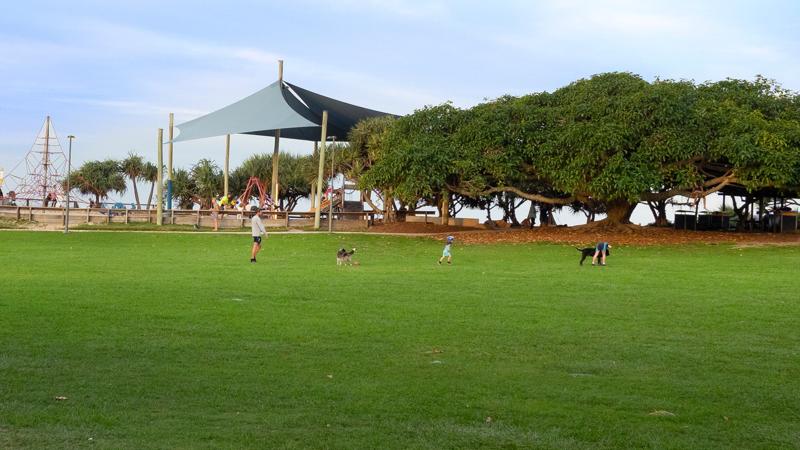
Size considerations (Kick and throw):
The RPP recommends minimum sizes as follows:
- Council wide park -
- one kick and throw space of 50 m x 70 m and
- 2 x kick and throw spaces of 30 m x 40 m each.
- District Park – 50 m x 70 m
- Local park – 30 m x 20 m
- Linear Park – 30 m x 10 m.
Overarching design considerations:
- All open spaces should include universal access (e.g. provide safe clearances, movement around equipment and access to equipment).
- Compliance with relevant legislation, standards and corporate documentation (including positioning and equal access guidance)
- Design by a professional play space designer, in accordance with Australian standards for play spaces and industry best practice.
- Design to minimise risk of injury by installing surfacing material.
- Design for provision of shade, either by planting new shade trees at installation, or shade sails, or other appropriate structure as per RPP requirements.
- Provision for different ages and abilities
- Playgrounds should be designed with a view to reflect:
- the needs of the local community – local landscape character, demographics, demands and identity, through the choice of infrastructure and colour schemes. Community consultation is recommended to engage the user and ensure the best outcome.
- children’s age and development level.
- learning capacity and needs (including considering access for those with a disability).
- park user numbers.
- A wide range of activities should be made accessible to disabled children and young adults so they can play alongside their peers.
- Playgrounds are to be safe, fun, interesting and inclusive to all users.
- Increase children’s opportunity for play by encouraging parents/carers to stay longer. Provide convenient, accessible and comfortable play infrastructure. Provide shaded seating and various seating options/configurations.
- Ensure play spaces are designed to allow children to run freely between the formal playground footprint and the wider area. Provide turfed areas and shade trees as part of the play space.
- Provide looped pathways and circuits within the play space to encourage the use of bikes and scooters.
Note: CCA treated timber shall NOT be used in play spaces, including any associated open space infrastructure such as fencing and the like. ACQ treated timber would be a suitable alternative.
Play space design

Play spaces must comply with AS 4685 – Playground equipment and surfacing SERIES and AS 4422 Playground surfacing – Playground surfacing, specifications, requirements and test method.
- The standard is intended for use by designers, manufacturers and installers of playground equipment, as well as operators of the playground.
- The objective of the Standard is to minimise the risk of injury to children using playgrounds by providing guidelines for:
- siting and developing playgrounds.
- product information requirements, instructions and operating procedures to support sound playground design.
- selection of appropriate equipment.
- minimisation of operational hazards.
- Particular attention should be drawn towards, AS 4685.0:2017 – Playground equipment and surfacing – Development, installation, inspection, maintenance and operation, which contains information on matters that should be considered before a playground is built.
The standards provide play space guidance on:
- planning
- site selection
- site information/conditions
- services
- regulations, and the like
- playground design
- surfacing
- shade and sun protection.
Play space design and layout
- Play spaces include the site, natural features, built landscape and any manufactured equipment and surfacing. It also includes associated open space infrastructure such as car parking, paths, public amenities (toilets), drinking fountains and picnic facilities.
See LIM Play spaces - Positioning for recommendations for play space layouts and further guidance.
Play space categories
Play spaces are generally broken up into the following categories:
- Toddlers to pre-schoolers – Ages 2 to 5yrs. Play focuses on the development of balance, creativity and social role play.
- Equipment that spurs verbal interaction.
- Equipment that supports fine motor skills.
- School aged – Ages 6 to 12 years. Play continues to focus on development of gross motor skills, balance, creativity and social role play. Children are testing the limits of their coordination and abilities and have developed most of their basic motor skills.
- Equipment that provides measurable challenges.
- Out of the way corners where small groups can gather.
- Teenage – Ages 13 + years. Have developed most of their basic motor skills and are confident with movement and creativity.
- Equipment that supports speed, endurance, strength, agility.
- Places for socialising.
- All abilities – Appeals to children of all abilities and provides equal access elements, under surfacing and facilities (see ‘equal access requirements’, ‘accessible and inclusive play’ and ‘all ability play spaces’ for further guidance).
- Adults/seniors – In the context of this manual applies to people 18 years +.
Teenagers
Teenage equipment is becoming more popular with the introduction of specific teenage play equipment ranges and hangout areas, for example:
- Consider this equipment in areas where there is a large teenage population. Locate in high use areas that are clearly visible to enable passive surveillance.
- Teenage equipment should be co-located with other suitable facilities such as basketball courts.
Play and fitness – adults/seniors
A range of play equipment has been designed to increase senior fitness which can also be used by young children, encouraging multi-generational use.
- Equipment includes:
- ramps
- snake pipes
- gangways
- balance beams and steps.
- Equipment is designed to promote balance, strength and cardiovascular fitness in a safe, play style environment.
- The experience can be enhanced by the presence of young children who are also able to enjoy the equipment.
- An illustration of this equipment is included, see Figure 17: Elevation of multi-generational exercise station for further guidance.
Parents and carers
The design and layout of the play space should encourage active participation and supervision by parents and carers.
- Ensure seating, pathways and play equipment are convenient, comfortable and accessible, to achieve this goal.
Developmental opportunities
All play space designs should consider play elements that provide a range of developmental opportunities for social and physical skills through play, such as:
Development opportunity type | Explanation |
Physical |
|
Social |
|
Cognitive |
|
Emotional |
|
testing xxx
6.x heading 2
testing xxx vvvv
heading;
Development opportunity type
testing xxx ^^^^
Seven senses
Sensory processing is the brain receiving and organising input from all of the active senses at any given moment. The 7 senses are:
Sense type | Explanation |
Sight | The capability of the eyes to detect images. Visual perception is how the brain processes these nerve impulses. |
Smell | Olfaction is the ability to detect scent (chemical odour molecules in the air). Odour molecules possess features that excite receptors which is interpreted by the brain to perceive the ‘smell’. |
Taste | Gustation is the capability to detect the taste of substances through sensory organs called taste buds. |
Hearing | Audition is the capability to perceive sound by detecting vibrations through the ear. Auditory processing relies on how the brain interprets, recognises and differentiates sound stimuli |
Touch | Somatosensory system is spread through all major parts of the body. Activity in a sensory receptor is triggered by stimulus such as heat. The signal passes to the brain which allows the stimulus to be felt |
Vestibular | Explains the perception of our body in relation to gravity, movement and balance such as being able to walk along a balance beam |
Proprioception | Is the sense of the relative position of neighbouring parts of the body and strength of effort being employed in movement such as applying the correct pressure when writing with a pencil |
This component is currently in development