Play spaces
Positioning
Best practice guidance for the placement and arrangement of embellishments
Site setout
Park users
- Provide shaded seats for spectators or parent/caregiver supervision (with clear sight lines) near the play space and outside the safety clearances.
Clarify entry
- Group embellishments at the entry to provide clarity and a reference point, e.g. an Activity entry sign (at the primary entry) in a garden bed, bike racks and rails and a waste bin.
Link areas
- Provide a pathway from the car park to the primary entry to the play space.
- Provide pathway connection to nearby facilities i.e. accessible shaded seating, drinking fountain, toilets
- Provide pathway connections to external pathway networks and transport, e.g. bus stops.
- Changes of material, level changes, signage and seating can also assist to define desired movement areas and delineate borders.
Safety
- Perimeter safety fencing should be considered if there is a hazard, such as a busy road. (See LIM Fences and gates for further guidance on the positioning and design of safety fencing).
- Crime Prevention Through Environmental Design (CPTED) principles apply.
- As per AS 16330:2021, exercise equipment is not intended for installation in the immediate vicinity of children’s playgrounds. If exercise equipment is installed in connection with playground equipment, they shall be separated from general playing activities by an appropriate distance, fencing or other structural measures.
Shade in relation to play equipment
- Play equipment should be positioned with regard to sun exposure. Shade trees and shade sails are to be sited to ensure equipment is protected from the sun. For example:
- plant trees to the northern and western sides of the playground for future shade provision.
- slides are to be positioned facing south to prevent excessive heating by the sun of the slide surface, unless otherwise shaded.
- swings are to be installed facing north - south unless otherwise shaded.
Site vehicle access
- Consider access for emergency services vehicles in the design.
- Provide access for maintenance vehicles.
- Consider combining pedestrian and vehicle access.
See LIM Fences and gates for further guidance.
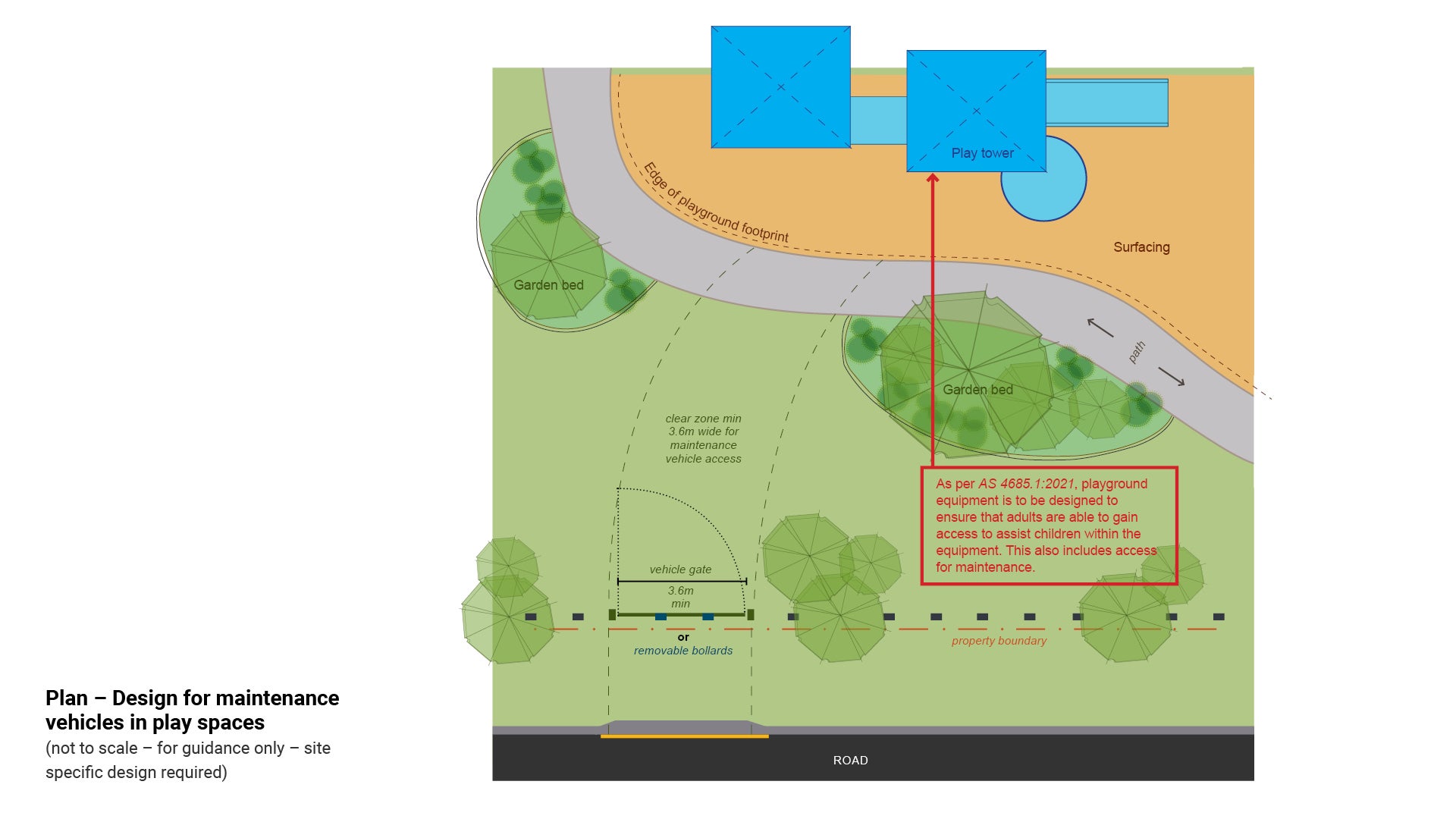
Design for maintenance vehicle access
When designing a play space, it must include access for a maintenance vehicle.
- The vehicle access must be from the gate/entry point, to the playground footprint. It should be direct and without obstacles.
- All pathways must be reinforced to cater for heavy vehicle use. (e.g vehicles with loads, cherry pickers, vehicles with work platforms). See LIM Paths trails and tracks for further guidance.
- Ensure the nominated area for a vehicle access provides adequate space between embellishments to allow the vehicle to manoeuvre. Ensure concrete edging and garden beds are not in the path of the vehicle access.
Access is required for the following maintenance activities:
- Installing and replenishing of undersurfacing.
- Loose fill surfacing is transported as close as possible to the playground footprint to reduce the need of manual labour (use of wheelbarrow).
- Playground equipment requires regular inspection, testing and repairs. Access may be required to the internal and external components, particularly tall play towers. Maintenance may require the use of elevated work platforms (EWP).
Consider positioning of trees to ensure tree branches are not impacted by the use of a maintenance vehicle.
See Figure 3: Design for maintenance vehicles in play spaces.
Figure 3: Design for maintenance vehicles in play spaces
Clearances
Table 2: Positioning guidance offsets
Embellishment | Distance from | Minimum distance | Reason |
Play equipment element | Any other items | Varies | Surfacing safety zones apply – refer manufacturer for clearances. |
Edge of playground footprint | Any loose rock dry creek beds | 50 m | Rocks can:
|
Edge of playground footprint | Any other items | 2.5 m | For deck mower clearance (where possible) Avoid creating small difficult to mow areas. |
Play spaces (including facilities such as car parking, path connections, toilet and picnic tables and benches) | Outdoor ashtrays | 10 m (see LIM Bins) | Tobacco and Other Smoking Products Act 1998 and regulations. Outdoor ashtrays are to be located more than 10 m from children’s playground equipment. |
Play spaces | All other embellishments | 2.0 m | Offset from fences to avoid escapes. |
Play spaces | Road, waterway, hazard | 20 m | To protect children from a hazard. |
Play spaces | Dog off leash park | Best practice would be to locate the two activity types in separate parks. Site specific design required for all other layouts. | Avoid locating play spaces near dog off leash parks, particularly all-abilities play spaces. Sunshine Coast Regional Council Local Law No. 2 (Animal Management) 2011 states that all animals are prohibited within 5.0 metres of a children’s playground or barbecue facility in a park or reserve. |
Play spaces | Dog drinking bowl | 5.0 m | To comply with Sunshine Coast Regional Council Local Law No. 2 (Animal Management) no animals within 5.0 m of a children’s playground. |
Play spaces | Exercise equipment | Exercise equipment is not intended for installation in the immediate vicinity of children’s playgrounds. | As per AS 16630:2021 exercise equipment is for youths and adults or users having an overall height greater than 1400 mm only. If exercise equipment is installed in connection with playground equipment, they shall be separated from general playing activities by an appropriate distance, fencing or other structural measures. |
Play spaces | Shade sail post | 2.5 m | To prevent the shade sail being climbed. |
Play spaces | Activity entry sign | Install at entry, garden bed preferred | For regulatory guidance. |
Bin | Truck collection point | No more than 80 m | For waste servicing. |
Layout of play equipment
- Site specific design required.
- Toddler, kindergarten, junior and middle equipment should be co-located so that parents/carers can easily supervise their children of different ages.
- There is benefit in creating combination units which cater for a wider range of ages, including equipment designed for adults/seniors. Placement of pieces and movement zones need careful design consideration by a suitably qualified play space professional.
- Provide sufficient space away from playground equipment for stockpiles of material on site. Do NOT stored stockpiles on or near playground equipment to avoid damage to equipment.
- Play space layout design is determined by the open space type, which also indicates the recommended level of embellishments. The following figures provide recommendations for play space layouts:
- Figure 4: Plan – local play space
- Figure 5: Plan – district play space
- Figure 6: Plan – Sunshine Coast Wide play space
- Figure 7: Plan – Sunshine Coast Wide (equal access) all abilities facilities play space (1 of 2)
- Figure 8: Plan – Sunshine Coast Wide (equal access) all abilities facilities play space (2 of 2)
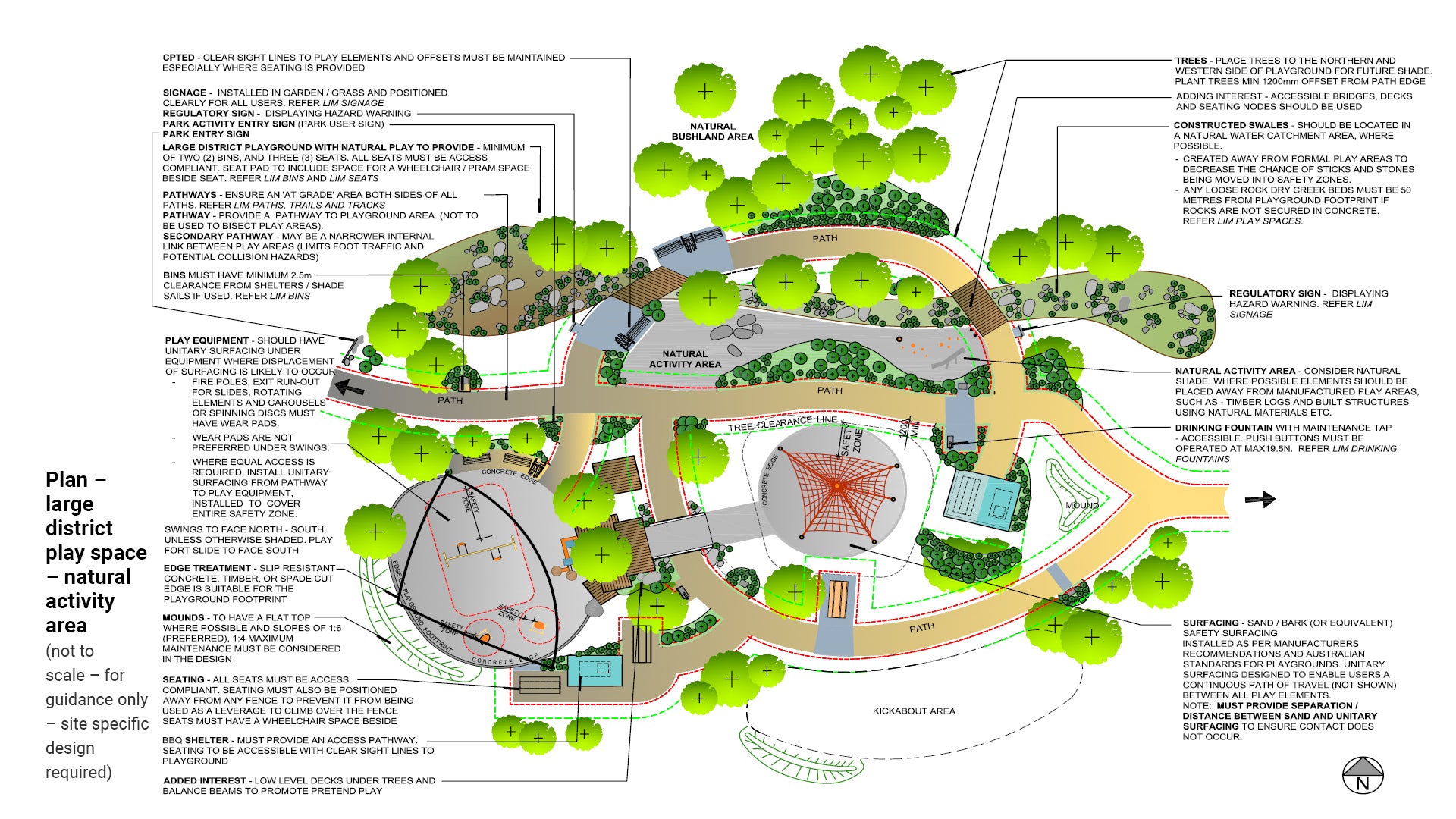
- Figure 9: Plan – large district play space – natural activity area.
Figure 4: Plan – local play space
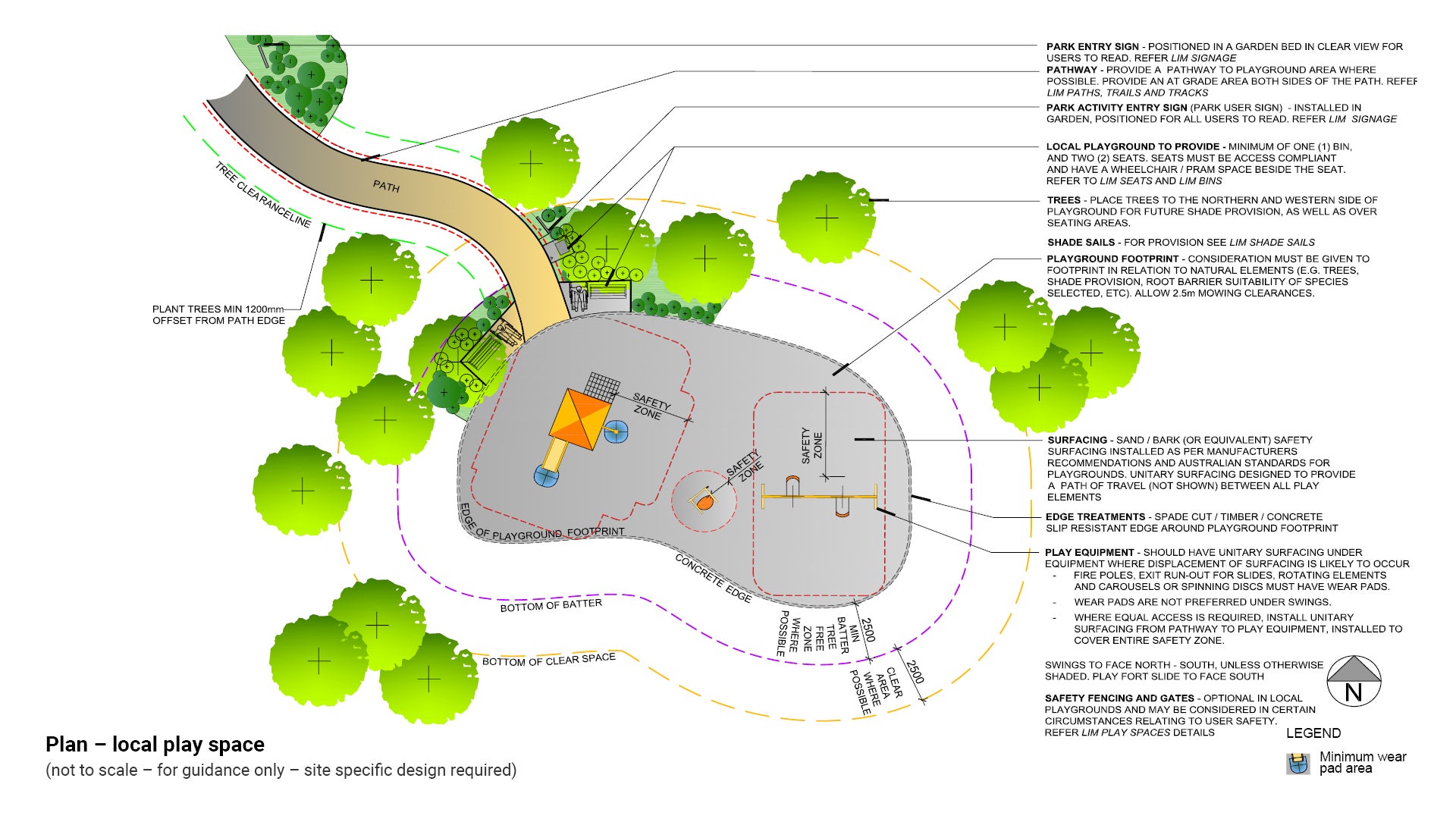
Figure 5: Plan – district play space
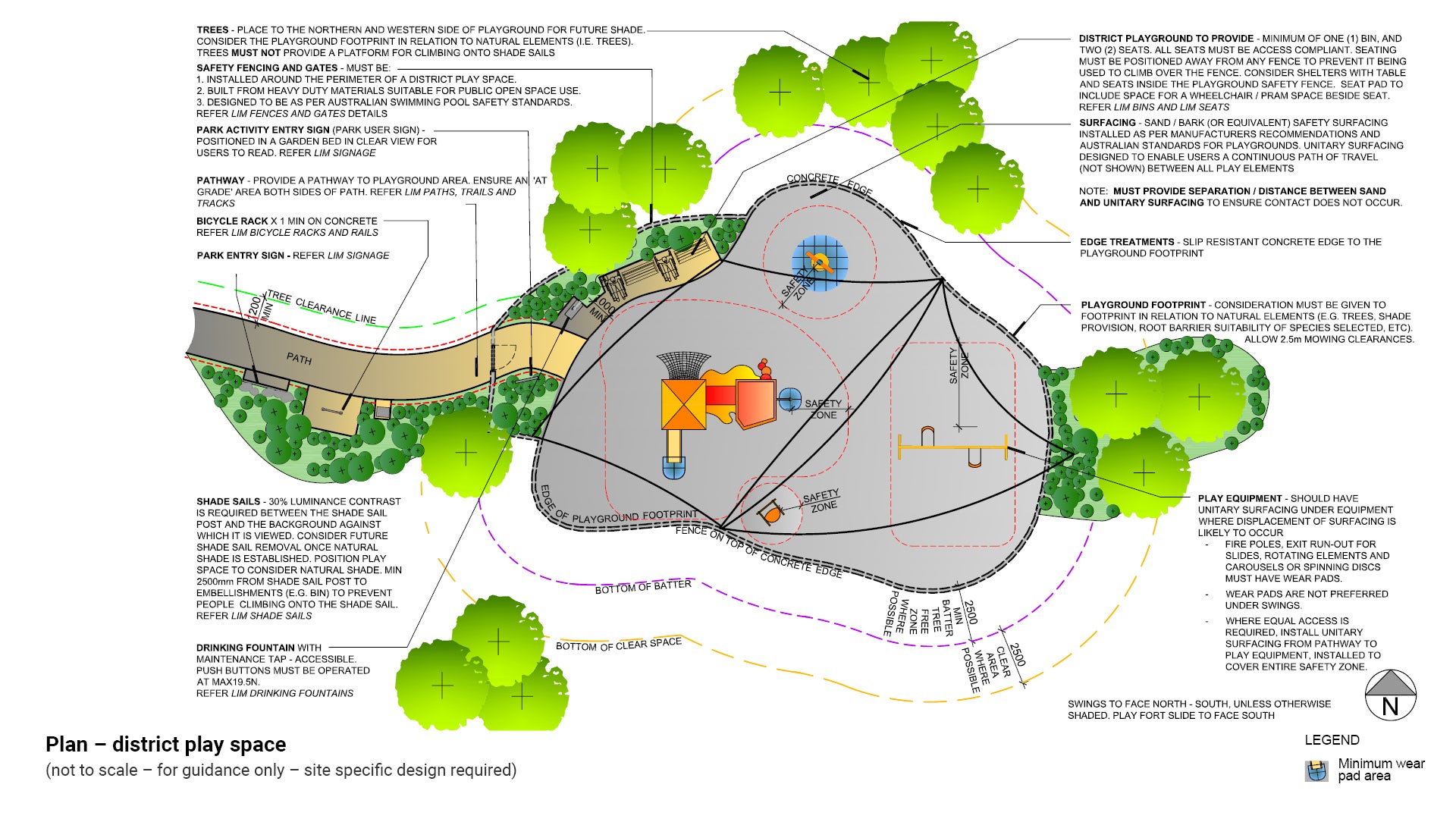
Figure 6: Plan – Sunshine Coast Wide play space
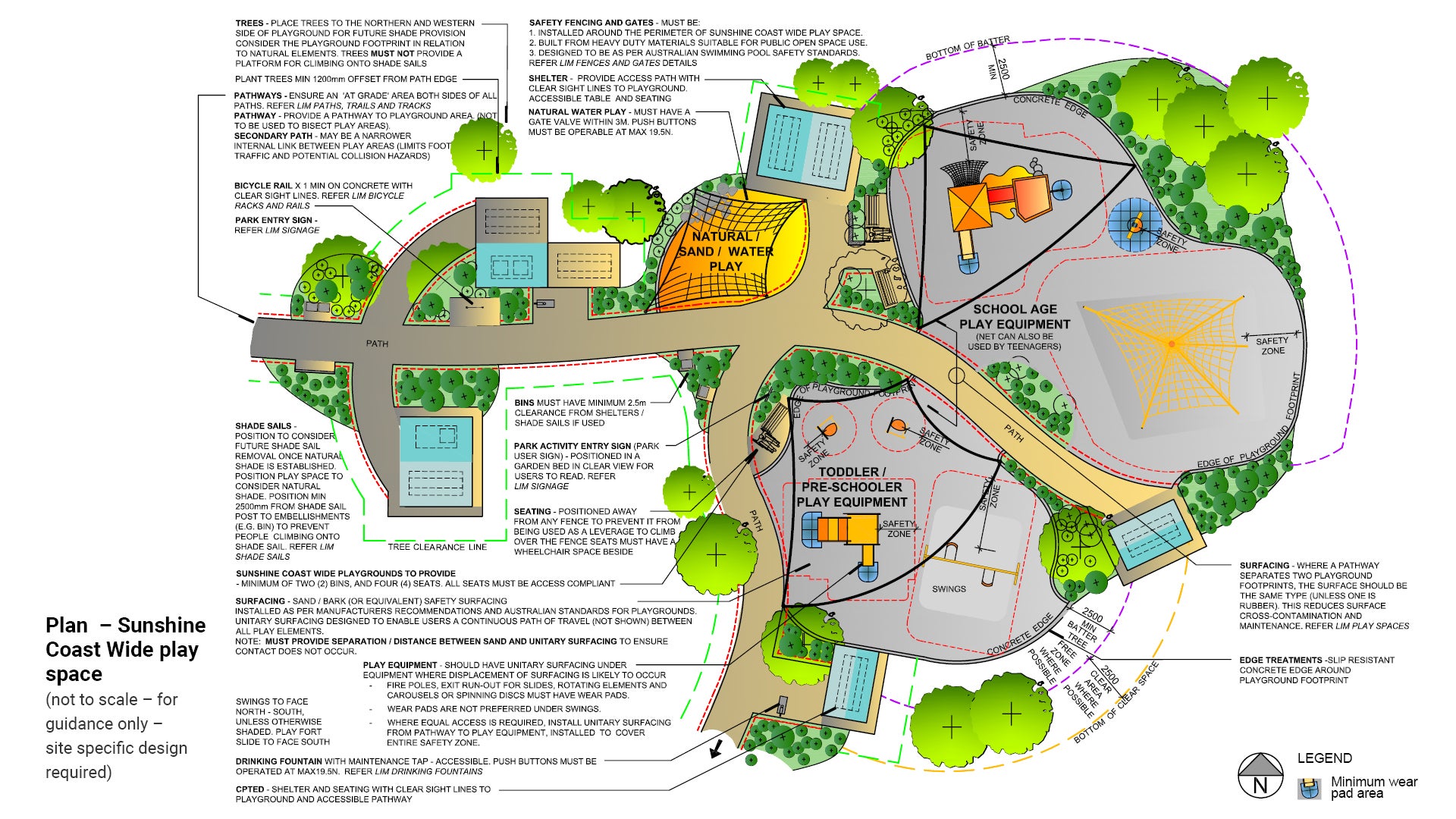
Figure 7: Plan – Sunshine Coast Wide (equal access) all abilities facilities play space (1 of 2)
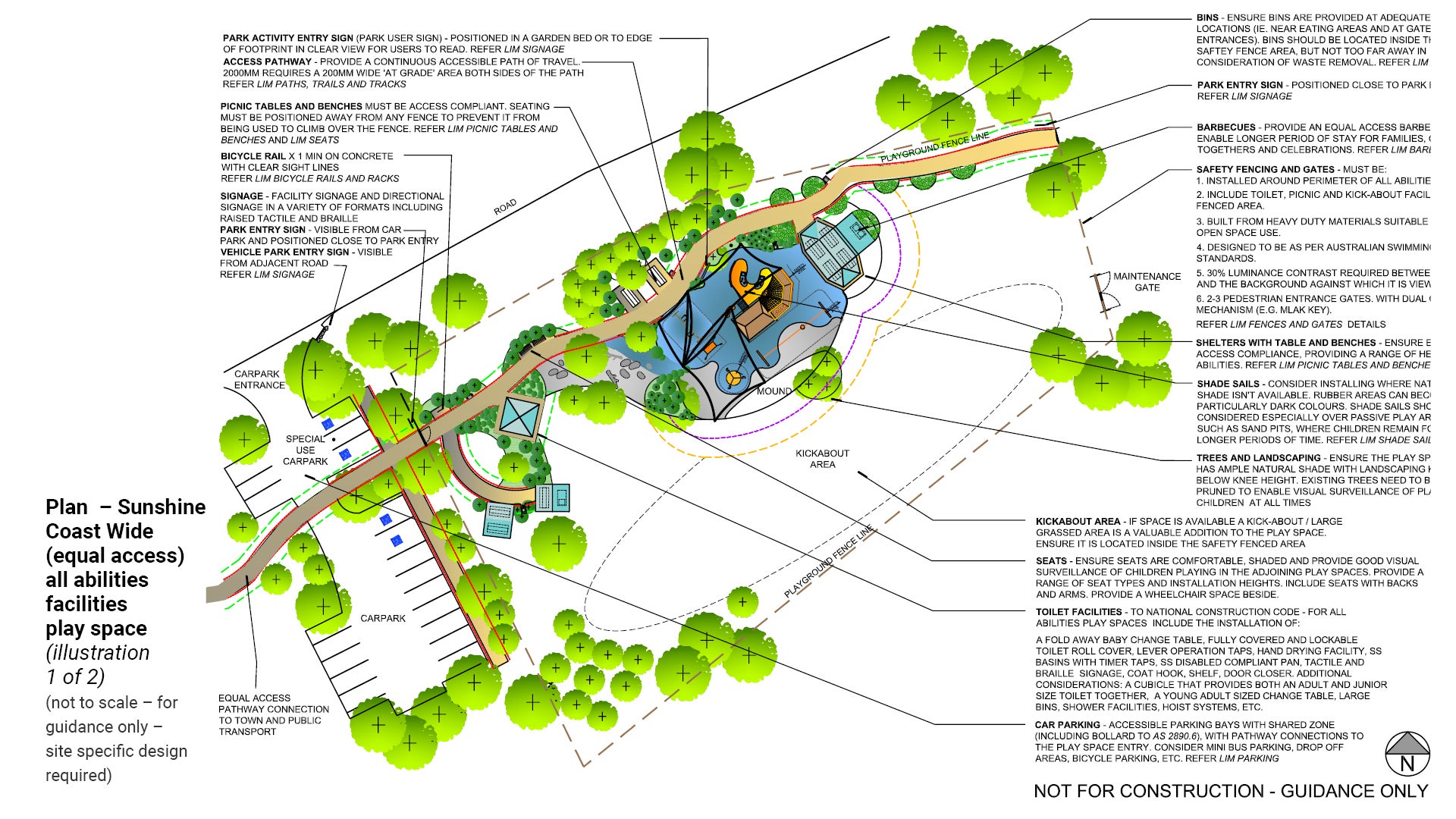
Figure 8: Plan – Sunshine Coast Wide (equal access) all abilities facilities play space (2 of 2)
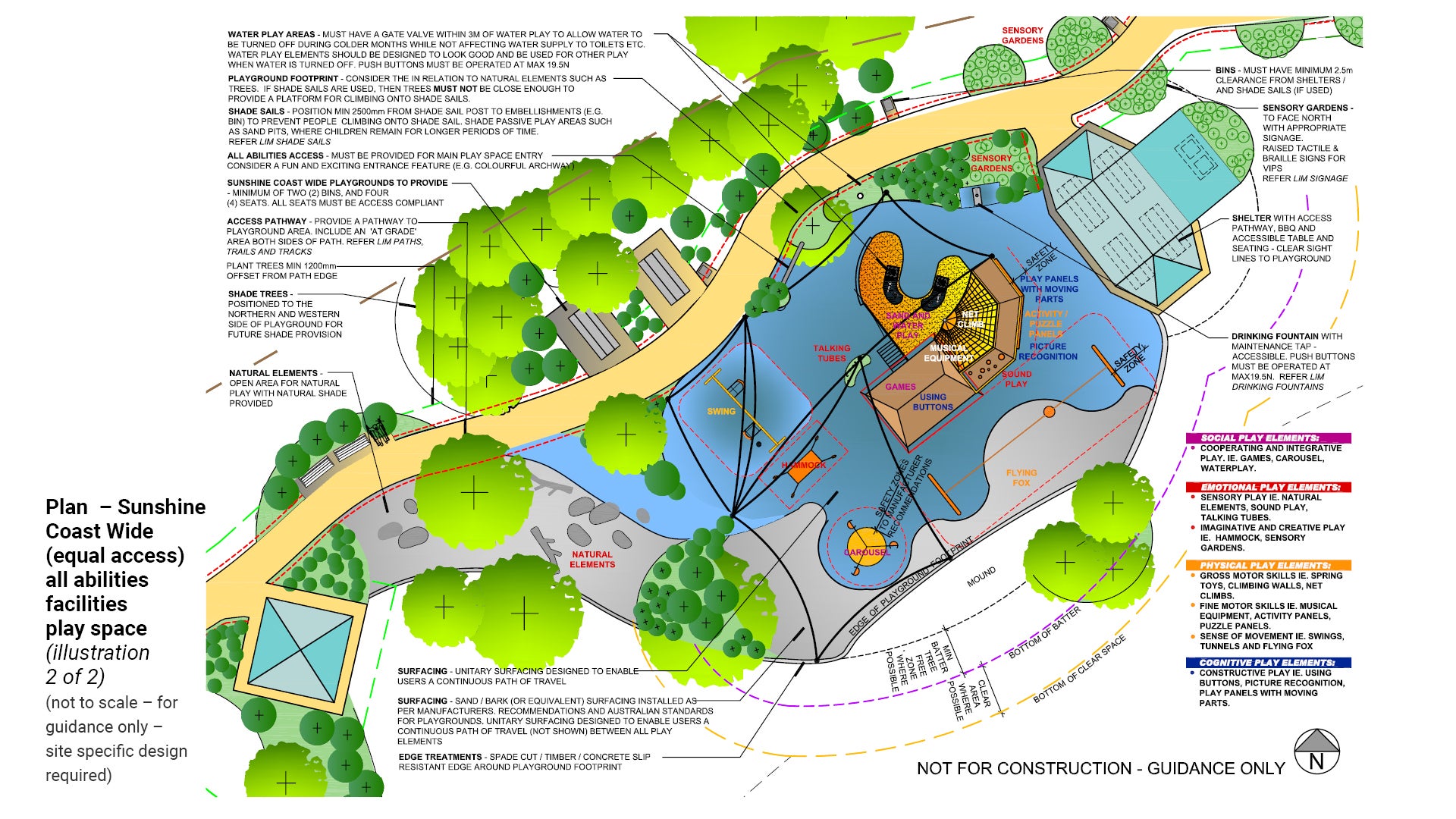
Figure 9: Plan – large district play space – natural activity area.
This component is currently in development