Sports and games
Design
Requirements for the design, manufacture and installation of embellishments
Good design
See the following corporate documents to identify relevant project design requirements:
Sunshine Coast Planning Scheme regulates the way land, buildings and structures are used and developed on the Sunshine Coast.

Sunshine Coast Design contains 10 design principles that guide good project planning and design outcomes, that are appropriate for the Sunshine Coast.
The LIM provides further overarching design advice, refer:
- Introduction and Design Principles - e.g. sustainability, CPTED, accessibility
- Preliminaries - environmental management, tree sensitive design and site set up.
Embellishment requirements
- Universal access.
- Comfortable and suitable for the average person.
- See 'Positioning' and 'Equal access' sections for the corresponding LIM category.
- Made from materials that will be durable and can be suitably protected from exterior elements, such as salt spray and UV exposure.
- Robust and sturdy to withstand constant public use and be resistant to vandalism.
- Fixings are to be 316 marine grade stainless steel (unless otherwise stated).
- Tamper proof fixings should be used
- Graffiti protection coatings applied (where applicable)
- Fire retardant (where applicable).
- Warranties should be as listed below.
- Easily repairable or replaceable.
- Sourced locally and use standard fittings.
- Reputable suppliers should be used who keep a supply of stock parts on hand for the life of the product.
- Use sustainable materials, although sustainability needs to be considered over the lifetime of the embellishment.
- Install on paved, concrete or other hard surfaces (where applicable).
- Manufactured to engineering specifications (where applicable).
- See the 'Standards' section for the corresponding LIM category.
Warranty and asset life
Product/embellishment | Warranty (minimum) | Asset life (typical useful life) |
Sports court - asphalt | 10 years | 30 years 2 |
Sports court - concrete | 10 years | 30 years 2 |
Sports court - cricket pitch | 10 years | 30 years 2 |
Sports field | 10 years | 30 years 2 |
Sports goals - basketball/netball | 2 years | 25 years 2 |
Sports goals - multi-goal system | 15 years | Not available |
Source 2: Sunshine Coast Council Asset Management Plan 2017/18-2022/23 – Parks and Gardens (figure based on current data, subject to change).
Sports and games
Once the location of the sports and/or games has been decided, based on the Environment and Liveability Strategy (ELS) and Recreation Parks Plan (RPP) guidance, consider the appropriate embellishment level to suit the selected site.
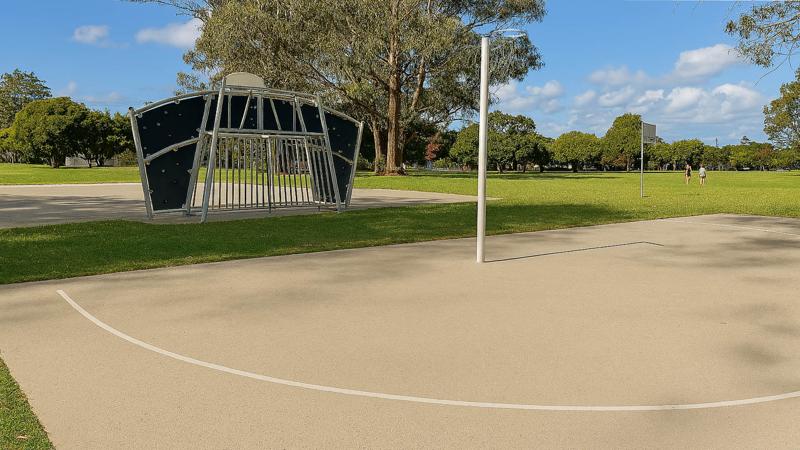
Overarching design considerations (field or hard court and outdoor games):
- Full size fields/courts are not required for informal play in a park (modified sizes may be suitable).
- The RPP provides guidance as to which level of park is suitable for modified hard courts (full and half court) and modified field sports such as cricket and football. It also provides guidance for the appropriate level of park for informal games.
- Seek professional design advice, particularly when designing multi-sport courts. Safety clearances must must be met.
- Each design should cater for a range of ages and abilities and provide multiple sports and games options (where possible), to attract the widest possible usage. Ensure the expected numbers of people who will participate in the activities can be accommodated.
Certification
For all structures over 3.0 m in height, certification by a professional building certifier is required. The professional certifier will advise which forms are necessary. (e.g. Form 15 - Before construction, Form 12 - During construction, Form 16 - During construction at mandatory inspection stages, Form 21 - End of construction).
Sports and games design
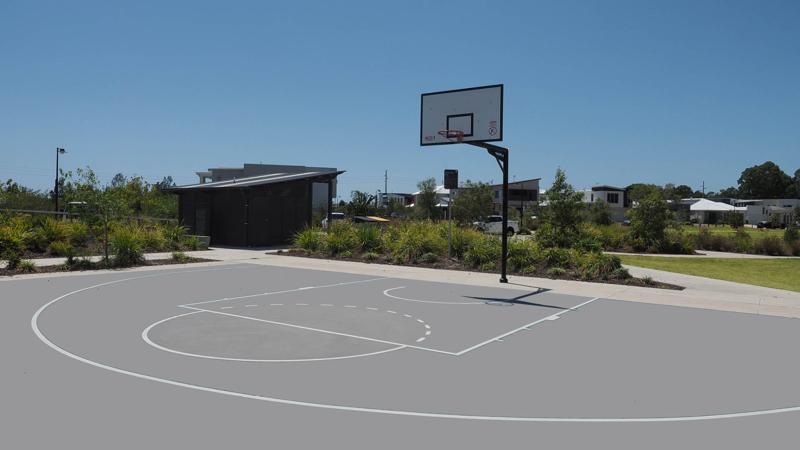
Orientation, layout and dimensioning
- Designers will need to obtain independent and professional advice in relation to their proposed sporting activity dimensions, clearances and layout.
- Ensure all embellishments are installed outside the clearance area.
- See Western Australian Government – Sports Dimensions Guide for Playing Areas, Sport and Recreation facilities, for orientation of outdoor facilities and line marking guidance:
- consideration that the most common recommended orientation is 15 degrees east of north. This reduces the chance of players facing the sun (east and west) during both sunrise and sunset.
Surface levels and drainage
- Drainage designs must ensure that all sports and games, do not create areas of standing water, to enable maximum use potential.
- Ensure all playing surfaces are flush with the adjoining surface level, to enable safe clearance areas or buffers.
Fields
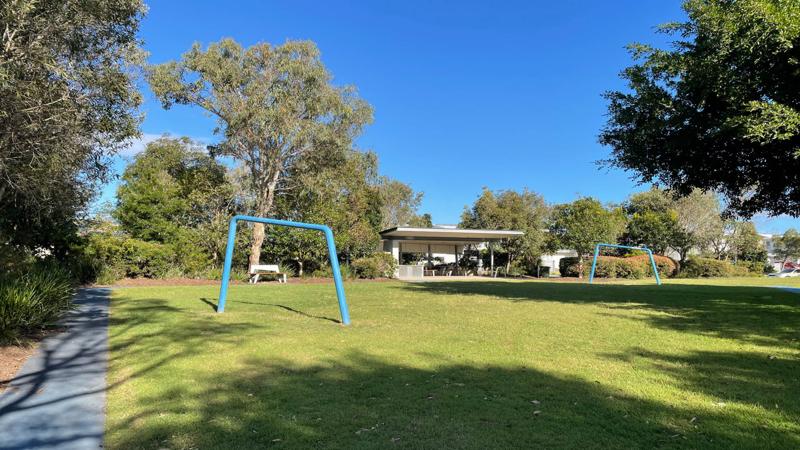
Fields can be used for informal sports such as rugby, soccer, AFL and cricket.
Multi-goalpost (rugby, soccer, AFL, etc)
Goals
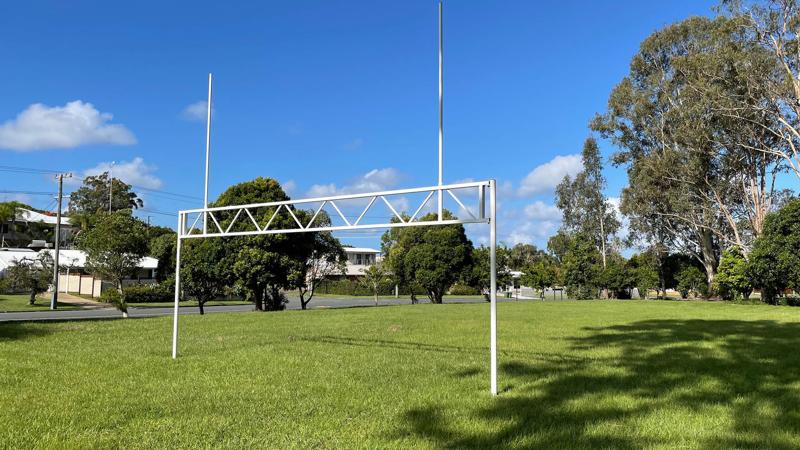
- Multi-goalpost systems are preferred to provide skills development in different sporting disciplines.
- Goal-posts are typically used for goal kicking practice, so one set of posts at one end of the field is sufficient.
- Position the goal post so the kicking area and ball landing area is free of obstacles from all angles (ie ensure there aren’t any activity areas beyond the goal posts).
- Netting – soccer goal ‘nets’ must NOT be installed.
- Goal posts, fixtures and fittings must be:
- suitable for the corrosive coastal environment (where appropriate)
- suitable for use in the public open spaces.
- manufactured to engineering specifications
- For socketed goals, refer to AS EN 16579:2020 Playing Field Equipment – Portable and permanent socketed goals – Functional, safety requirements and text methods.
Cricket Pitch
Surfaces and markings
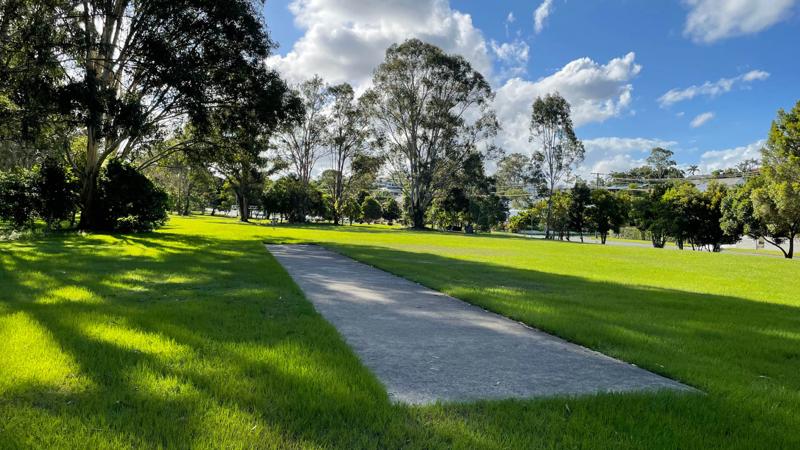
- Sports surfaces must be non-slip and preferably without coloured surface application which may fade and wear, and is not easily replaced.
- Artificial turf must NOT be used, due to cleaning issues, potential trip hazards and irregular surface wear.
Concrete slabs
- All concrete slabs to be designed by a suitably qualified professional.
- All concrete slabs to be reinforced.
- Reinforcing to allow a maintenance vehicle to drive over it without causing damage.
- Consider drainage (based on soil type) to ensure slab does not create areas of standing water.
- To provide equal access, ensure that the finished slab level is flush with the surrounding surfaces. Turf to be flush to finished floor level of slab.
Wickets
- Wicket holes are not to be provided.
Hard courts
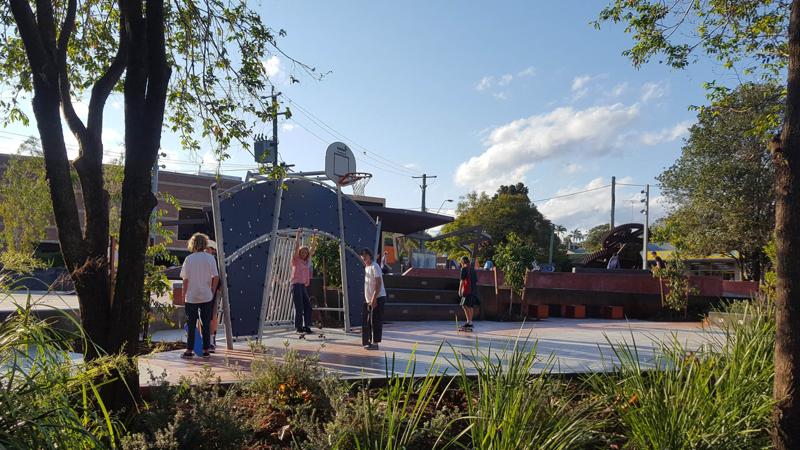
Hardcourts can be used for informal sports such as basketball and netball.
Basketball and netball
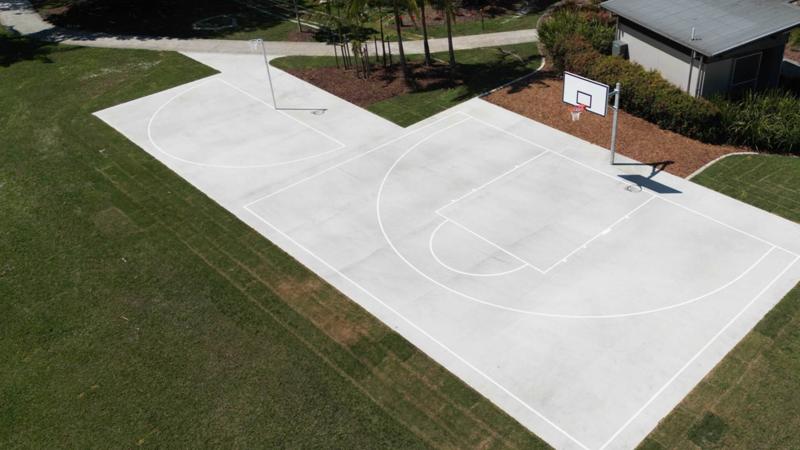
Surfaces and markings
- Generally all court marking is to be 50 mm wide (Refer individual sporting advice).
- Sports surfaces must be non-slip and preferably without coloured surface application which may fade and wear, and is not easily replaced.
- Asphalt surfaces are not preferred as they are prone to damage by tree roots and are hotter than concrete.
- Artificial turf must NOT be used, due to cleaning issues, potential trip hazards and irregular surface wear.
Concrete slabs
- All concrete slabs to be designed by a suitably qualified professional.
- All concrete slabs to be reinforced.
- Reinforcing to allow a maintenance vehicle to drive over it without causing damage.
- Consider drainage (based on soil type) to ensure slab does not create areas of standing water.
- To provide equal access, ensure that the finished slab level is flush with the surrounding surfaces. Turf to be flush to finished floor level of slab.
Goals
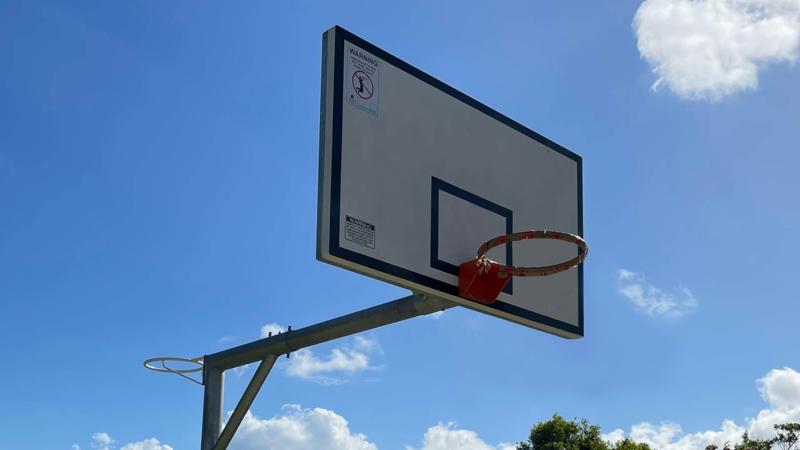
- Hoop and netting (basketball and netball)
- ‘nets’ must NOT be installed.
- install a hoop that does NOT include the hooks that hold the net in place.
- Install a hoop that includes the hooks to hold the net in place.
- Backboards (basketball)
- must have product manufacturer’s signage regarding proper use, such as ‘no slam dunk/no swinging on the ring’.
- must have additional signage (sticker), regarding consideration of noise to nearby residents.
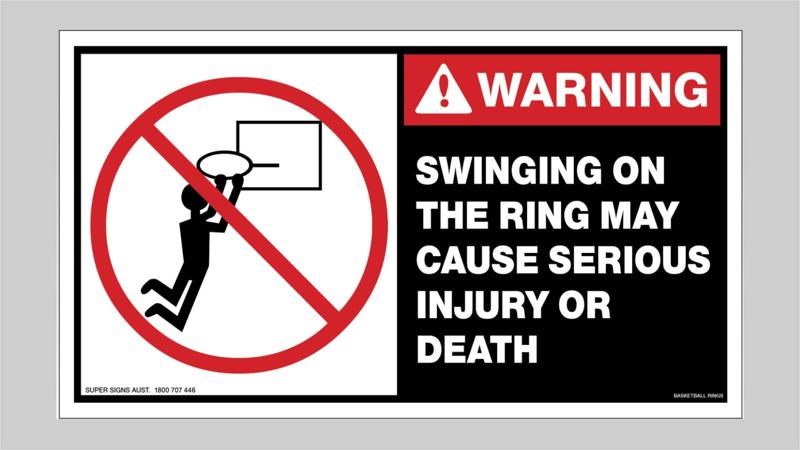
Warning sign (provided by manufacturer)
- must have product manufacturer’s signage regarding proper use, such as ‘no slam dunk/no swinging on the ring’.
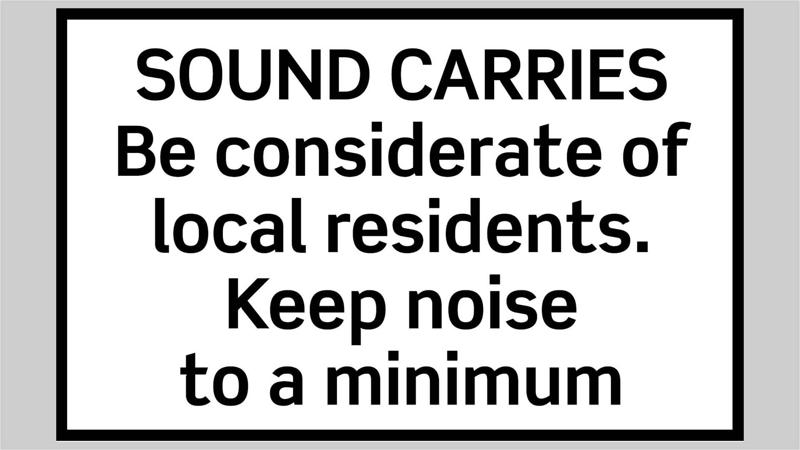
Backboard noise awareness sticker
- must have additional signage (sticker), regarding consideration of noise to nearby residents.
- Goal posts, hoops, fixtures and fittings must be:
- suitable for the corrosive coastal environment (where appropriate)
- suitable for use in the public open spaces.
- manufactured to engineering specifications
Multi-goal system
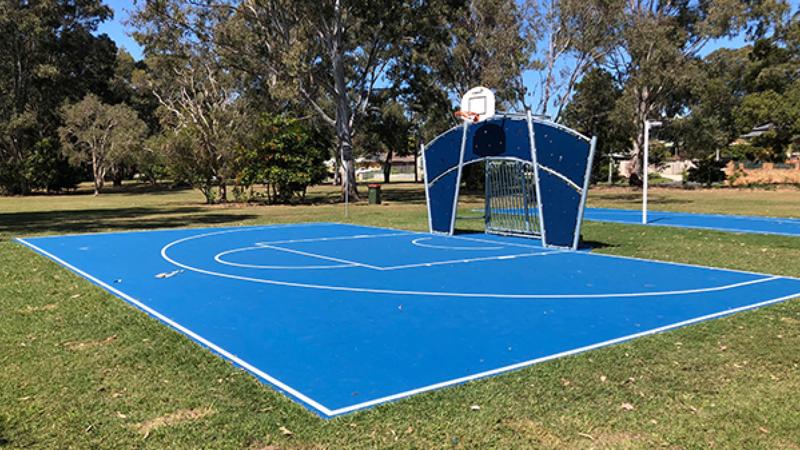
- Multi-goal systems are preferred to provide multiple options for skills development such as:
- multi-goal systems that provide for various sports – soccer, basketball, netball, hockey and handball. (Do not install netball hoop on the back of a basketball post).
Multi-sport courts
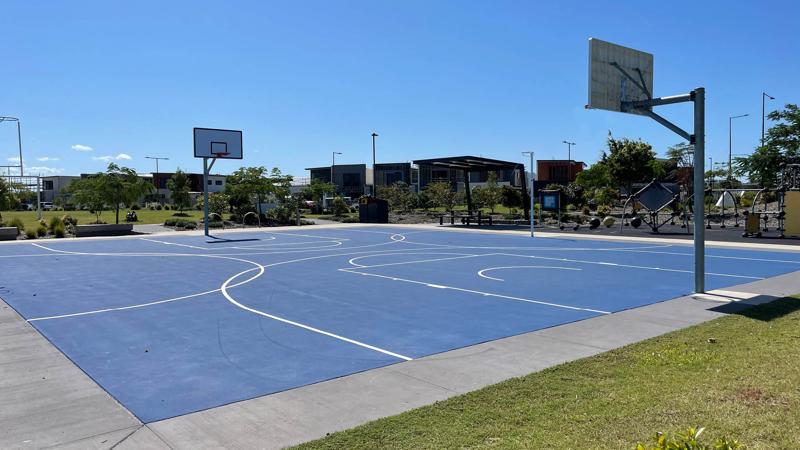
- Multiple game types can be overlayed to provide many different informal sports opportunities, on the one larger concrete slab. Pavement games (ie hopscotch, handball), may also be considered in the design.
- The courts can be half/full size courts (modified sizes) with linemarking adjusted to suit.
- Seek professional design advice. Safety clearances must be considered.
Outdoor games
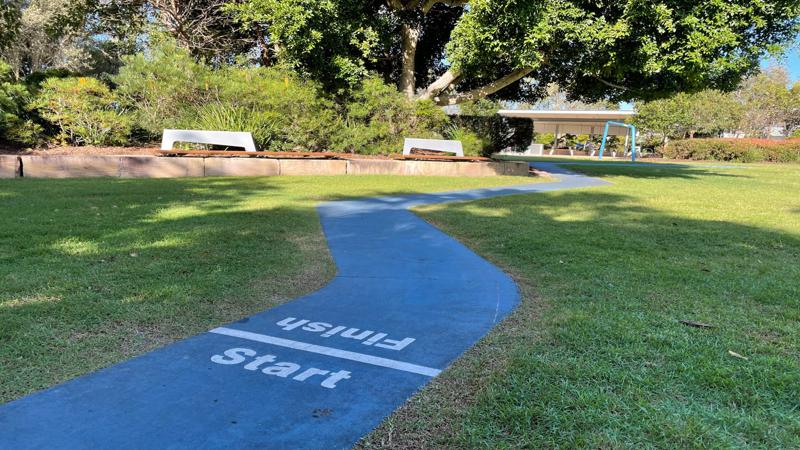
Outdoor games can be installed, such as a rebound wall, table tennis, board games, pavements games and children's bicycle education tracks.
Rebound wall
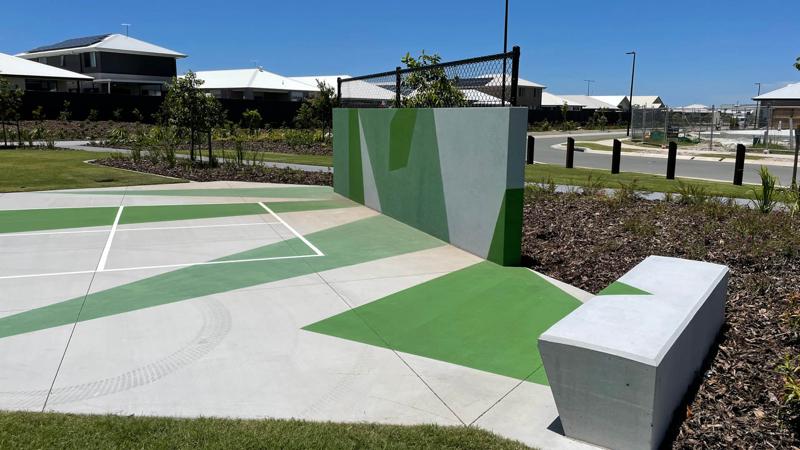
- Designed for informal play and to practice ball skills ie handball, soccer, netball, basketball. Provide a dedicated unit, or can be included as part of a multi-goal system.
- Position using CPTED principles eg. low height, good sightlines.
- Installation of a concrete slab and linemarking, will enable it be used for other sports ie. handball.
- Surfaces and linemarking must be non-slip.
- Consider noise impacts from facility.
- May require engineering
- May require additional design considerations (ie. barrier/fencing) if located near hazards like roads, waterways, etc.
Table tennis (ping pong)
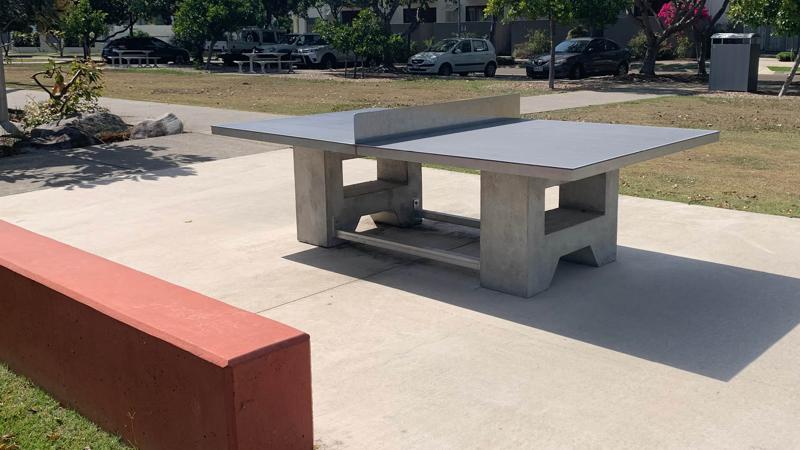
- Should be located out of the wind as this will impact the direction of the ball during play.
- Appropriate clear space around all four sides of the table must be provided to allow room for safe play. See technical drawing for guidelines.
- Must be designed for outdoor use and include a weatherproof top surface. Concrete tables are durable and weatherproof.
- Table top must be sealed with a matte finish. The table top must be a dark colour, such as blue or green, to allow the players to see the white ball when playing.
- Fittings and finishes should be 316 stainless steel (coastal areas) or galvanised steel when not exposed to coastal conditions, i.e. the hinterland.
- To accommodate wheelchair use, table legs should be wide enough to fit a standard wheelchair between them (min width 800 mm). An overhang is required to enable wheelchair access to the table. Ensure that side panels or leg extensions do not create an obstruction for wheelchair users.
- ‘Nets’ must NOT to be installed. In place of a traditional net, install a durable vandal resistant panel.
Board games – chess, checkers
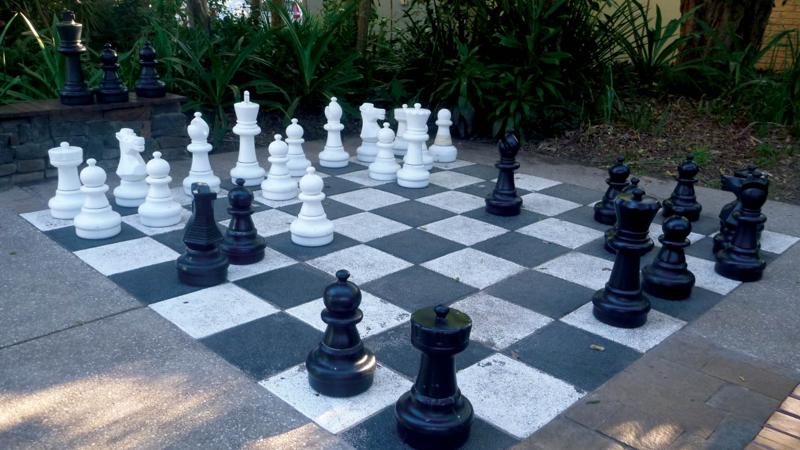
- Games that require large playing pieces (such as chess pieces) must be co-located near a facility that can manage and store them, such as a library or community hall.
- Table with in-built gameboard (e.g. chess), players can bring their own pieces. Must be vandal resistant and easy to replace game panel if damaged.
- Position away from a direct path of travel and ensure adequate clearance to avoid conflict with pedestrians.
- Surfaces and line marking must be non-slip.
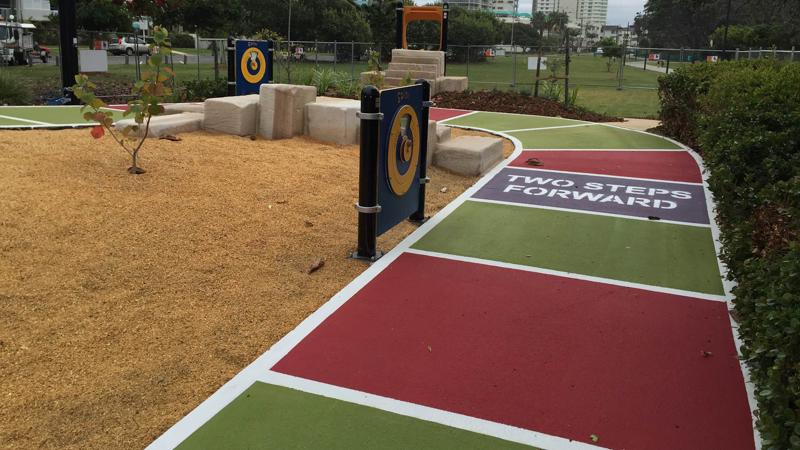
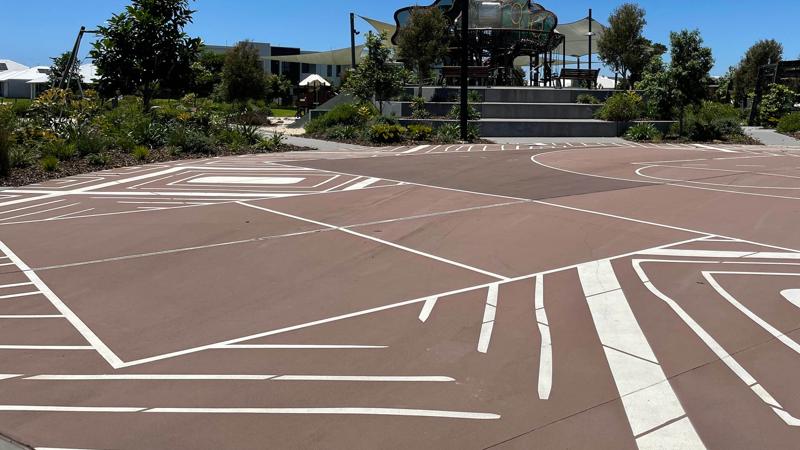
Pavement games - hopscotch, handball, snakes and ladders
- Children’s pavement games should be incorporated where possible. They can be positioned on basketball courts, in children’s playgrounds, etc.
- Position away from a direct path of travel and ensure adequate clearance to avoid conflict with pedestrians.
- Surfaces and line marking must be non-slip.
- Appropriate clear space around the all four sides of game platform, to allow room for safe play.
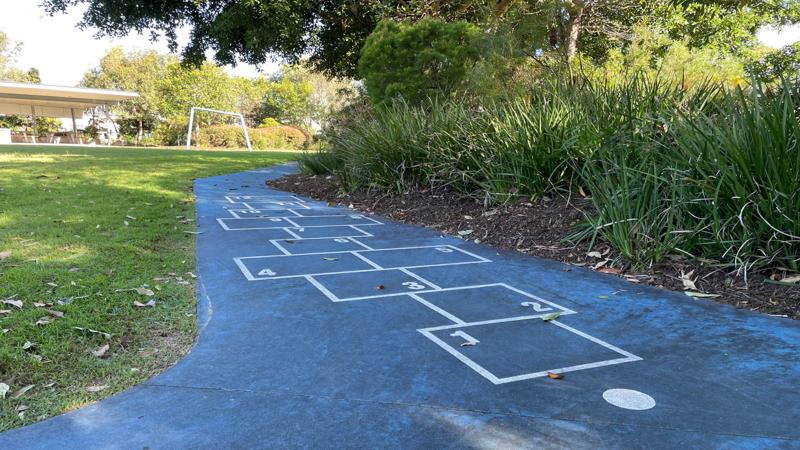
Hopscotch
Snakes and ladders
Handball
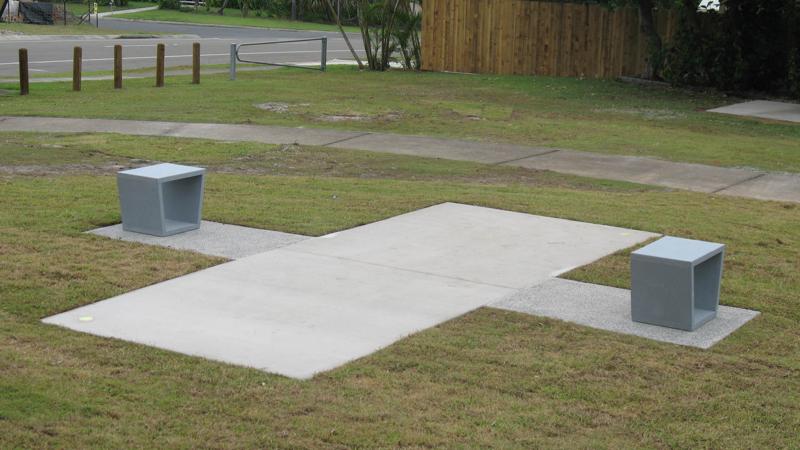
Handball (with seating)
Children’s bicycle education track
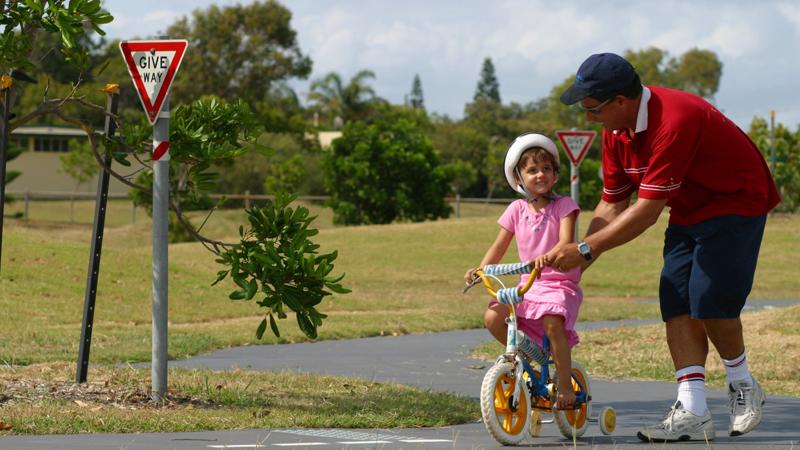
- Children’s bicycle tracks are designed to provide:
- increased knowledge of safe cycling and road rules skills
- engage children with bikes and their benefits
- play based (imaginary role play) for younger children.
- Incorporate imagination play elements such as petrol pumps and shops for younger children.
- Signage at bicycle education tracks is to reflect approved traffic signage in Transport and Main Roads AS 1742 – Manual of Uniform Traffic Control Devices (Queensland) to ensure children have a learning experience which is road relevant. Road signs must be child safe (no sharp edges) and at an age appropriate viewing height.
- Coloured concrete or asphalt surfacing should be used with white line marking. 30% luminance contrast and colour contrast is required between the selected surface material and the line marking.
- Surfaces and linemarking must be non-slip.
- Asphalt bicycle tracks to include formalised concrete edge to avoid the risk of edges crumbling and to provide a clean edge for mowers.
- It is preferred that timber products are to be treated with alkaline copper quaternary (ACQ), a water based wood preservative. CCA is not to be used.
- All playground equipment must be compliant with the Australian Standards. See LIM Play spaces for further guidance.
See Table 1: Children’s bicycle education track examples.
Table 1: Children’s bicycle education track examples
Bicycle education track | Bicycle element examples |
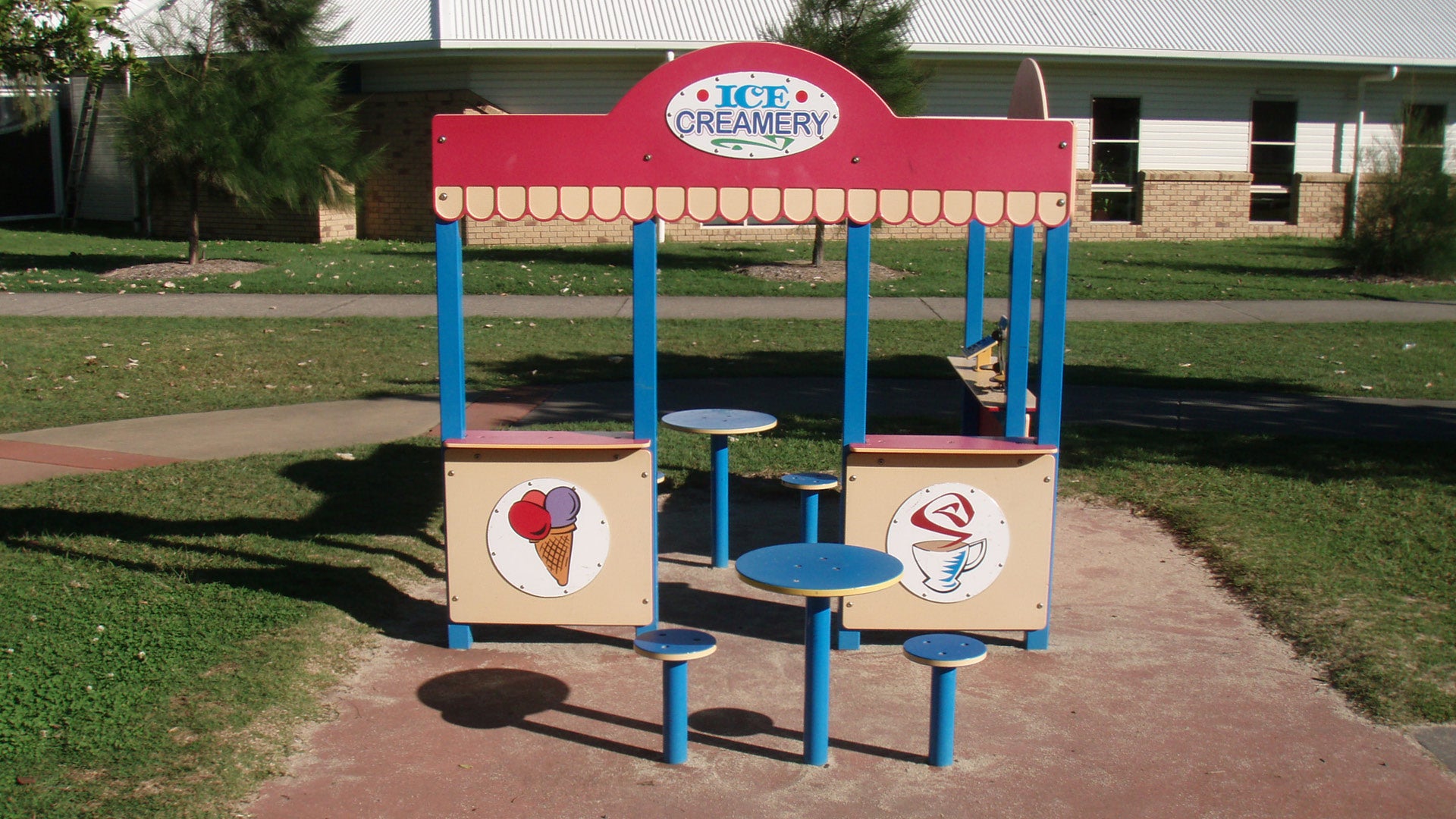 | Play town – create an entire play based experience. The bike education track can connect to play space elements such as miniature shop fronts, petrol pumps, telephones (connected by talking tubes), and parking meters. |
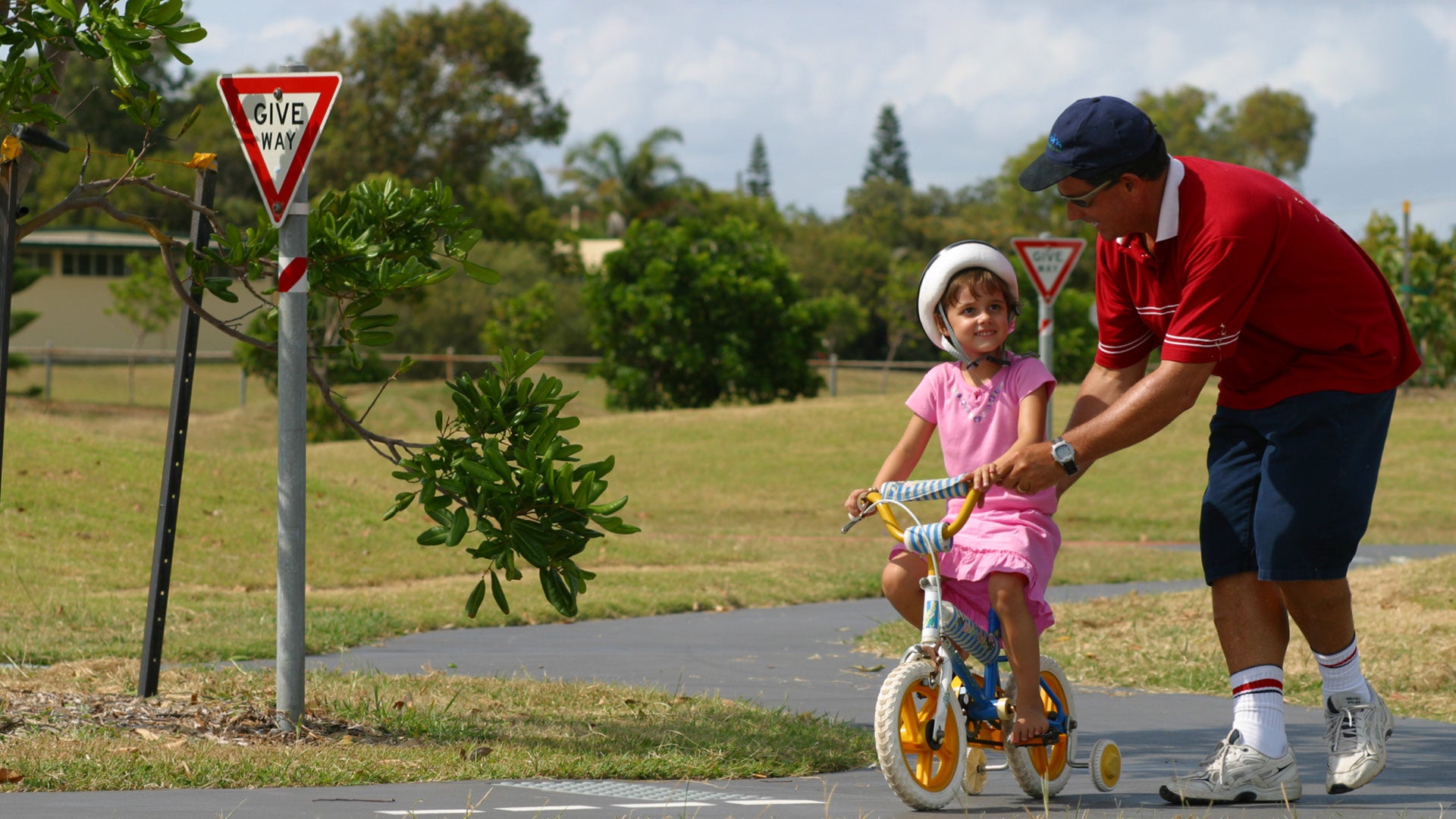 | Age appropriate – bicycle education tracks can be used by toddlers on small push bikes, through to older children on pedal bikes learning the road rules and signs. |
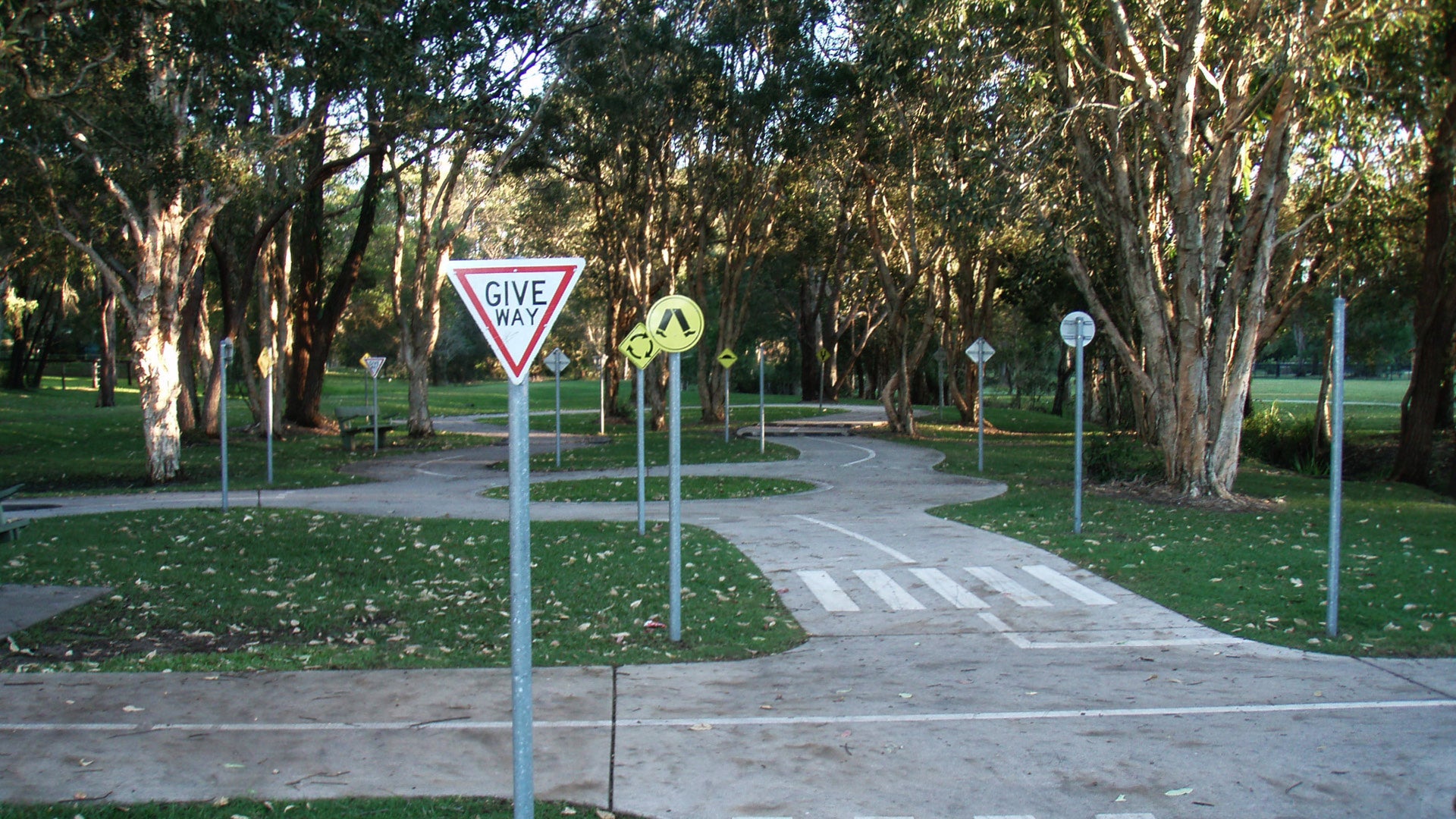 | Linemarking – 50 mm wide and non-slip. Lines and signage should be as real to life as possible. Add turning lanes, pedestrian crossings, roundabouts, speed bumps and car parking to add interest. |
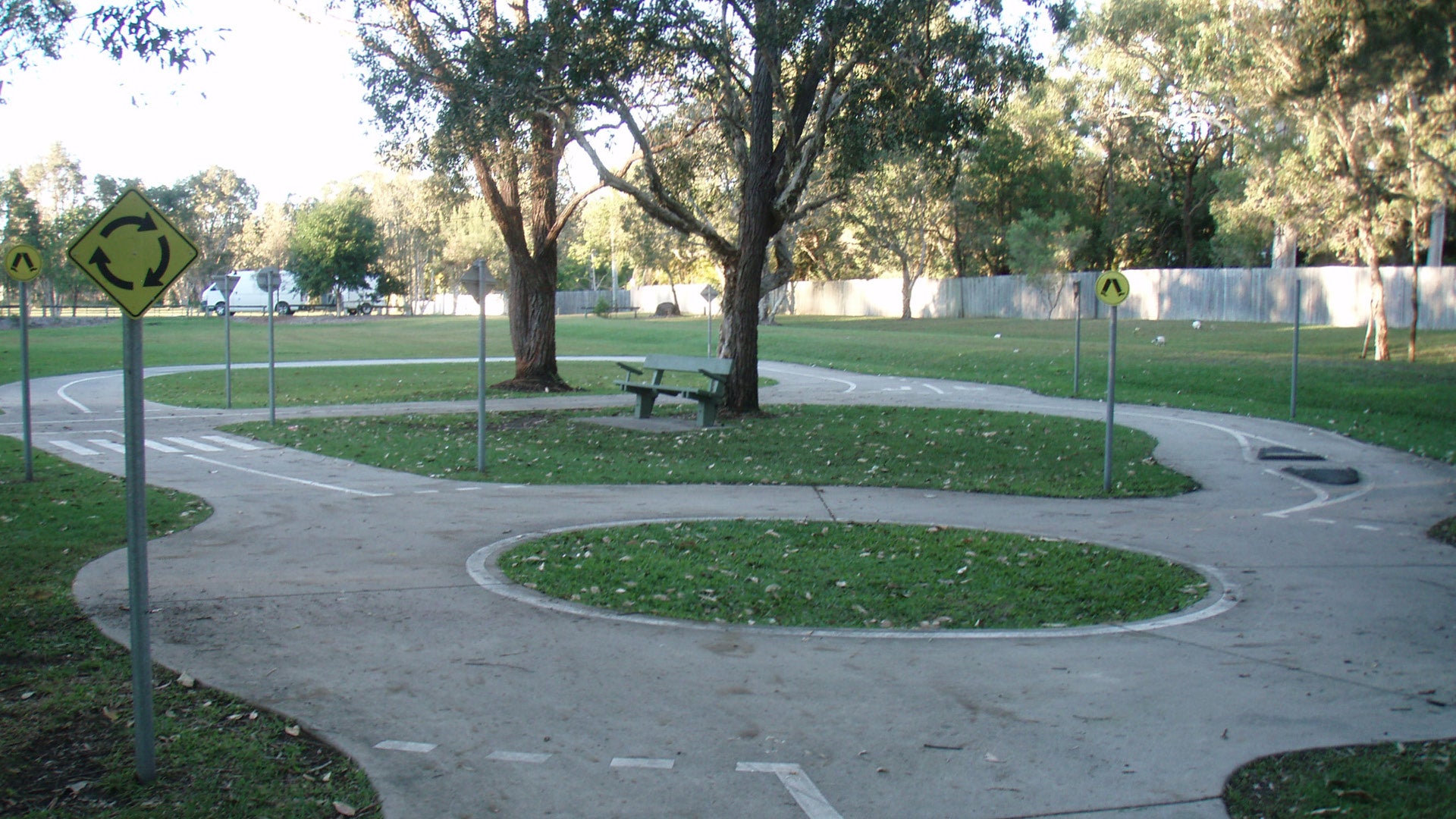 | Obstacles – fun features such as weaves, water/sand traps and bridge crossings can be used to add interest. Ensure they are installed correctly with safe lead on. Avoid using bicycle obstacles with moving parts such as see-saws bridges and rollerbar bridges as ongoing maintenance is problematic. |
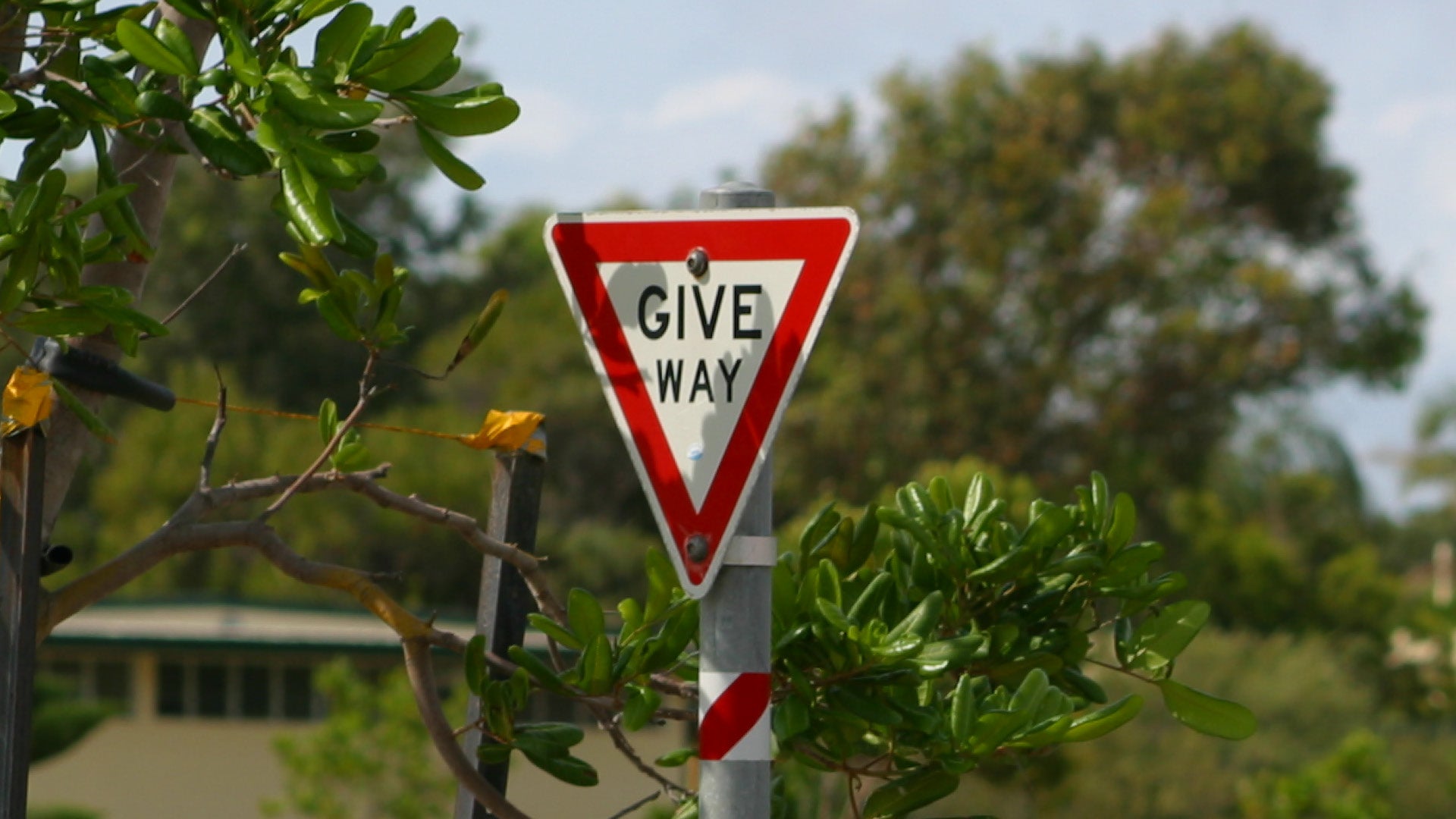 | Signage – signs should be child friendly (no sharp corners), at a good child viewing height and be vandal resistant. |
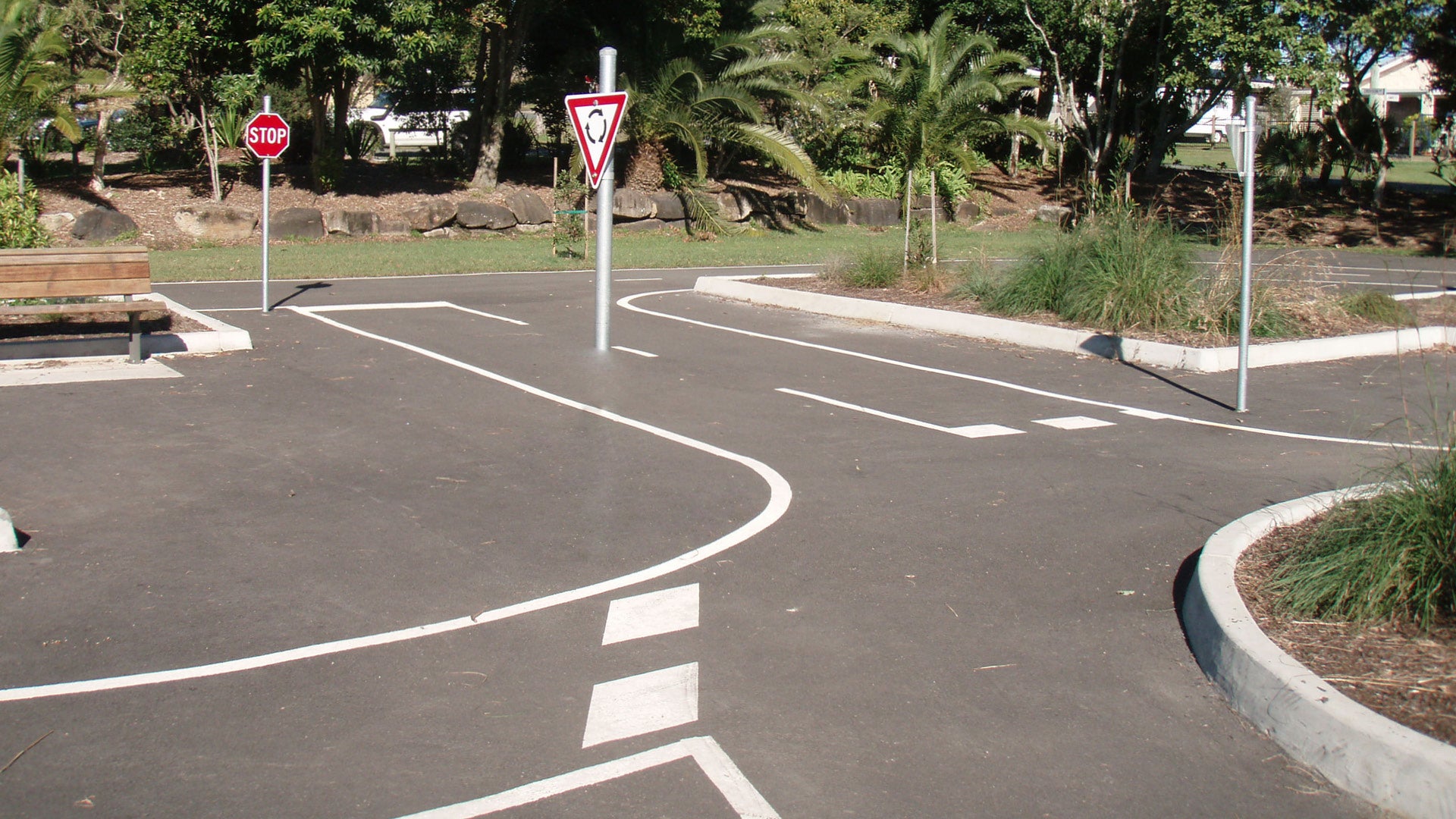 | Bicycle track surfacing – coloured concrete or asphalt surfacing should be used with white line marking. 30% luminance contrast and colour contrast is required between the selected surface material and the white line marking. |
Ancillary embellishments
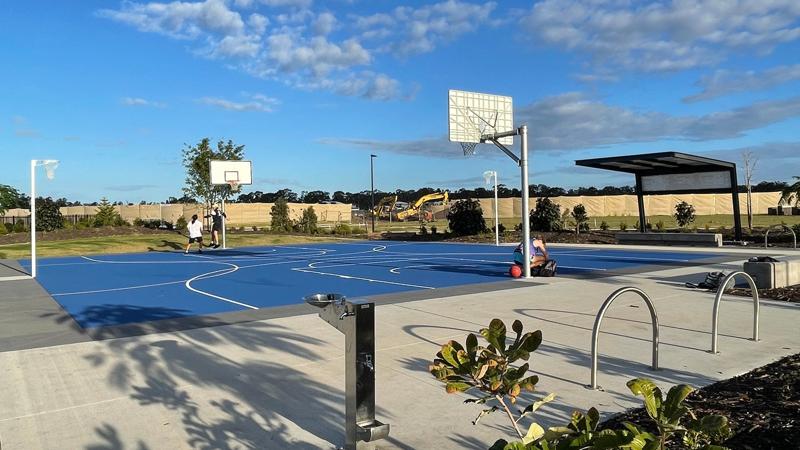
Utilise the ELS and RPP guidance, to determine what ancillary facilities should be provided with sports and games.
Furniture
Seats
- Provide shaded seating areas for players/spectators outside the run-off/safety clear area.
See LIM Seats for further guidance.
Drinking fountain
A drinking fountain is preferred, near sports and games facilities and outside clearance areas for sports.
See LIM Drinking fountains for further guidance.
Shade (natural)
- Sports and games must be designed with areas of effective shade from trees.
General
Shade is the best way to provide maximum protection against UV radiation.
- Provision should be made in each sport and game facility for areas of sun protection and shade, both for the users, as well as for any caregivers present.
- Care should be taken to site equipment so that it is correctly positioned with respect to sun exposure. Uncovered platforms and some under-surfacing materials can become uncomfortably hot if exposed to too much direct sunlight.
Landscape Planting
Shade trees
- Natural shade is preferred.
- Plant shade trees near seats at time of installation, ensuring the mature canopy width is outside clearance areas for sports.
- Install shade trees to the north and west to protect sports and games at the hottest part of the day.
- Use existing trees for shade where the design can be sensitive to tree root requirements, under guidance of a qualified arborist. It is preferable to plant trees at the time of installation of sports and games facilities.
- Ensure tree roots do not compromise the surfacing or create trip hazards. For guidance on tree roots and specific treatments contact qualified arborist.
See the following for further guidance
- Preliminaries - LIM Tree sensitive design (existing and new trees).
- LIM Planting (landscape).
Planting
- Choose plants that will provide clear sight-lines for parent and carer supervision (CPTED guidelines).
- Avoid planting plants and trees which cause hazards on hard surfaces (ie paths, hard courts). For example, dropped berries or flowers which may become slippery when wet.
- Avoid plants with leaves with cutting edges, sharp thorns, spikes, poisonous parts, fragile tree limbs or prone to limb drop.
- Avoid fruit bearing plants that may attract significant levels of birds and bats as this becomes a maintenance issue.
See LIM Planting (landscape) for further guidance.
Site drainage
Sports and games must have adequate sub-surface and surface drainage to avoid nuisance water pooling.
- Sub-surface drainage plans must be provided.
- Surface runoff must be directed away from equipment and pathways.
- Drainage grates are to comply with AS 1428.1 Design for access and mobility set. Sub-surface drainage is to be installed and connected as per Council plumbing advice.
- Fields - site to be well drained and take account of natural drainage lines and overland flows to prevent ponding. Include requirement for subsurface drainage.
- Hard courts and outdoor games - consider drainage (based on soil type) to ensure slab does not create areas of standing water.
Pathways
Pathways must provide a continuous accessible path of travel (CAPT) to the sports and games activity area (where possible), as defined in AS 1428 Design for access and mobility. This enables access for all users.
- Consider that a 1.8 m wide pathway is required for two wheelchairs to pass each other.
See LIM Paths, trails and tracks for further guidance.
Internal paths
- provide internal path connections to other sporting facilities i.e. exercise equipment.
Connection paths
- provide a connection path from the car park to the sports/game facility and associated seating.
- consider connecting park pathways to existing pedestrian and cycle networks.
- consider connecting park pathways to shopping and public transport hubs.
Signage
Note: This section should be read in conjunction with LIM Signage suite - for a complete suite of suitable signage, from the carpark to activity area.
Activity entry sign - park
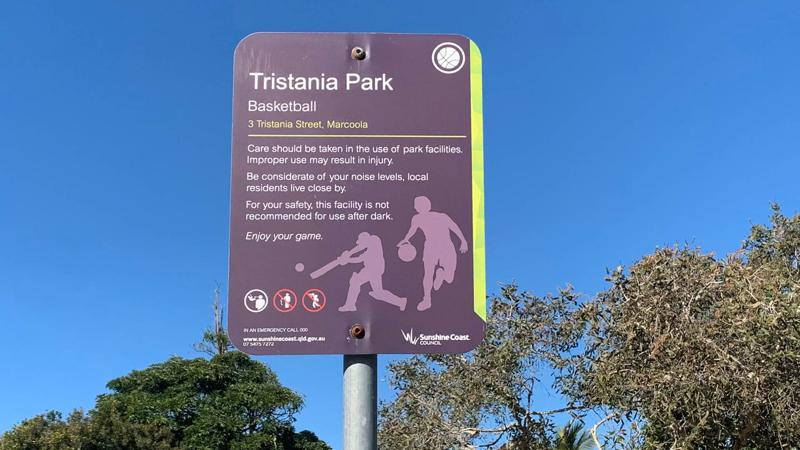
A park activity entry sign must be installed. It can be positioned at the entrance, start or most appropriate visible location, of the activity area. Ensure the sign posts do not create collision points when using equipment.
This component is currently in development