Beach infrastructure

Site planning
Best practice guidance for site planning
Decision framework
Coastal Hazard Adaptation Strategy (CHAS)
The Coastal Hazard Adaptation Strategy (CHAS) is a risk and change management initiative to better prepare Council and the community to proactively respond to coastal hazards. This includes to mitigate and adapt to the social, cultural, economic, environmental risks associated with current and future coastal hazards.

Sunshine Coast Shoreline Erosion Management Plan
The Sunshine Coast Shoreline Erosion Management Plan addresses priority erosion issues at specific locations and recommends preferred management options that are underpinned by sound science, coastal engineering principles and community values. The Plan has two parts. Part 1: Background information. Part 2: Erosion management actions.
Sunshine Coast Shoreline Erosion Management Plan
text/html
There are a range of Australian Standards/best practice guidelines, relating to this category. Key documents are referenced throughout and in the LIM Beach infrastructure - Standards.
Site decisions
All decisions, including the location of the embellishment and related infrastructure, must be made in conjunction with council (determined by site location), including officers from such areas as:
- Council (Parks and Gardens)
- Council (Environmental Operations)
- Council (Transport Network Management)
Users
Consult with council stakeholders, neighbouring properties and identified park users in the planning stage of a project.
Site conditions
Consider the physical characteristics of a site and requirements of the activities to be conducted:
- prevailing winds
- location of utilities
- surface materials.
Co-location of facilities
- Facilities, including parking and pathways, are often already established and need to be considered in the overall design.
- Where possible, include connecting pathways for universal access.
Safety
- Adopt principles of Crime Prevention Through Environmental Design (CPTED) Guidelines for Queensland. Locate beach infrastructure to allow users to feel safe, and to provide an opportunity for casual surveillance.
Planning for sustainability
Refer Design principles – Sustainability for guidance.
Planning for future works
- Co-locate embellishments requiring similar services e.g. water, to reduce infrastructure, where possible.
- Where underground utilities are installed, set brass markers to concrete slab edges to indicate the location.
- Consider installation of additional conduits under concrete slabs for future provision, where utilities (e.g. electrical, water) and irrigation systems are planned. Ensure additional conduit is capped to prevent ingress of water and debris.
- Consider climate change impacts on the embellishment location and construction 1.
- In coastal areas, or near waterways, design should consider rise in sea level predictions, storm tide, salt inundation and severe storm events.
- Positioning should also consider flooding, seasonal/ephemeral water bodies and water table changes.
- Near bushland areas, design should consider the occurrence of bushfires.
Source 1: Sunshine Coast Environment and Liveability Strategy 2017.
Environmental management
Climate change
Climate change is a key issue for Sunshine Coast Council (SCC). Coastal areas are already at risk from a range of coastal hazards and, over time, these risks are expected to increase due to changes in extreme events and increased climate variability.
See the following for further guidance:
Flora/vegetation management
An integrated approach should be undertaken when construction works commence in order to protect the existing environment. Machinery choices should be appropriate to the site specific conditions and physical constraints.
See LIM Environmental management of fauna and flora for further guidance.
Fauna
Where new development is planned, consult Queensland Government Department of State Development, Infrastructure and Planning (DSDIP) State Assessment and Referral Agency (SARA) for permits which cover fauna related issues, such as protecting existing habitats.
Marine turtles
During nesting, turtles and their hatchlings are easily disturbed by light and movement, and are particularly vulnerable when leaving the water, crossing the beach and digging their nest.
See the following for further guidance:
Beach nourishment
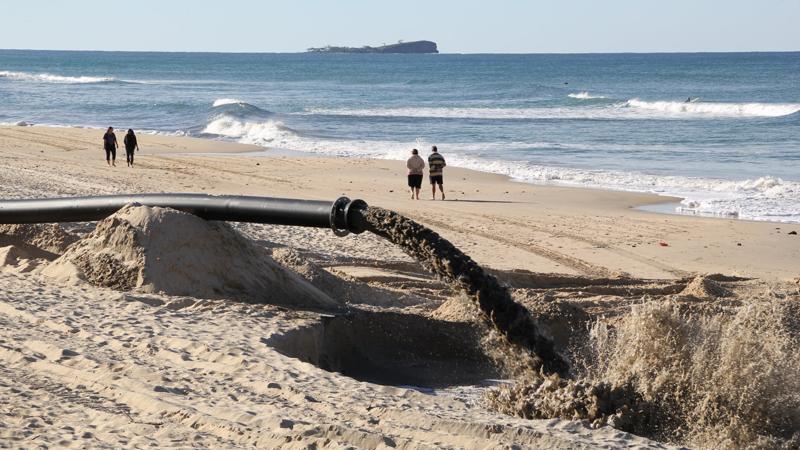
Beach nourishment (replenishment) consists of pumping sand and beach re-profiling. This allows some protection at the front of the dune until seasonal deposition occurs. Once a small patch of fore dune vegetation is lost (usually from moderate pedestrian use), strong onshore winds can complete the destruction by producing ‘blowouts’ and then unstable dune systems move inland. Natural recovery of this area is slow due to the harsh environmental conditions. Beach front fences play an important role to help the recovery stage, once the sand build up has occurred.
This component is currently in development