Ramps and stairs
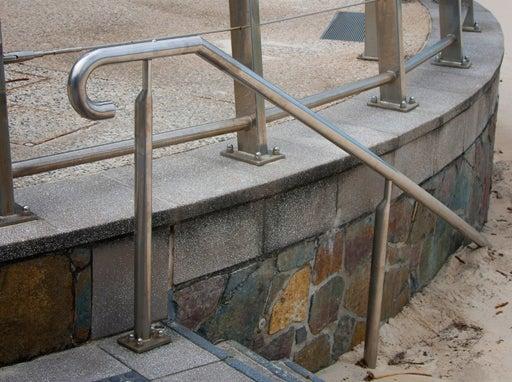
Materials, fixings and finishes
Best practice guidance for the selection of materials, fixings and finishes
Overview
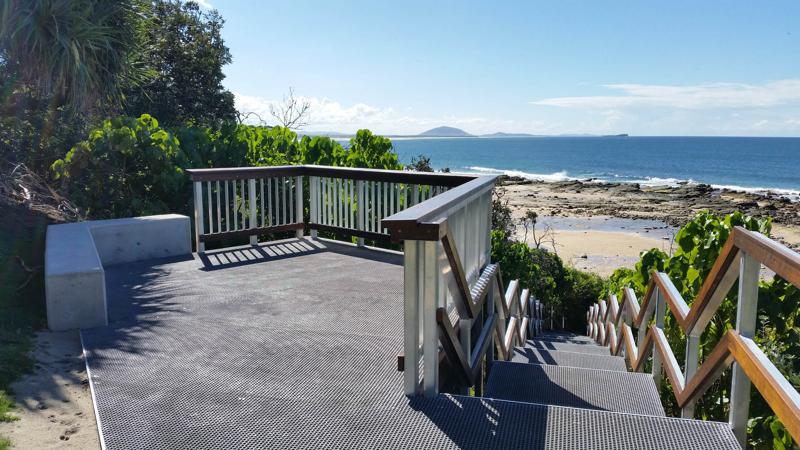
All materials, fixings and finishes must be made from robust heavy duty materials that are vandal and corrosion resistant (particularly in coastal areas) and suitable for use in public places.
Council has adopted the Bruce Highway as the dividing line between the highly corrosive environment of the coastal zone, and the more benign environment of the hinterland.
- Components must be manufactured to engineering specifications (where applicable).
- 316 marine grade stainless steel is required in coastal areas east of Bruce Highway.
- Other material may be selected for use in hinterland areas west of the Bruce Highway.
Ramps/stairs – construction materials
- Ramps and stairs in open spaces may be constructed from concrete, timber, recycled plastic, fibre composite materials, steel or aluminium, and in natural areas, brick and rock.
- Selection of surface materials may also depend upon existing vegetation protection requirements.
Ramps/stairs – balusters, rails and fixing materials
- Beach-side locations which are exposed to salt water and sand should include robust, low maintenance materials such as stainless steel, fibre reinforced plastic (FRP) and aluminium.
- Handrails and barrier to ramps and stairs at any high profile location, may include stainless steel, galvanised steel or aluminium, or a mix of metals and timber.
- Council does not recommend the use of colour coating for high use items, however if necessary, council prefers a 2-pack epoxy based paint system, rather than powder coating.
Material requirements for aggressive coastal locations or waterlogged areas
Ramps and stairs located in aggressive coastal environments or waterlogged areas require materials which provide operational and maintenance benefits.
- Materials must be manufactured and constructed to operate in exposed, high energy environments to achieve the required design life, and provide ‘very long term’ (ISO 12944-1) corrosion resistance.
- Steel coating systems must be in accordance with AS 2312 – Protection of structural steel against atmospheric corrosion for the CS-M Zone as per AS 4312 – Atmospheric corrosion Zones.
- Match or exceed the requirements noted in Table SC6.14.8A of the Sunshine Coast Council Planning Scheme policy for development works.
- Where metallic surfaces are painted following the above treatment, this is to be done with a 2-pac Epoxy paint, (powdercoating of steel work is not accepted).
- Supply of stainless steel components is to be by an ASSDA (Australian Stainless Steel Development Association) SSSR (Stainless Steel Specialist Register) or equivalent for high use pedestrian areas or where a high level of finish is required.
- All stainless steel elements must be treated with a clear surface protectant to protect against discolouring and tea staining.
- Hardwood timber (appropriate species and treatment) to approved areas.
- Ideally select standardised components such as 38 mm thick FRP panels.
See the following for further guidance
- Table 1: Ramps/stairs - construction materials
- Table 2 Ramps/stairs - balusters, rails and fixing materials
- LIM Tactiles - for specific tactile applications
- LIM Handrails and balustrades.
Material slip resistance
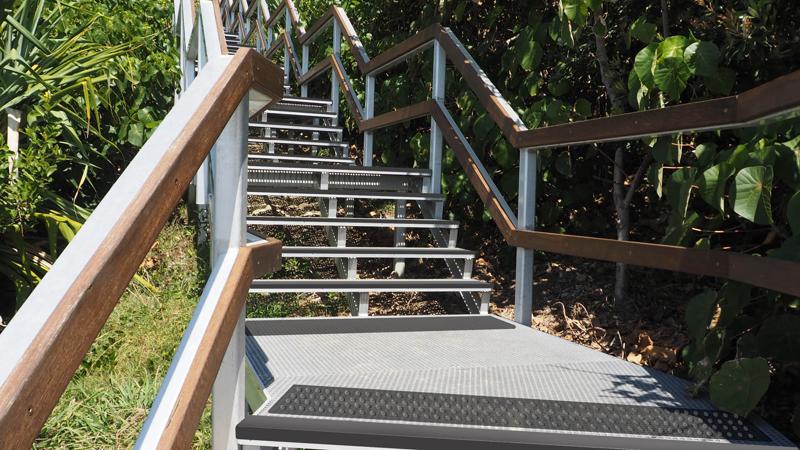
Slip resistance is the science of measuring the resistance of flooring surfaces to slip incidents.
Finishes for ramps and stairs must be suitable for the required application. Caution should be exercised when determining whether or not products are suitable for a specific purpose.
- SA HB 197:1999 – An introductory guide to the slip resistance of pedestrian surface materials recommends a minimum:
- External ramps – R11
- External ramps – BPN 54
- External walkways – R10 W
- External walkways (and pedestrian crossings) – BPN 45.
- SA HB 197 recommends:
- Broom finishes provide greater slip resistance across the grain than along the grain.
- Stamped and broom finishes give similar slip resistance results.
- Colour pigment in concrete does not affect slip resistance.
- Surface wear may reduce slip resistance.
- Applied coating with an aggregate broadcast must have a uniform distribution to avoid variable slip resistance.
- Sealers must be uniformly applied to avoid variable slip resistance.
- Penetrating sealers are preferred.
Testing for slip resistance
The wet pendulum test uses a pendulum friction tester to measure the frictional force offered by simulating a foot moving over a water-contaminated surface. Generally undertaken in a laboratory and used for new pedestrian surface materials.
The instrument reading is the British Pendulum Number (BPN), a dimensionless unit of slip resistance.
Slip testing classification by the wet pendulum test method is expressed as ‘BPN’ and is expressed as ‘P’ rating. Materials for ramps and stairs in public places require careful evaluation for their suitability:
- Where ramps and stairs are located under, or near trees and shrubs, consider the surface material in conditions of reduced slip resistance.
- An accumulation of fallen leaves and plant debris followed by a rainfall event can increase slip hazards.
The oil-wet ramp test involves an individual standing on a ramp at various angles of incline either:
- Method 1 – barefoot on a water lubricated ramp or
- Method 2 – in rubber soled boots on an oil lubricated ramp.
Slip testing classification by the ramp method is expressed as ‘R’ rating.
See AS 4586:2013 – Table 2: Classification of pedestrian surface materials according to the AS 4586 Wet Pendulum Test for further guidance.
Note: Concrete finish which is stippled, broomed, wood float or exposed aggregate generally all provide good pedestrian slip resistance.
Table 1: Ramps/stairs - construction materials
Materials | Key considerations |
Concrete |
|
Timber |
|
Recycled plastic and fibre composite |
|
Natural stone |
|
Table 2 Ramps/stairs - balusters, rails and fixing materials
Materials | Key considerations |
Stainless steel |
Tea staining:
|
Galvanised steel |
|
Aluminium |
|
This component is currently in development