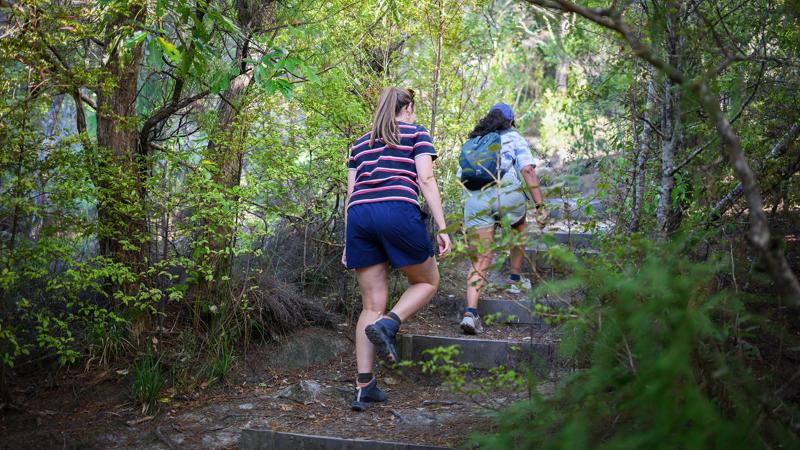
Where stairs are required on a recreational walking trail consider the following elements:
Stairs on trails must be designed and constructed in accordance with:
AS 1428.1:2009 Design for Access and mobility
AS 1657:2013 Fixed Platforms, walkways, stairways and ladders (maintenance stairs)
AS 2156.2:2001 Walking Tracks – Infrastructure design.
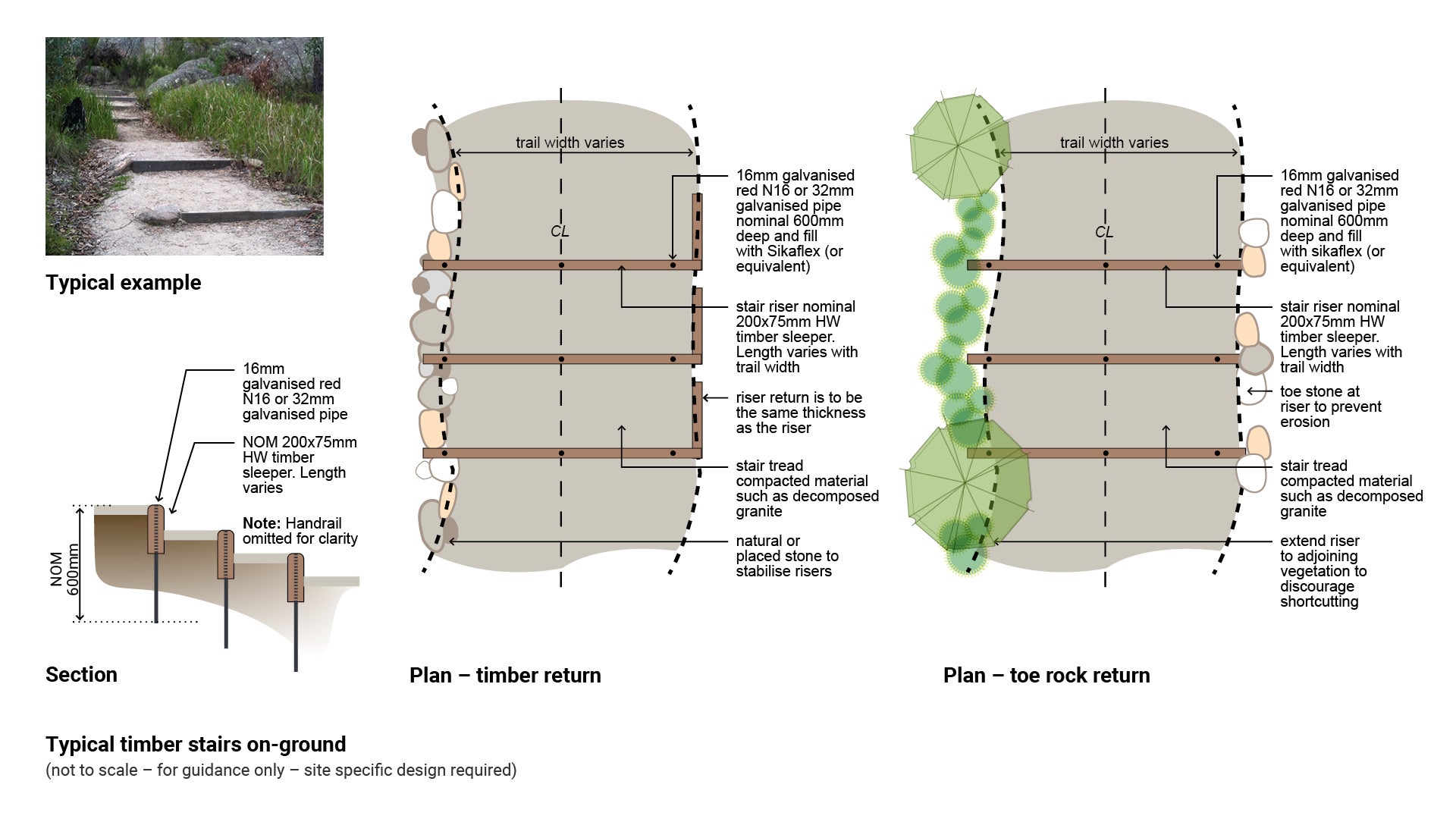
On-ground timber stairs are suitable for dry, stable soils and moderate grades.
A level landing area is required at the stairs start and finish.
More than one straight flight of 18 rises must be connected by a level landing.
Level landing should be constructed to allow water to exit the stairs in consecutive runs which will prevent cascading on stairs and trail surface erosion.
Install rises and goings of a uniform dimension as non-uniform stairs can cause people to stumble and fall.
Avoid using a single stair as it can go unnoticed by users and may cause a trip hazard.
Extend the stair tread beyond the trail width into adjoining vegetation to discourage short cutting around stairs.
Return risers or use toe stones to reduce erosion.
Where steps cannot be cut into the embankment, fill treads with compacted material such as decomposed granite.
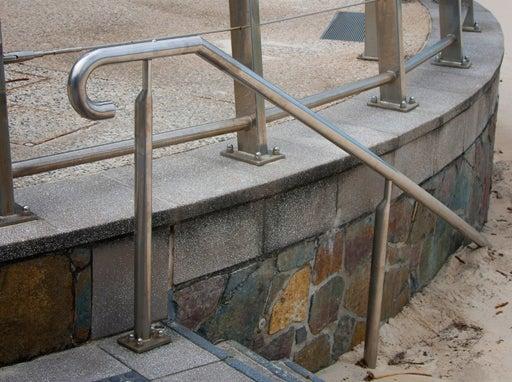
Where appropriate for the class of trail, install handrails both sides of stairs to assist left handed and right handed people.
Steps are not suitable for trails to be used by horses.
Where stairs are required on a recreational walking trail consider the following elements:
Stairs must be designed and constructed in accordance with:
AS 1428.1:2009 Design for Access and mobility
AS 1657:2013 Fixed Platforms, walkways, stairways and ladders (maintenance stairs)
AS 2156.2:2001 Walking Tracks – Infrastructure design.
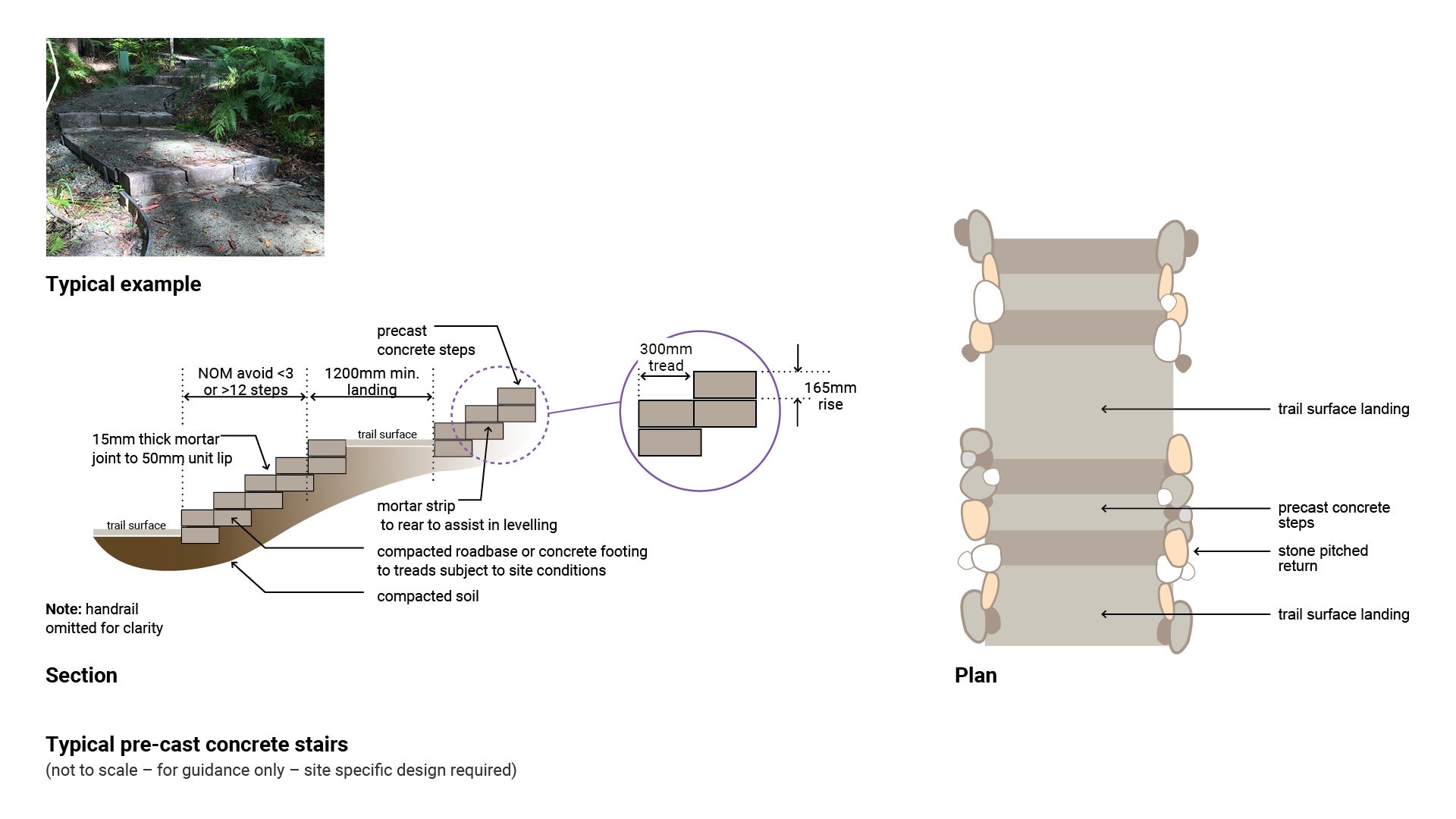
Pre-cast natural rock such as sandstone, or concrete stairs are a durable low maintenance alternative to timber.
Simple to install and safer than natural rock due to their uniformity of shape and size.
A level landing area is required at stairs start and finish.
More than one straight flight of 18 rises must be connected by a level landing.
A level landing should be constructed to allow water to exit the stairs in consecutive runs which will prevent cascading on stairs and trail surface erosion.
Install rises and goings of a uniform dimension as non-uniform stairs can cause people to stumble and fall.
Avoid using a single stair as it can go unnoticed by users and may cause a trip hazard.
Use compacted roadbase as a base in drier areas.
Use concrete as a base in areas with a high humus content.
Pre-cast concrete step sizes and approximate weight (products vary):
450 x 350 x 160 mm (40 kg)
600 x 350 x 160 mm
900 x 350 x 160 mm
1200 x 350 x 160 mm (70 kg).
Finish concrete stair tread with a penetrating sealer with a non-slip finish.
Install stone pitched returns to sides of stairs as necessary, using square shaped rocks.
Pre-cast sandstone step sizes and approximate weight (products vary):
1000 x 500 x 180 mm (216 kg)
1200 x 500 x 180 mm (260 kg)
1800 x 500 x 180 mm (324 kg)
2000 x 500 x 180 mm (432 kg).
Where appropriate for the class of trail, install handrails both sides of stairs to assist left handed and right handed people.
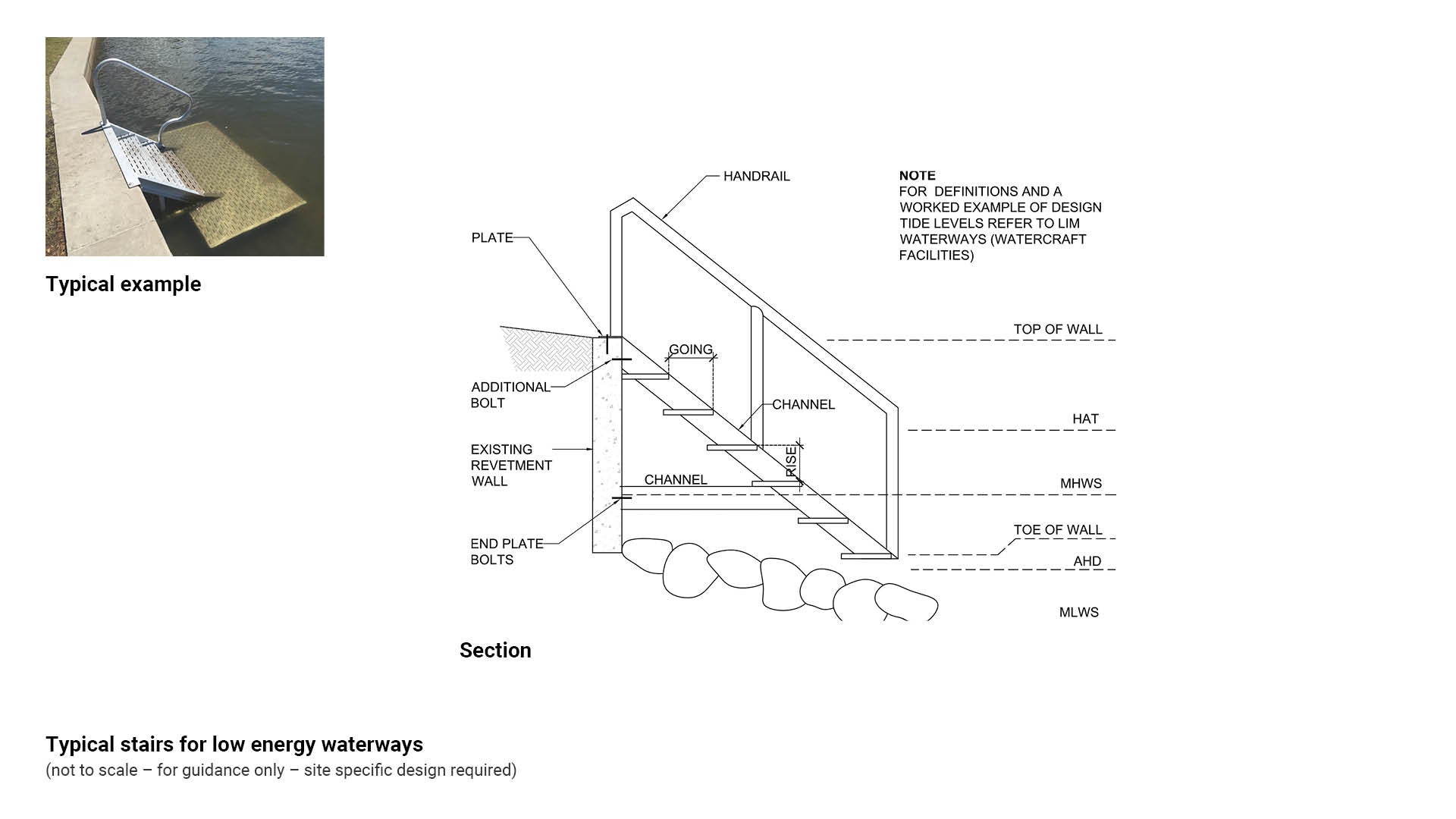
Where stairs form part of a manual portage system (used for carrying watercraft to access a waterway), consider the following:
Design considerations
Stairs must be designed and constructed in accordance with:
AS 1428.1:2009 Design for Access and mobility – General requirements for access – new building work. Stairs design for equal access.
AS 1657.1:2013 Fixed Platforms, walkways, stairways and ladders – Design construction and installation. Stairway terminology, grating and expanded metal requirements.
AS 2156.2:2001 Walking Tracks – Infrastructure design. Stairs slope limits, maximum steps between landings, fall surface assessment for barrier selection.
When retro-fitting portage stairs to an existing marine structure, the stairs vertical loading must be independent of the weir or revetment wall.
Consider a range of watercraft including longer kayaks.
Consider requirements for all abilities and age groups including seniors.
Stairs and handrail
Preferred stair width 1500 mm.
Stairs are to have handrail one side only to enable users to manoeuvre their watercraft.
High profile sites such as lakes and canals may require a platform at the bottom of the stairs.
To prevent accumulation of marine organisms, select an anti-fouling material for stair treads, platforms / sunken landings and handrail construction.
A weatherproof, corrosion resistant pulley system such as galvanised cord / wire may be attached to stairs at the water line to allow watercraft to be secured for boarding or disembarking.
Where appropriate include a soft slide / mat mechanism such as soft rubber (or other material) adjacent to stairs to prevent watercraft damage when hauled across it.
See the following for further guidance:
Figure 15: Typical stairs for low energy waterways
To prevent handrail and TGSI protrusion to path of travel.
Page payload data
This component is currently in development
Sunshine Coast Open Space Landscape Infrastructure Manual (LIM) DISCLAIMER
Disclaimer
Information contained in this document may change without notice and you should use the current material available from Council’s website and not rely on material previously printed or stored by you.
All figures and diagrams are intended to be used as an aid to design and include Council’s preferred elements but they are not intended to be prescriptive and may need to be varied as dictated by site specific factors. While Council has exercised reasonable care in preparing this document, it does not warrant or represent that it is accurate or complete. The Council will not accept responsibility for any loss, damage, cost or expense that you may incur as a result of the use of or reliance upon any material contained in this document.
This document is produced to convey general information and is not intended to constitute advice whether professional or legal. Any reference to legislation in this document is not an interpretation of the law. It is to be used as a guide only. Consult relevant authority websites for current documents, revisions and amendments.
Where a particular product or supplier is profiled in this document, Council is NOT nominating this product or supplier as the selected choice. Product/supplier information has been provided to allow users to source products which contain the correct elements required for Council embellishments. Each product profiled states ‘or equivalent’ which means that different products may be supplied provided they satisfy the identified performance criteria, recommended standards, equal access guidance and product specifications.
Product design, manufacture and installation requires appropriately qualified people to provide site specific solutions to ensure the embellishment is appropriately adapted to local conditions and data.
This document does not override requirements stipulated in a development approval. Project specific variations may be appropriate as a result of site, environmental or other constraints. Any variations to these standards must be approved in writing by council prior to commencement of variation works. Components of this document may be used within a contract document but users should undertake their own investigations to confirm the information is suitable for this purpose.
Drawings contained in this document are NOT FOR CONSTRUCTION.
Details in this document are deemed to be the minimum standard and the user may wish to apply a higher standard subject to approval by council.
Acknowledgements
Council wishes to thank all contributors and stakeholders involved in the development of this document.
Copyright
Sunshine Coast Regional Council (Council) supports and encourages the distribution of its material however, copyright protects this document. Council has no objection to this material being reproduced but only if council is recognised as the owner of the copyright and this material remains unaltered.