Play spaces
Specifications
Specifications for embellishments
This specification section addresses the following:
- Project specifications.
These Play Space specifications are prescribed for open space ‘landscape design’ projects such as parks, landscaped areas and sports grounds.
Manufactured
General
- Play space equipment to be designed and manufactured in accordance with AS 4685 Playground Safety Set.
- Play space equipment over 3.0 metres in height requires building approval
- Installation to be carried out according with manufacturers instructions for assembly, erection and siting of material in accordance with AS 4685.0 Playground equipment and surfacing - Development, installation, inspection, maintenance and operation.
- Concrete work (footings etc.) associated with the installation of play space equipment and shade structure to engineer’s specification. Footing detail to AS 4685.
- Fixtures inside the playground footprint to comply with AS 4685
- A thread locker to be used to prevent fixings from becoming loose through vibration and movement (unless the fittings are not specified to use thread locker).
- Water play areas to have a gate valve installed within 3.0 m of the water play but not within play space footprint. Gate valve to be on a separate water supply to other plumbed units e.g. toilet, drinking fountain.
- Coastal areas - All coastal locations (east of the Bruce Highway), must be constructed of coastal hardy materials and fixings such as:
- 316 Stainless steel
- Aluminium
- HDPE/Poly panels
- Timber (appropriate species, mounted on marine grade 316 stainless steel stirrups – with approval from Council (Parks and Gardens).
- It is preferred that timber products are to be treated with alkaline copper quaternary (ACQ), a water based wood preservative. CCA is not to be used.
- Hinterland areas - materials, finishes and fixings shall be specified as stated above, but 316 Stainless Steel elements are optional.
- Compliance ID plate and basic level marking, should be installed on the equipment so it isn’t a hazard for users and still in range for viewing for maintenance purposes.
- No sharp edges. all edges to be rounded min. 3.0 mm. points to be rounded min. 20 mm.
- No gaps between 8–25 mm on items over 1.0 m to avoid finger entrapment where falling is possible.
- All timber to be dressed and have no splinters.
- The contractor is to ensure that the play space is free of the following entrapment risks:
- Head and neck: 89 mm to 230 mm. refer AS 4685.
- Finger: 8.0 mm to 25 mm. refer AS 4685.
- Clothing: refer AS 4685.
- Whole body: refer AS 4685.
- Foot or leg: min. 30mm gap. refer AS 4685.
Positioning
- Slides must be installed in a southerly direction (to reduce the effect of direct sunlight onto the slide surface) unless the slide is shaded from full sun by trees or shade sail.
- Swings to be installed facing north/south unless otherwise shaded.
- Swings to have 6 mm short-link chain 316 Stainless Steel. Conduit must not be used over swing chains.
- Ensure items of play equipment are placed to consider the safe movement of playing children (if two items of play equipment were placed either side of a swing, children running between these elements would be in the path of the swing, and at risk of injury).
- Do not place entry gates so they lead into fall zones where the traverse would be through a forced movement area such as a slide or swing.
- Music play elements shall be at a maximum level of noise as per Environmental Protection (Noise) Policy 2008 Schedule 1 - Acoustic quality objectives, and be located in a park or garden that is open to the public for use other than sport or organised entertainment.
- If play equipment is to be relocated to a different position on site, place it within the shade patterns of existing trees or under a shade sail where possible.
- Play equipment should be located within the existing footprint of the play space and, if possible, outside the TPZ (Tree Protection Zone) of the existing trees.
- Play equipment should be positioned to maximize existing natural shade, with all slides covered where possible and facing south.
- The fall zone is to be reviewed in conjunction with the existing play equipment and trees to ensure the required adequate offset.
Natural activity areas
General
- Natural play elements incorporated into a play space are subject to the requirements of AS 4685 (series). Where the requirements of this Standard cannot be applied to natural elements incorporated into a playground, a ‘risk benefit assessment’ is to undertaken to determine the suitability of such elements. This report must be submitted to Council prior to approval.
- Natural play elements to be designed, manufactured and installed by an approved play space company.
- Natural play elements to meet all play space standards
- Natural play elements be independently certified
- Logs must be secured to prevent rolling, have rounded edges with minimum 15 mm radius, no splits, be certified stress graded and have a compliance certificate by an independent play space compliance engineer.
- A qualified arborist should be consulted to determine the appropriate timber species to be used for logs and the like, in order to prevent rot and de-lamination. A ‘non-toxic’ termite deterrent must be used.
- Natural balance equipment e.g. boulders, logs, to be maximum 495 mm high unless safety surfacing and fall zones are installed as per Australian Standards for Play Spaces.
- Grass mounds to be maximum 1:4 grade (minimum 2.5 m wide) with a near level top at least 3.0 m wide.
Positioning
- Dry creek beds to be located away from formal play space safety surfacing areas as rocks can contaminate the safety surfacing zones. If dry creek beds are within 50 m of equipment or safety surfacing, that section of rocks must be secured in a concrete bed.
- Natural Play that utilises rocks and sticks must be designed to prevent rocks contaminating grass areas (they require removal by hand to prevent mowers turning them into projectiles).
Natural bushland areas
Natural bushland areas adjoining formal play spaces requirements
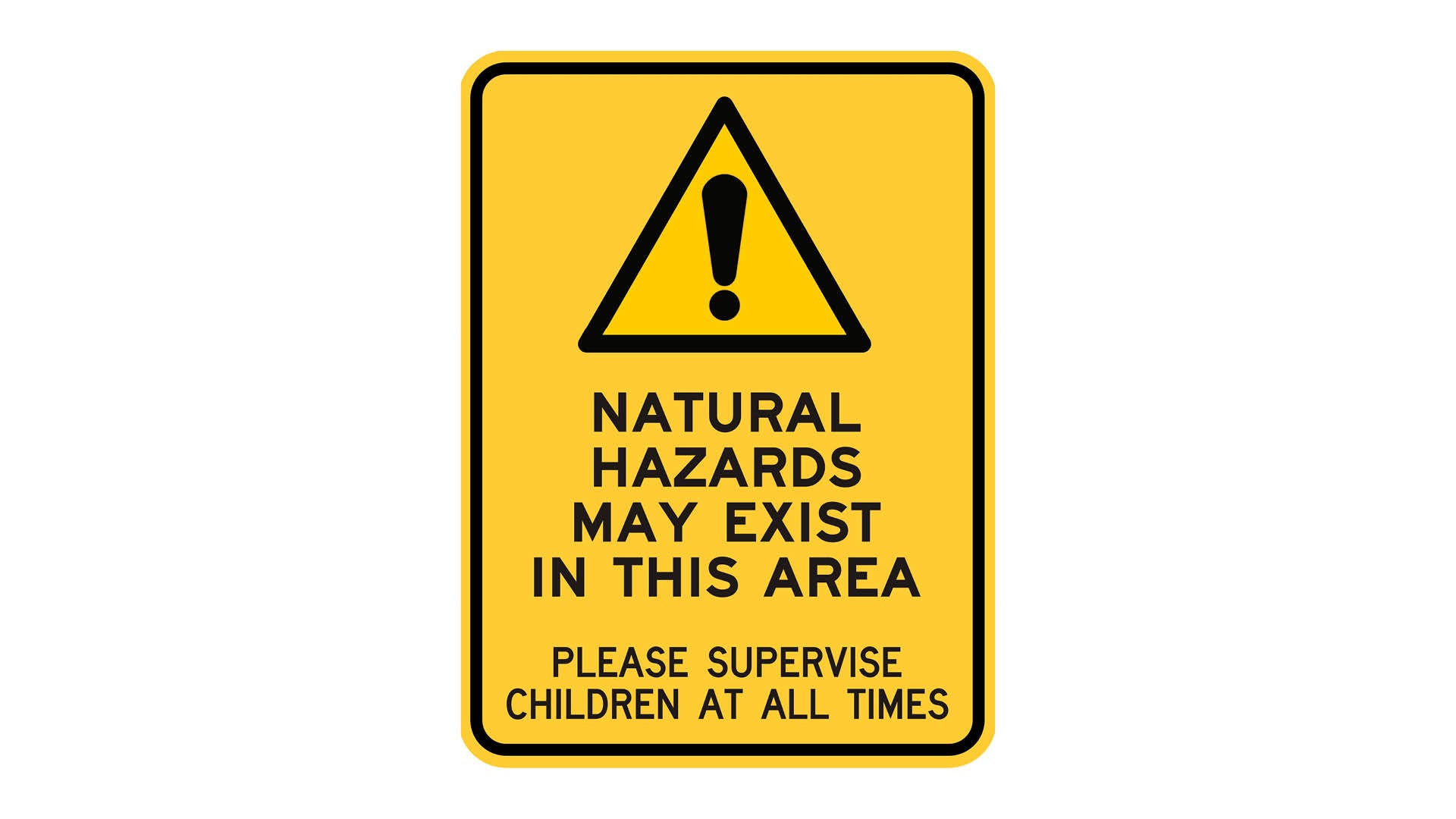
- Remnant or natural bush land areas that may be accessed by children must include a sign “natural hazards may exist in this area”. Sample sign shown is currently under review. See Figure 1: Natural hazards may exist in this area sample sign
- These areas must not include any formal play equipment.
- As per AS 4685.0, a risk benefit assessment must be undertaken and report submitted to Council prior to approval.
Figure 1: Natural hazards may exist in this area sample sign
Safety surfacing
General
- All items with a height over 600 mm require an impact area and suitable certified soft fall surround.
- Non-compacting sand, bark, or rubber as per AS 4422 Playground surfacing - Specifications, requirements and test method.
- Safety surfacing depth as per play space manufacturer’s Australian Play Space Standards and impact attenuation test compliance certificate relative to equipment height.
Loose fill surfacing requirements:
- Surfacing depth to comply with AS 4422. Loose bark surfacing, and sand surfacing as per compliance depth. In accordance with AS 4422 an additional 20% is to be installed in fall zones for swings, run out of slides and other risk impact fall zones.
- Council specifies a minimum 400 mm depth of loose fill surfacing material to allow for compaction and depletion.
- Surfacing to be free from sharp edged parts or hazardous projections e.g. splinters, sticks and to be free of toxic substances, chemically treated wood chips, and to be A Grade quality as per Test Certificate.
- Takura manufactured wood (or equivalent) safety surfacing is NOT to be used.
- Note: Geofabric must NOT be installed between the ground and safety surfacing.
Unitary (rubber) surfacing requirements:
- Play equipment is to have unitary surfacing under equipment where displacement of loose fill surfacing is likely. Surfacing depth to comply with AS 4422. Unitary surfacing is to be installed under fall zones of fire poles, exit run-out for slides, rotating elements, carousels, spinning discs etc.
- Wear pads are NOT preferred under swings. Where equal access is required for swings, install unitary surfacing from pathway to the play equipment, installed to cover the entire safety zone.
- All unitary surfacing is to be fully shaded.
- Unitary surfacing is to be installed on a cement treated base (CTB) or concrete slab - refer drawings
- Unitary surfacing must be installed with a concrete edge
- Unitary surfacing edges to be installed minimum 100 mm below the bottom of the safety surfacing, back filled and compacted.
- The design of the unitary under surfacing must consider the following, but not exclusively:
- Sub-base
- Materials
- Slip resistance
- Fire resist
- Impact absorbency
- Critical fall height analysis (fall heights to be identified by the play space
- Manufacturer
- Fall zones
- Colour
- Permanency of colour
- Wearability/maintenance in use.
- Surfacing manufacturer to liaise with play space manufacturer to obtain accurate information regarding items listed above that will affect design and installation of unitary surfacing and sub-base.
Shade
Planting, shade and shade sails
- Planting and shade sails to comply with LIM Planting landscape and LIM Shade sails, LIM Play spaces and LIM Site set up drawings.
- Do not select plants which have sharp thorns. Do not select poisonous plants.
- Do not select plants that will inhibit clear sightlines to and from play space when mature. Refer to Crime Prevention Through Environmental Design Guidelines Ensure low profile planting to maximise child safety and increase sight lines for parents and carers (planting to be generally below 500 mm and trees to be lift pruned).
- Do not select plants that require rocks/gravel mulch near formal play areas.
- Do no select plants that drop seeds/fruits onto the playground surfacing.
- Sensory gardens to be clearly signed with a children’s language sign depicting ‘do not eat’. Positive signage such as ‘smell’ and ‘touch’ is to be used at appropriate planting.
- Refer AS 4685.0 2017 – Appendix A, for comprehensive shade and sun protection information.
- For example, as per AS 4685.0:2017, App A: “large flat or inclined surfaces, especially metal ones, likely to contacted by the user (e.g. on a slide) may heat up and cause serious burns. Protect impact-attenuating surface and the slide from direct sunlight by the use of trees or shade cloth are examples of ways in which this hazard may be reduced”.
- See LIM Shade sails for provision and design guidance.
- Install shade trees to the north and west to protect play equipment at the hottest part of the day.
- Position new trees to avoid unintended access to shade sails.
- Ensure that tree roots do not compromise the surfacing or create trip hazards in the fall zone.
- Provision should be made in each playground for areas of sun protection and shade, both for the children using the playground as well as for any caregivers present.
- Care should be taken with respect to site equipment so that it is correctly positioned with respect to sun exposure. Uncovered platforms and some under-surfacing materials can become uncomfortably hot if exposed to too much direct sunlight.
- Provide site specific shade modelling (shade diagram). See LIM Shade sails for shade requirements.
See the following for further guidance:
Drainage
- Drainage to comply with Council Standard drawings.
- Install adequate subsurface and surface drainage to avoid water pooling nuisance.
- A brass ‘D’ marker to be fitted to both sides of edging to indicate position of drainage pipes.
- Site construction drawings to identify location of subsurface drainage.
- Surfacing material to be free draining, sheet flow to swale, to sub-surface agricultural pipe, to soakage trench or to piped gully pit system.
- Design must consider impacts of drainage when installing concrete edging.
Edge treatment and root growth
- Edge treatment and root barrier to comply with LIM Play spaces - technical drawings
- Install edge treatment to surrounds of play spaces. Fall zones to comply with AS 4685 and AS 4422 (or manufacturers recommendations whichever is the higher requirement).
- Concrete edging for bark, sand or rubber safety surfacing.
- Timber edging for bark or sand is NOT preferred. In cases where timber sleepers are used as footprint edging:
- A treatment of acrylic topcoat non-slip/splinter containment paint should be applied to manufacturers instructions, with a minimum two coats.
- H5 treated hardwood, F14 ACQ is preferred. Do NOT use CCA treated timber).
- NO heartwood.
- Use 316 stainless steel screws for fixings.
- Spade cut edging is NOT preferred.
- Concrete and timber edging to be installed flush with adjoining turf.
- Provide concrete edging with expansion joints installed to a depth of ¾ the finished concrete thickness, spaced at maximum 2.0 m centres.
- Provide concrete edging with fibre reinforcement or S12 reinforcing rod centrally placed, or high-strength concrete.
- Consider both existing and future tree root growth potential in playground footprints.
- For any advice on tree roots and specific treatments contact project Aborist and refer LIM Tree sensitive design (existing and new trees).
Signage
Install a Activity Entry Sign adjacent to the playground for compliance as per AS 4685 – Playground equipment and surfacing. See LIM Signage - Activity entry signs.
Fencing
Safety fencing to comply with Council play space safety fence technical drawing (see LIM Fences and gates).
Play space safety fence to be installed near hazardous areas, or where there are identified use conflicts. Fencing must be commercial grade heavy duty (suitable for open space use) and the design (height, gap sizes and latch requirements) must comply with AS 1926 Swimming pool safety.
The fence profile is to be free of entrapment sites (may be present with a partially bound opening on the top rail). A suitable top rail is flat.
This component is currently in development