Fences and gates
Design - general
Requirements for the design, manufacture and installation of embellishments
Good design
See the following corporate documents to identify relevant project design requirements:
Sunshine Coast Planning Scheme regulates the way land, buildings and structures are used and developed on the Sunshine Coast.

Sunshine Coast Design contains 10 design principles that guide good project planning and design outcomes, that are appropriate for the Sunshine Coast.
The LIM provides further overarching design advice, refer:
- Introduction and Design Principles - e.g. sustainability, CPTED, accessibility
- Preliminaries - environmental management, tree sensitive design and site set up.
Embellishment requirements
- Universal access.
- Comfortable and suitable for the average person.
- See 'Positioning' and 'Equal access' sections for the corresponding LIM category.
- Made from materials that will be durable and can be suitably protected from exterior elements, such as salt spray and UV exposure.
- Robust and sturdy to withstand constant public use and be resistant to vandalism.
- Fixings are to be 316 marine grade stainless steel (unless otherwise stated).
- Tamper proof fixings should be used
- Graffiti protection coatings applied (where applicable)
- Fire retardant (where applicable).
- Warranties should be as listed below.
- Easily repairable or replaceable.
- Sourced locally and use standard fittings.
- Reputable suppliers should be used who keep a supply of stock parts on hand for the life of the product.
- Use sustainable materials, although sustainability needs to be considered over the lifetime of the embellishment.
- Install on paved, concrete or other hard surfaces (where applicable).
- Manufactured to engineering specifications (where applicable).
- See the 'Standards' section for the corresponding LIM category.
Warranty and asset life
Product/embellishment | Warranty (minimum) | Asset life (typical useful life) |
Bayco sighter wire (or equivalent) | 10 years | 10 years |
Recycled plastic | 10 years | 25 years 2 |
Aluminium | 5 years | 20-30 years 2 |
Timber | Varies | 20 years 2 |
Steel | 5 years | 25 years 2 |
Source 2: Sunshine Coast Council Asset Management Plan 2017/18-2022/23 – Parks and Gardens (figure based on current data, subject to change).
Fences and gates
Once the location of the fences and gates has been decided, based on the Environment and Liveability Strategy (ELS) and Recreation Parks Plan (RPP) guidance, consider the appropriate embellishment level to suit the selected site.
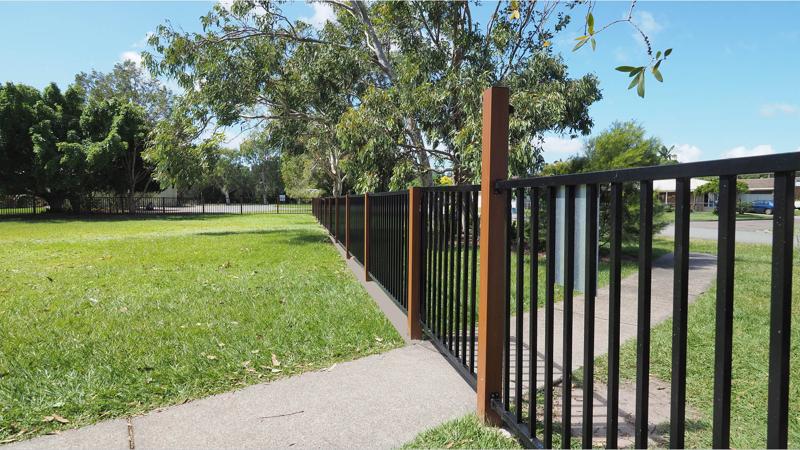
Overarching design considerations:
- All open spaces should include universal access (e.g. ensure the operation of gates caters for equal access).
- Consider the method of safe operation associated with fences and gates (i.e. size, weight, material and method of safe operation).
- Select appropriate fence type for the purpose.
- Vehicle/maintenance access – typically all standard vehicle gates are minimum 3.6 m clearance for maintenance vehicles and emergency services (4.0 m clearance for environmental reserves). This clearance may require increasing in the following situations:
- the restricted manoeuvring area on site, requires a larger turning circle.
- non-standard wide/heavy machinery with frequent use, i.e. beach access and maintenance.
Design of fences and gates
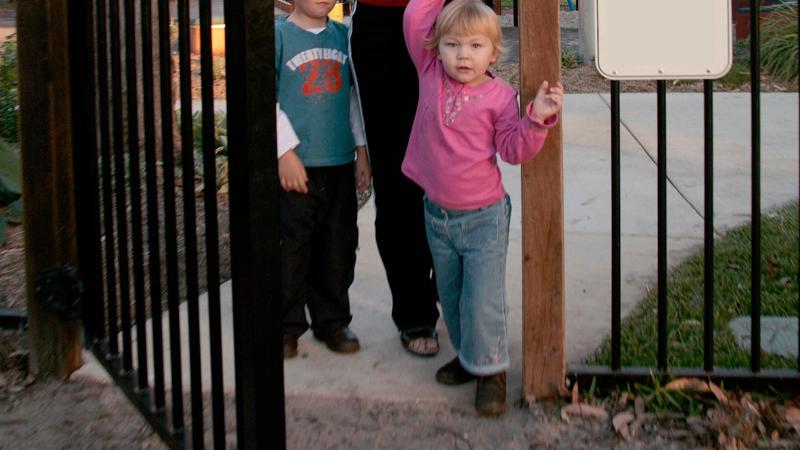
Fences
Fences are installed to provide separation, protection or demarcation of boundary limits by creating a localised barrier, or to fully enclose a perimeter.
Fences deliver outcomes such as:
- Human or animal exclusion
- Security/direction
- Safety/site protection
- Boundary demarcation.
Fences at the side of a path used by cyclists are desirable where:
- there is a steep batter or large vertical drop close to the path.
- the path is adjacent to an arterial road and it is necessary to restrict cyclist access to the road.
- a bridge or a culvert exists on a path.
- a hazard exists adjacent to a bicycle facility.
- cyclists are likely to be ‘at speed’ at an intersection between paths or around a path terminal (Source: Austroads Guide to Road design Part 6a).
Gates
Gates are installed to provide authorised pedestrian, equestrian and vehicle access, to restrict unauthorised access and to direct toward approved entry and exit points.
Gates must provide access for:
- pedestrians, equestrians, mobility devices and/or assistance animals
- authorised maintenance/emergency vehicles/temporary event vehicles
- farm stock and native fauna.
Gates must not conflict with:
- passing pedestrian traffic
- passing human powered vehicles such as bicycles/wheelchairs
- passing motor vehicles
- motorised vehicles such as mobility scooters.
Barrier fence versus perimeter fence
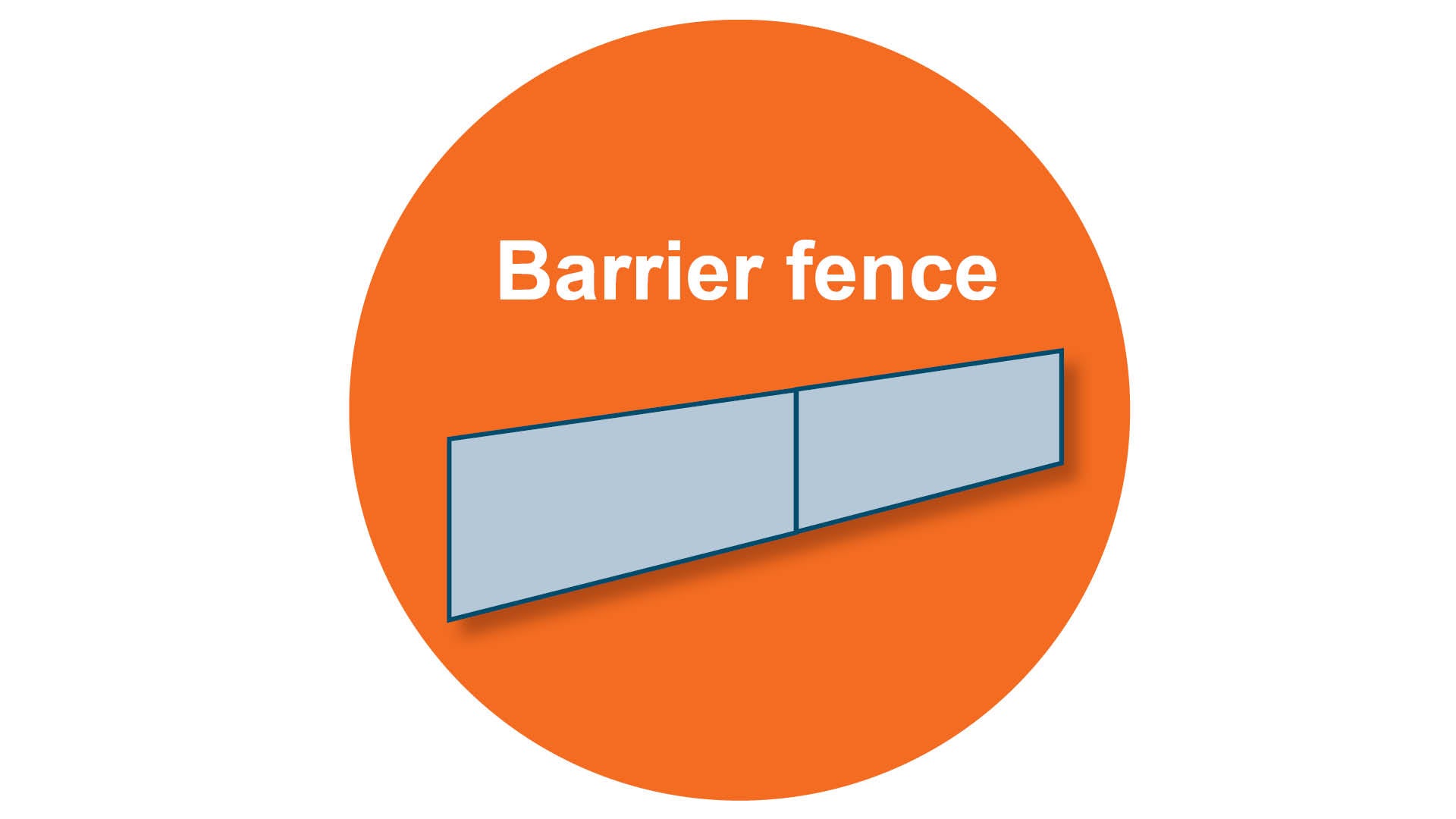 | 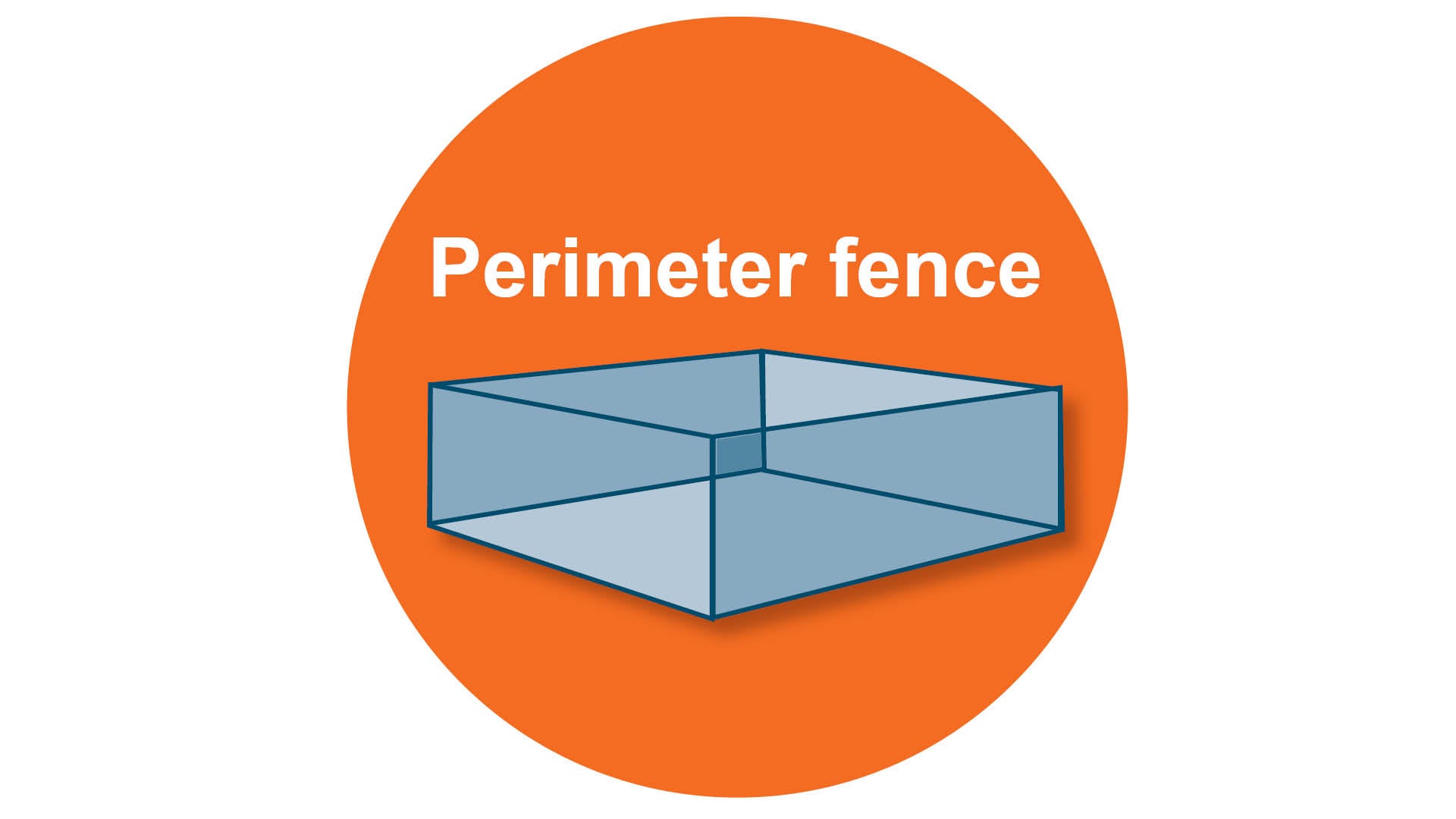 |
Barrier fence | Perimeter fence |
A barrier fence is made up of one or more than one fence panels installed to demarcate an area or provide protection for an area or for a user. A barrier fence provides:
Protection from hazards may arise where there is a risk of:
It is preferred to install handrails and balustrade on safety barriers in high profile locations, such as at district and Council wide parks. See LIM Handrails and balustrades for further guidance | A perimeter fence is installed to surround and enclose an area. The area is only accessible through pedestrian and vehicle gates. Perimeter fences are typically used to create areas, such as playgrounds, dog off leash parks, sports grounds, to separate areas of competing functions and to prevent unauthorised access to infrastructure which contains fragile ecosystems or elements of risk. They are designed to:
Competing use areas which may require separation include:
|
MUST be designed following a risk analysis and certification by a professional Engineer, where applicable | MUST be designed following a risk analysis and certification by a professional Engineer, where applicable |
Refer the following documents:
| Where a perimeter fence crosses an overland flow path refer to:
|
Selecting an appropriate fence and gate category
Fences and gates fall into the following categories:
- Environmental reserves
- Parks and open space; or
- Other options that may be considered.
Fences and gates designed for parks and gardens may be installed at environmental reserves and vice versa.
- Special use fences and gates (such as, at stormwater infrastructure and wetlands) must be designed and engineered to suit the purpose.
- Approval must be obtained from the asset custodian.
Note: Further technical information for Sport will be incorporated at a later date. In the interim, the basic Recreation/Landscape information can be adapted to suit the site specific solution required.
This component is currently in development