Fences and gates
Design - parks and open space
Requirements for the design, manufacture and installation of embellishments in parks and open space
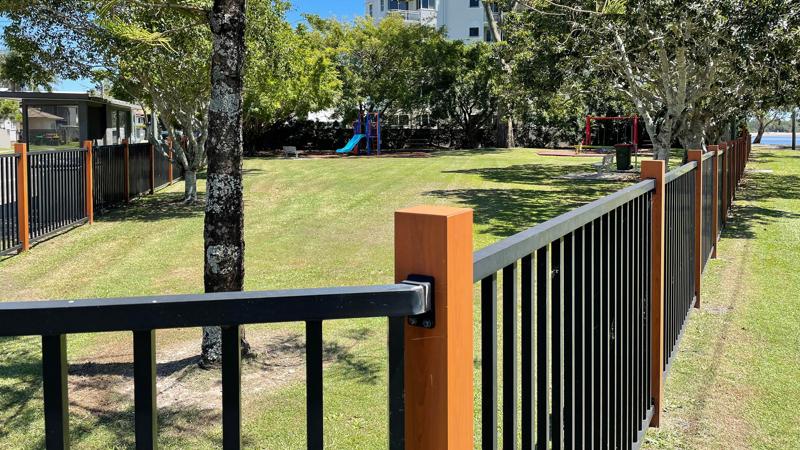
Fences and gates installed in parks and open spaces provide:
- Boundary division
- Separation of conflicting activities
- Safe play areas for children
- Defined areas for animals and handlers
- Defined areas for sports ground playing fields
- Restriction of unauthorised vehicles such as motorbikes or motor vehicles.
- Hazard protection barrier – any fence panel may be used to create a barrier. Fence panel selection should complement the existing site.
See the following for fence and gate types for environmental reserves:
- Table 10: Standard - fence and gate for parks and open spaces
- Table 11: Special purpose - fence and gate for parks and open spaces.
Table 10: STANDARD - fence and gate for parks and open spaces
Standard - typical example | Type/name and purpose |
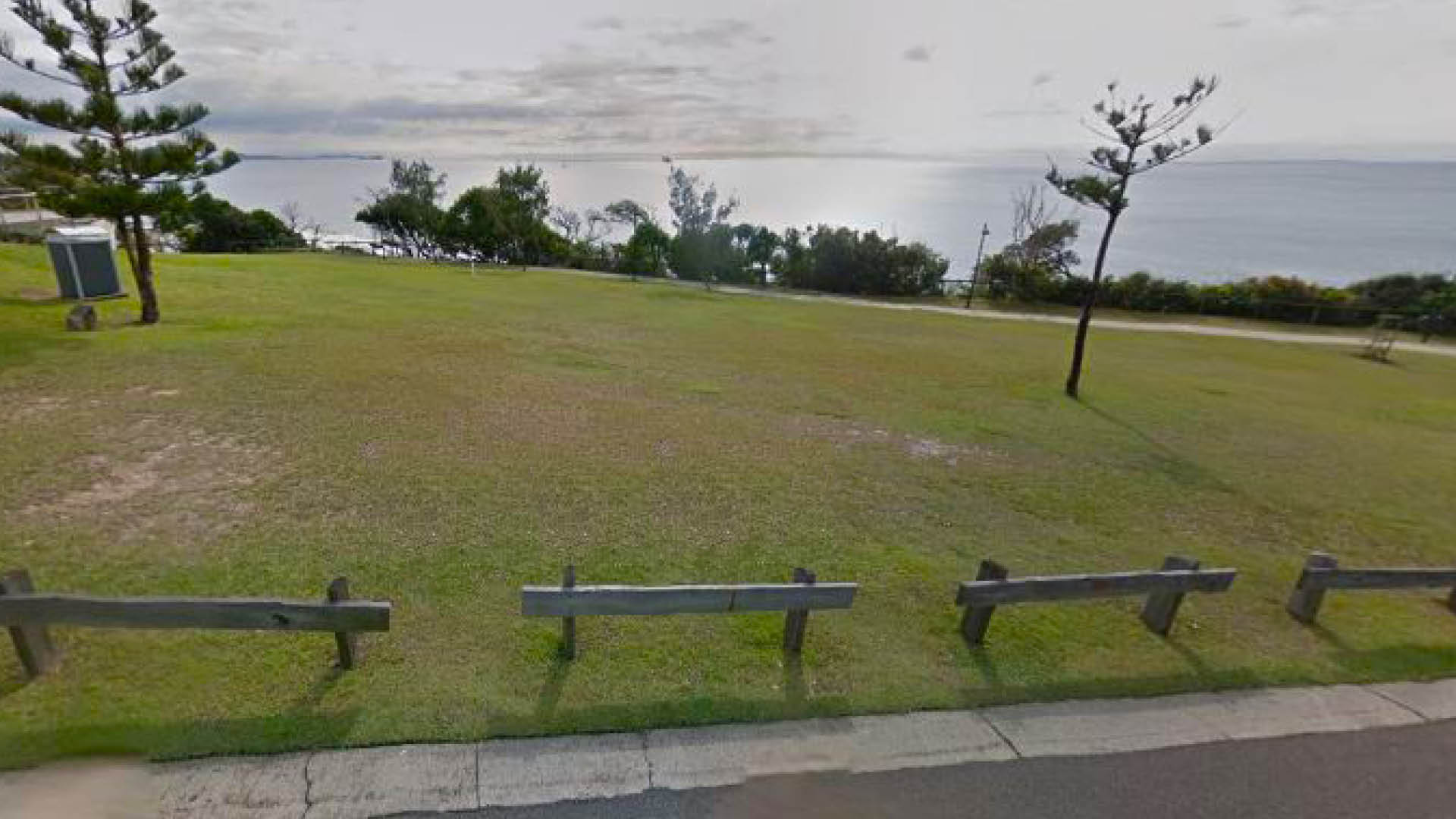 |
Bollard and rail barriers
Provide basic vehicle exclusion Provide demarcation for of an area |
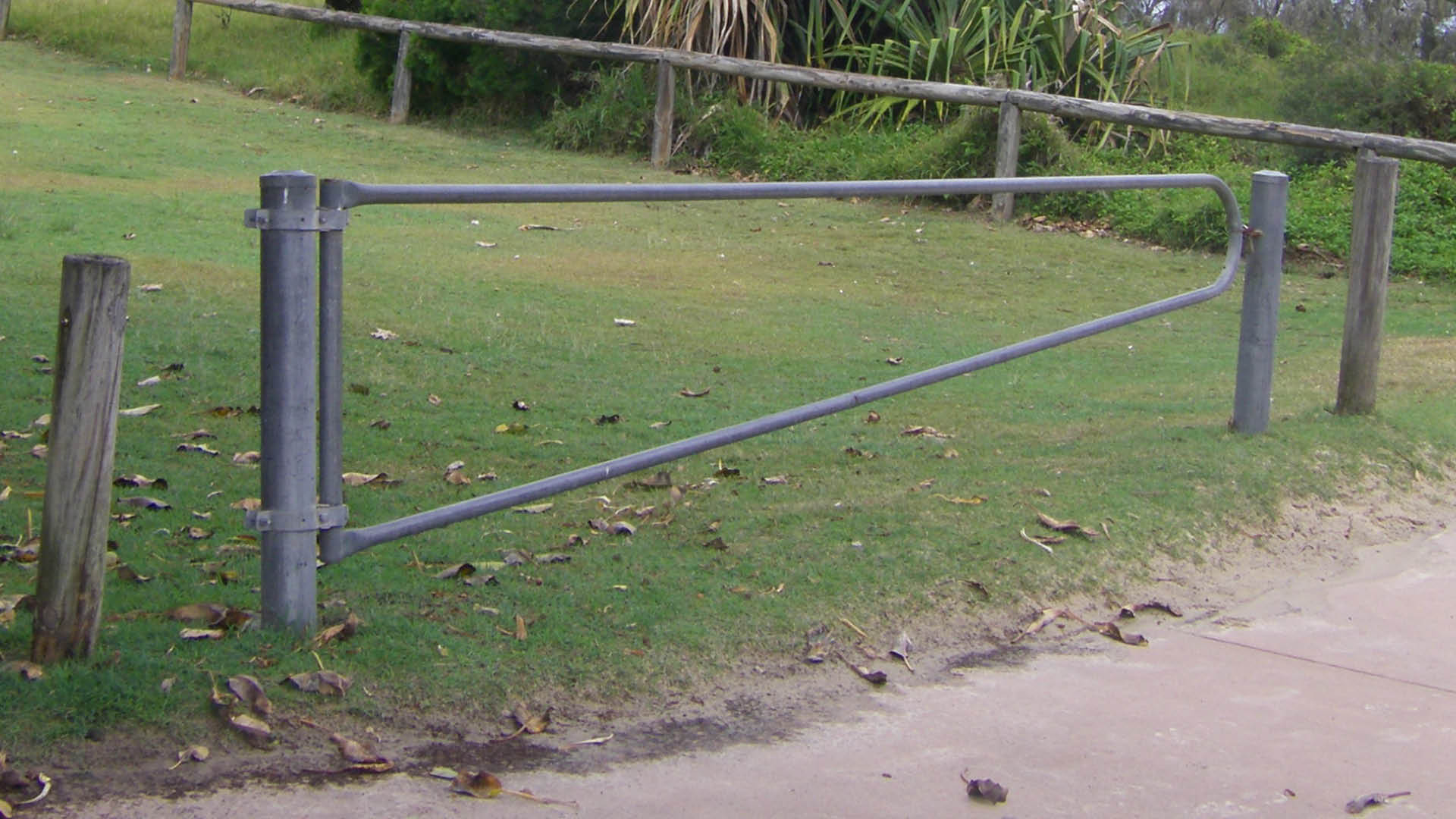 |
Vehicle gate (standard CHS)
Provide access for maintenance and emergency vehicles to enter an otherwise restricted area |
Table 11: SPECIAL PURPOSE - fence and gate for parks and open spaces
Special purpose - typical example | Type/name and purpose |
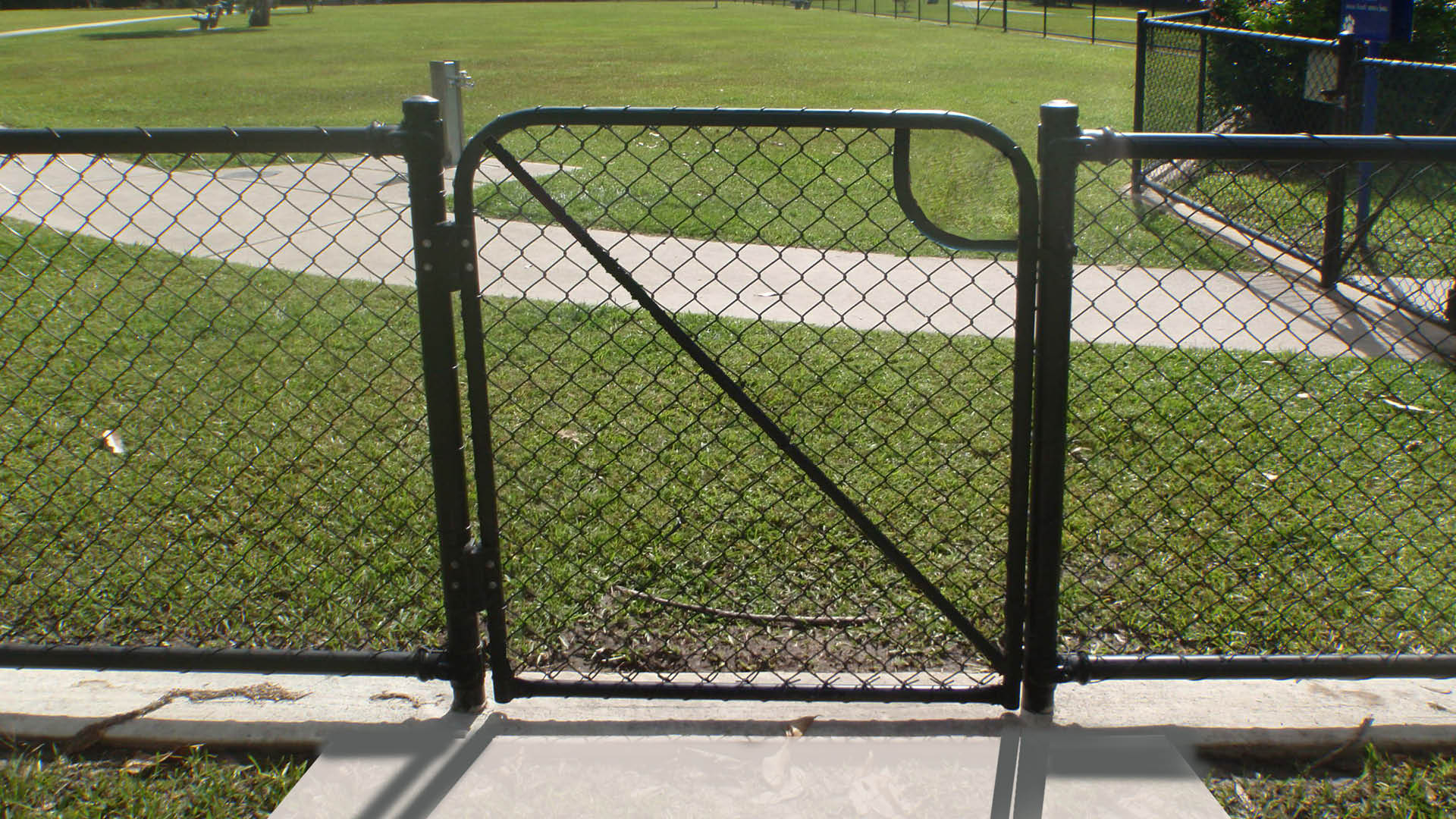 |
Dog off leash park fences and gates (matching pedestrian and vehicle gates)
|
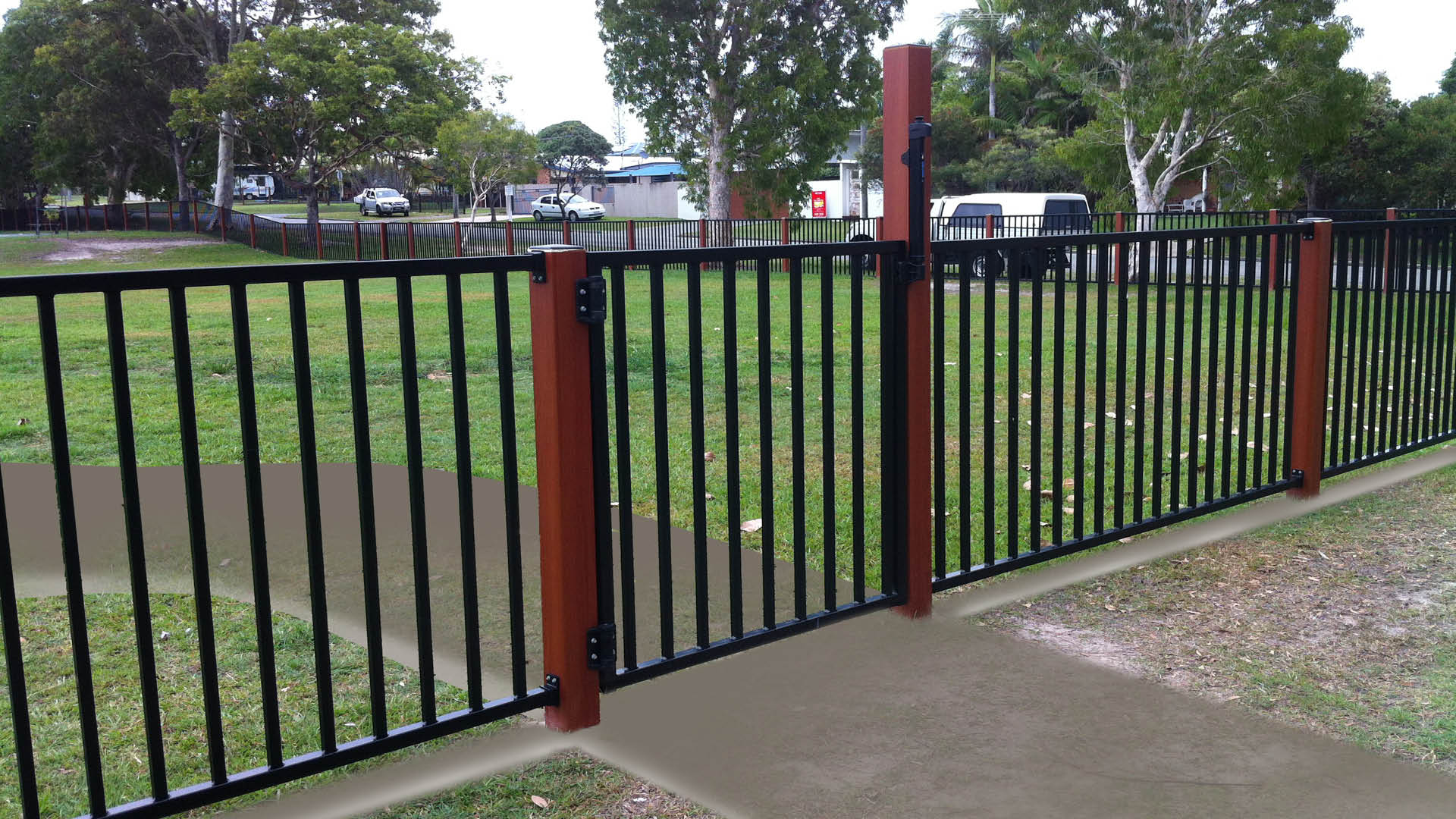 |
Playground fences and gates (matching pedestrian and vehicle gates)
Playground boundary demarcation to contain users within a safe play area:
|
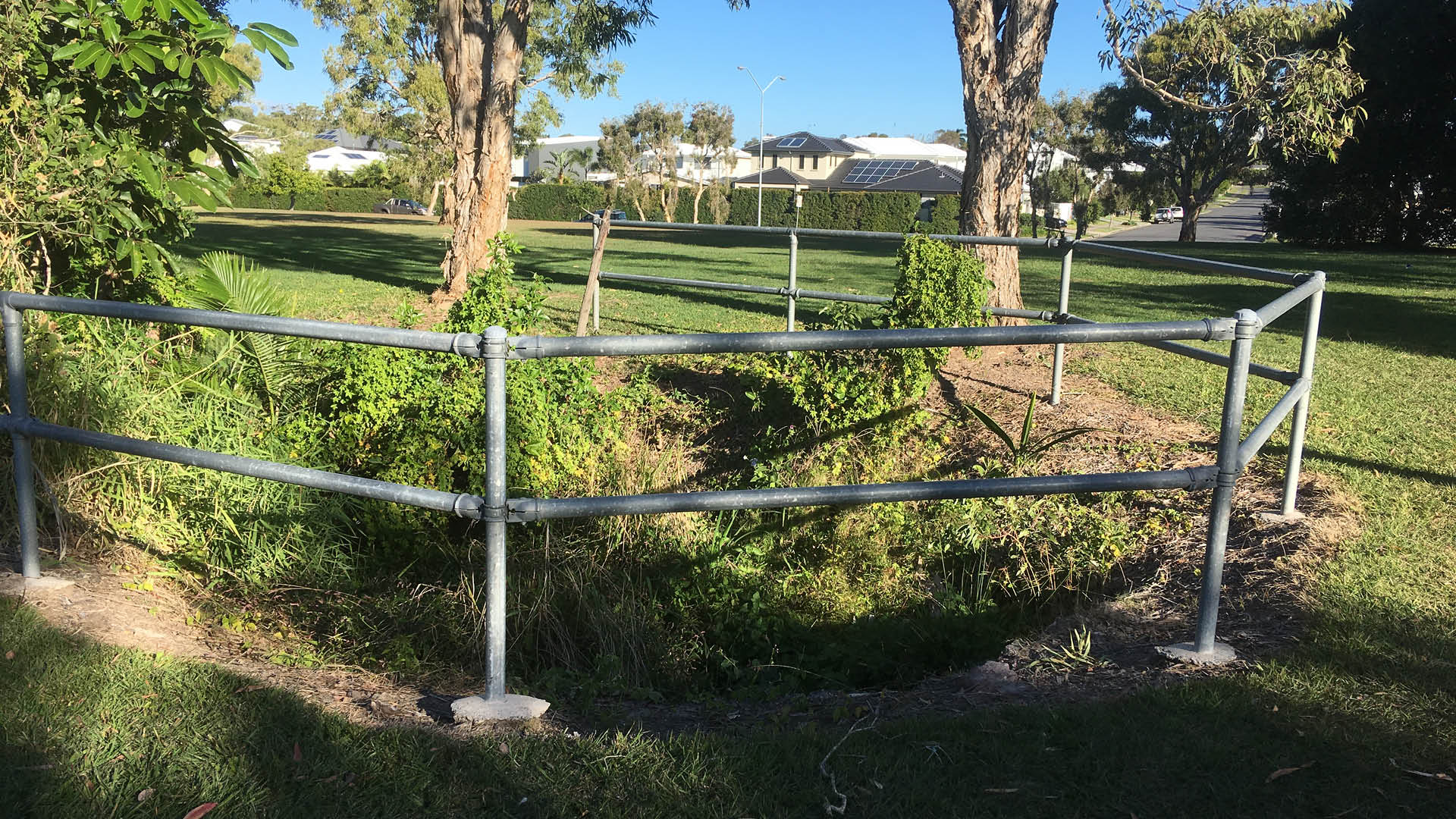 |
Stormwater infrastructure (matching vehicle gates where required)
Fencing located around stormwater inlets / outlets to create a visual and physical barrier are installed to:
|
- Parks and open space fences may be used at environmental reserves.
- Environmental reserve fences and gates may be used at parks and gardens.
- Fences and gates must be designed to suit the application. Engineering certification may be required.
- Approval must be obtained from the asset owner/custodian.
Bollard and rail barriers
Purpose
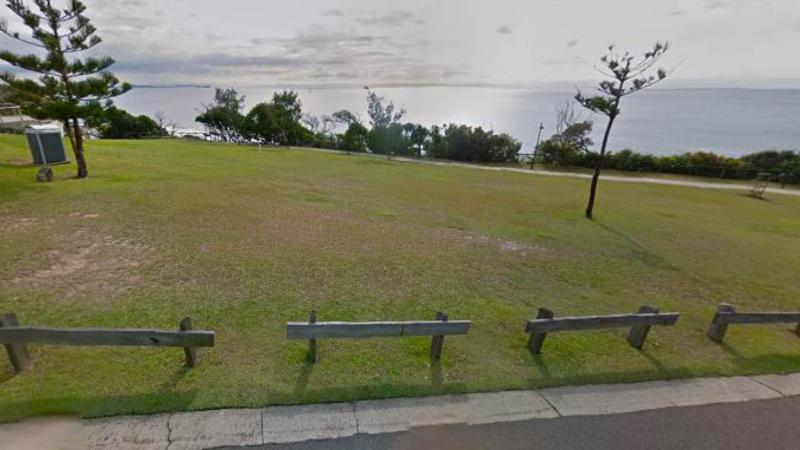
Bollard and rail barriers prevent unauthorised vehicle access and provides demarcation for a protected area.
Bollard and rail barriers are installed to create visual barriers to protect against activities such as:
- children from running out onto a busy roadway located near a park.
- to direct pedestrian movement to a safe road crossing/specific location.
Planning
Only install bollard and rail fences when natural elements such as tree planting and placed boulders are not appropriate.
Design considerations
Bollard and rail barrier design should include the following:
- Minimum gap between single barriers 1.5 m.
- Bollards to be recycled material or hardwood timber.
- All footings must be designed and installed to engineers specifications.
The barrier material should blend with the surrounding environment.
- Ensure the barrier is installed with a vehicle gate or opening where required.
- If a gate(s) is installed, ensure materials and components complement the fence materials.
Materials selection should consider:
- level of use.
- any potential unlawful entry.
- adjacent fence material.
Bollard and rail barriers are constructed from various materials to complement the site, such as recycled plastic, hardwood timber and stainless steel or hot dipped galvanised.
See Table 12: Typical examples of bollard and rail barriers.
Table 12: Typical examples of bollard and rail barriers
Typical movement example | Purpose |
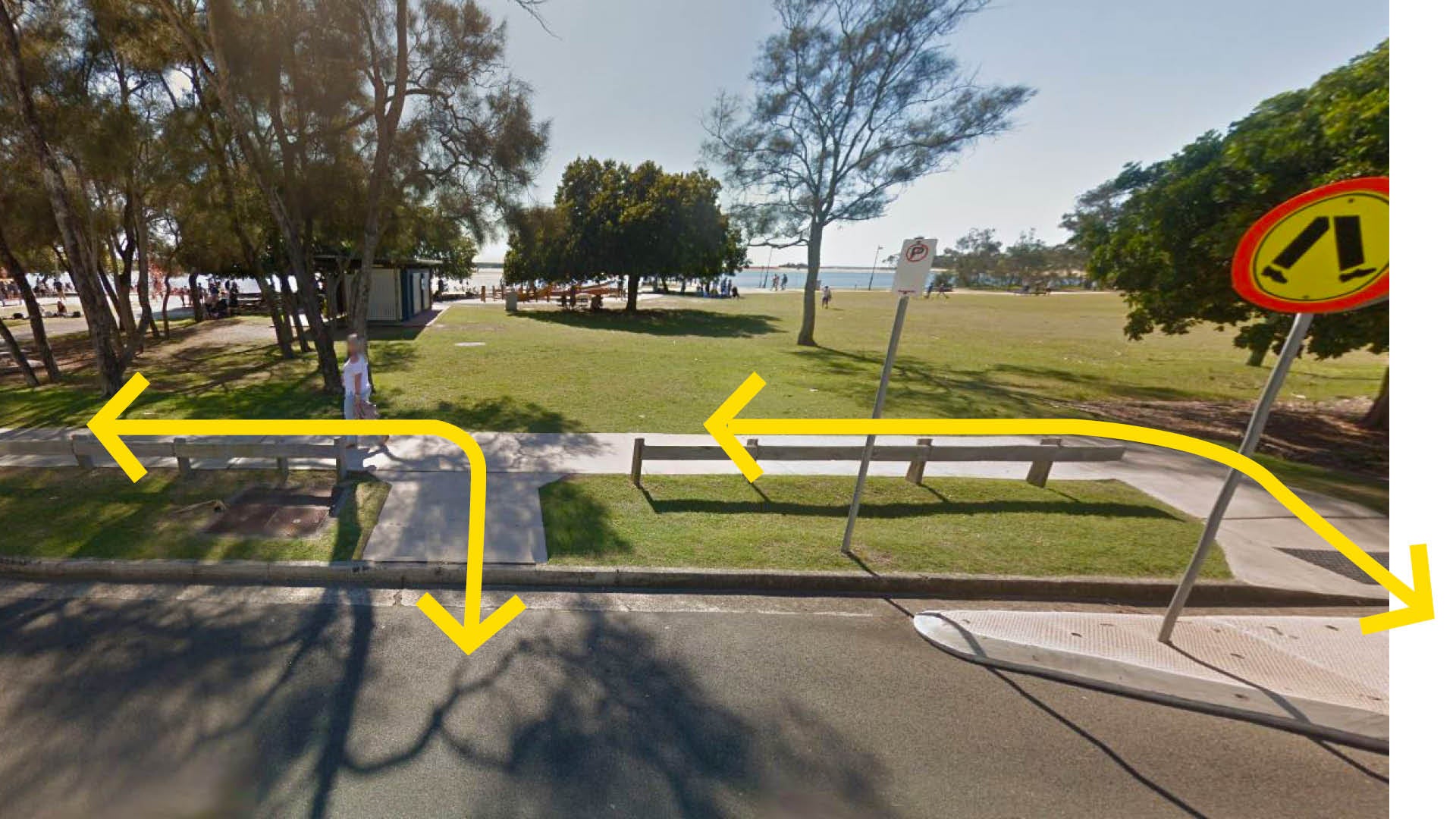 |
Barrier placement directs pedestrians to safe road crossings |
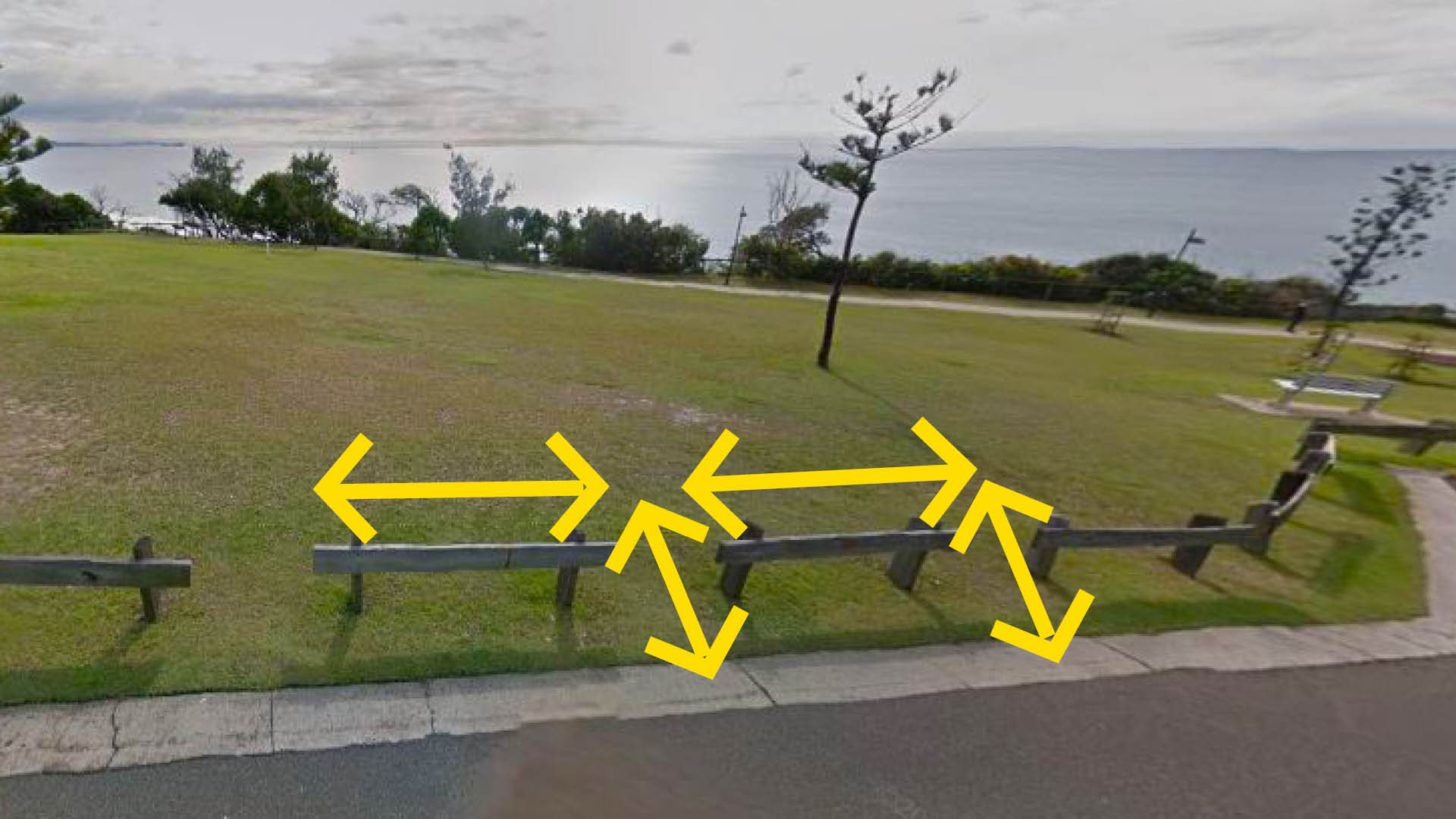 |
Gaps between barriers allow entry/exit and reduce pedestrian speed |
Vehicle gate (‘standard CHS’)
Purpose
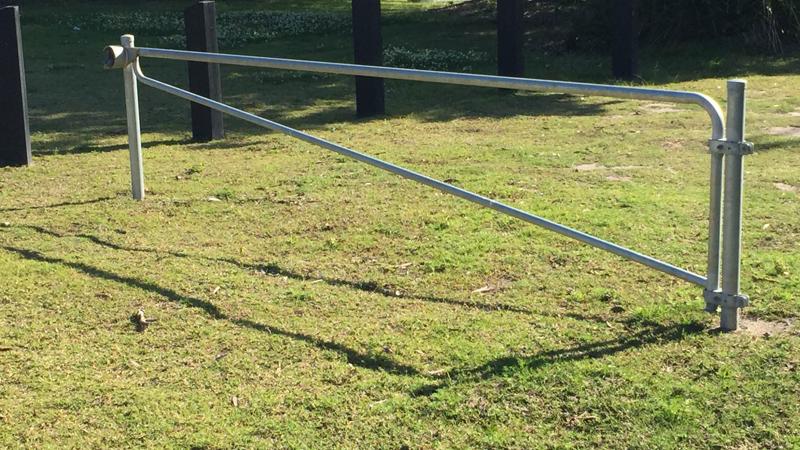
A vehicle gate is designed to provide approved vehicle access. Where unauthorised vehicles enter a protected area (such as park), they can cause irreversible damage.
A standard CHS vehicle gate is installed as barrier to deter unauthorised vehicles (such as motorbikes or motor vehicles). Where there is infrequent casual surveillance, a more robust design may be required (see vehicle gate ‘super heavy duty’).
Planning
Consider the following when selecting gate locations:
- Direct access from the nearest road.
- Locate along a fence line with easy access. Consult Council (Parks and Gardens - Operations) to determine their preferred location.
- Ensure the gate does not open cross a footpath or provide no conflict with other activities.
- Sufficient overhead clearance for crane truck delivery such as components for shelters, barbecues, park furniture.
- Where a vehicle gate is accessed via a sealed road, paint a yellow ‘no stopping’ line across the entry to prevent vehicles parking and blocking the gate.
- Locate vehicle gate at a site easily accessible from a road. Ensure there is sufficient parking area for approved vehicles to temporarily park (outside of the gate), prior to entry. Ensure the parked vehicle does not interrupt the normal flow of on-road traffic.
- Ensure the gate swing area is not restricted by trees and allows adequate circulation space for entering vehicles. The gate location must be free of tree roots.
- Locate gate with a connecting barrier fence, bollards or natural elements (i.e. vegetation)
- Gates adjacent to roadways, must comply with road related standards and guidelines (clear zones, spearing hazards).
Design considerations
- Minimum 3.6 m clear space for approved maintenance and emergency vehicles.
- Hinged swing system which opens inwards to the fenced area, or both ways where possible. Manufactured with two hinges for safe operation. Ease of operation to comply with health and safety requirements.
- Ensure there are no entrapment or crushing points (i.e. appropriate gaps at gate openings).
- All ends to be capped.
- All footings must be designed and installed to engineers specifications.
Consider the following when selecting gate materials:
- level of use, any potential unlawful entry and adjacent fence material.
Vehicle gates (standard CHS) should be constructed of galvanised steel (after fabrication) components for durability and to complement adjoining fence materials.
Locks and keys
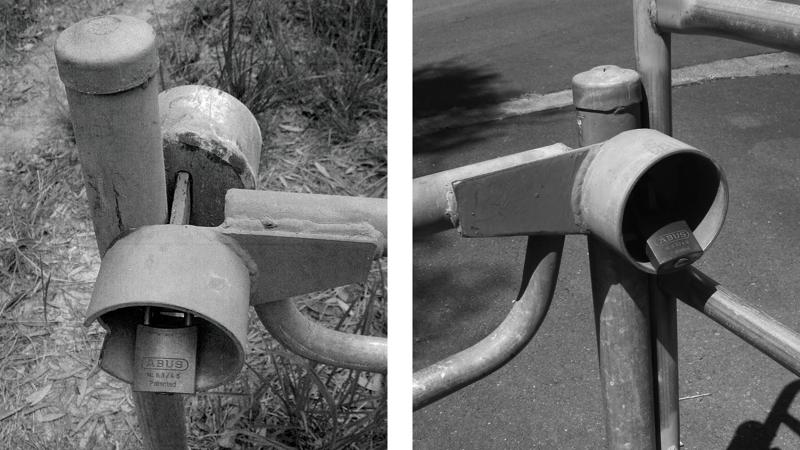
Vehicle gates must be secured by:
- A padlock operable by both council and external parties such as emergency services.
- Provide either a single key access or two separate keyed access points:
- A single key access must contain a lock shroud
- Two separate keyed access points must contain two separate lock shrouds within, on one same gate.
- Both lock options must include:
- Provide a shroud around each locking mechanism for weather proofing and to prevent vandalism.
- Padlock and Council Parks 30 key – contact Council (Parks and Gardens – Operations) for further information.
Note: For most appropriate/preferred location for vehicle access gates, consult Council (Parks and Gardens – Operations)
Dog off leash fences and gates
Purpose
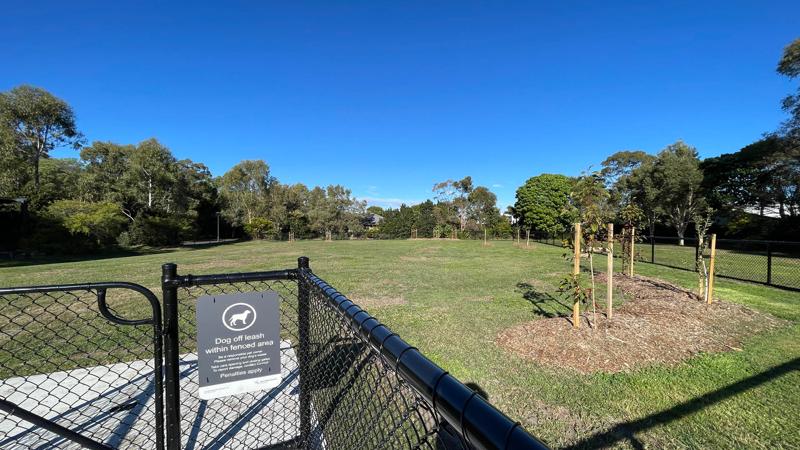
A dog off leash perimeter fence is installed to create a safe and secure area for handlers to take dogs to play and exercise. The fenced environment aims at preventing dogs from escaping without a handler and preventing unattended dogs from entering.
Consider the following when planning and selecting DEA site locations:
- Locate away from potential conflict areas (i.e. playgrounds, picnic facilities).
- Positioning of fences and mowing/anti dog digging strips must take into account natural drainage lines and overland flows to prevent trapping of water and ponding.
- Locate entry fences and gates at an elevated area (high point) to minimise the chance of being waterlogged or washed away in flood events.
- Fences and gates adjacent to roadways, must comply with road related standards and guidelines (clear zones, spearing hazards).
- Pedestrian gates - a minimum of two, dual gate entry and exit systems are required.
- Vehicle gate – all perimeter fences must have a vehicle gate. Maintenance and emergency access must be provided.
- Design the fenced area to maximise the length for a dog run.
- Ensure embellishments (i.e. seats), are not positioned too closely to a fence, that they can be used as leverage to jump the fence.
- A minimum of 2.5 m wide clear turf area is to be provided (where possible) around a fenced area to allow for deck mowers and maintenance – maximum grade 1:4.
Note: This category should be read in conjunction with LIM Dog exercise areas (DEAs)
'Dog off leash fences' can also be adapted to suit alternate purposes, such as sports ground fences.
Fence panel (dog off leash)
Planning (fence panel)
axxxx
Design considerations (fence panel)
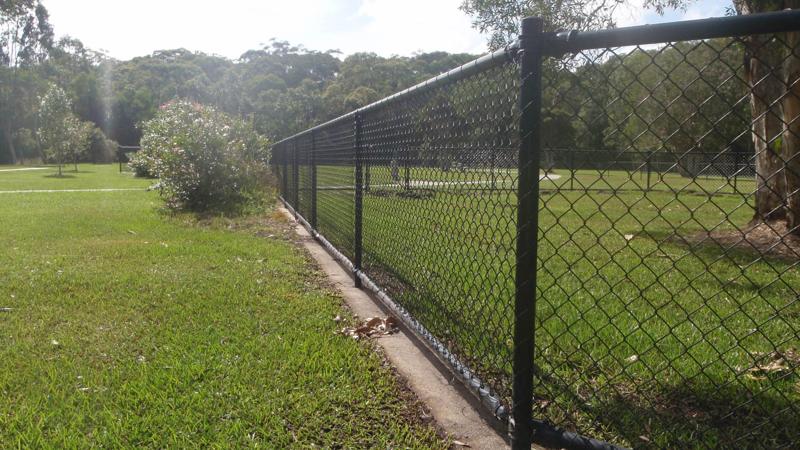
- A minimum of 1.2 m high panel with a maximum gap of 50 mm between the bottom rail and the top of the concrete mowing strip, to prevent small dogs escaping or unwanted dogs entering.
- A site specific risk assessment should be conducted on the height of the fence to ensure it prevents dogs escaping. Options include a cranked fence or increasing the fence height.
- Reshaped ground level to minimise steps in the fence height.
- Concrete mowing/anti dog digging strips centred directly under the fence to help prevent dog escapes (tunnelling/digging).
- Gaps in mesh must not allow a small dog to escape.
- Ensure there are no entrapment or crushing points (i.e. appropriate gaps at gate openings).
- All footings must be designed and installed to engineers specifications.
- Chain wire mesh fence (black) must be laced at every crossover to prevent clothing entrapment. All ends to be capped.
Pedestrian gates (dog)
Planning (pedestrian gate)
Consider the following when selecting gate locations:
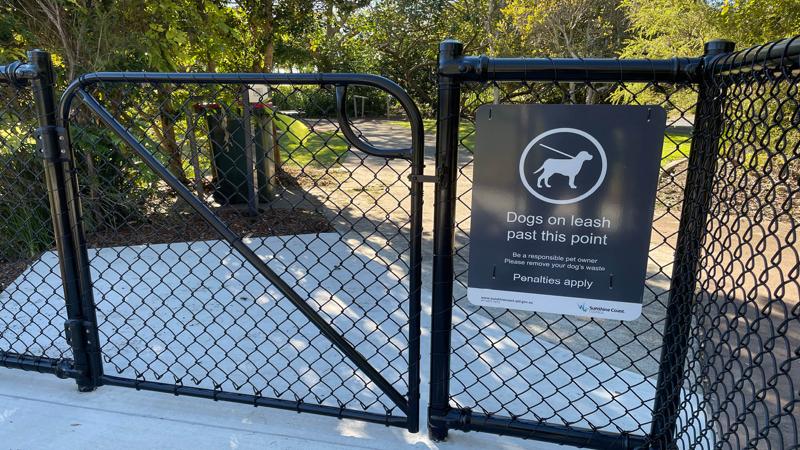
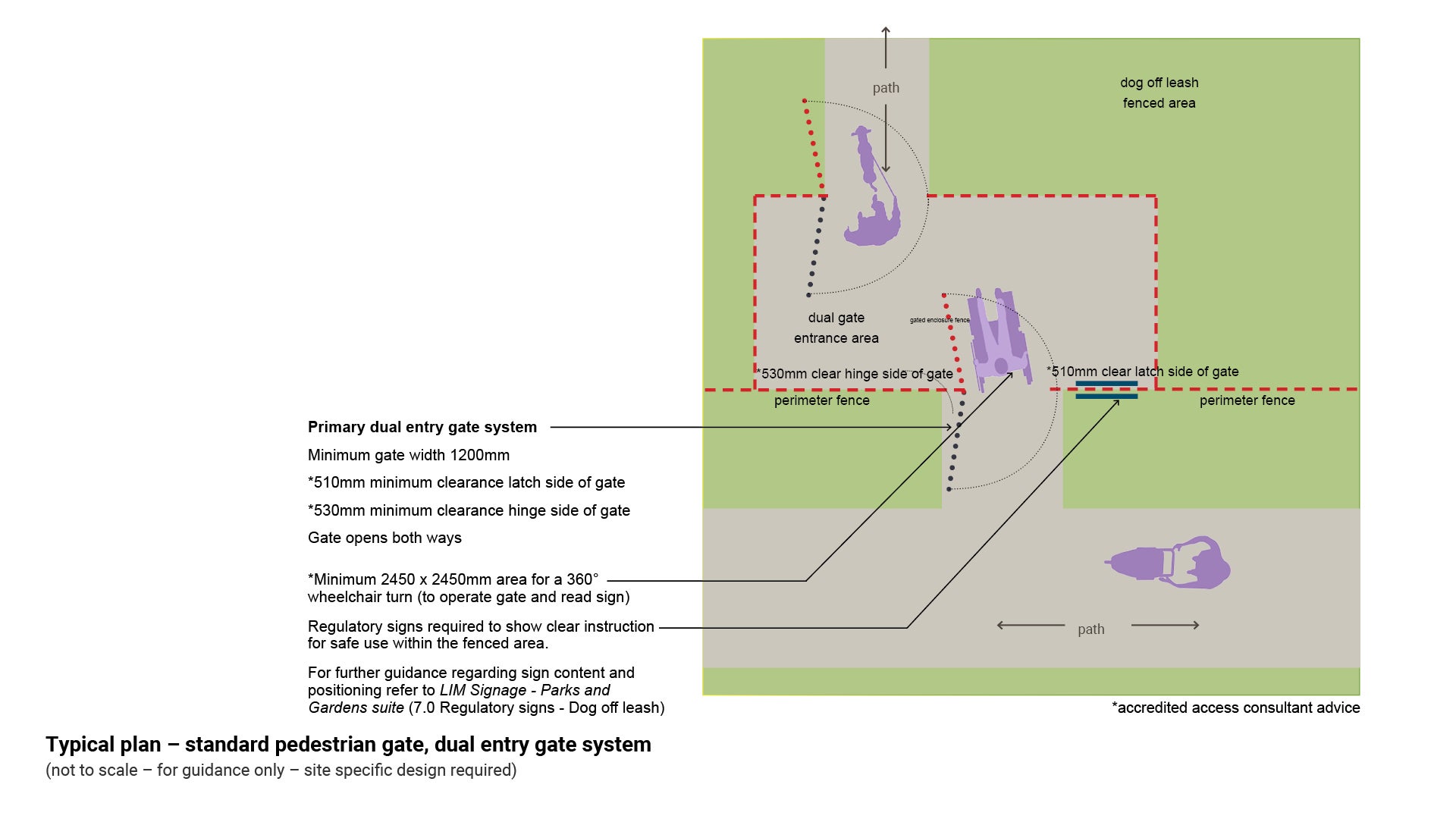
- A minimum of two, dual gate entry and exit systems are required. They are essential to allow for leashing and to prevent accidental escape.
- Gates must be visible from all areas of fence park to ensure a safe exist route can be seen if an emergency occurs.
- After entry into the first gate, the dog handler is able to unleash/leash the dog safely in a fully enclosed space.
- The second gate is then opened to release the dog into the exercise area or exit the space.
- Gate entries must be located to minimise the possibility of dogs escaping and running towards other activity areas, such as playgrounds, roads and sports fields.
- Ensure fenced enclosures have a minimum of two pedestrian gates on opposite sides of the park. If one gate is blocked, the other gate provides an alternate exit. More than one entry and exit may avoid potential conflicts between dogs.
- A hard, level surface area is preferred through gate thresholds and to seating nodes, to provide equal access. Where possible connect to existing pedestrian pathways.
- Provide pedestrian gate access from a car park into the dog off leash park.
- Ease of removal of waste services bins for emptying to collection trucks.
Design considerations (pedestrian gate)
- Continue the same design as the fence to maintain the level of protection the fence provides and to maintain a consistent appearance.
- Pedestrian gates should have a minimum clear opening of 850 mm and circulation space as per AS 1428.1 – Design for Access and Mobility set.
- All gate material must be heavy duty commercial grade, suitable for use in public areas.
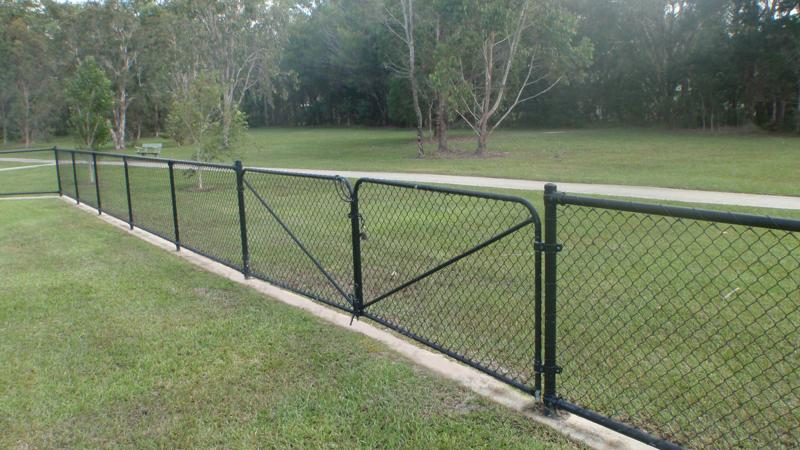
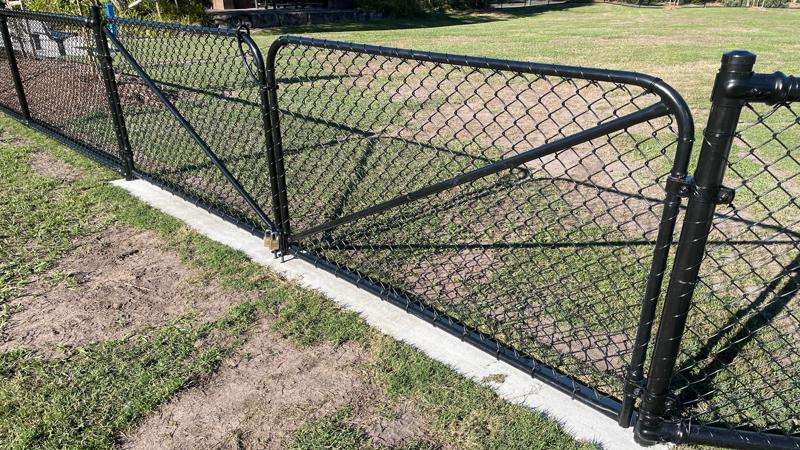
- Gates are to open both ways if possible and select a ‘D’ latch system with 100 mm opening in chain wire for easy of operating the gate from both sides. Install heavy duty commercial grade hinges and latches to pedestrian gates.
- To prevent wear to the latch, gates must NOT be self-closing.
- Install gates and latches at a height that is wheelchair accessible. All ends to be capped.
- Ensure there are no entrapment or crushing points (i.e. appropriate gaps at gate openings).
- Ensure a minimum gap width of 12 mm on both sides of any gate, hinge side and latch side, to prevent crushing of fingers.
- Minimum height 1.2 m and minimum 1.2 m clear width.
- Provision for wheelchair circulation:
- 510 mm clear distance along a fence to any obstacle (on the latch side of gate).
- 530 mm clear distance along a fence to any obstacle (on the hinge side of gate).
- Allow adequate wheelchair circulation space between gates.
- 1540 mm W x 2070 mm for >90 - 180° turn
- 2450 mm W x 2450 mm for 1 360° turn.
See the following for guidance:
- Figure 10: Typical pedestrian gate with ‘D’ latch
- Figure 11: Typical standard pedestrian gate for a dog off leash dual gate entry
- Figure 12: Typical standard pedestrian gate for a dog off leash dual gate entry
- LIM Signage for regulatory sign requirements.
Figure 10: Typical pedestrian gate with ‘D’ latch
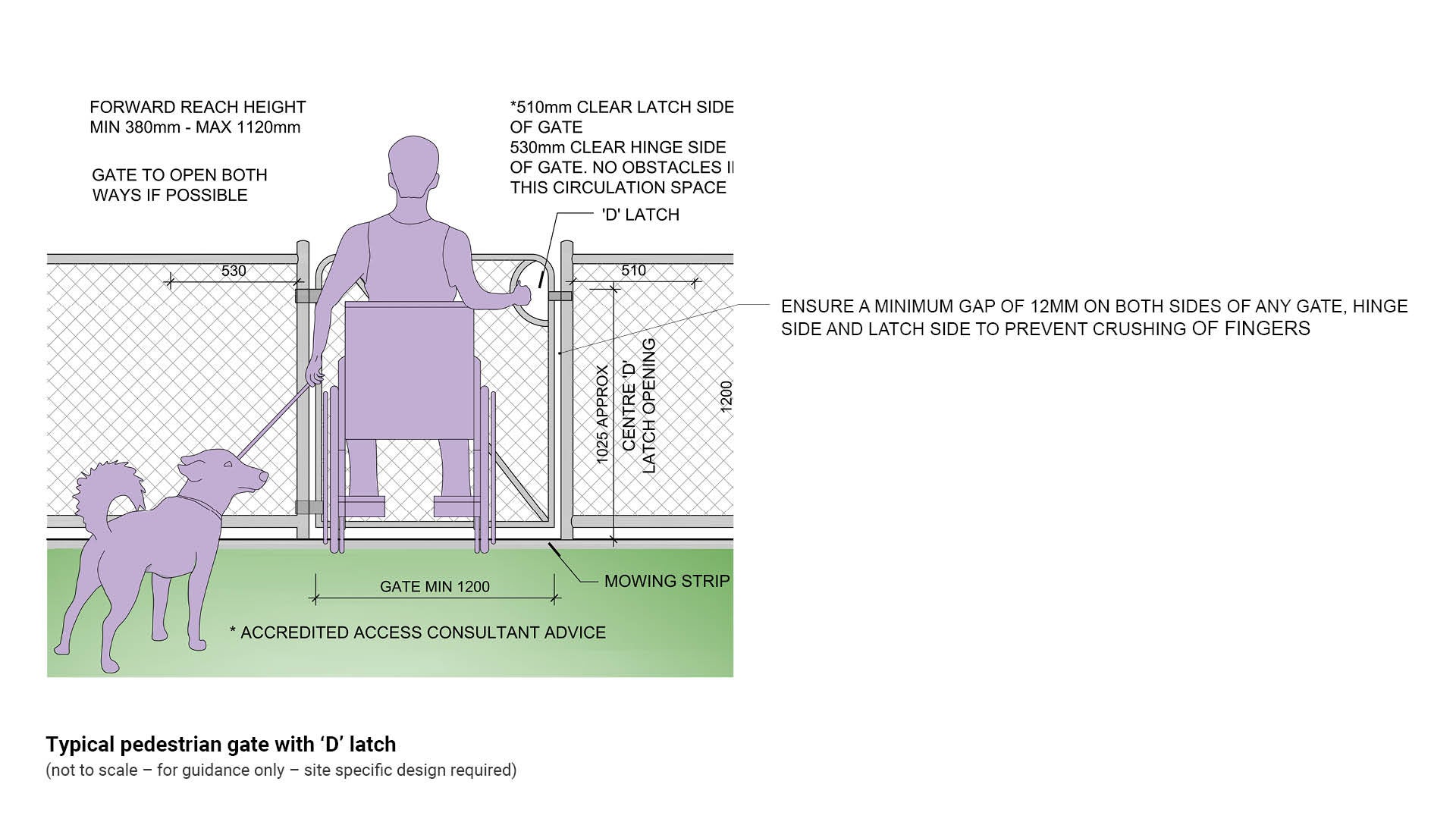
Figure 11: Typical standard pedestrian gate for a dog off leash dual gate entry
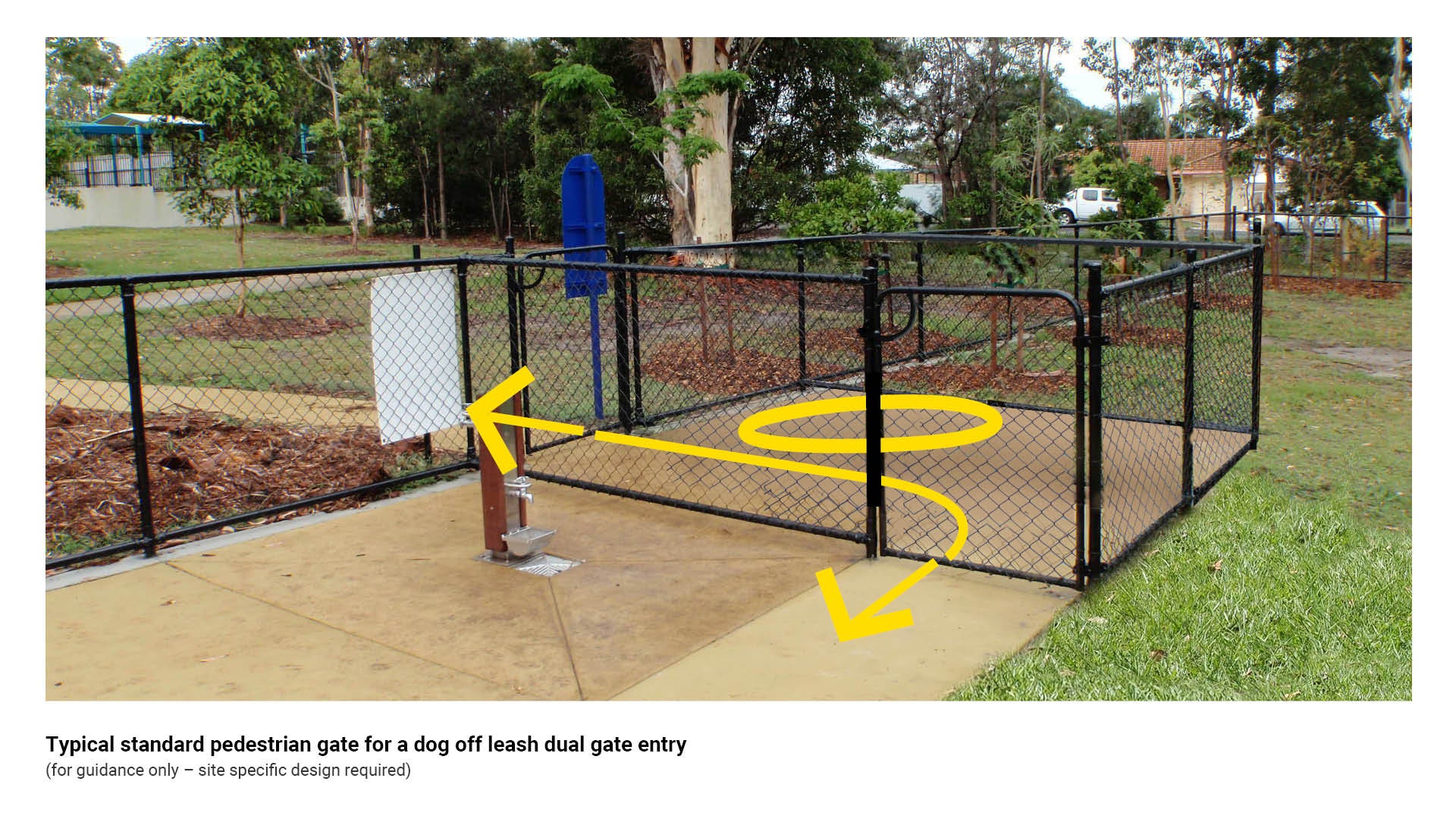
Figure 12: Typical standard pedestrian gate for a dog off leash dual gate entry
Vehicle gate (dog)
Planning (vehicle gate)
Consider the following when selecting gate locations:
- All perimeter fences must have a vehicle gate. This provides access for approved vehicles (such as maintenance and emergency services).
- Vehicle gates must provide easy and direct access from the nearest road. They must ensure suitable set-down and clearance requirements for maintenance vehicles and associated activities.
- Ensure there is sufficient parking area for approved vehicles to temporarily park (outside of the gate), prior to entry. Ensure the parked vehicle does not interrupt the normal flow of on-road traffic.
- Emergency vehicle access must be provided.
- Locate along a fence line with easy access. Consult Council (Parks and Gardens - Operations) to determine their preferred location.
- Ensure the gate does not open cross a footpath or provide no conflict with other activities.
- Sufficient overhead clearance for crane truck delivery such as components for shelters, barbecues, park furniture.
- Where a vehicle gate is accessed via a sealed road, paint a yellow ‘no stopping’ line across the entry to prevent vehicles parking and blocking the gate.
- Locate vehicle gate at a site easily accessible from a road. Ensure there is sufficient parking area for approved vehicles to temporarily park (outside of the gate), prior to entry. Ensure the parked vehicle does not interrupt the normal flow of on-road traffic.
- Ensure the gate swing area is not restricted by trees and allows adequate circulation space for entering vehicles. The gate location must be free of tree roots.
Design considerations (vehicle gate):
- The double vehicle gate should be fabricated to match the fence panels, to maintain the same level of protection the fence provides, as well as maintaining a consistent appearance.
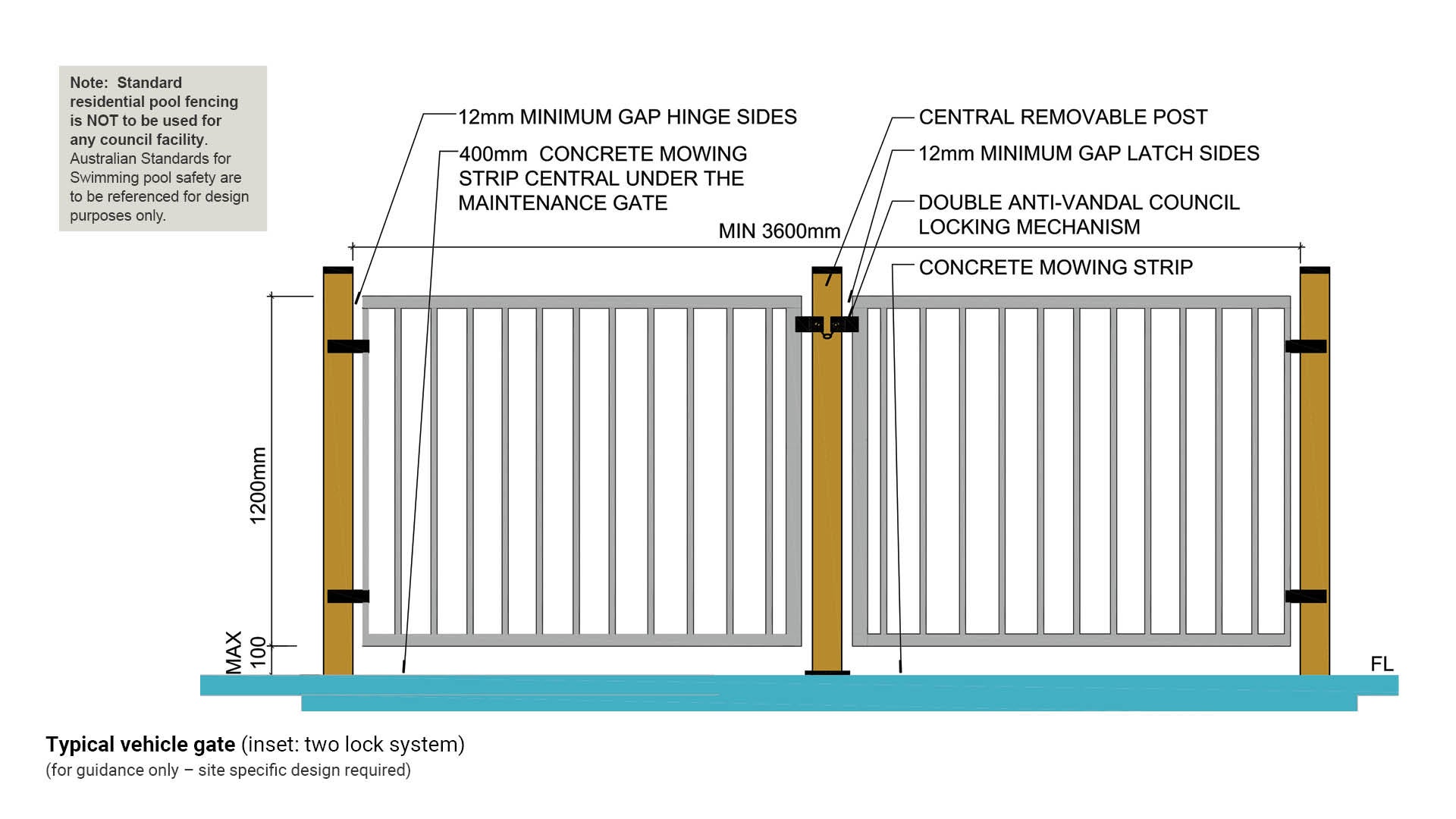
- Double gate system – minimum 3.6 m wide clear space for approved vehicles.
- Double hinged swing system which opens into the fenced area, or both ways where possible.
- Ensure there are no entrapment or crushing points (i.e. appropriate gaps at gate openings).
- All ends to be capped.
- Where a mowing/anti dog digging strip is used directly under a vehicle access gate, it must be extra thickness reinforced concrete to withstand vehicle loads.
- All footings must be designed and installed to engineers specifications.
Locks and keys
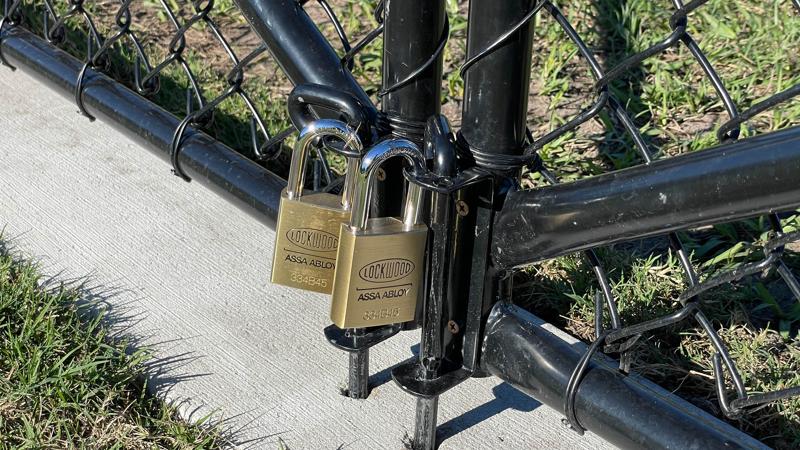
Vehicle gates must be secured by:
- A padlock operable by both council and external parties such as emergency services.
- Provide either a single key access or two separate keyed access points.
- Padlock and Council Parks 30 key – contact Council (Parks and Gardens – Operations) for further information.
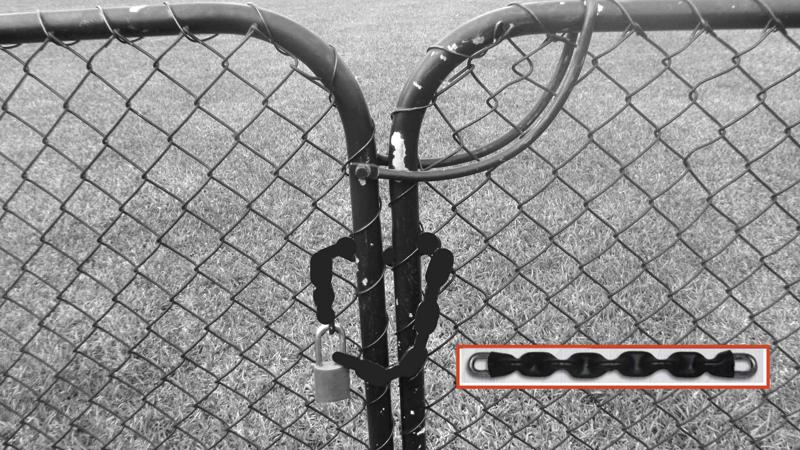
- Vehicle gates must incorporate a latch and accommodate a chain with heat shrink tubing cover and an anti-vandal, Council locking mechanism.
- The mowing/anti dog digging strip directly under the gate must include a recessed hole for the padbolt pin (one per gate) to slide into. This provides both lockable security and stability for the gates.
Play space fence and gates
Purpose
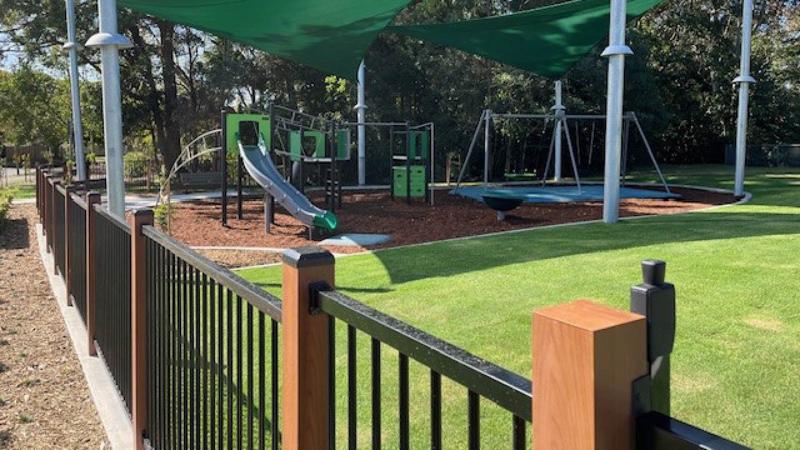
Play space fence, most commonly referred to as ‘playground perimeter fence’ is installed to create a safe environment for play.
Note: Standard residential pool fencing is NOT to be used for any council facility. Australian Standards for Swimming pool safety are to be referenced for design purposes only.
Note: This section should be read in conjunction with LIM Play spaces.
When does a play space require fencing
Play spaces should be considered for fencing where they are located as follows:
- Within 20 m of a hazard, for example:
- near a Transport and Main Roads (TMR) road.
- at council roads over 50 km/h or high volume roads – refer to Council (Transport Network Management) for traffic parameters.
- a car park.
- a commuter bikeway.
- permanent or potential water bodies, including drains. Urban waterways and stormwater drainage systems can represent a significant safety risk during storms and times of flood. Risks associated with urban waterways and stormwater drainage systems shall be managed in accordance with QUDM (See also LIM Landscape drainage).
- Considerations should also be made in situations where there is a need to separate play spaces from other activities:
- formalised dog off leash parks.
- formal sports areas.
- All abilities play spaces are to be fully fenced.
- Where retaining walls are constructed, there may be a requirement for a barrier fence with balustrade. Where a difference in height from the top of the retaining wall to the ground or a lower level is 1.0 m or more, or where the ‘height of effective fall’ (see AS 2156.2:2001) determines a balustrade, a minimum 1.0 m high barrier is required.
Alternative options to full fencing
- Partial fencing may be considered for certain situations including:
- formal sports areas adjacent to play spaces.
- commuter cycleways.
- Vegetation may be used as a visual deterrent. In some situations this may be suitable, provided plantings around hazards maintain sight-lines for CPTED and safety.
- Vegetation would be suitable for separating low risk areas such as sports, however water bodies must have a clear line of sight for parent and carer surveillance.
Fence panel (play spaces)
Planning (fence panel)
Consider the following when selecting locations:
- Mowing strips and fences must take into account natural drainage lines and overland flows to prevent trapping of water and ponding.
- Fences and gates must enable easy access and surveillance by parents and carers.
- The size of the playground perimeter fence will be determined by the activities within.
- Locate entry fences and gates at an elevated area (high point) to minimise the chance of being waterlogged or washed away in flood events.
- To assist with wayfinding, a concreate entry pathway must extend either side of the pedestrian gate.
- To assist further with identifying the entrance, consider a different power coat colour (must be contrasting to fence panels and approved by asset custodian) for the gate balusters and gate frame.
- Fences and gates adjacent to roadways, must comply with road related standards and guidelines (clear zones, spearing hazards).
- Pedestrian gates – 1, 2 or 3 (varies) pedestrian gates are required.
- Vehicle gate – all perimeter fences must have a vehicle gate. Maintenance and emergency access must be provided.
- Ensure embellishments (i.e. seats), are not positioned too closely to a fence, that they can be used as leverage to jump the fence.
- A minimum of 2.5 m wide clear turf area is to be provided (where possible) around a fenced area to allow for deck mowers and maintenance – maximum grade 1:4.
Design considerations (fence panel):
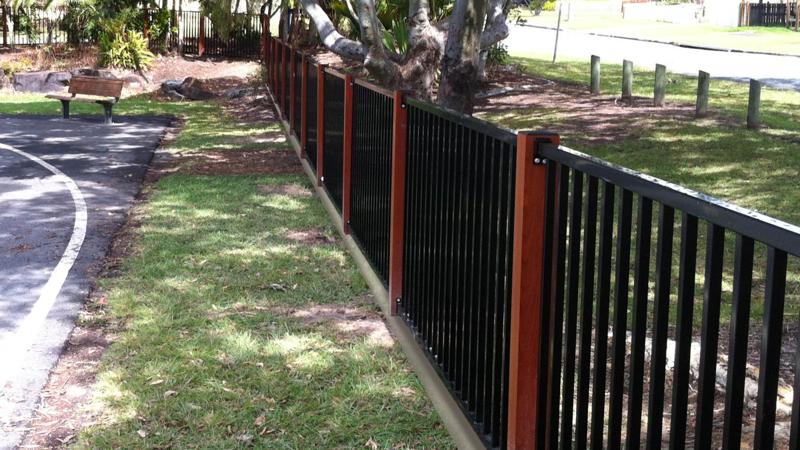
- The design of play space safety fencing (i.e. height, gap sizes and latch requirements) is to be in accordance with AS 1926.1:2012 Swimming Pool Safety Part 1: Safety barriers for swimming pools. Whereas the pool safety standards are designed to prevent young children entering pool areas, the play space fence design aims to prevent young children from exiting play spaces without parental supervision.
- Materials manufactured for fence construction are to be extra heavy-duty and suitable for public open space use:
- Extra heavy duty strength aluminium is required to prevent accidental damage and vandalism to fence components.
- Panels must be black powder coated, or 2 pack epoxy (where the fence is exposed to a marine environment).
- Balusters should be maximum 85 mm between uprights (allows for flex) to comply with playground standards. Square or round balusters with square flat top and bottom rails.
- Posts are to be timber look powder coated aluminium (preferred) or black powder coated. Timber posts are not preferred due to ongoing maintenance requirements.
- Only ‘flat top’ fence profiles are to be used to prevent clothes entrapment or injury. The fence profile is to be free of entrapment sites, which may be present with a partially bound opening on the top rail.
- Signs attached to a fence should not have sharp edges or create a foothold.
- Mowing strips and fences:
- Must allow for natural drainage lines and flows.
- Concrete mowing strip is to be installed, centered directly under fence line.
- Maximum 100 mm gap underneath fence bottom rail.
Note: Standard residential pool fencing is NOT to be used for any council facility. Australian Standards for Swimming pool safety are to be referenced for design purposes only.
Pedestrian gates (play spaces)
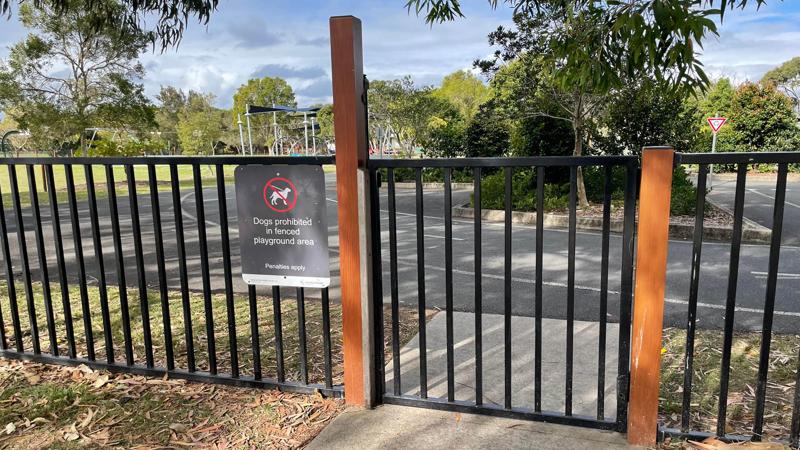
Site considerations – pedestrian gates
Consider the following when selecting gate locations:
- In most fenced areas two pedestrian gates should be installed for safety. If one gate is blocked at any time, the other gate provides an emergency exit.
- Small fenced areas (such as local parks), install one pedestrian gate.
- Large fenced play spaces, such as an all abilities play space (AAPS), install two to three pedestrian gates.
- A hard, level surface area is preferred through gate thresholds and to seating nodes, to provide equal access. Where appropriate connect to existing pedestrian pathways.
- Provide pedestrian gate access from a car park into the play space.
- Gates must provide easy access and enable surveillance by parents and carers.
- Ease of removal of waste services bins for emptying to collection trucks.
Design considerations (pedestrian gates):
- Continue the same design as the fence to maintain the level of protection the fence provides and to maintain a consistent appearance.
- Pedestrian gates should have a minimum clear opening of 850 mm and circulation space as per AS 1428.1 – Design for access and mobility (Set).
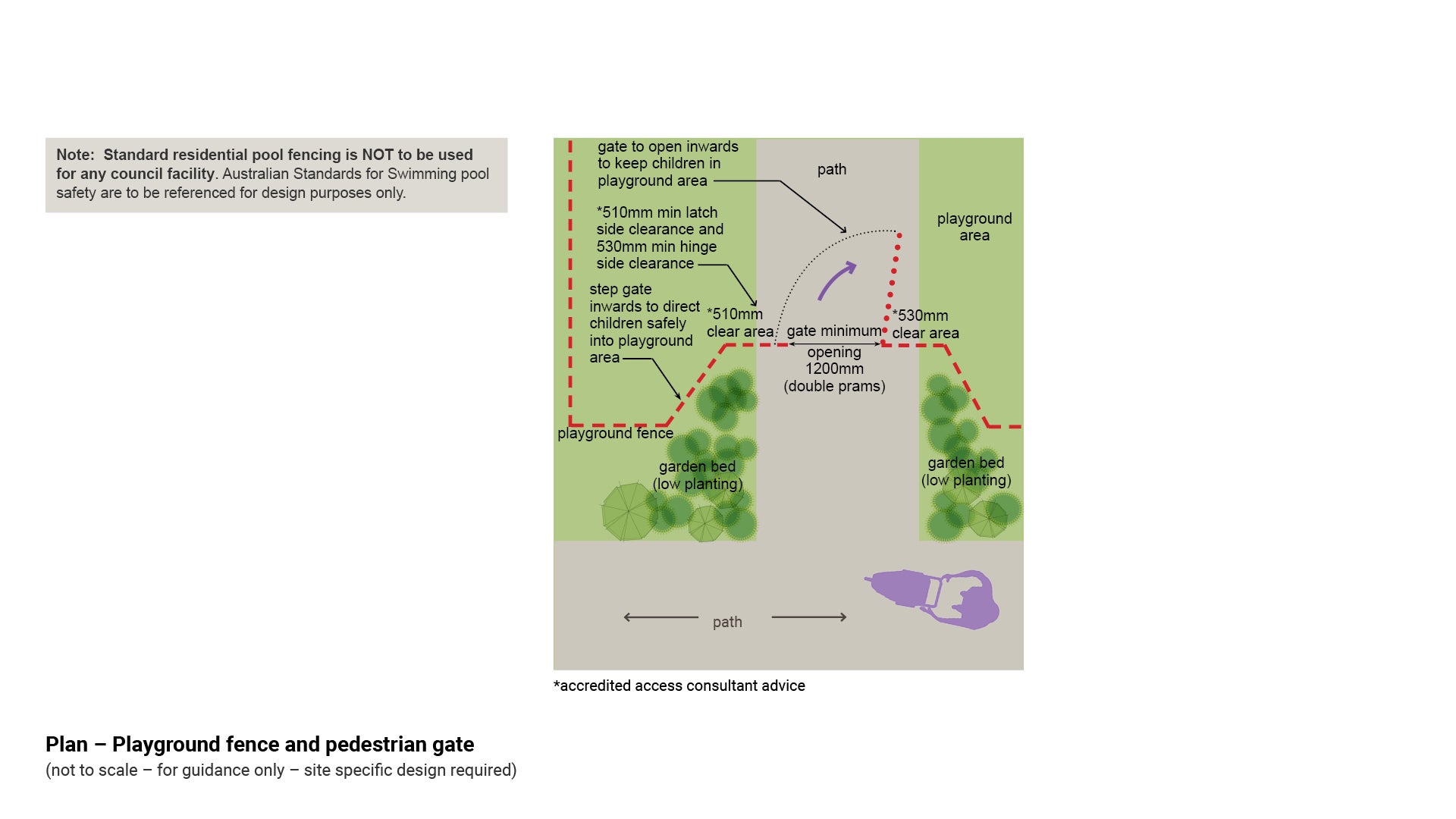
- Recess the pedestrian gate inwards (where possible) to direct children safely into the playground area. Gate to open inwards to keep children in the playground area (opposite to pool safety standards).
- All gate material must be heavy duty commercial grade, suitable for use in public areas. Aluminium is preferred, due to lower weight than similar products e.g. steel.
- Custom gates are not preferred, as they often fail, requiring repair or replacement. Standard grates are able to be kept on hand for quick and easy replacement.
- Solid panels on custom gates impeded retrofit installation of MLAK keying system, i.e. clear space required to pass hand through gate from outside to unlock.
- Install heavy duty commercial grade ‘self closing’ hinges and ‘self latching’ pool safety latches to pedestrian gates as per AS 1926.1:2012 Swimming Pool Safety – Safety barriers for swimming pools. Three hinges are recommended due to a high incidence of breakage, particularly in high use areas.
- Gate hinges are to include a safety cap over the exposed hinge area to minimise creation of climbing points.
- An in-frame rubber gate stop is to be installed to provide a secure stopping point for gates, absorb impacts and prevent excess gate swing.
- Ensure there are no entrapment or crushing points (i.e. appropriate gaps at gate openings).
- Ensure a minimum gap width of 12 mm on both sides of any gate, hinge side and latch side, to prevent crushing of fingers.
- Brace each corner of gate (as welds are prone to becoming weak), ensure footholds are not created.
- Provision for wheelchair circulation:
- 510 mm clear distance along a fence to any obstacle (on the latch side of gate).
- 530 mm clear distance along a fence to any obstacle (on the hinge side of gate).
- Allow adequate wheelchair circulation space between gates.
Note: Standard residential pool fencing is NOT to be used for any council facility. Australian Standards for Swimming pool safety are to be referenced for design purposes only.
Locks for pedestrian gates
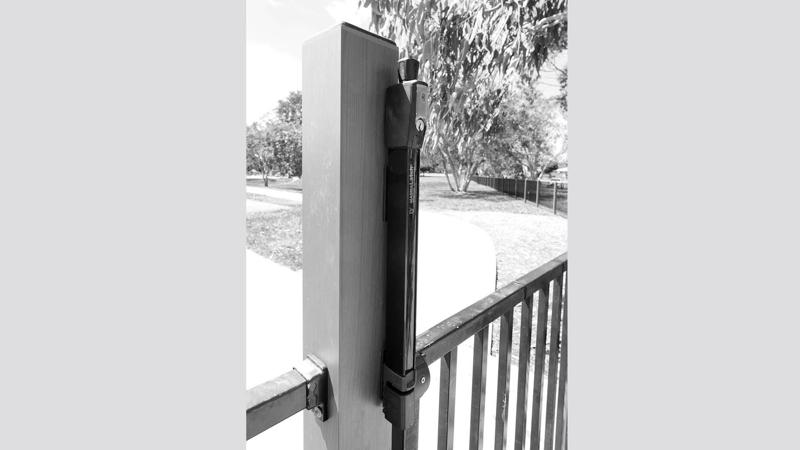
It is recommended that gates to all abilities play spaces (AAPS) incorporate a dual locking mechanism.
- In the first instance a child safety top latch Magnalatch (or equivalent) shall be installed at a minimum height of 1.5 m above ground level.
- A secondary lock may also be installed (product name/height of installation to be determined). This lock may utilise the Master Locksmith Access Key (MLAK key) to enable a person seated in a wheelchair or a person of short stature to open the gate. Ensure reach ranges and force to operate mechanisms are within the allowable dimensions and operational requirements of AS 1428 – Design for access and mobility.
- An extra plate (gate stop) attachment is required on the gate to stop excessive strike on a Magnalatch (or equivalent).
See Figure 15: Typical playground/play space pedestrian gate.
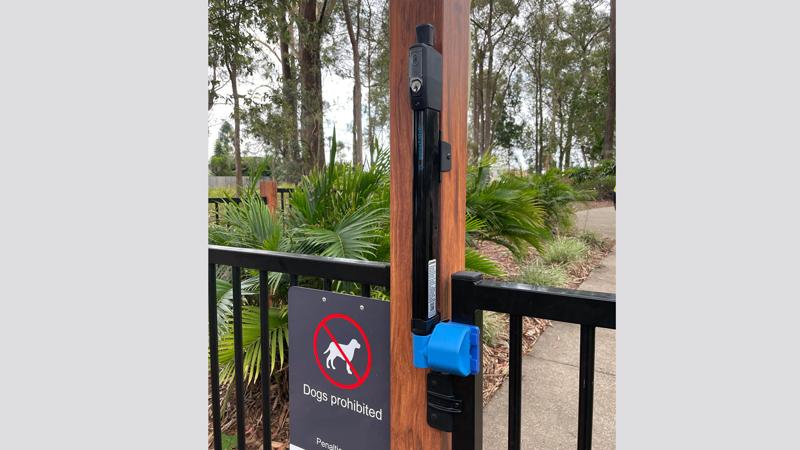
Keys for specialised playground equipment
The MLAK (Master Locksmiths Access Key) is a key which fits a universal lock system to enable people with disabilities 24 hour a day access to public facilities such as:
- Playground Liberty Swing.
- Changing Places public toilets – fully accessible facilities with change tables and hoists for people with severe or profound disability.
See the following figures for further guidance:
- Figure 16: Elevation – Playground fence and pedestrian gate – including dual operating system
- Figure 17: Plan – Playground fence and pedestrian gate.
Figure 15: Typical playground/play space pedestrian gate
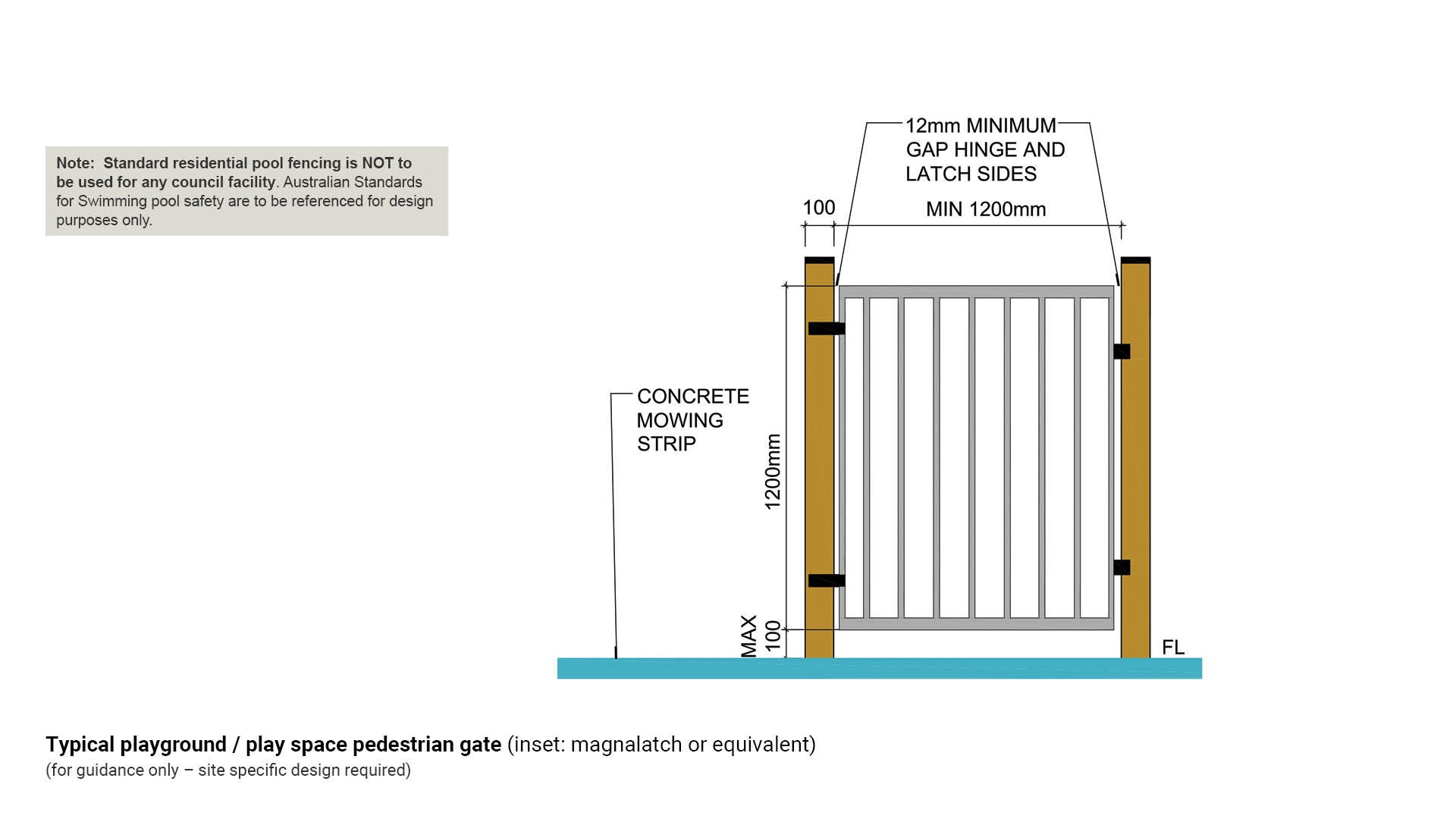
Figure 16: Elevation – Playground fence and pedestrian gate – including dual operating system
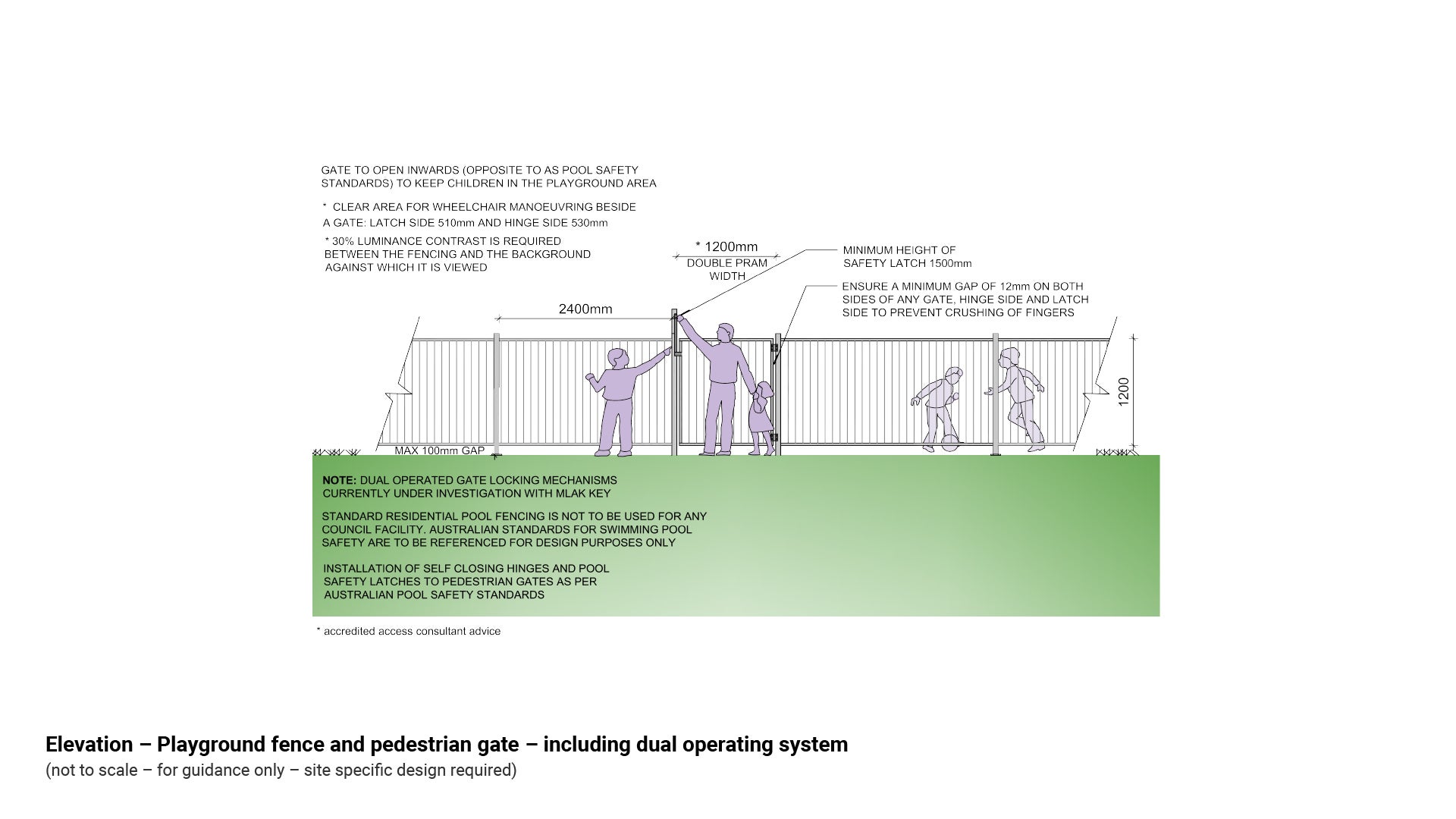
Figure 17: Plan – Playground fence and pedestrian gate
Vehicle gates (play spaces)
Site considerations – vehicle gate
Consider the following when selecting gate locations:
- All perimeter fences must have a vehicle gate. This provides access for approved vehicles (such as maintenance and emergency services).
- As per AS 4685.0, maintenance access must be provided to the site and to the equipment, surfacing, planting, etc. Truck access will be required for replenishment of loose-fill safety surfacing. Ensure adequate space for vehicle manoeuvring within a fully fenced play space, to allow access to; landscaping areas, turf, kick and throw areas, toilet, shelters and barbecues.
- Vehicle gates must provide easy and direct access from the nearest road. They must ensure suitable set-down and clearance requirements for maintenance vehicles and associated activities.
- Ensure there is sufficient parking area for approved vehicles to temporarily park (outside of the gate), prior to entry. Ensure the parked vehicle does not interrupt the normal flow of on-road traffic.
- Emergency vehicle access must be provided.
- Locate along a fence line with easy access. Consult Council (Parks and Gardens - Operations) to determine their preferred location.
- Ensure the gate does not open cross a footpath or provide no conflict with other activities.
- Sufficient overhead clearance for crane truck delivery such as components for shelters, barbecues, park furniture.
- Where a vehicle gate is accessed via a sealed road, paint a yellow ‘no stopping’ line across the entry to prevent vehicles parking and blocking the gate.
- Ensure the gate swing area is not restricted by trees and allows adequate circulation space for entering vehicles. The gate location must be free of tree roots.
Design considerations (vehicle gate):
- Continue the same design as the fence to maintain the level of protection the fence provides and to maintain a consistent appearance.
- Double gate system – minimum 3.6m wide clear space for approved vehicles.
- Hinged swing system which opens into the fenced area, or both ways where possible.
- Install heavy duty commercial grade hinges and latches.
- Ensure there are no entrapment or crushing points (i.e. appropriate gaps at gate openings).
- Where a mowing strip is used directly under a vehicle access gate, it must be extra thickness reinforced concrete to withstand vehicle loads.
- All footings must be designed and installed to engineering specifications.
Note: Standard residential pool fencing is NOT to be used for any council facility. Australian Standards for Swimming pool safety are to be referenced for design purposes only.
Locks and keys
Vehicle gates must be secured by the following:
- Provide either a single or two separate keyed padlocks to be operated by council and emergency services.
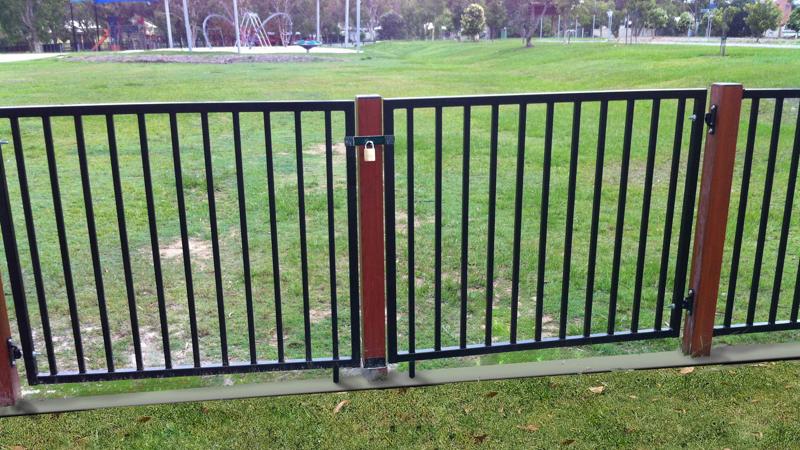
- Padlock strips must be included on each gate panel.
- The gate design is to include a drop bolt on each gate panel.
- The gate system must include a removable post between the two gate panels. The post must be identical to those used for the surrounding fence panels.
- The removable central post is to sit inside a sleeve, which is inset into a footing.
- The removable central post must include throw loops designed to receive the padlock strips.
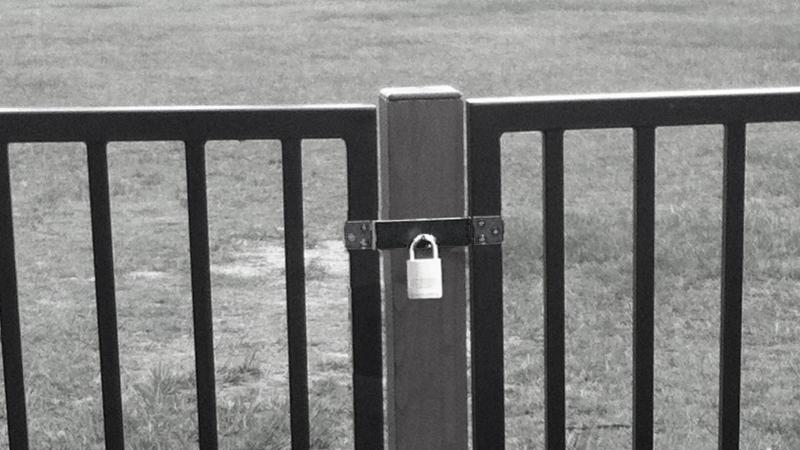
- Padlock single staple with two haps system. Hasp must be bolted to each gate end post with single staple bolted to removable post. Padlock operated by Parks 30 key – contact Council (Parks and Gardens - Operations) for advice.
See Figure 18: Typical vehicle gate.
Figure 18: Typical vehicle gate (inset: two lock system)
Stormwater infrastructure
Planning
The use of fencing to reduce the risk of unauthorised entry of a stormwater infrastructure area is only acceptable if all other ways of providing a safe environment have been exhausted.
Fencing around stormwater infrastructure is not aesthetically pleasing and can encourage anti-social behaviours. It is not the desired outcome. In many scenarios a less invasive solution can be achieved if planned for well; resulting in improved open space for both the stormwater function and recreation function.
See LIM Water sensitive urban design (WSUD) which sets out how to plan and design for stormwater infrastructure (with case study examples) while having a positive impact on the surrounding open space.
If fencing in unavoidable, consider which type of fence best suited to the possible risk at the site:
- Perimeter fence design (typically installed to secure a site) – creates both a visual and a physical barrier. The perimeter fence is a closed loop with keyed entry maintenance gate, by authorised personnel only. This fence type excludes access by unauthorised vehicles and pedestrians.
- Barrier fence design (typically installed to prevent the risk of falls) – creates a visual warning barrier. The fence is open ended.
Design considerations
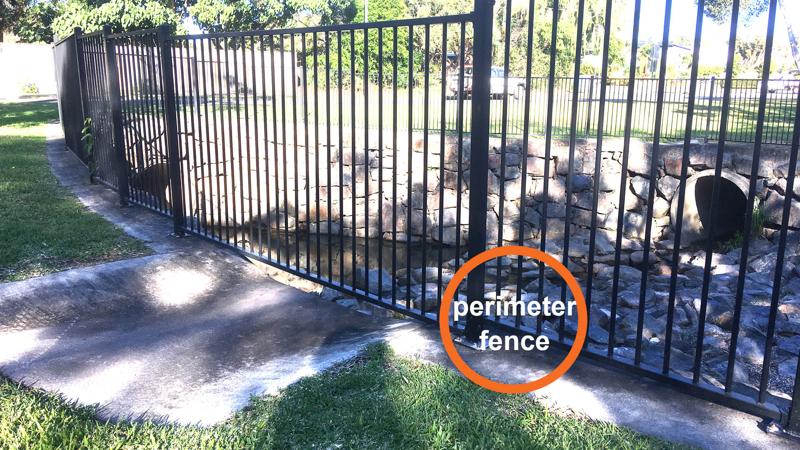
Stormwater perimeter fence must include the following attributes:
- Designed to keep unauthorised person from entering a site or being swept into the pipe network.
- Must be designed by a suitably qualified engineer.
- Fence must comply with the appropriate standards and guidelines and consider site conditions and requirements.
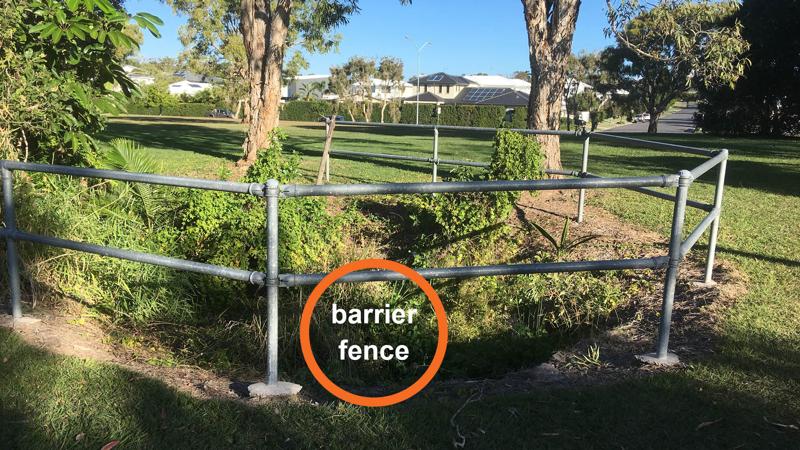
Stormwater barrier fence must include the following attributes:
- Designed to provide a highly visible barrier.
- Must be designed by a suitably qualified engineer.
- Fence must comply with the appropriate standards and guidelines and consider site conditions and requirements.
All stormwater fencing must comply with the standards and guidelines. Liaise with a stormwater engineer for advice.
Note: Standard residential pool fencing is NOT to be used for any council facility. Australian Standards for Swimming pool safety are to be referenced for design purposes only.
See the following for further guidance:
This component is currently in development