Fences and gates
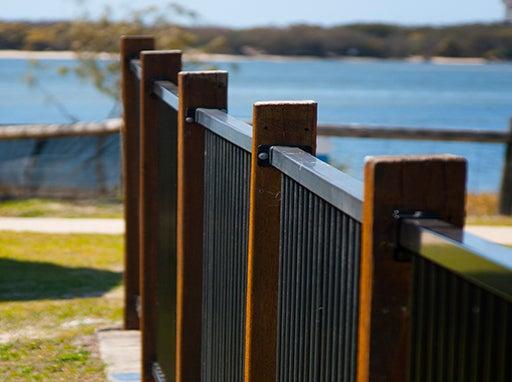
Standards
Compliance requirements for embellishments
Note:
- Where Australian Standards or part thereof have been adopted by legislation, they are a legal requirement.
- This list may not be exhaustive. Please refer to the relevant authority websites for updated information and current document distribution dates. These documents are subject to amendments from time to time.
Legislation
Refer Legislation for guidance.
Australian Standards/industry guidelines
To install fences and gates, apply the overarching and specific standards and guidelines for the intended use.
- Design for the highest order of needs at each site.
- Design for site specific physical features.
- Analyse risks associated with fence application to determine barrier requirements.
- Refer to the full standard or guideline for a complete list of requirements.
Note: Standard residential pool fencing, or any other residential fencing, is NOT to be used for any council facility. Designers must select heavy duty fence materials.
Note: If the fence type selected, is intended for purposes other than originally specified, it MUST BE ENGINEERED TO SUIT the individual application/site requirements.
National Construction Code (NCC)
The embellishment shall be developed in accordance with the NCC (current edition):
- Building Code of Australia (BCA) Volumes 1 and 2
- Plumbing Code of Australia (PCA) Volume 3.
Safety in design (SiD)
Include Safety in Design (SiD) principles to eliminate, or if not reasonably practical, minimise risks to health and safety throughout the design, construction and life of the embellishment.
See Legislation – Work Health and Safety Act 2011 for additional safety guidance.
General
Gates and handrail
- AS 1428.1:2009 Design for access and mobility Part 1: General requirements for access – New building work. Handrail and gate design.
Barrier offset
- Austroads Guide to Road Design Part 6A: Paths for walking and cycling. Lateral clearance of 0.5 m (absolute minimum) is required between a path and any obstacle.
Paths, trails and tracks and safety barrier guidance
- AS 2156.1:2001 – Walking Tracks Part 1 – Classification and signage. Provides managing authorities with guidance for walking track classification (class one to five to a track, dependant upon track attributes) and signage in order to provide consistency of information to users of paths, trails and tracks.
- AS 2156.2:2001 – Walking Tracks Part 2 – Infrastructure design (withdrawn). Provides guidance for Barrier design to protect against falls such as at an embankment, waterbody, drainage infrastructure. Also provides guidance for the design of walking track signage, depending upon classification.
See LIM Paths, trails and tracks - Australian Standards/Industry guidelines for additional safety guidance.
Play space/playgrounds
Protection against entrapment
- AS 4685.1:2021 Playground equipment and surfacing – General safety requirements and test methods (EN 1176.1:2017 MOD).
Child entrapment protection design features
- AS 1926.1:2024 Swimming Pool Safety Part 1: Safety barriers for swimming pools.
Finger entrapment
- HB 296 3.21:2008 – Product Safety Framework Part: Gaps and openings – Finger entrapment.
See LIM Play spaces for further guidance.
Dog exercise areas (DEAs)
Perimeter DEA fencing and gates are to be designed in accordance with best practice and overarching standards.
See LIM Dog exercise areas (DEAs) for further guidance.
Fauna fences
Fauna protection perimeter and barrier fences, pedestrian and vehicle gates
- Department of Transport and Main Roads - Fauna Sensitive Infrastructure Delivery Manual Vol 5.1.
Fauna barrier fence
- Austroads Guide to Road Design Part 6B: Roadside Environment.
Stormwater, wetlands and drainage basins
Perimeter and barrier exclusion fences
- IPWEAQ Queensland Urban Drainage Manual (QUDM) Fourth Edition 2017.
Drainage basin barrier fences
- Austroads Guide to Road Design Part 6B: Roadside Environment.
Pedestrian, cyclist and roadside fence
Barrier and perimeter fence
- Austroads Guide to Road Design Part 6A: Paths for walking and cycling.
Roadside barrier design
- Austroads Guide to Road Design Part 6B: Roadside Environment.
Roadside clear zone
- Road Planning and Design Manual Edition 2: Volume 3 - Supplement to Austroads Guide to Road Design.
See LIM Paths, trails and tracks for further guidance.
Foot bridges, cycleways, light traffic bridges
Roadside clear zone
- Transport and Main Roads Manual – Design criteria for bridges and other structures (February 2024).
Stairs and canoe launching platforms
Guardrailing
- AS 1657:2018 – Fixed platforms, walkways, stairways and ladders – Design, construction and installation.
See LIM Waterways (watercraft facilities) for further guidance.
Materials and finishes
Timber
- AS/NZS 1604.1:2021 - Preservative-treated wood based products. Specifies timber treatment.
Steel
- AS 2837:1986 – Wrought alloy steels – Stainless steel bars and semi-finished products (withdrawn). Requirements for wrought stainless steel for engineering purposes supplied as hot rolled and cold finished.
- AS/NZS 4680:2025 - Hot dip galvanised coatings on fabricated iron and steel articles - Specifications and test methods. Requirements and tests for hot-dip zinc coatings (galvanised steel).
- AS 1725.1:2010 - Chain link fabric fencing, Part 1: Security fences and gates - General requirements. Design of chain wire fences.
Aluminium
- AS/NZS 1866:1997 – Aluminium and aluminium alloys – Extruded rod, bar, solid and hollow shapes. Specifies requirements for aluminium and aluminium alloy extruded rod, bar, solid and hollow products for general engineering purposes.
- AS 3715:2025 – Metal finishing –Thermostat powder coating for architectural applications for aluminium and aluminium alloys. Specifies requirements for powder coating architectural aluminium.
Designing for access and inclusion
- AS 1428 (Set) – Design for access and mobility. Design requirements for new building work to provide access for people with disabilities. This Standard is referenced in legislation.
Designing for safety (CPTED)
- Queensland Government – Crime Prevention Through Environmental Design (CPTED) – Guidelines for Queensland, 2021. Provides guidelines about designing a safe environment to assist in the prevention of the opportunity for crime.
Erosion and sediment control
- Best Practice Erosion and Sediment Control (BPESC) documents - IECA Australasia. Erosion and sediment control documents by the International Erosion Control Association (IECA).
- Queensland Acid Sulfate Soil Technical Manual: Soil Management Guidelines. Technical and procedural advice to avoid environmental harm and to assist in achieving best practice environmental management (BPEM).
- Procedural guide (Environmental Protection Act 1994) - Releases to waters. Best practice guide to achieve water quality objectives and management goals:
- from building sites and small construction sites less than 2500 m2
- from land development sites and construction sites greater than 2500 m2.
Trees
- AS 4970:2025 – Protection of trees on development sites. Provides guidance on the principles for protecting trees on land subject to development.
- AS 2303:2018 – Tree stock for landscape use. Specifies the criteria for the assessment of above-ground and below-ground characteristics of tree stock that are to be supplied for landscape use.
- AS 4373:2007 – Pruning of amenity trees. Specifies methods for pruning trees and gives guidance on correct and uniform practices.
Approvals/authorised person
Assessable development
- Where a fence is deemed ‘assessable development’ it requires building approval from a private building certifier and must meet all of the requirements of the Building Regulation 2021, the Building Code of Australia (current edition) and the Sunshine Coast Planning Scheme 2014:
- Building approval is required for any fence that is higher than 2.0 m above the natural ground level. This may include a combined retaining wall and fence.
Coastal management district
- Ensure appropriate environmental approvals are obtained and the conditions observed where any building work is proposed in the Coastal Management District.
- Consult with Queensland Government Department of State Development, Infrastructure and Planning (DSDIP) – State Assessment and Referral Agency (SARA) for application forms, guidelines and information sheets.
Other
- Ensure all relevant approvals are obtained from the appropriate governing bodies and all conditions are observed.
- Department of Transport and Main Roads (DTMR) approval is required for works near state controlled roads. This applies to any part of the road reserve including pathways, kerb and channelling, nature strip and traffic island.
Council additional requirements
Corporate documents
- Refer Overview of corporate documents for guidance.
Corporate liaison
Developer delivered assets
- Council (Development Services) – all works associated with any development application.
Council delivered assets
- Council (Parks and Gardens) – recreation parks, amenity reserves, linear parks, landscape corridors, sports grounds and recreation trails enquiries relating to asset management, business planning and direction.
- Council (Environmental Operations) – recreation trails, foreshore infrastructure, environment reserves, constructed waterbodies and wetlands.
- Council (Design and Placemaking Services) – recreation parks, amenity reserves, linear parks, landscape corridors, sports grounds, specific purpose (sports), recreation trails and streetscape/centres enquiries relating to design.
- Council (Sport and Community Venues) – sports ground planning and asset management.
- Council (Transport Network Management) – technical and design solutions to facilitate ongoing management and safe operations of road and assets. Water management and drainage solutions. Plus street lighting and electrical infrastructure.
This component is currently in development