Fences and gates
Positioning
Best practice guidance for the placement and arrangement of embellishments
Site setout
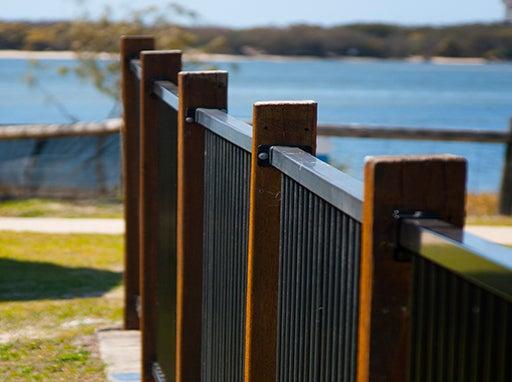
Fences are normally constructed on a property boundary line to define differing uses such as between parks and open spaces and road reserve. They may be built off the boundary line where physical features of the land prevent it, or where competing uses within an area necessitate specific delineation.
Consider the following:
- Fences and gates adjacent to roadways, must comply with road related standards and guidelines (clear zones, spearing hazards).
- Positioning of fences, gates and mowing strips must take into account natural drainage lines and overland flows to prevent trapping of water and ponding.
Fences
- Fences around park activity areas and park perimeters should be installed within garden beds where possible to reduce maintenance.
- Retain existing views
- Avoid obscuring seated height views with fence rails where possible.
- Consider CPTED principles to reduce crime by providing enhanced ‘passive surveillance’ for open space areas.
- Retain sight lines for supervision near activity areas, such as playgrounds, dog exercise areas (DEAs) and sporting fields.
- As an integral part of a project, incorporate low level planting to soften fences (where possible).
- Ensure embellishments (i.e. seats), are not positioned too closely to a fence, that they can be used as leverage to jump the fence.
Gates – pedestrian
- Pedestrian gates are to be located at the safest point of entry and exit, positioned to allow unobstructed views of oncoming pedestrian, cyclist and vehicular traffic.
- Ease of removal of waste services bins for emptying to collection trucks.
- Proximity of gates to amenities buildings to enable cleaning service vehicle and personnel access to the facility which is to be cleaned.
- Install gates to provide the most direct pedestrian access from connecting of pathways.
Gates – vehicle access
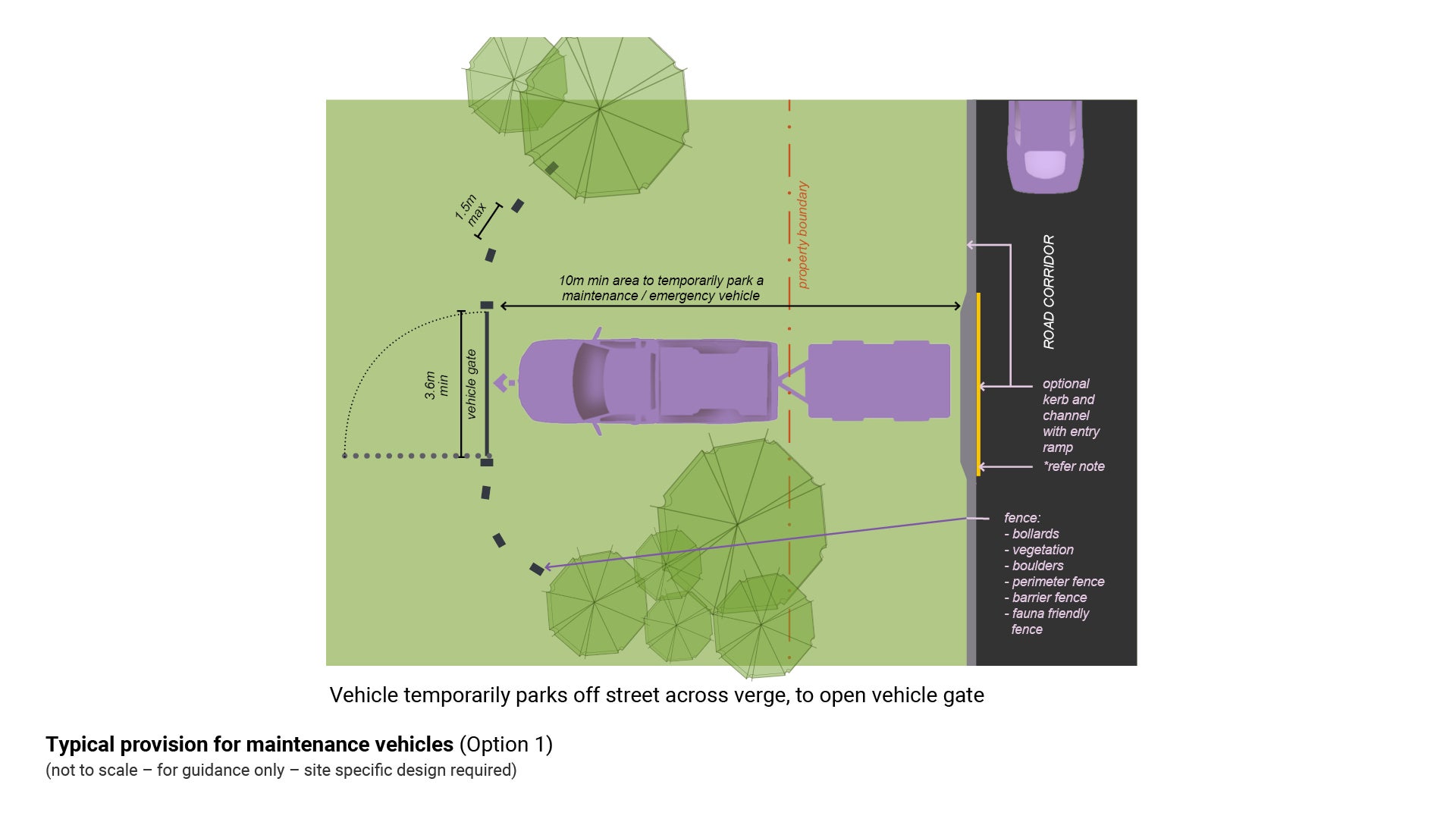
- Vehicle gates are to be positioned on a fence line or recessed into a park or open space, in the most suitable place for ease of access for maintenance, waste removal and emergency vehicles.
- For the most appropriate placement of vehicle access gates consult the appropriate Council department.
- Gates are to provide clear vehicle access, free of obstructions such as trees, garden beds and furniture.
- Where a vehicle gate is accessed via a sealed road:
- paint a yellow ‘no stopping’ line across the entry to prevent vehicles parking and blocking the gate.
- install ‘emergency and maintenance vehicle only’ signs to each end of a parking bay near the gate entry.
- Vehicle gates (where concreted under) are to include a trafficable reinforced vehicle crossover. Some locations may require a more heavy duty vehicle crossing. Consider the following:
- large trucks to top up playground surfacing.
- excavators used for beach sand nourishment.
- crane trucks for replacement of superseded shelters and installation of beach access stairs.
- trucks used for garden maintenance delivery of mulch and soil.
- waste removal services trucks.
- cleaning services vehicles.
- Where maintenance vehicles are repeatedly crossing a formal pathway, it must be strengthened/upgraded to withstand the load of plant vehicles.
- Consider future design for pedestrian and cycle facilities when locating gates.
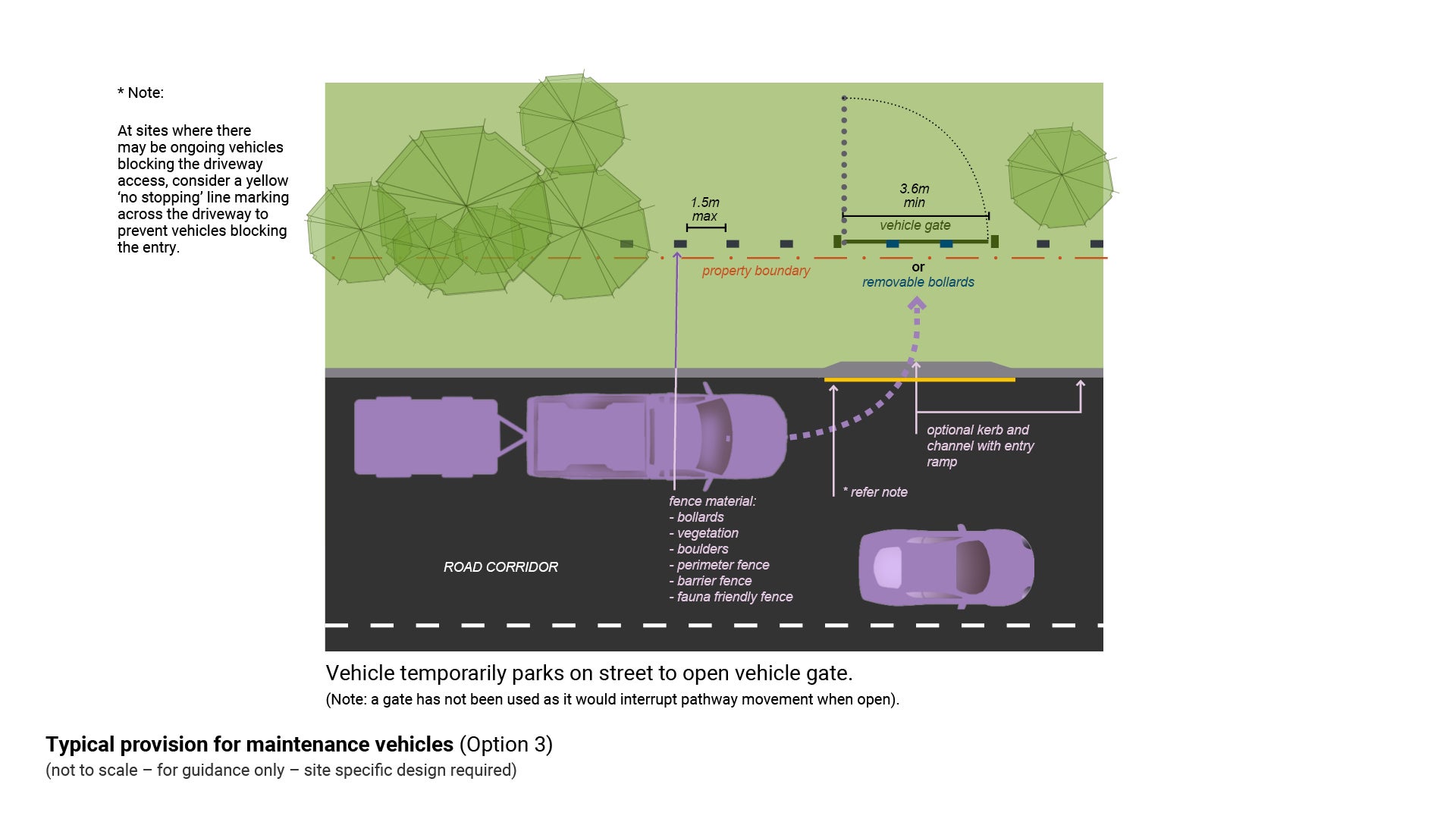
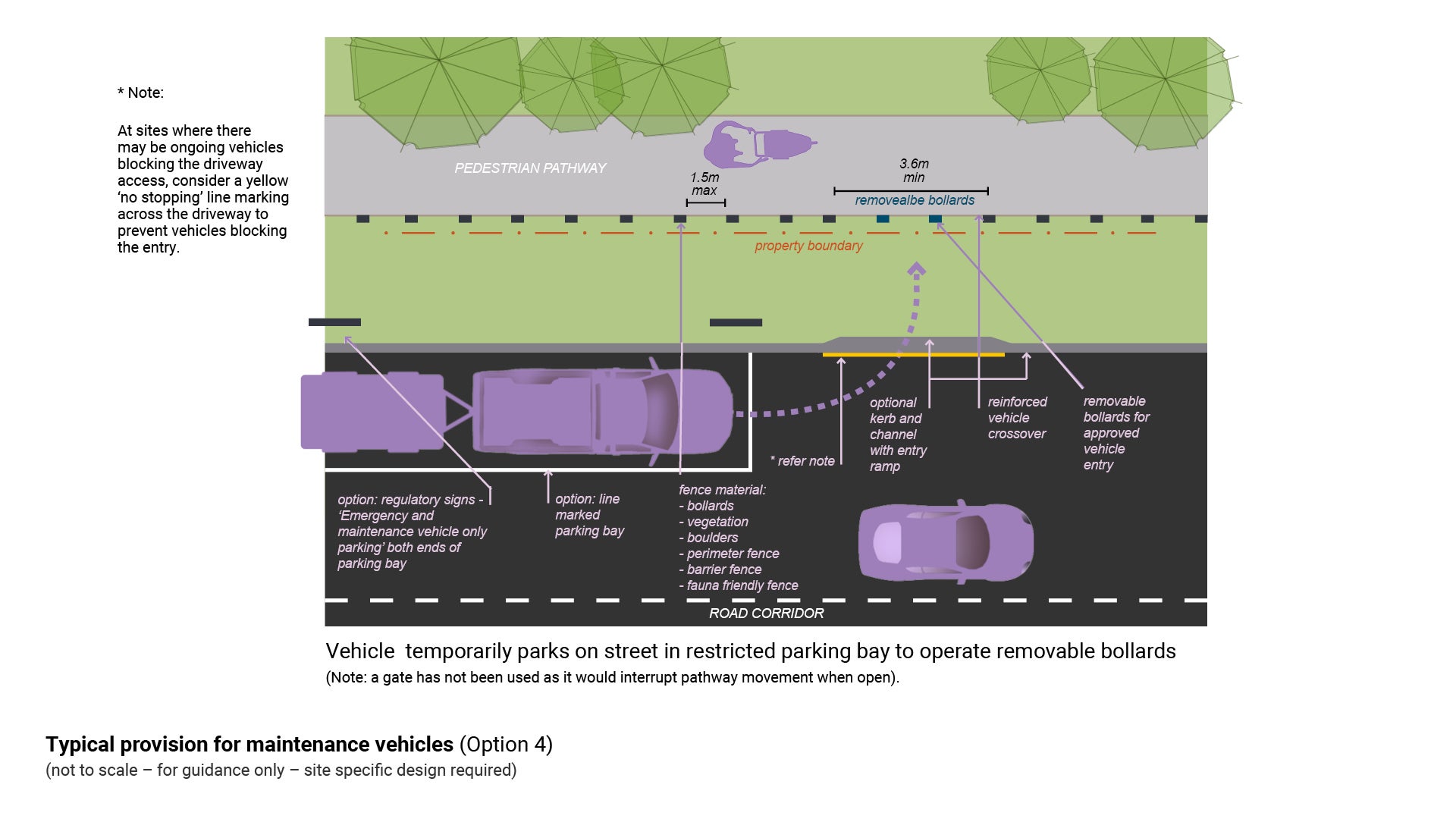
- Install lightweight removable bollards in place of a vehicle access gate when the following occurs:
- a pathway runs immediately parallel to other pavement areas.
- there is insufficient space for a gate system.
- the gate system will impact passing pathway foot traffic (the gate will open across the pathway).
See the following for further guidance:
- Figure 21 and 22: Typical provision for maintenance vehicles.
- LIM Bollards.
Vehicle access gate
The following diagrams illustrate possible vehicle access gate configurations which allow safe parking of a maintenance vehicle, and exit of the vehicle to open a gate (Options 1 and 2). Options 3 and 4 illustrate removable bollards employed as a vehicle access gate.
* Note: At sites where there may be ongoing vehicles blocking the driveway access, consider a yellow ‘no stopping’ line marking across the driveway to prevent vehicles blocking the entry.
Figure 21: Typical provision for maintenance vehicles (options 1 and 2)
Option 1
Option 2
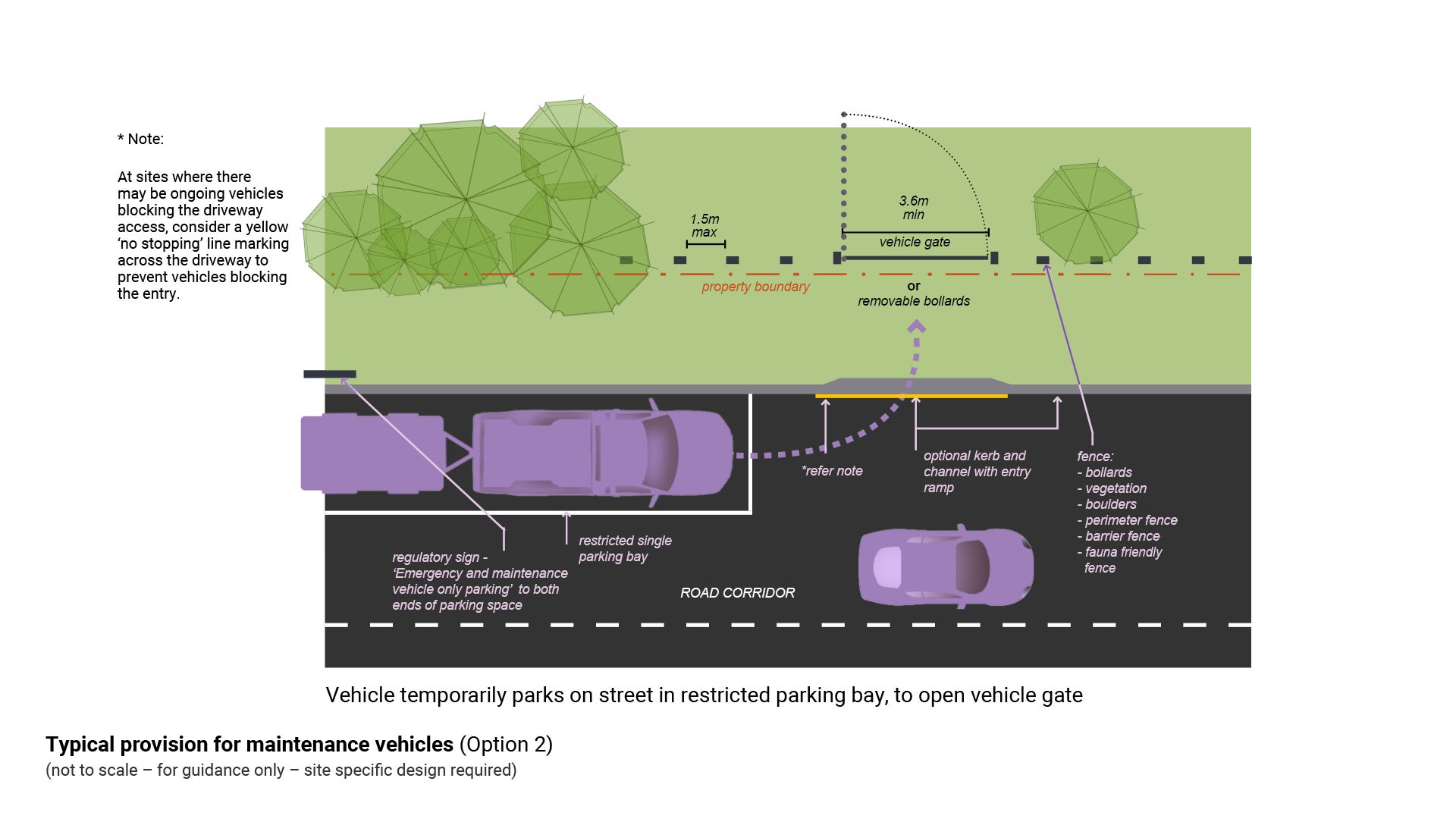
Figure 22: Typical provision for maintenance vehicles (options 3 and 4)
Option 3
Option 4
Clearances
Table 16: Positioning guidance offsets
Embellishment | Distance from | Minimum distance | Reason |
Fences and gates | established Trees | Tree Protection Zones (TPZ) varies | avoid excavation near tree roots |
Vehicle access gate | between gate posts | 3.6 m min | clear vehicle access |
fence post both sides | 12 mm | to prevent finger entrapment | |
Gap between fence and FL – playground | bottom of fence and top of concrete strip/finished level (FL) | 100 mm max | to provide a secure environment where children cannot crawl under the fence |
Gap between fence and FL – dog off leash park | bottom of fence and top of concrete strip/finished level (FL) | 50 mm max | to prevent small dog escapes |
Fences and gates | fence or gate componentry | ensure min 12 mm gap both sides of any gate, hinge side and latch side | prevent finger entrapment hazards/crushing of fingers |
any other item | 2.5 m | for deck mower clearance (where possible). Avoid creating small difficult to mow areas | |
Pedestrian gate | fence post both sides | 12 mm | to prevent finger entrapment |
between gate posts | 1.0 m | clear pedestrian/mobility device access | |
latch side gate post | 510 mm | clear of obstacles for wheelchair manoeuvre | |
hinge side gate post | 530 mm | clear of obstacles for wheelchair manoeuvre | |
Fence | seat located in a dog off leash park | 2.0 m | to prevent dog escapes |
seat located in a fenced play space | 2.0 m | to prevent a child from climbing over the fence | |
Fence (smooth) | pathway | 300 mm | cyclist and pedestrian safety |
Fence | edge of pathway | 500 mm | for pedestrian and cyclist safety, comply with Austroads 500 mm min offset from path edge to any obstacle. |
This component is currently in development