Fences and gates
Summary
Quick reference guide for key criteria
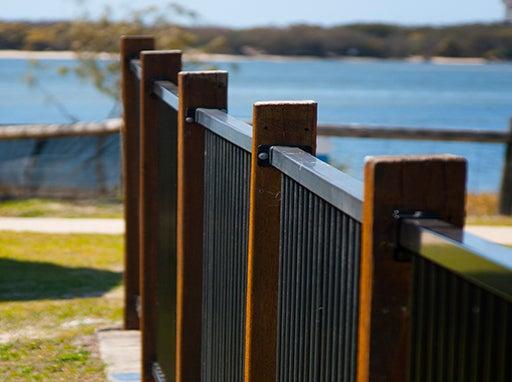
Post and rail fences

Overarching requirements
Embellishments should be designed/selected and installed as follows:
- Fit for purpose, appropriately positioned and accessible.
- Durable, robust and safe (suitable for corrosive environments).
- Vandal resistant with parts that are easily replaceable.
- Easy to maintain (with appropriate warranty and workmanship).
- Comply with relevant standards, legislation, corporate documents and approvals
Planning/design/positioning
- Locate where separation, protection or demarcation of boundary limits is required
- Fences and gates adjacent to roadways, must comply with road related standards and guidelines (clear zones, spearing hazards).
(A) Post and rail fence requirements
- Design must restrict unauthorised access by motorbikes or motor vehicles
- Post and rail fence panels can be used as ‘barrier’ and or ‘perimeter’ fences – case by case basis. Engineering certification may be required
- Where gates are required, match fence material where possible
- Natural elements may be used to create/contribute to a barrier fence (i.e. vegetation, stones/boulders)
- Materials selection should consider – the level and type of use, potential unlawful entry and adjacent fence material
- Post tops – all timber post tops to be angled at 15 degrees to prevent water damage. Galvanised post tops to be capped
- Rails – all timber rails to have arrissed edges for safety and superior finish, all galvanised top rails to be welded to galvanised posts.
Finished surface and fixing method
- All footings must be designed and installed to engineer’s specifications.
Note: Further guidance and clarification of the content on this page, can be found in the relevant sections of this information sheet.
Chicane gate and horse step overs

Overarching requirements
Embellishments should be designed/selected and installed as follows:
- Fit for purpose, appropriately positioned and accessible.
- Durable, robust and safe (suitable for corrosive environments).
- Vandal resistant with parts that are easily replaceable.
- Easy to maintain (with appropriate warranty and workmanship).
- Comply with relevant standards, legislation, corporate documents and approvals
Planning/design/positioning
- Locate where separation, protection or demarcation of boundary limits is required
- Fences and gates adjacent to roadways, must comply with road related standards and guidelines (clear zones, spearing hazards).
Chicane gate systems and horse step over requirements
- Design must restrict unauthorised access by motorbikes or motor vehicles
- Must allow access for pedestrians, bike riders and horse and rider
- Materials selection should consider – the level and type of use, potential unlawful entry and adjacent fence material
- Gates/step over, must appropriately match the adjacent fence material or natural elements (i.e. vegetation, stones, boulders)
- Post tops – all timber post tops to be angled at 15 degrees to prevent water damage. Galvanised post tops to be capped
- Rails – all timber rails to have arrissed edges for safety and superior finish, all galvanised top rails to be welded to galvanised posts
- Chicane gate designs must ensure there are no entrapment or crushing points (i.e. appropriate gaps at gate openings).
Finished surface and fixing method
- All footings must be designed and installed to engineers specifications.
Note: Further guidance and clarification of the content on this page, can be found in the relevant sections of this information sheet.
Dog off leash parks fence and gates

Overarching requirements
Embellishments should be designed/selected and installed as follows:
- Fit for purpose, appropriately positioned and accessible.
- Durable, robust and safe (suitable for corrosive environments).
- Vandal resistant with parts that are easily replaceable.
- Easy to maintain (with appropriate warranty and workmanship).
- Comply with relevant standards, legislation, corporate documents and approvals
Planning/design/positioning
- Locate where separation, protection or demarcation of boundary limits is required
- Locate away from potential conflict areas (i.e. playground)
- Fences and gates adjacent to roadways, must comply with road related standards and guidelines (clear zones, spearing hazards)
- Ensure there are no entrapment or crushing points (i.e. appropriate gaps at gate openings).
Fence panel requirements
- Hot dipped galvanised CHS frame, heavy duty PVC coated black wire mesh
- Concrete mowing/anti dog digging strip centred directly under fenceline to prevent dog digging and escapes
- Gaps in mesh and under fence must not allow a small dog to escape. Finished surface and fixing method.
Pedestrian gate requirements
- Must match fence panels
- Install minimum 2 x entry points, must be visible from all areas of park
- Each entry point must have dual gate entry system (2 x gates per entry), gates open both directions and must NOT be self-closing.
- Lock – ‘D’ latch with 100mm opening in chain wire, operation of gate both sides
- Concrete mowing strip centred under fenceline.
Vehicle gate requirements
- Must match fence panels
- Lock – Parks 30 key. Provide either a single or two separate keyed locks to be operated by council and emergency services. Incorporate loop latch over both gates for security and stability with anti-vandal locking mechanism
- Concrete mowing/anti dog digging strip centred directly under fenceline and reinforced for vehicle load
- Include a recessed hole for pad-bolt pin (one per gate).
Finished surface and fixing method
- All footings and concrete mowing strip must be designed and installed to engineers specifications.
Note: Further guidance and clarification of the content on this page, can be found in the relevant sections of this information sheet.
Play spaces fence and gates

Overarching requirements
Embellishments should be designed/selected and installed as follows:
- Fit for purpose, appropriately positioned and accessible.
- Durable, robust and safe (suitable for corrosive environments).
- Vandal resistant with parts that are easily replaceable.
- Easy to maintain (with appropriate warranty and workmanship).
- Comply with relevant standards, legislation, corporate documents and approvals
Planning/design/positioning
- Locate where separation, protection or demarcation of boundary limits is required
- May be located adjacent to a potential risk/conflict (i.e. busy roads)
- Fences and gates adjacent to roadways, must comply with road related standards and guidelines (clear zones, spearing hazards).
Fence panel requirements
- Fence fixtures – MUST meet AS 1926.1:2012 (hinges, latches, height requirements, etc.)
- Fence materials – MUST be extra heavy duty, suitable for public open space use. Standard residential pool fencing is NOT to be used for any council facility.
- Aluminium powder coated (black panels and timber look posts), all posts capped.
- Ensure there are no entrapment or crushing points – i.e. square flat top and bottom rails (no partial bound openings), appropriate gaps at gate openings
- Signs attached should not have sharp edges or create footholds
- Concrete mowing strip centred directly under fence line.
Pedestrian gate requirements
- Must match fence panels
- Install 1,2 or 3 entry points (varies), must be visible from all playground areas
- Gate must open inwards only and be self latching
- Lock – child safety top latch Magnalatch (or equivalent)
- Brace each corner of gate (as welds are prone to becoming weak).
Vehicle gate requirements
- Must match fence panels
- Lock – Parks 30 key. Provide either a single or two separate keyed padlocks to be operated by council and emergency services. Include a drop bolt on each gate. Include removable post (match panel posts) in a sleeve between the two gates, inset in an in-ground sleeve. Gates to lock to removable post
- Concrete mowing strip centred directly under fence line and reinforced for vehicle load Include a recessed hole for pad-bolt pin (one per gate).
Finished surface and fixing method
- All footings and concrete mowing strip must be designed and installed to engineers specifications.
Note: Further guidance and clarification of the content on this page, can be found in the relevant sections of this information sheet.
Vehicle gates (excluding for use for playground and dog fence areas)

Overarching requirements
Embellishments should be designed/selected and installed as follows:
- Fit for purpose, appropriately positioned and accessible.
- Durable, robust and safe (suitable for corrosive environments).
- Vandal resistant with parts that are easily replaceable.
- Easy to maintain (with appropriate warranty and workmanship).
- Comply with relevant standards, legislation, corporate documents and approvals
Planning/design/positioning
- Locate where controlled vehicle access is required
- Ensure the gate opening area is not restricted by obstructions (trees) and allows adequate circulation space for the vehicle
- Fences and gates adjacent to roadways, must comply with road related standards and guidelines (clear zones, spearing hazards)
- Ensure there are no entrapment or crushing points (i.e. appropriate gaps at gate openings).
Vehicle gate (super heavy duty) requirements
- Design must restrict unauthorised access by motorbikes or motor vehicles
- Constructed with heavy duty materials and hinged to open both ways where possible to facilitate entry. All ends to be capped
- Lock – Parks 30 key. Provide lock shrouds around locking mechanism to be operated by council and emergency services, determine by site. Lock system to provide provision for up to two (min) or four separate keyed access points
- Provide sufficient overhead space and width for large vehicles (fire trucks)
- Locate gate with a connecting barrier fence or natural elements (i.e. vegetation).
Vehicle gate (standard CHS) requirements
- Design must restrict unauthorised access by motorbikes or motor vehicles
- Constructed with CHS material and hinged to open both way where possible to facilitate entry. All ends to be capped
- Lock – Parks 30 key. Provide lock shrouds around locking mechanism to be operated by council and emergency services, determine by site. Lock system to provide provision for one (min) or two separate keyed access points
- If gate is wider than 4.5 m structural supports are required
- Provide sufficient overhead space for large vehicles (fire trucks)
- Locate gate with a connecting barrier fence or natural elements (i.e. vegetation).
Finished surface and fixing method
- All footings must be designed and installed to engineers specifications.
Note: Further guidance and clarification of the content on this page, can be found in the relevant sections of this information sheet.
Fauna fencing

Overarching requirements
Embellishments should be designed/selected and installed as follows:
- Fit for purpose, appropriately positioned and accessible.
- Durable, robust and safe (suitable for corrosive environments).
- Vandal resistant with parts that are easily replaceable.
- Easy to maintain (with appropriate warranty and workmanship).
- Comply with relevant standards, legislation, corporate documents and approvals
Planning/design/positioning
- Locate where native fauna require protection/direction
- Fences and gates adjacent to roadways, must comply with road related standards and guidelines (clear zones, spearing hazards)
- In accordance with Fauna Management Plan (where required)
- Ensure there are no entrapment or crushing points (i.e. appropriate gaps at gate openings).
Fauna friendly fence requirements
- Correct fence type must be selected for the identified native fauna species
- Design must allow fauna to move through, across and or over in both directions
- Plant trees and shrubs close to fence or overhanging the fence
- Plastic coated wire is preferred
- Fire break close to a fence is not preferred
- Install signs advising of fauna presence.
Fauna exclusion fence requirements
- Design must contain the targeted fauna or re-direct fauna to safe areas.
- Fence and gate panels must not contain any gaps, to contain animals safely.
- Matching vehicle gates, subject to site requirements.
- koala exclusion fence – coated PVC chain wire fence, posts, galvanised flat sheet powder coated mounted at top, all end caps welded, min O/A height 1.5 m (prefer 1.8 m)
- frog exclusion fence – shade cloth (green or black knitted above 80% weave), posts O/A height min 1.2m from finished ground level to base of bend
- kangaroo exclusion fence – chain wire fence, posts, all end caps welded, must contain a ‘floppy top’ design, min O/A height 1.8 m (prefer 2.0 m).
- All footings and optional concrete mowing strip must be designed and installed to engineers specifications.
Finished surface and fixing method
- All footings and optional concrete mowing strip must be designed and installed to engineers specifications.
Note: Further guidance and clarification of the content on this page, can be found in the relevant sections of this information sheet.
This component is currently in development